
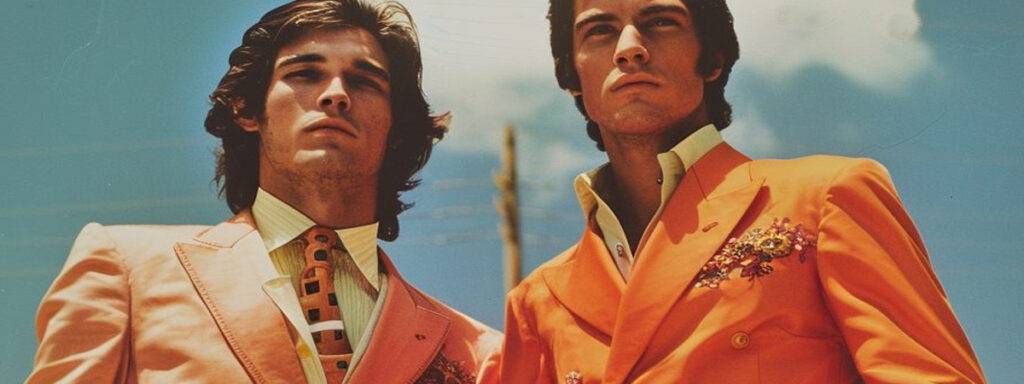
PEACOCK REVOLUTION
Changes in men's fashion
I am not fond of fashion from the late 1960s onwards. Its starting point was the Peacock Revolution, which I understand to be a revolution aimed at liberating men to wear bright colors. I felt that unless I study the atmosphere of that era, I would not be able to progress in the history of men’s fashion and the history of shirts, so I would like to summarize it here.
1967
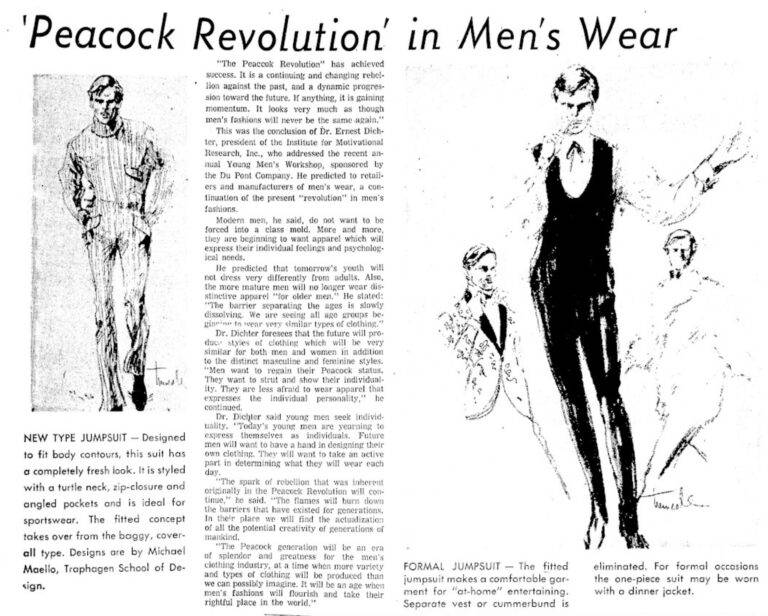
“The Peacock Revolution” has achieved success. It is a continuing and changing rebellion against the past, and a dynamic progression toward the future. If anything, it is gaining momentum. It looks very much as though men’s fashions will never be the same again.”
This was the conclusion of Dr. Ernest Dichter, president of the Institute for Motivational Research, Inc., who addressed the recent annual Young Men’s Workshop, sponsored by the Du Pont Company. He predicted to retailers and manufacturers of men’s wear, a continuation of the present “revolution” in men’s fashions.
Modern men, he said, do not want to be forced into a class mold. More and more, they are beginning to want apparel which will express their individual feelings and psychological needs.
He predicted that tomorrow’s youth will not dress very differently from adults. Also, the more mature men will no longer wear distinctive apparel “for older men.” He stated: “The barrier separating the ages is slowly dissolving. We are seeing all age groups beginning to wear very similar types of clothing.”
Dr. Dichter foresees that the future will produce styles of clothing which will be very similar for both men and women in addition to the oldest masculine and feminine styles. “Men want to regain their Peacock status. They want to strut and show their individuality. They are less afraid to wear apparel that expresses the individual personality,” he continued.
Dr. Dichter said young men seek individuality. “Today’s young men are yearning to express themselves as individuals. Future men will want to have a hand in designing their own clothing. They will want to take an active part in determining what they will wear each day.
“The spark of rebellion that was inherent originally in the Peacock Revolution will continue,” he said. “The flames will burn down the barriers that have existed for generations. In their place we will find the actualization of all the potential creativity of generations of mankind.
“The Peacock generation will be an era of splendor and greatness for the men’s clothing industry, at a time when more variety and types of clothing will be produced than we can possibly imagine. It will be an age when men’s fashions will flourish and take their rightful place in the world.”
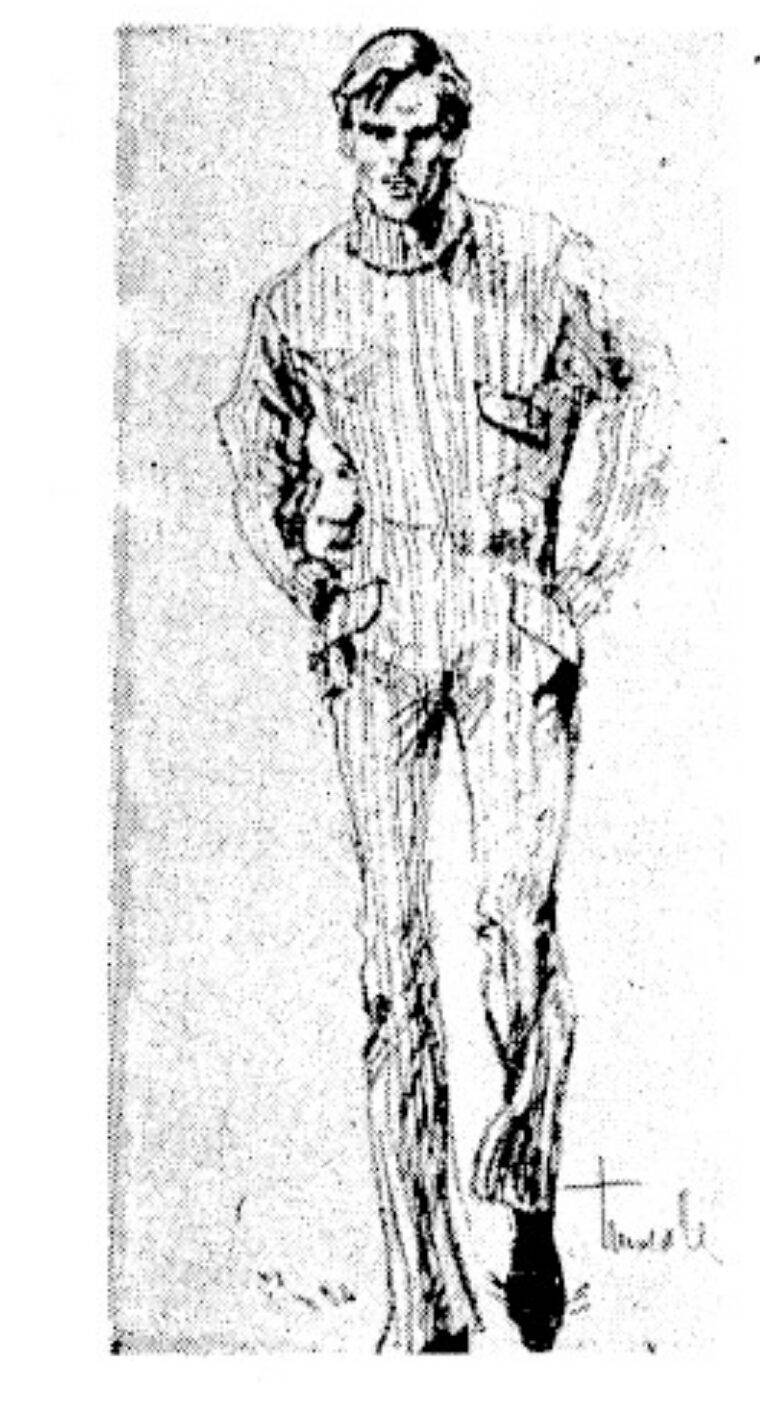
NEW TYPE JUMPSUIT — Designed to fit body contours, this suit has a completely fresh look. It is styled with a turtle neck, zip-closure and angled pockets and is ideal for sportswear. The fitted concept takes over from the baggy, cover-all type. Designs are by Michael Maello, Traphagen School of Design.
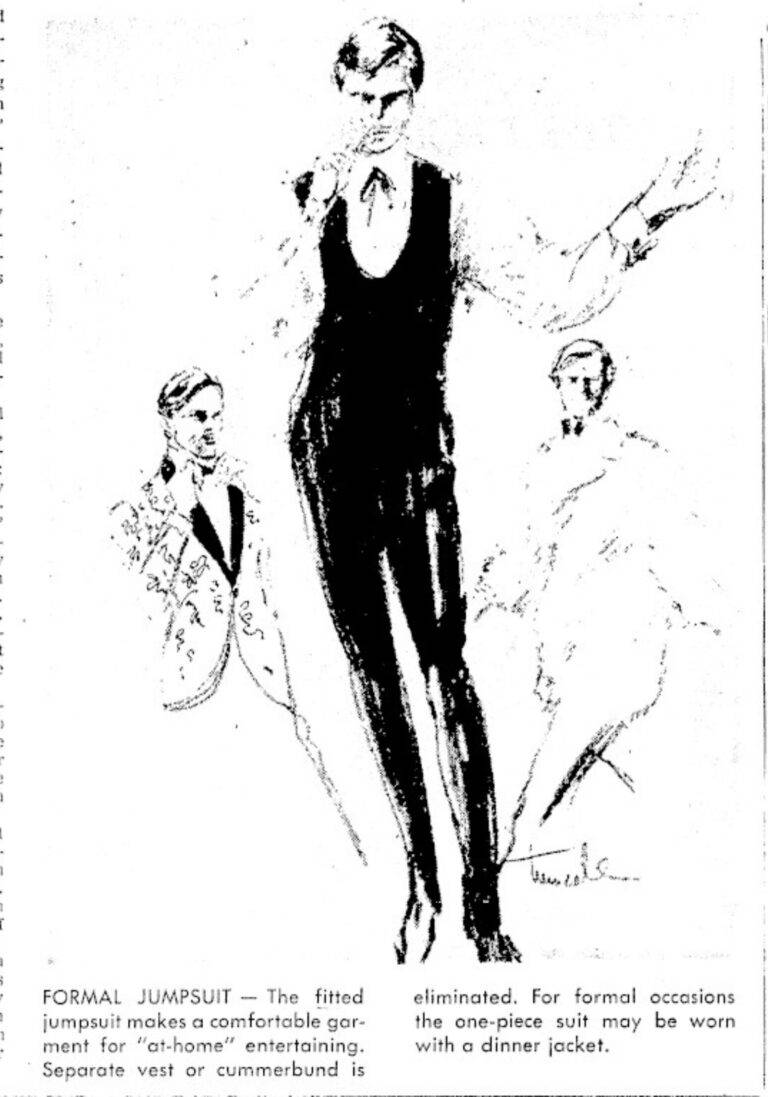
FORMAL JUMPSUIT — The fitted jumpsuit makes a comfortable garment for “at-home” entertaining. Separate vest or cummerbund is eliminated. For formal occasions the one-piece suit may be worn with a dinner jacket.
- Origin: Launched in the fall of 1967 by the U.S. chemical fiber manufacturer DuPont to promote its colorful synthetic fibers.
- Proponent: Psychologist Dr. Ernest Dichter.
- Concept: The idea that “men should also dress more stylishly and brilliantly.”
- Impact in Japan: The shift to colored dress shirts spread rapidly, and vivid red or green shirts and wide ties appeared in business scenes.
- Result: From the late 1960s to the 1970s, it defined the diversification and individualization of men’s fashion.