
J. Press’s lie
Why I don’t trust their history
As I have pointed out before—including in the case of Brooks Brothers—history is often written by the victors. As time passes, and especially when stories cross national borders, writers tend to embellish them with poetic or exaggerated language. Those embellishments are then passed down until they come to be treated as established facts.
Even today, these kinds of “myths” are repeated as common knowledge within the industry. The stories surrounding Lacoste, Clarks, and L.L.Bean are examples of this very phenomenon.

In reality, The relationship between J. Press Inc. and Japan did not suddenly begin with the 1986 acquisition. The groundwork had already been laid in the early 1970s; Kashiyama Co., Ltd. (later Onward Kashiyama) had been handling the brand’s licensing business in Japan from around this period. While there is a slight discrepancy regarding the starting year—official corporate records place it in 1974, whereas Richard Press, a member of the founding family, recalls it as “around 1972”—J. Press had already been active in the Japanese market for more than a decade before the acquisition.
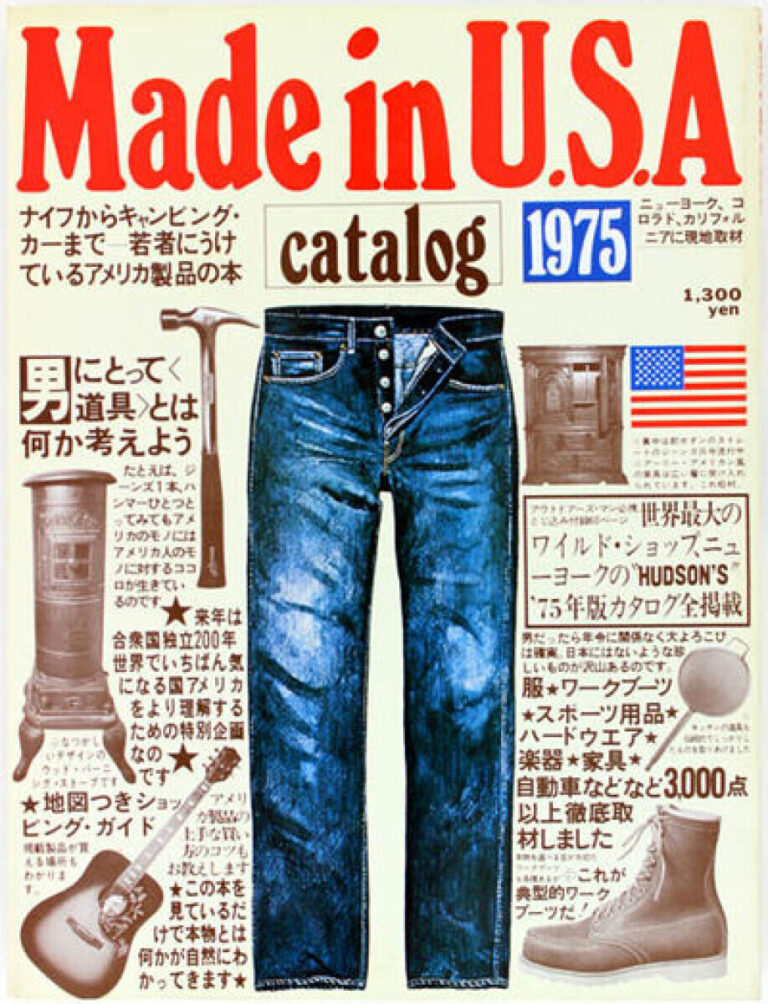
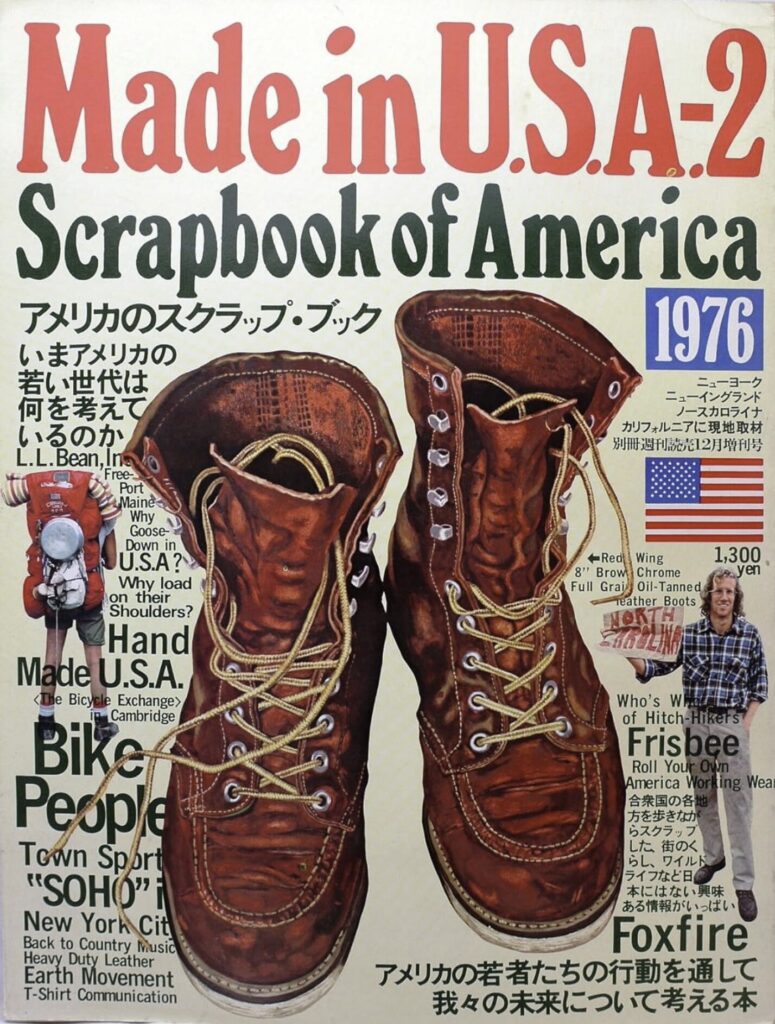
J. Press was introduced in Japan alongside Brooks Brothers as one of the icons of Ivy League style. At the time, its shirts were priced between 14 and 18 dollars. Although the later shift to a floating exchange rate system made it easier for foreign products to enter the Japanese market, these shirts still remained high-end luxury items in Japan.
In October 1986, Kashiyama Co., Ltd. acquired all shares of J. Press Inc. At the time of the transaction, the company was owned primarily by Irving Press and Paul Press, with Richard Press and Irving’s sons holding minority stakes. Through this acquisition, J. Press Inc. passed from the hands of its founding family into the ownership of a Japanese apparel manufacturer. The transaction appears to have proceeded amicably, following a proposal from Irving Press’s side.
This event also aligned with the economic and cultural landscape of late-1980s Japan. As the country moved toward the bubble economy, department stores, specialty retailers, magazines, and licensing businesses were expanding rapidly. American traditional and preppy styles were no longer perceived merely as foreign student attire, but as refined styles for urban consumers. The acquisition of J. Press Inc. was a concrete example of an era in which Japanese companies moved beyond simply operating foreign brands under license and began directly acquiring the original companies and trademarks behind them.
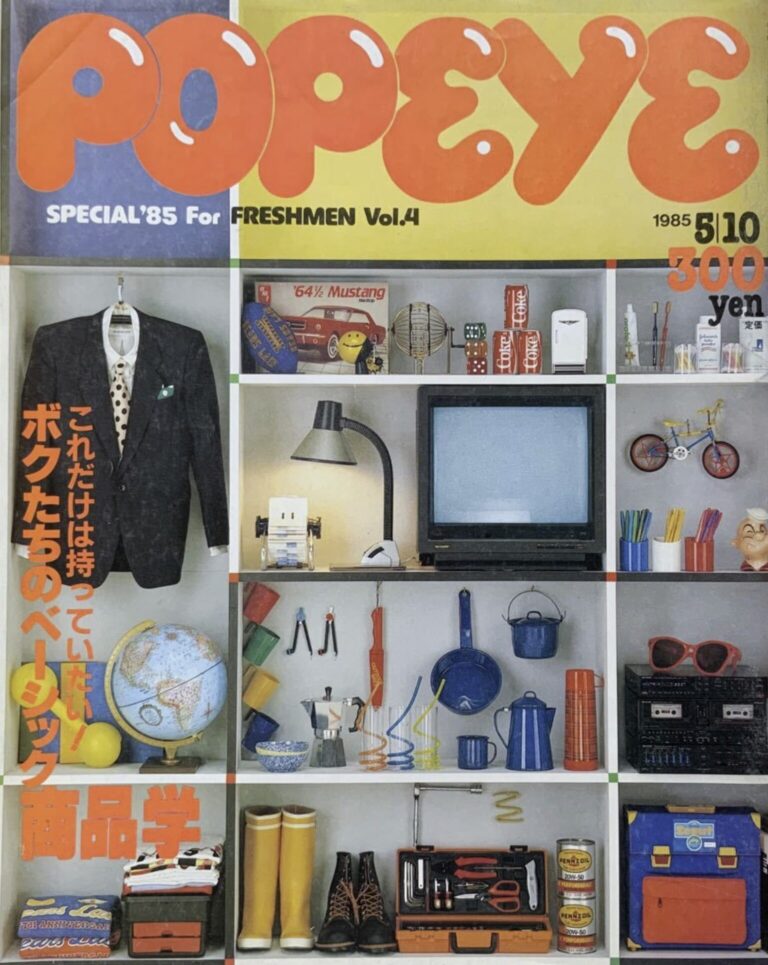
(Note: 1 USD = 160 JPY as of July 2026.)


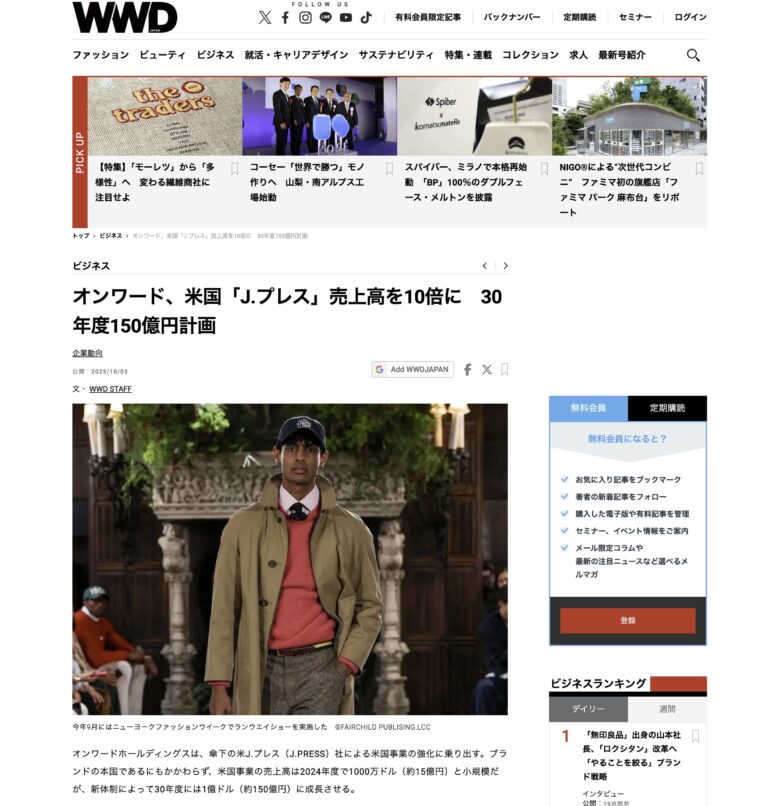
There is a well-known website called “Ivy Style”. In my opinion, it is an essential resource for understanding the Ivy League style of that era, and as many of you already know, it features contributions from Richard Press, the 3rd-generation president of J.PRESS. However, I actually believe that his accounts are highly dramatized. I would like to begin by pointing out a few specific examples of this.
Without a doubt, I love this website and hold it in high regard. However, in any field, memories often become exaggerated—whether by the speaker or by the writer—turning facts into myths. This is precisely why continuous historical verification is essential, yet I feel that there is a complete lack of critical scrutiny in this area.
IS: Let’s talk about some of the signature Press items and how they came about. What about the flap-pocket oxford?
RP: I believe Irving Press devised that as a way to differentiate from Brooks Brothers and the other competition. That signature private trademark represented a bond amongst the cognoscenti who did not need to advertise the public symbols of an advertised brand, such as polo sticks or crocodiles, but instead displayed their small personally initialed monogram on the lower left flap of their dress shirt, which incidentally was full bodied the better to drape an athletic torso or disguise a beer belly.
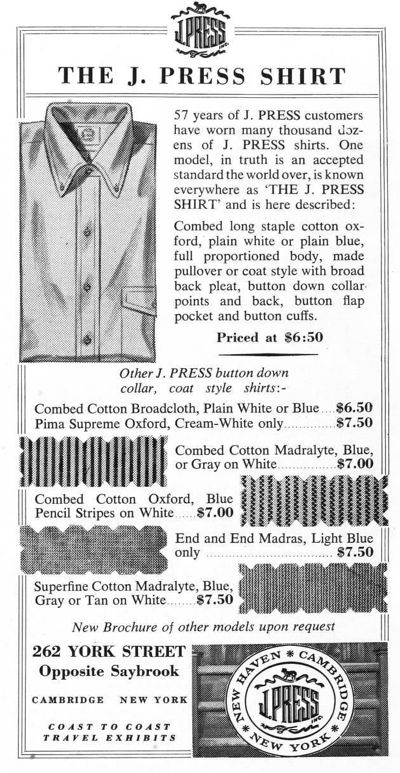
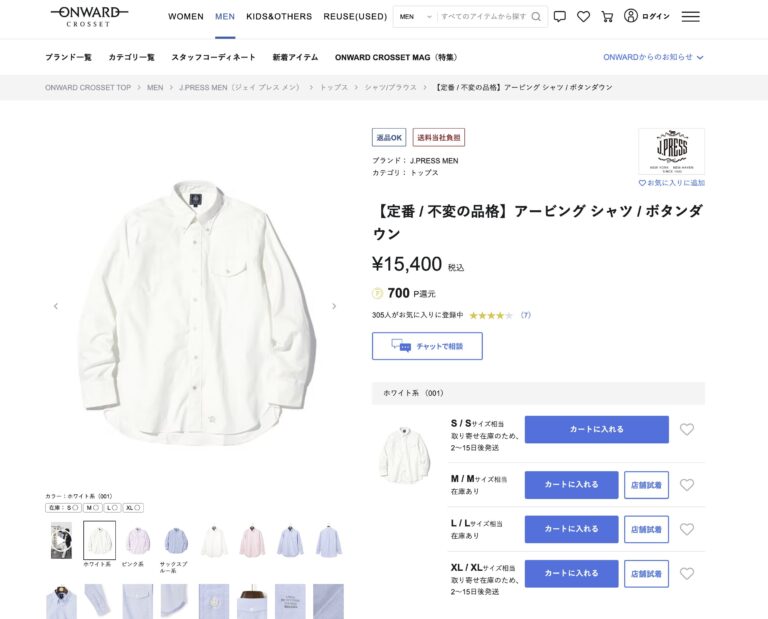
This claim can easily be disproven. On the contrary, J. Press appears to have copied a style that had already become a standard college shirt by that time, and I cannot understand why the company continues to insist that it was the originator.
If the timeline presented in this memoir were correct, Irving Press, the second-generation head of the company, would have graduated from Yale University and joined the family business in 1926. In other words, if the existence of a flap-pocket shirt can be documented before 1926, then either Richard Press’s recollection was inaccurate or the brand’s internal narrative is inconsistent with the historical record.
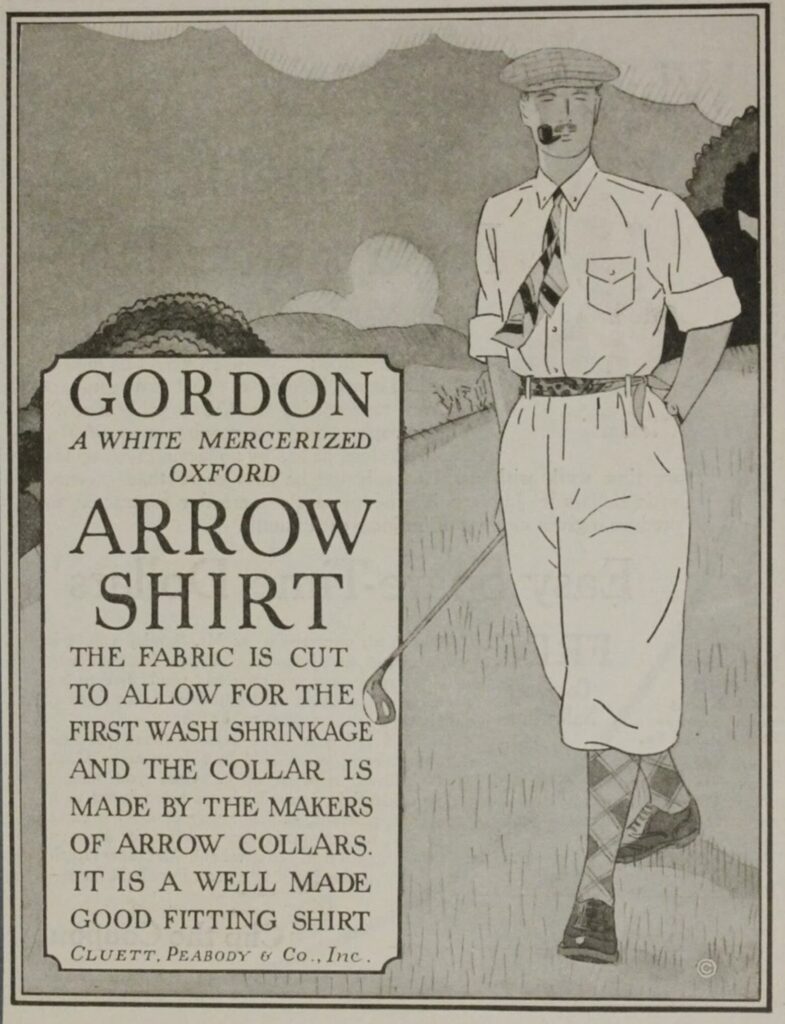
1924 ARROW GORDON
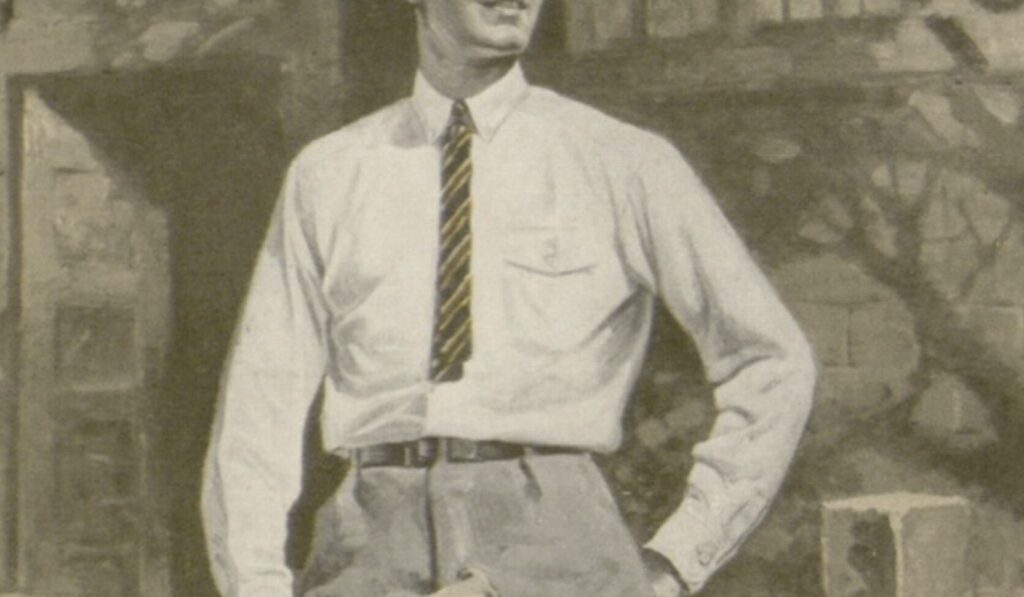
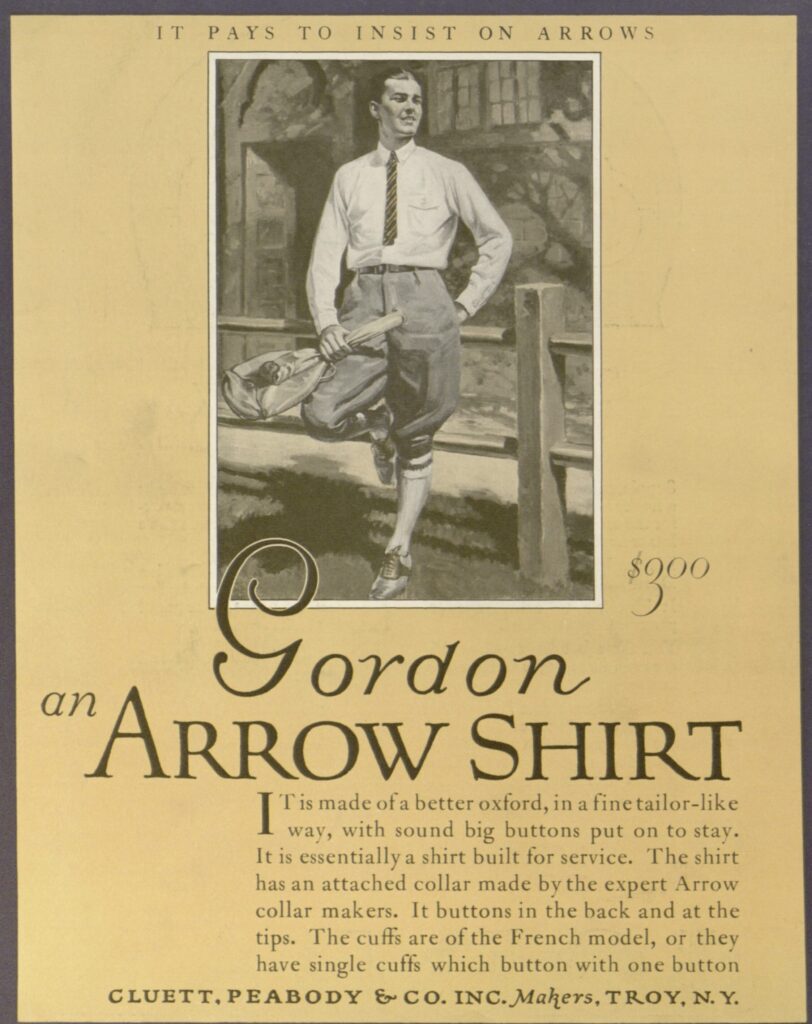
1923 ARROW GORDON
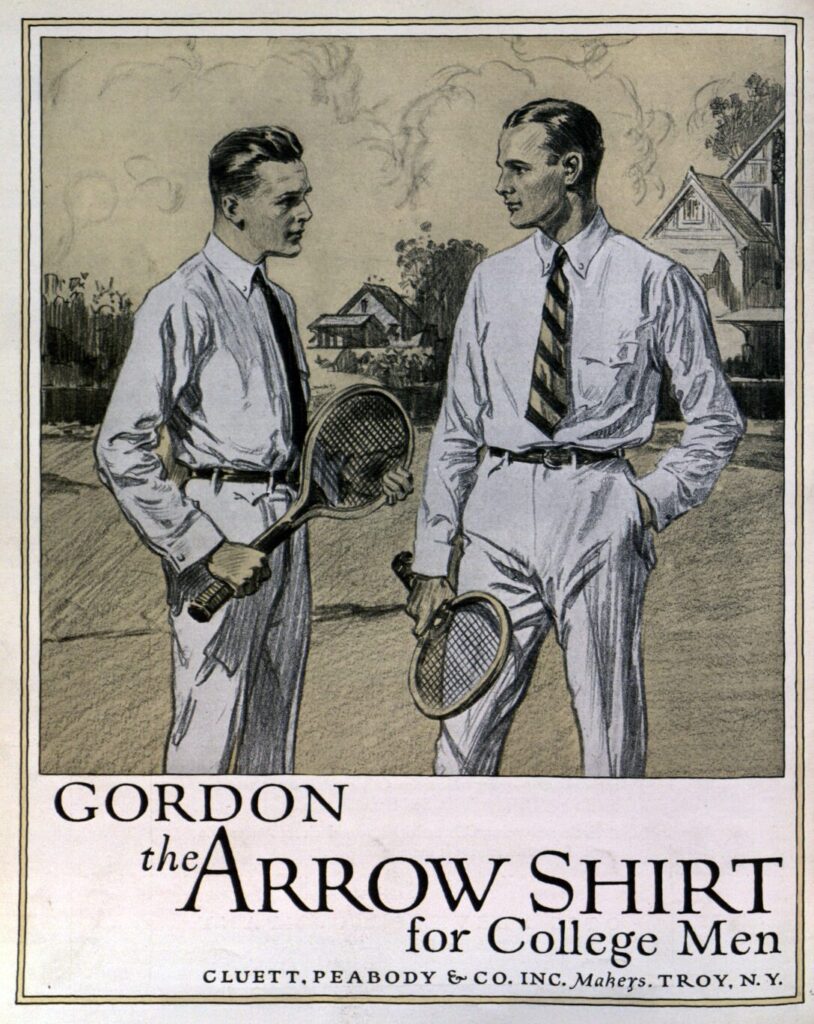
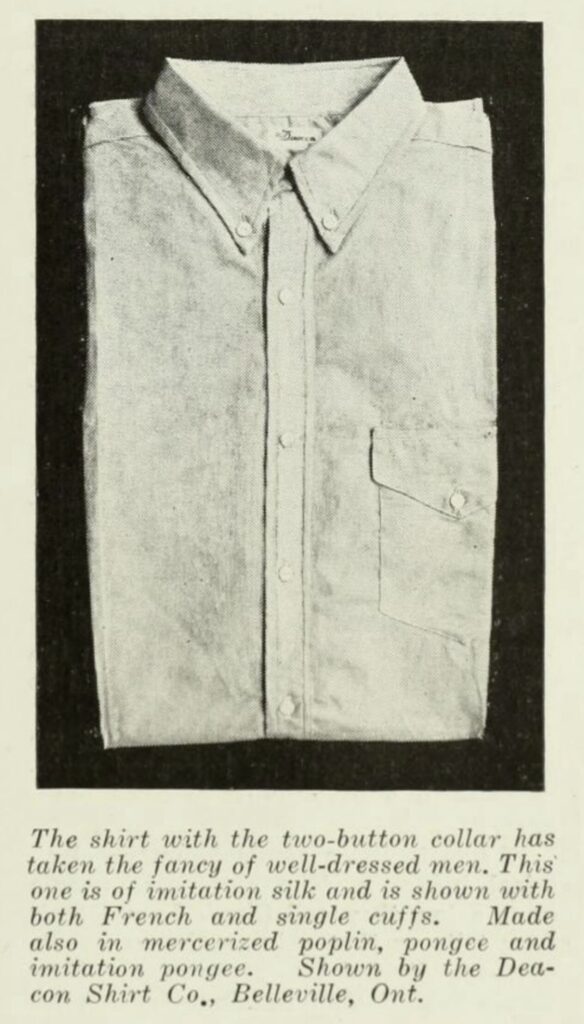
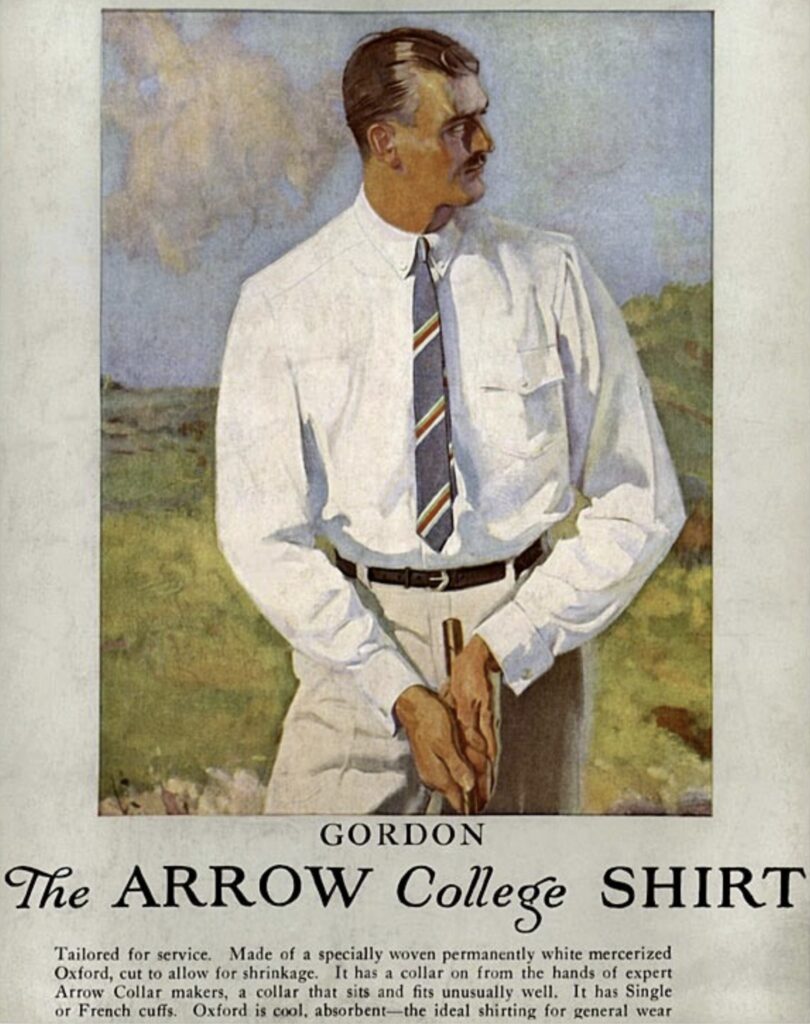
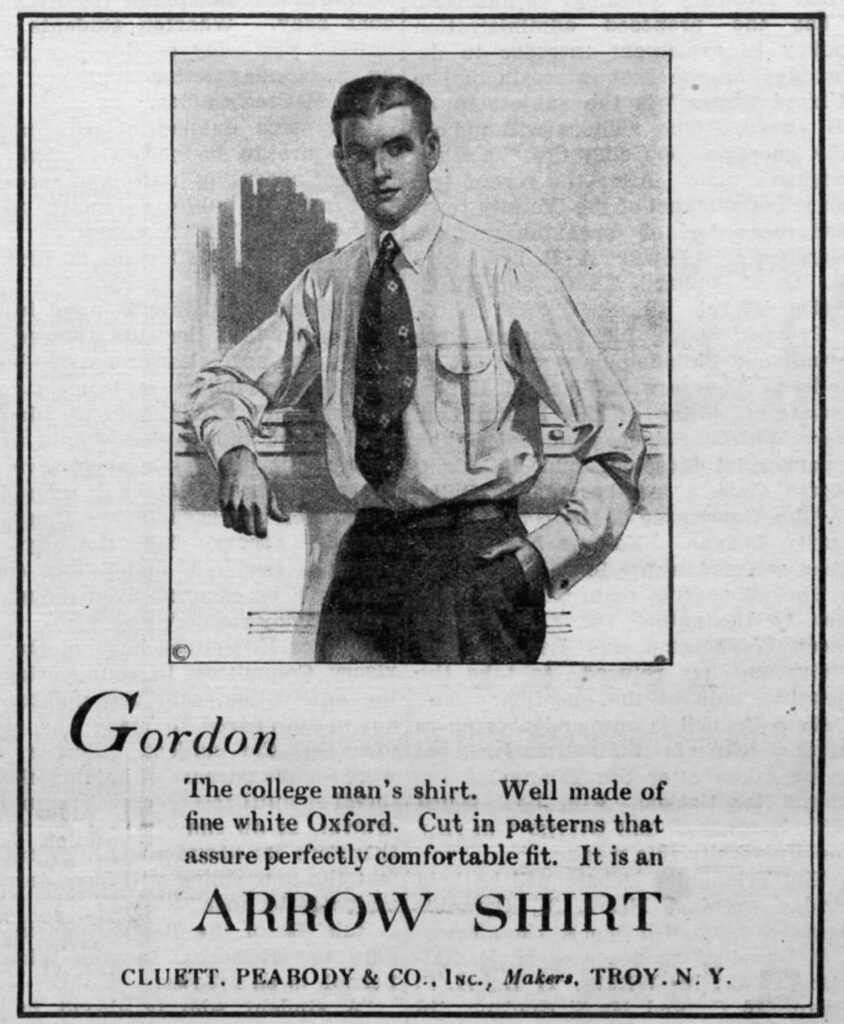
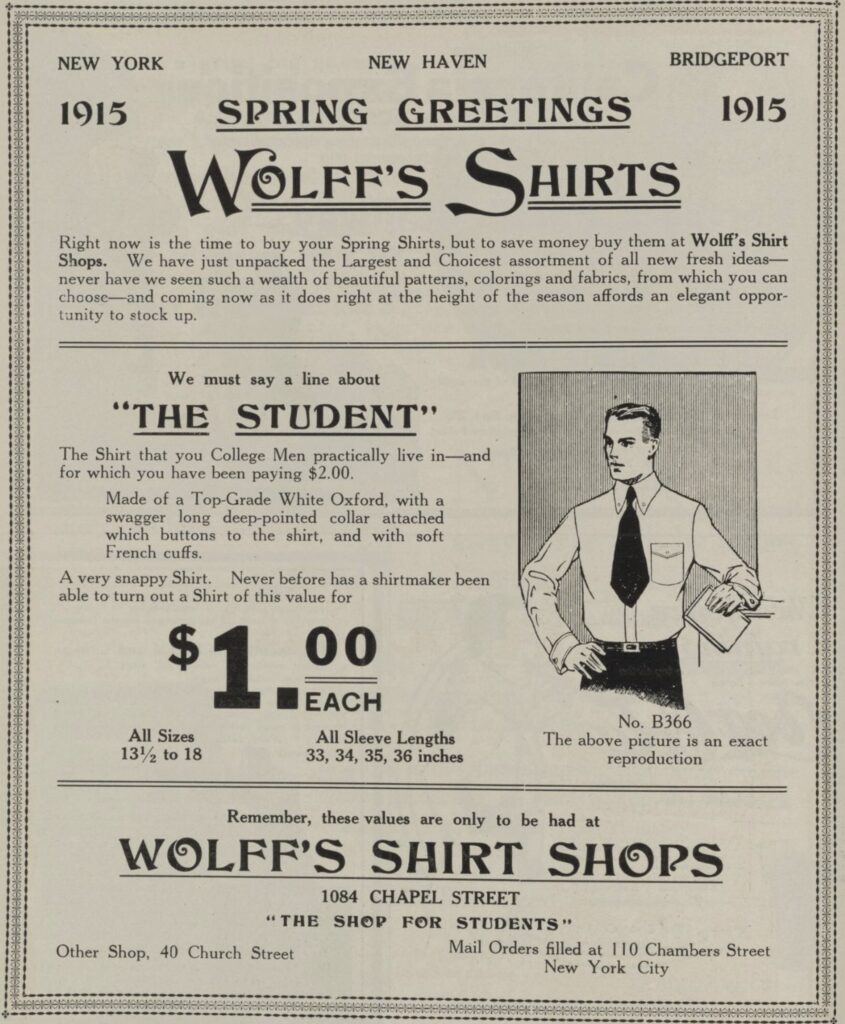
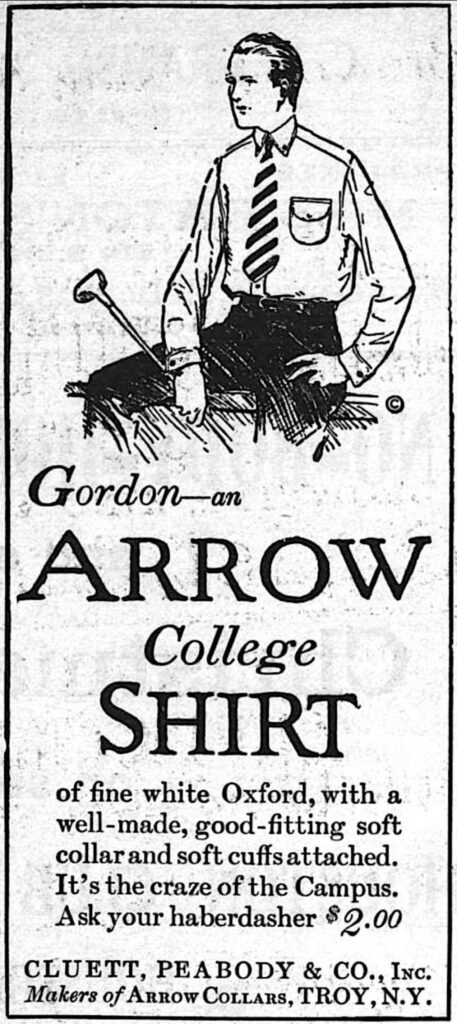
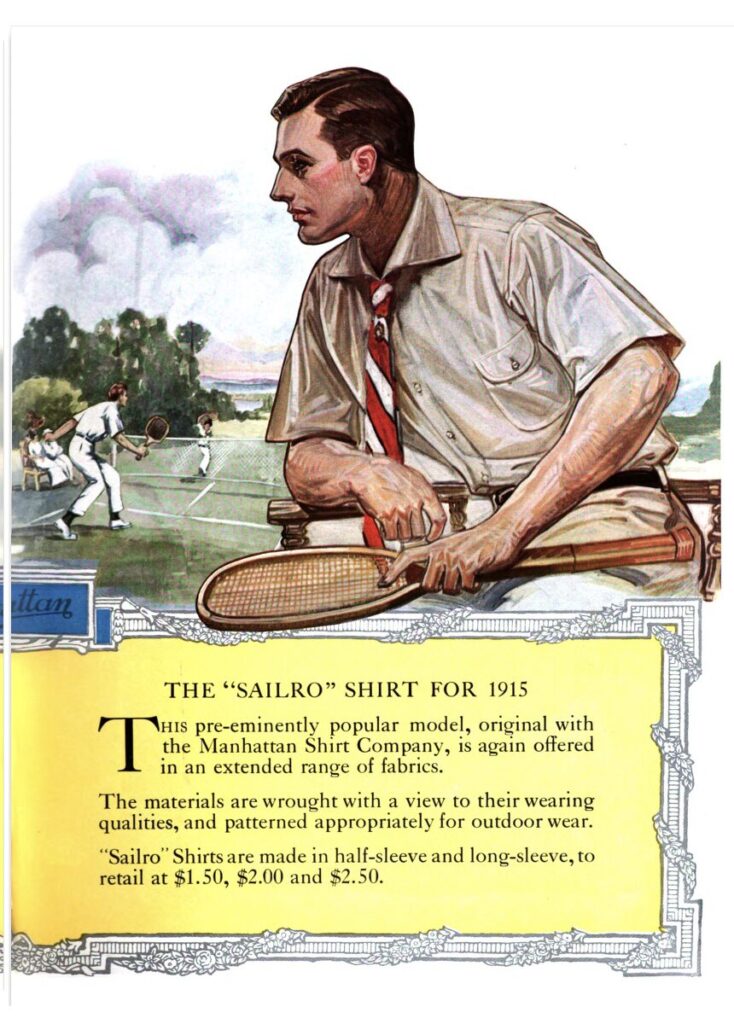
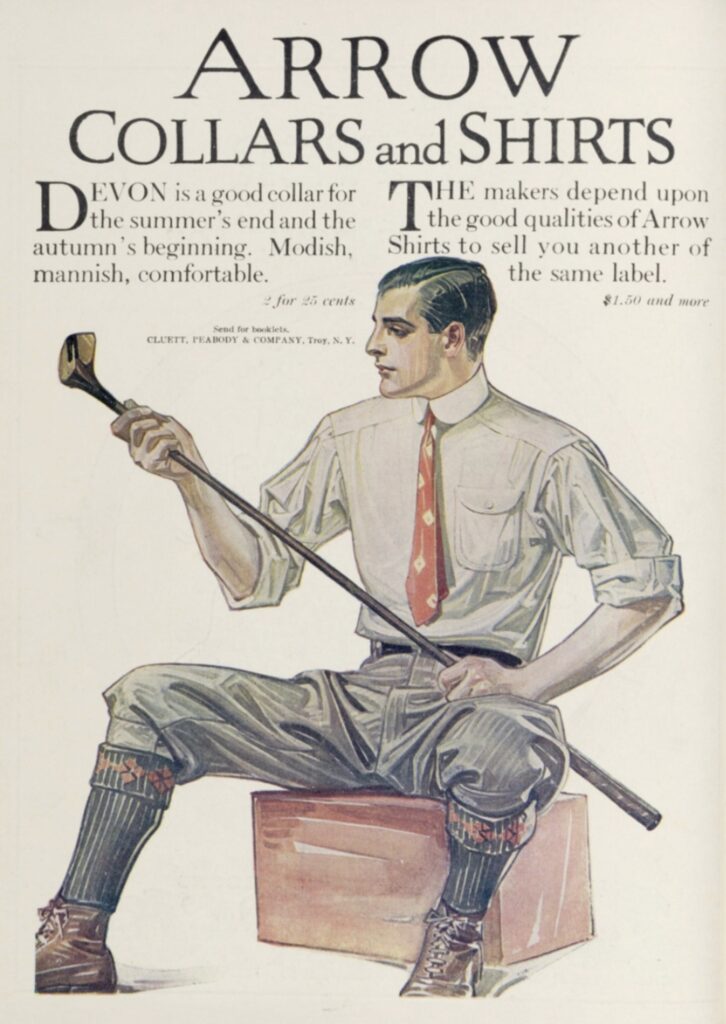
The Yale record v. 41, no. 1, 10/25/1912
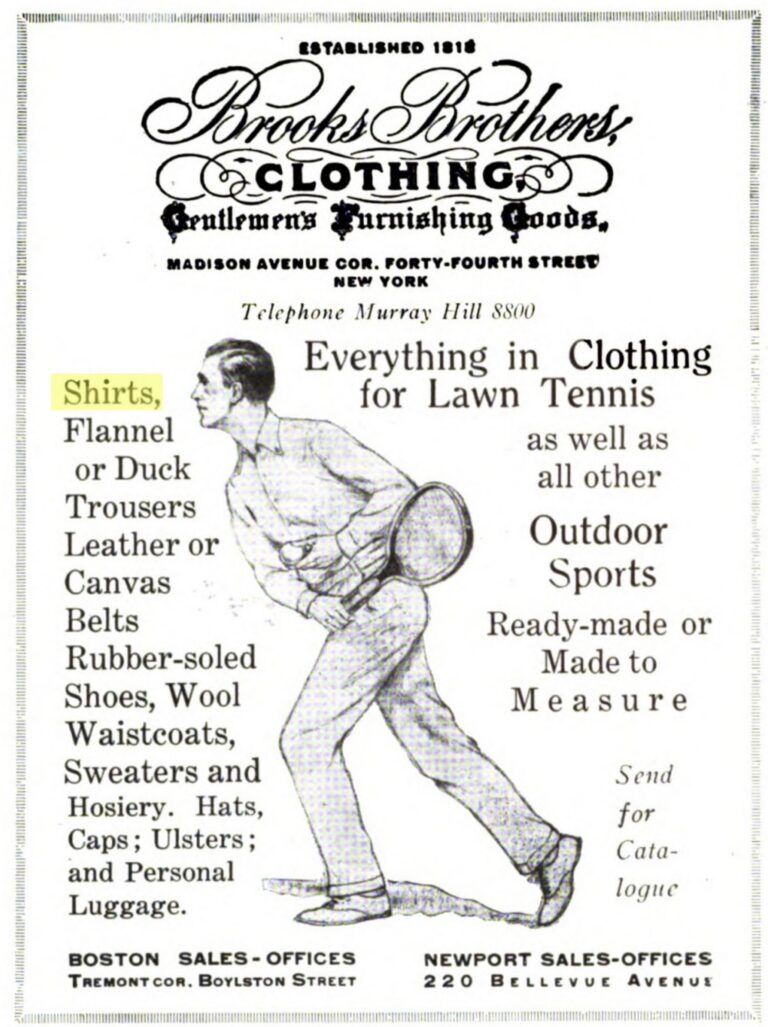
※ Based on my research so far, I have been able to confirm that Brooks Brothers’ button-down shirt appeared in its catalog by 1915. I have also found a 1919 advertisement in which a button-down shirt was presented as a tennis shirt. However, although Oxford-cloth shirts existed before that, I have not yet found any evidence of a button-down collar from an earlier date. I intend to continue investigating this point.
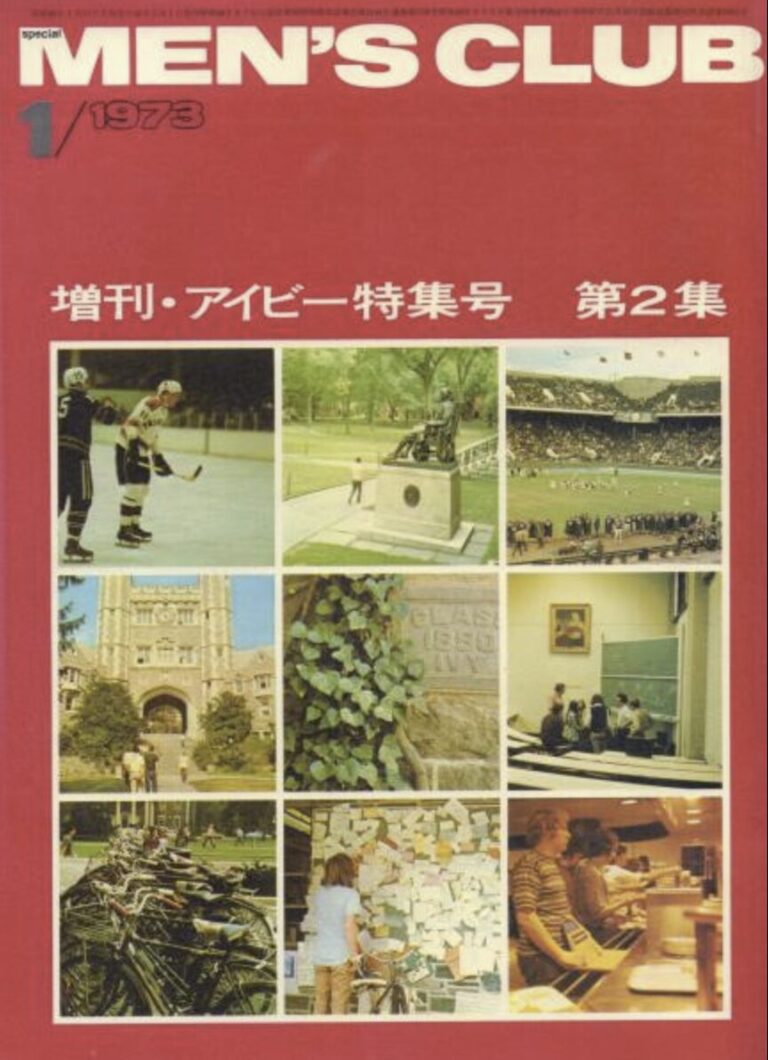
MC: “First of all, please tell us about the history of J. Press.”
P.P.: “The company traces its origins back to the 1860s, when my father, Jacobi Press, and a partner named Goldbaum established the merchant-tailoring firm Goldbaum & Press at this location. Every week, Jacobi Press traveled to New York to visit Yale graduates who had become customers and take their orders. In 1916, he opened a branch at 230 Broadway. That shop also began as a custom-tailoring establishment, but it eventually came to carry accessories as well.” In 1920, the shop moved to 241 Madison Avenue, directly across from Brooks Brothers—or, although the president did not say so, presumably on the side where the Roosevelt Hotel stood. Five years later, it moved diagonally across the street to 16 East 44th Street, the location of the present New York branch. In 1931, a Cambridge branch opened near Harvard University. In fact, the day before visiting the main store, we had visited this branch and interviewed its manager, Joseph Porter. Five years later, J. Press also opened a branch in Princeton, which remained in operation until it closed in 1944.
In 1968, the company opened its first West Coast branch near Union Square in San Francisco.
“I have been involved in this family business ever since graduating from the University of Pittsburgh in 1933.”
MC: “You began as a custom tailor, but what percentage of your total sales now comes from the custom-tailoring division?”
P.P.: “About 33 percent. Most of those sales come from the New York branch, which is managed by my son, Richard Press. Even the orders taken in New York are brought here and made here. About twenty tailors are engaged in this work.”
MC: “What are the prices?”
P.P.: “A two-piece suit costs approximately $380 to $500, a vest about $45, a jacket around $130, and a coat approximately $275 to $375.”
MC: “That is quite expensive.”
[Omitted]
There appeared to be a wide range of items, including trousers and sweaters.
“Harvard has 125,000 alumni, and Yale has 80,000. These are our customers. Within a few years of graduation, such people tend to assume leading positions in society, and the suits they wear therefore cannot be too inexpensive.”
MC: “When Continental styling became extremely popular, were your customers influenced by that fashion?”As though to say that this was a strange question,
P.P. answered with a single sentence: “Our customers were not influenced by Continental fashion at all.”
MC: “Please give us some typical examples of the traditional styles for which J. Press is known.”
- P.P.: “Well, the following would be examples:
Shaggy brushed sweaters—mostly crew-neck styles with elbow patches, especially those known as ‘Shaggy Dogs.’ - British Warm coats. We made a special purchase of these from Burberry in England in 1930, and they became extremely popular among Ivy Leaguers.
- Reversible coats. J. Press also imported these from England in the early 1930s.
- Button-down shirts with flap pockets, which have become our trademark. We first made them in 1938, but now they are copied everywhere.”
MC: “Blazers are now extremely popular among young people in Japan. How are they regarded in America?”
P P.: “We have been selling blazers for fifty or sixty years, and they are the bread and butter of our business—that is, an absolute staple.”
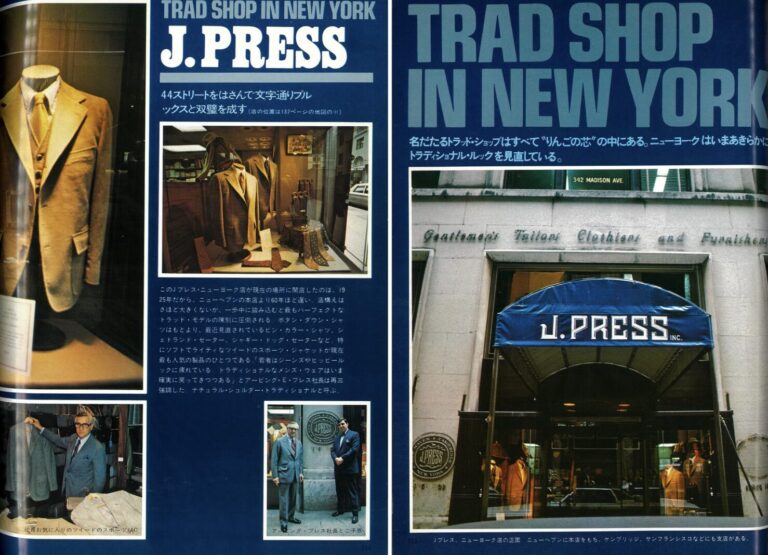
The J. Press New York store opened at its present location in 1925, about sixty years after the company’s main store in New Haven. Although the storefront is not particularly large, the moment one steps inside, one is overwhelmed by the display of perfectly executed traditional styles. In addition to button-down shirts, the store carries pin-collar shirts, which have recently been enjoying renewed popularity, as well as Shetland sweaters and Shaggy Dog sweaters. Particularly popular at present are sports jackets made from soft, lightweight tweed. “Young people are tired of jeans and the hippie look. Traditional menswear is now definitely making a comeback,” President Irving E. Press repeatedly emphasized. This style is known as natural-shoulder traditional.
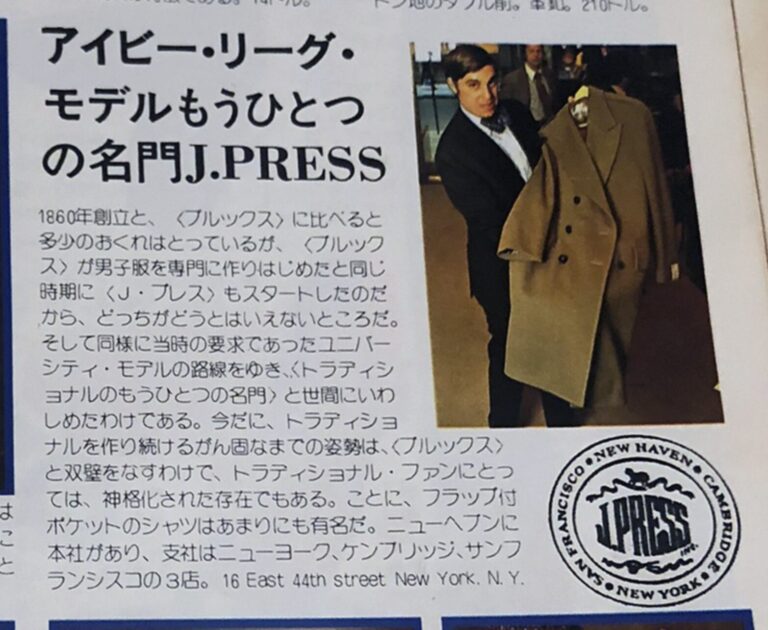
Although J. Press, said to have been founded in 1860, came somewhat later than Brooks Brothers, it began around the same time that Brooks Brothers started specializing in menswear. It is therefore difficult to draw any clear distinction between the two. J. Press likewise followed the university-model style that reflected the demands of the period, earning a reputation as another of the great names in traditional menswear. Its almost stubborn commitment to continuing to produce traditional clothing places it on an equal footing with Brooks Brothers. For devotees of traditional style, it has become an almost sacred institution. Its shirts with flap pockets are particularly famous. The company is headquartered in New Haven and has three branch stores, in New York, Cambridge, and San Francisco. 16 East 44th Street, New York, N.Y.
The J. Press story began the turn of the century, serendipitously around the corner from the current J. Press quarters, on College Street. JC Goldbaum was a bespoke tailor on Chapel Street who had sold to Yale students since the Civil War. Grandfather Jacobi Press learned both tailoring and the English language as an intern in Goldbaum’s second-floor quarters. Two years after arriving in New Haven an immigrant from the Pale of Russia, he knocked on doors showing swatches to students in the Yale dorms at the same time while he was running Goldbaum’s tailor shop.
My grandfather was a dapper man, carefully decked out in three-piece English woolens, garnering his wardrobe as if to-the-manner born of Professor William Lyon Phelps, Coach Walter Camp, and other notables on the Yale campus. He adopted the gift of gab and a quick sense of humor, and soon was regularly invited to serve the tweed-clad elites on bended knee. He also drummed up most of Goldbaum’s business. The older gentleman obliged Grandpa’s acumen, selling him what had become Goldbaum & Press in 1902, which then became J. Press
In the half decade since its founding, the enterprise bearing his name expanded geometrically in capital and prestige. The narrow confines of the old shop were bursting at the seams with multitudes of garments stuffed from every corner. Seizing the moment, in 1907 Grandpa Press bought the fashionable French Second Empire-styled building directly across from Pierson College at 262 York Street. Originally built circa 1860, the gregarious urban townhouse was the home of Cornelius Pierpont, a prominent merchant grocer, manufacturer and street railway man. Mr. Pierpont’s trophy occupied 30,000 square feet on three floors over a warehouse-sized basement, and featured multiple front and back entrances that over the course of its history were able to accommodate Barrie Ltd. Shoe Store, Klingerman’s Luncheonette, Stonehill Rare Books, Valentine’s Barber Shop, and, during the administration of President George W. Bush, half the second floor to accommodate the Secret Service guarding the President’s daughter during her undergraduate years at Yale.
IS: Let’s start at the beginning. Tell us about your grandfather and the origins of J. Press.
RP: My grandfather came over from Latvia in 1896. His uncle had been a tailor in Middletown, Connecticut, since the Civil War. When he married, he moved to New Haven where he was introduced to a Mr. Goldbaum, who had a tailoring shop. He bought into the business, which became Goldbaum & Press, and in 1902 he bought out Goldbaum and founded J. Press.
In 1912 he built the store on York Street. That same year he also opened a store off of Wall Street in New York, which stayed there until 1938, when we moved to 341 Madison Avenue. We moved to 44th Street in 1961, then across the street in 1988, and they moved to the new location on the corner of 47th Street several years ago. In 1924 he opened a store in the Delta Upsilon Club at Harvard in Cambridge, and in 1935 opened a store in Princeton. And of course the traveling road shows to prep schools around the country were a large part of the operation from after the first World War until we stopped doing it in about 1970.
Jacobi had a daughter and two sons. Irving Press was born in 1904, and my father Paul was born in 1911. My father worked in New Haven and was the chief financial officer. Irving was based in New York and was the stylist and designer and buyer of all the clothing until I took over at the end. My grandfather died a week before my bar mitzvah in 1951.
IS: What was your grandfather like?
RP: He was a charismatic but scholarly individual with great leadership qualities. Originally he planned to follow the family tradition, which was rabbinical. But when he moved to the US, he discarded that and decided to go into commerce with his uncle.
He was a very studious man who had an enormous library of Judaica and Talmudic studies in his home. He was also a very charitable man, and rescued much of his family before the Nazi occupation.
IS: How did he rescue these family members?
RP: Going back to the late ’20s and early ’30s, they were family members to whom he provided funds to help them emigrate to the United States. The pale of Russia is the area where the czarist regimes had relegated a good part of the Jewish population. They were very religious, and lived in vastly poor agricultural villages. Elsewhere, the Polish and communist regimes were anti-Semitic, and a certain part of the Jewish community longed to emigrate to the US, as in “Fiddler on the Roof,” which in theatrical terms describes the period. My grandfather wanted nothing more than to move his family members from Russia, Poland, Lithuania and Latvia to the US where they could reunite and prosper.
NEW YORK (UPI) —
There has been confusion in some circles as to whether J. Press invented Yale University or whether it was the other way round. Both, of course, invented what is now called the “Ivy League Look.”
For the record, Yale got its charter back in 1701 although it fooled around at Killingworth and Old Saybrook, Conn., for a few years and didn’t move to New Haven until 1718. J. Press got started in 1902 but its predecessor was in business in the 1880s.
The “J” is for Jacobi. His specialty was “fine tailored clothes for gentlemen.” The firm has maintained that tradition although in the postwar years it has gone heavily into ready made suits for Ivy League and University of Virginia undergraduates.
The firm now is run by Irving Press, 55, a Yale Law graduate, who is president and manages the New York end of the family business, and by his brother Paul, 50, who attended Pittsburgh and Columbia (Ivy) and handles the New Haven end.
Sick Of Uniforms
With the end of World War II, Ivy League alumni were heartily sick of uniforms and yearned for the way of life they were used to — the Ivy look. Finding the market loaded with English drape suits with monstrous padded shoulders and floppy trousers, they turned to J. Press.
There were so many orders that the firm bought up British woolens, built some factories and began producing ready-to-wear, Ivy League style. It was what the firm had been making for 60 years but there was just more of it. By 1954 it had swept the country. Now it is about all that is sold.
“You can look at the classbook for the Yale classes of 1925, 1935, 1945 — even 1915 — and you’ll find the students look very much the same in the same type of clothes except for those who wore Hoover collars,” Irving Press said.
The Ivy League look became the rage and other manufacturers began turning out basically the same thing. But, Press complained, some of them made “such narrow lapels they almost disappeared. Also the pants.”
The nice thing about the setup from the J. Press point of view is that undergrads who can buy a ready made suit for $85 go into business later, then enter an upper bracket, become corpulent and can afford the custom-tailored clothes which start around $200 to $245.
Five Travelers
There are stores in Cambridge, Mass., in New Haven and in New York (“a sort of a catchall for transients”) and five salesmen, called travelers, who visit all parts of the country. The Ivy alumni are fiercely loyal and a Harvard graduate in Chicago, for example, might convert a Northwestern man to the Ivy look. The hallmarks of the Ivy Look are well known — straight hanging three-button suits. No two-button. No double breasted suits except for blazers. Top fabrics this fall are cashmeres, and suits are dark. Best sellers are sharkskin glen plaids in gray and navy with faint red overplaid. Stripes are suddenly in again — pin and subdued chalks in medium dark grey and dark blues. Shirts are button down. Ties are at least 2¾ inches wide in hand-blocked foulard or perhaps reps (“English silk — they have so many old school ties and regimentals over there you get a better color selection.”) Hats are small brimmed with pinch front. Sweaters are shaggy Shetland. Trousers are slim and have no pleats.
Sports jackets are lighter — medium dark instead of just dark.
“We pride ourselves on the fact the things we sell grow old gracefully,” Press said. “No obsolescence. A man can wear a sports jacket for 20 years. It may be bad for business but that is what our customers want.”
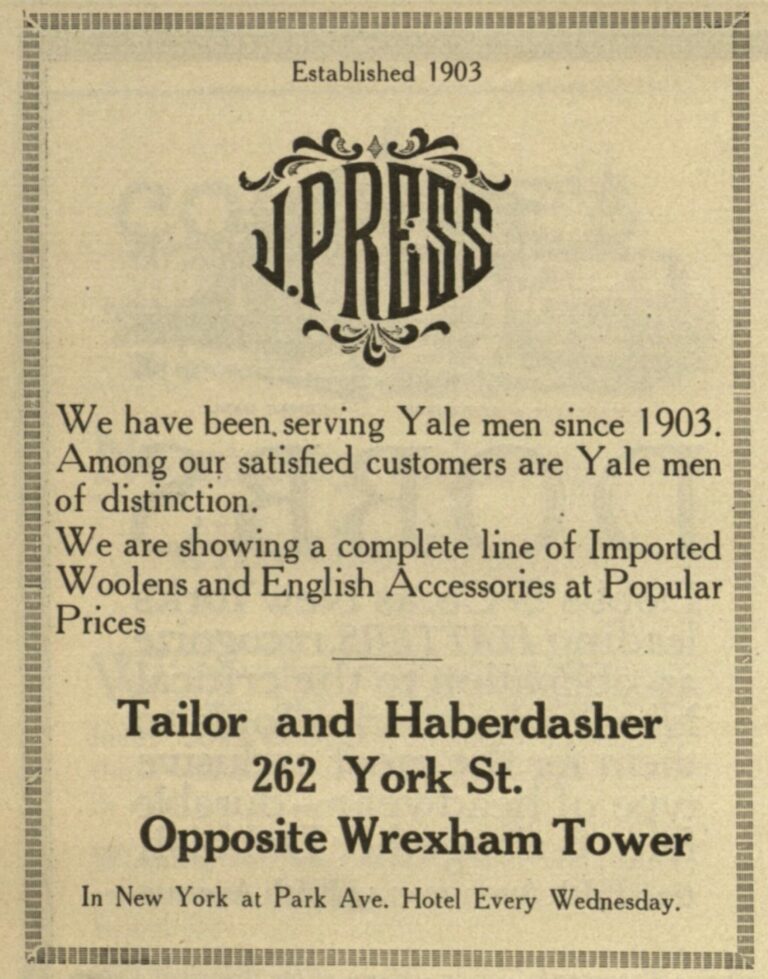
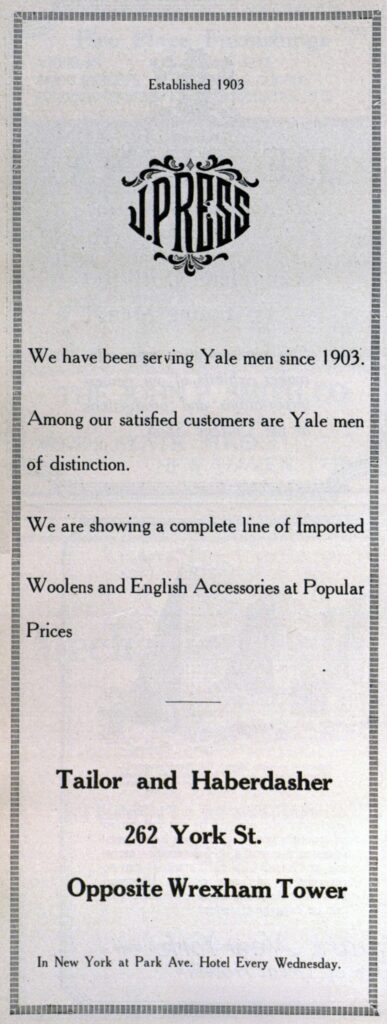
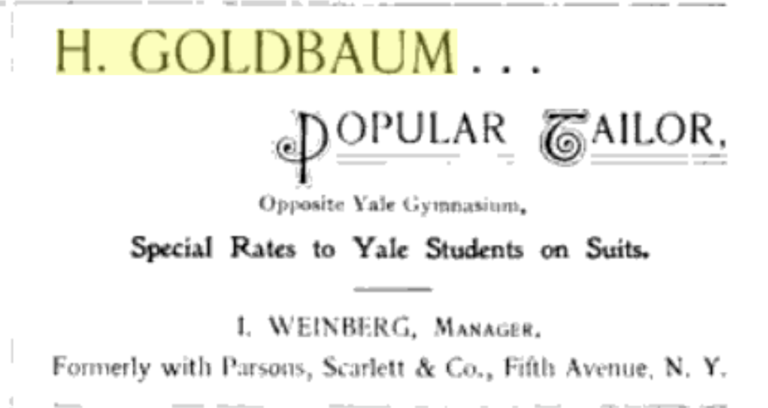
There is another reason why I consider 1903 to be the definitive founding year. The historical account mentioned earlier described Jacobi Press’s relationship with Mr. Goldbaum, and the earliest business name under which Jacobi Press appears in the contemporary advertising record is Goldbaum & Press. Let us now trace that history.
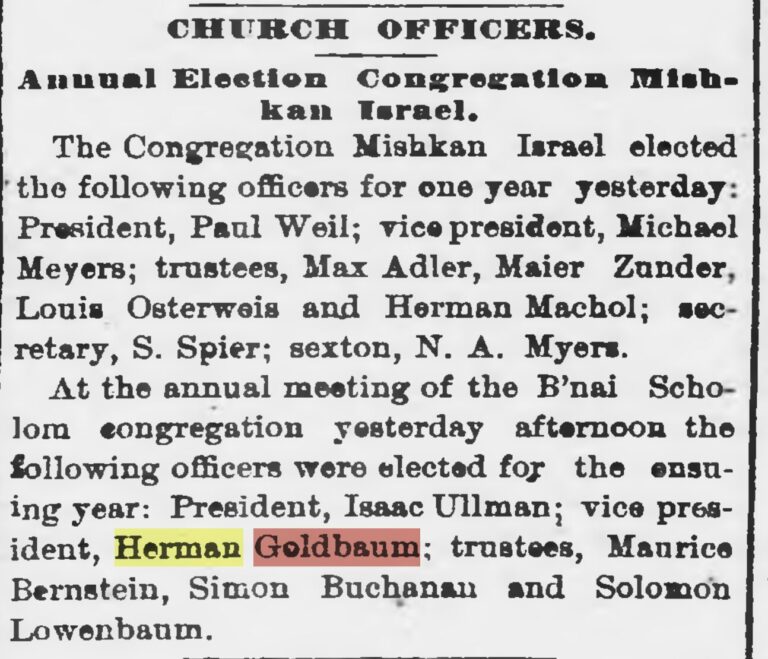
The earliest reference I have found to him appears in a New Haven newspaper from April 1885, which reported that he had been elected vice president at the annual meeting of the Jewish congregation B’nai Scholom. He was evidently already an important figure within New Haven’s Jewish community.
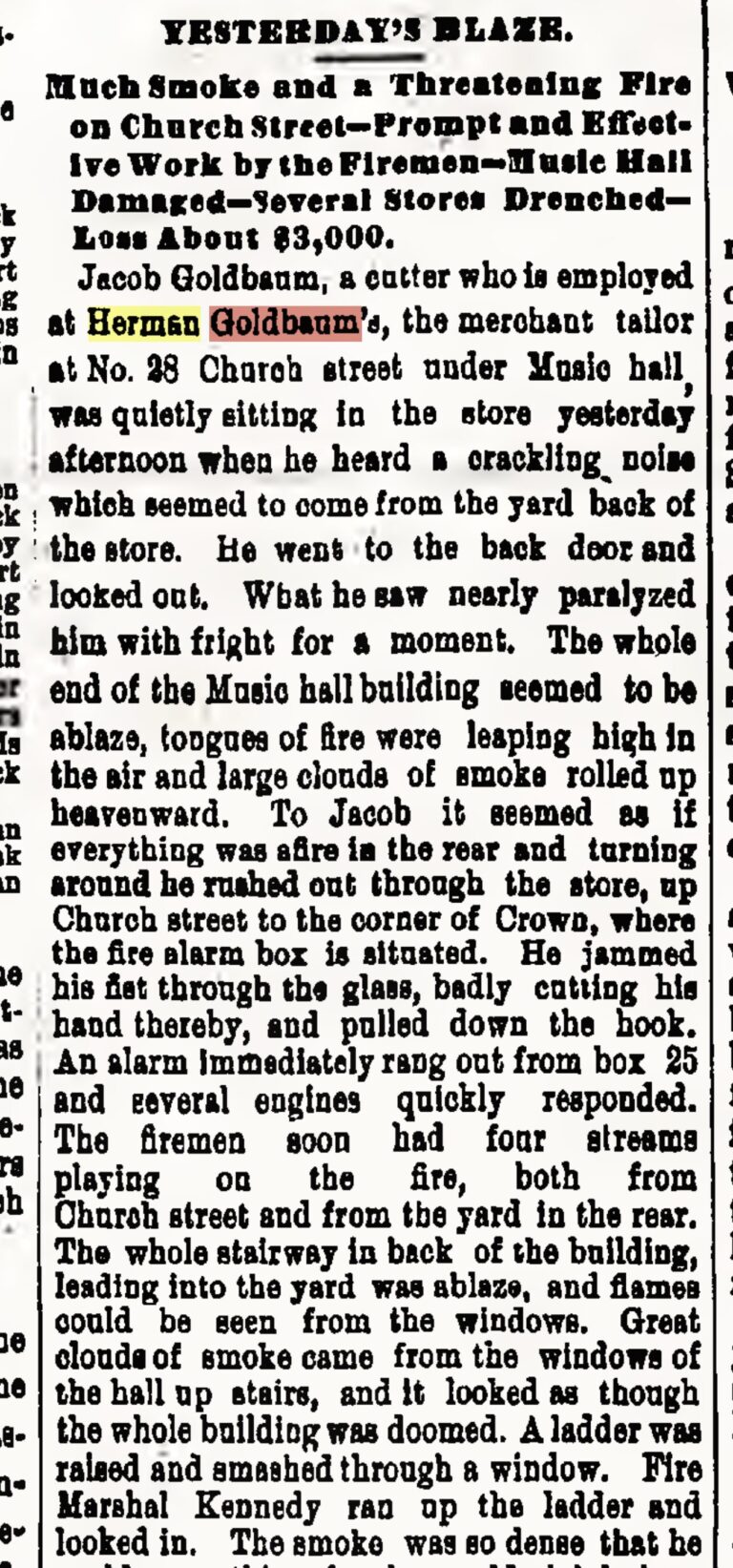
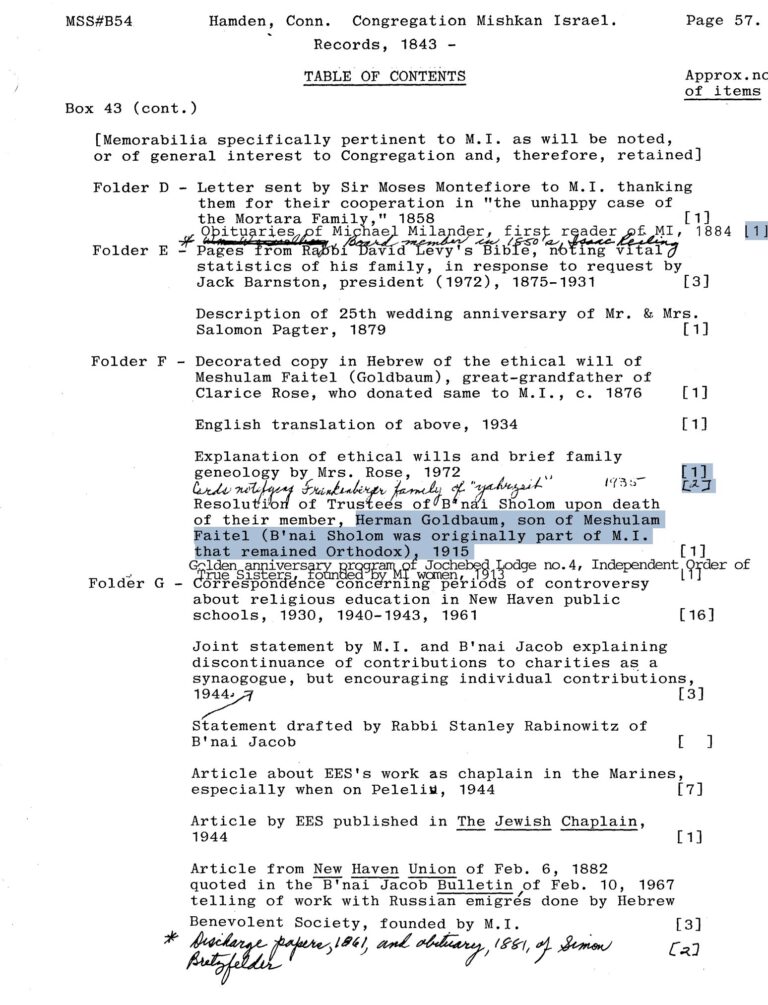
Herman Goldbaum is confirmed to have had a shop at 28 Church Street, under Music Hall, according to the April 1890 issue of the New Haven CT Morning and Courier. The article, which covers a fire that broke out on Church Street, states that Jacob Goldbaum, a cutter employed at Herman Goldbaum’s shop, noticed an unusual noise and activated the fire alarm. It also reports that surrounding businesses were flooded during the firefighting efforts, and that merchandise, including fabrics in Goldbaum’s shop, sustained water damage. In a May 1896 article from the New Haven CT Morning and Courier, Herman Goldbaum is confirmed to have operated as a tailor at 42 Congress Avenue. Although the article itself reports on a theft, it explicitly identifies him as “Herman Goldbaum, a tailor at 42 Congress Avenue,” establishing his business presence at that location by at least 1896.
Let us now turn to Benham’s New Haven City Directory, published in 1899. This was an annual city directory and business register for New Haven. It combined a residential directory, a business registry, and a classified directory of trades and professions—roughly equivalent to a modern telephone directory and business directory combined.
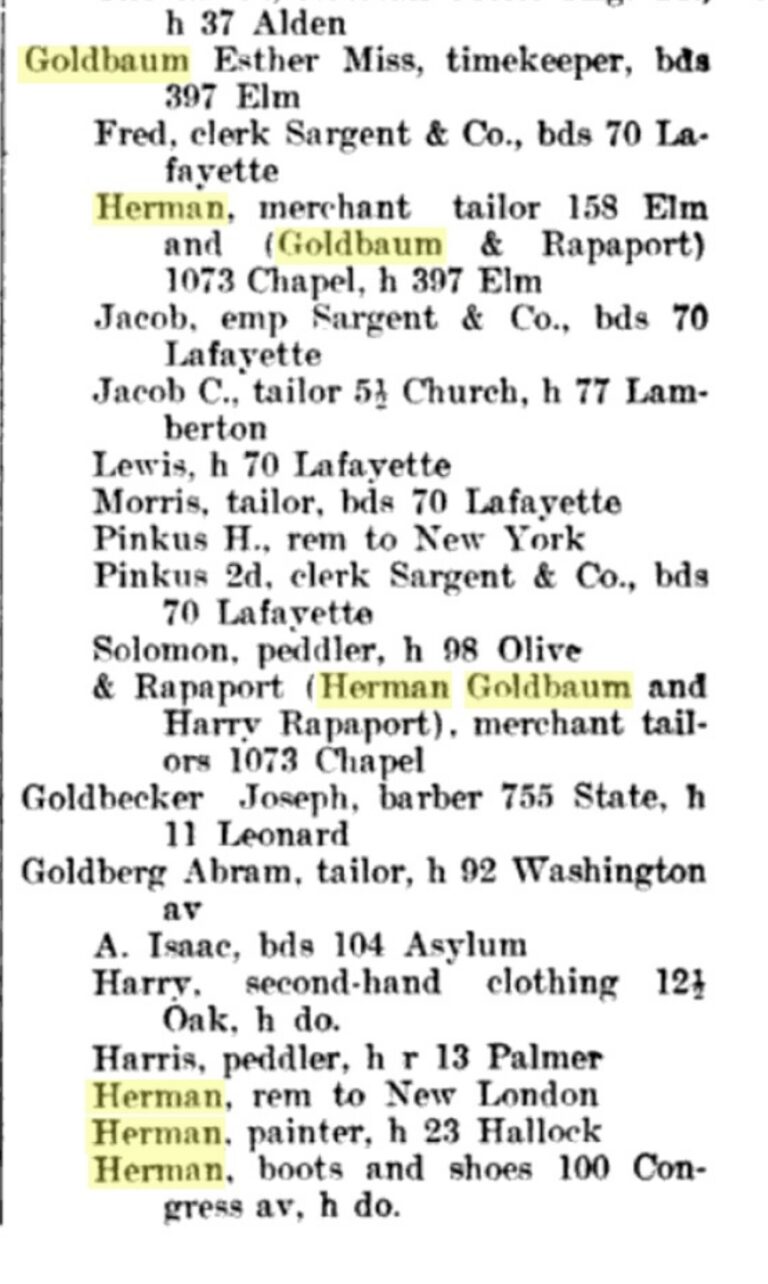
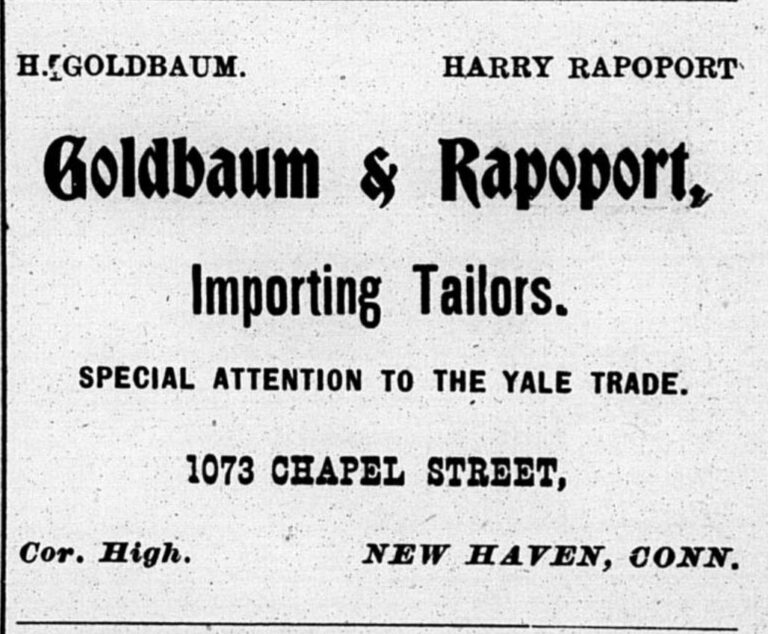
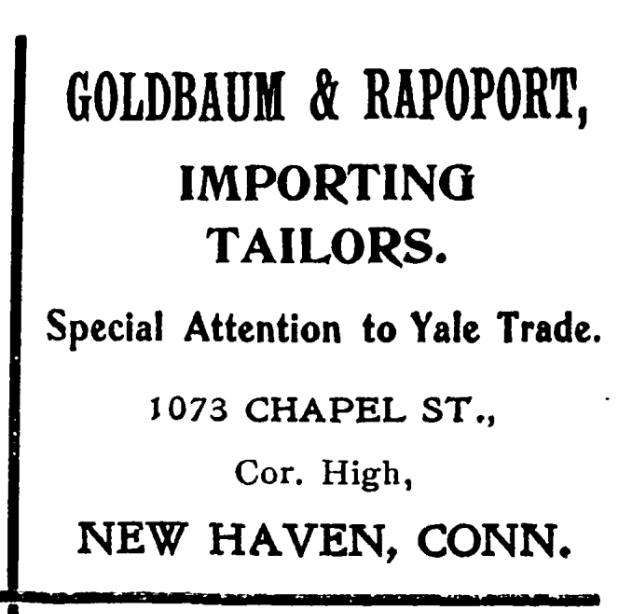
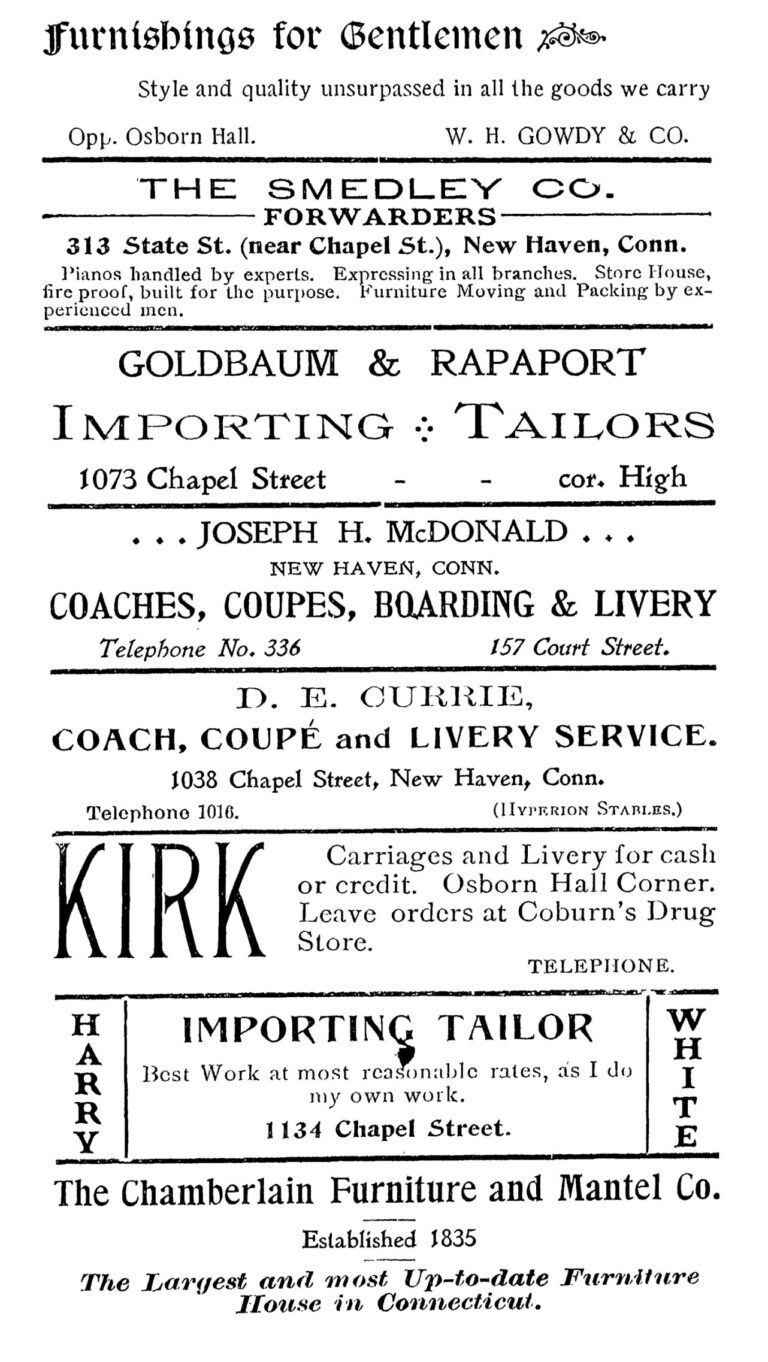
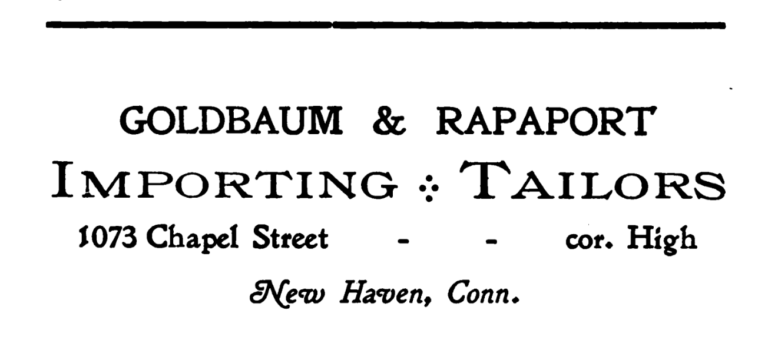
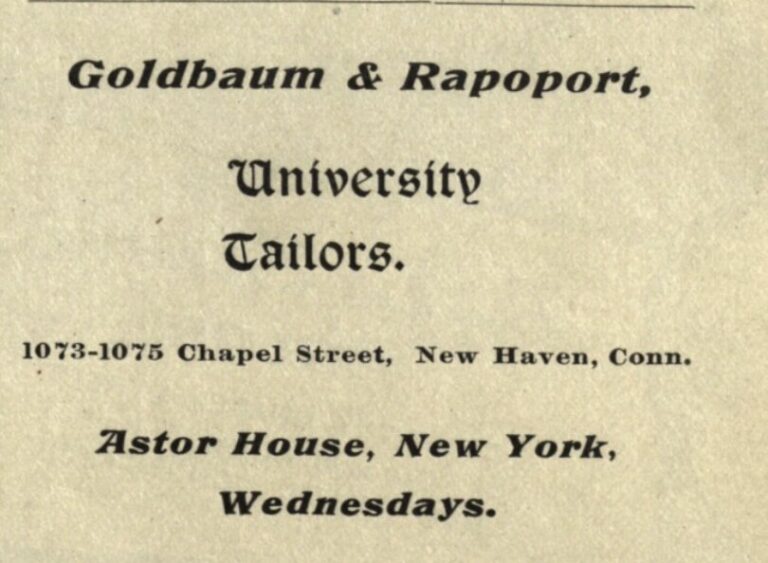
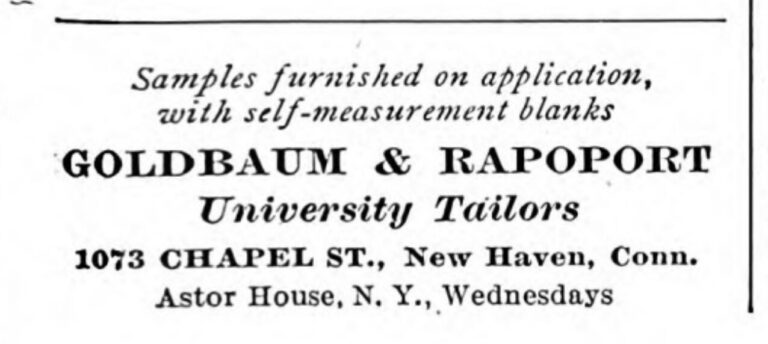
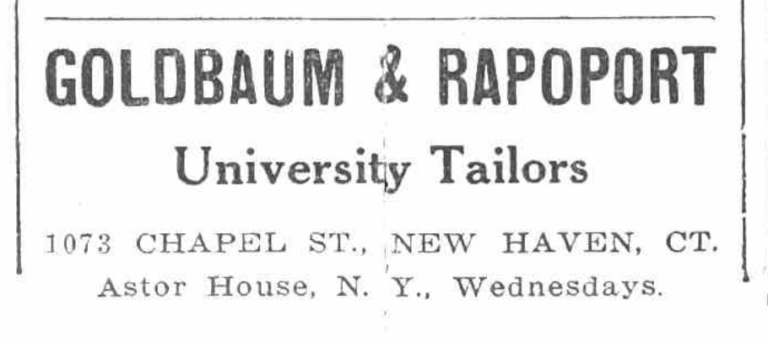
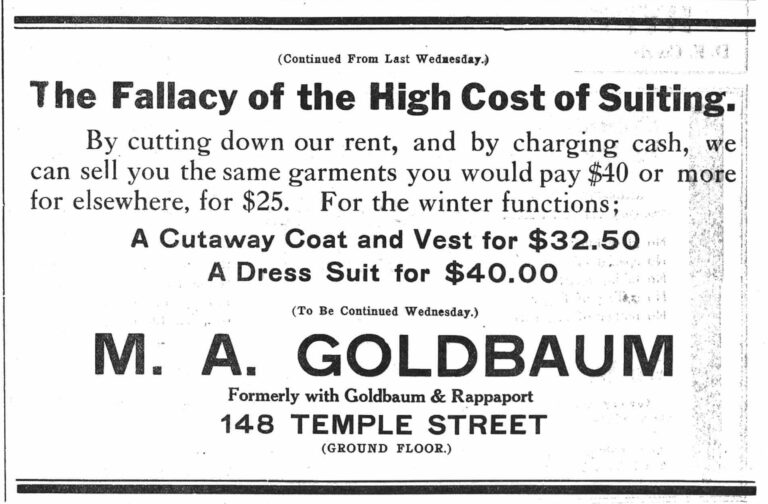
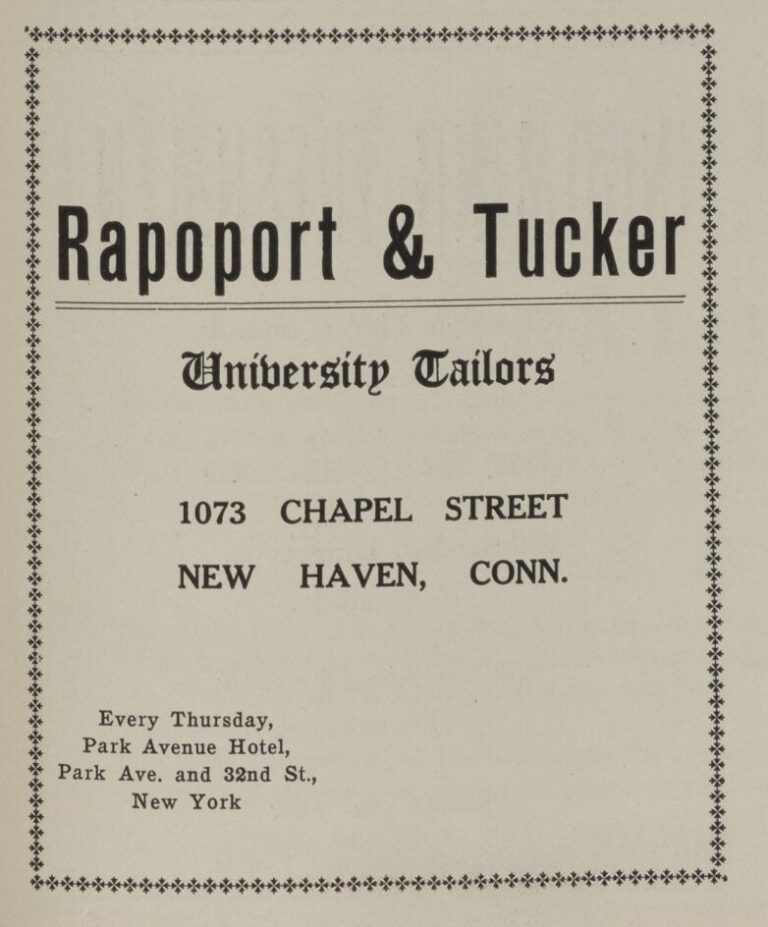
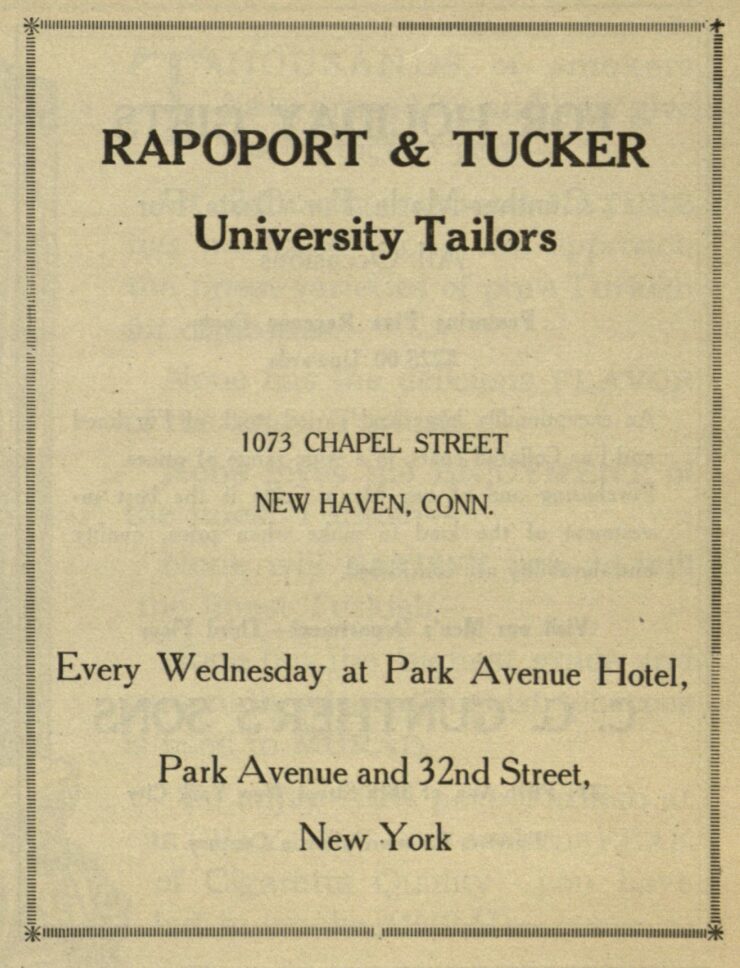
According to the 1899 directory, Herman Goldbaum was already operating as a merchant tailor at 158 Elm Street while simultaneously conducting business with Harry Rapaport under the name “Goldbaum & Rapaport” at 1073 Chapel Street.
Goldbaum & Rapaport (Herman Goldbaum and Harry Rapaport), merchant tailors 1073 Chapel
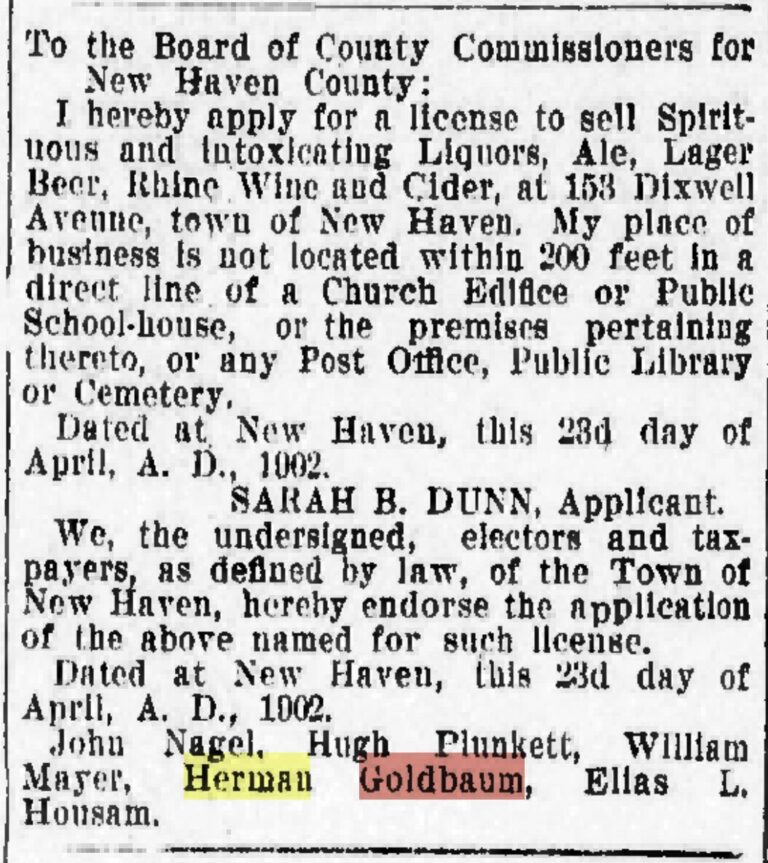
In April 1902, Herman Goldbaum’s name appears in a newspaper notice in the New Haven CT Morning and Courier as one of the endorsers of a liquor-license application. This indicates his status as an elector and taxpayer in New Haven. Another article from the same month, also in the New Haven CT Morning and Courier, references Herman Goldbaum in connection with a forgery case dating back to December 8, 1900. This confirms that his name was also recorded in New Haven financial transactions and court-related proceedings around the turn of the century.
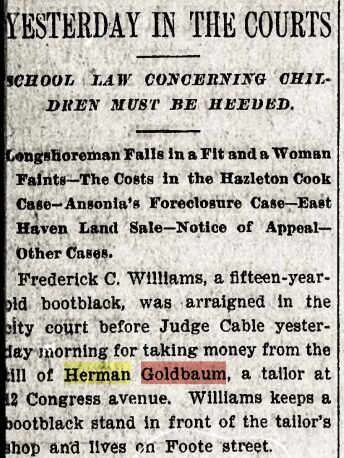
In a May 1896 article from the New Haven CT Morning and Courier, Herman Goldbaum is confirmed to have operated as a tailor at 42 Congress Avenue. Although the article itself reports on a theft, it explicitly identifies him as “Herman Goldbaum, a tailor at 42 Congress Avenue,” establishing his business presence at that location by at least 1896.
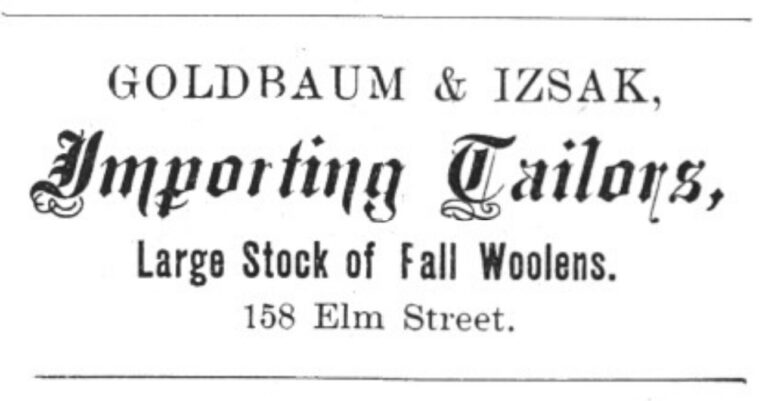
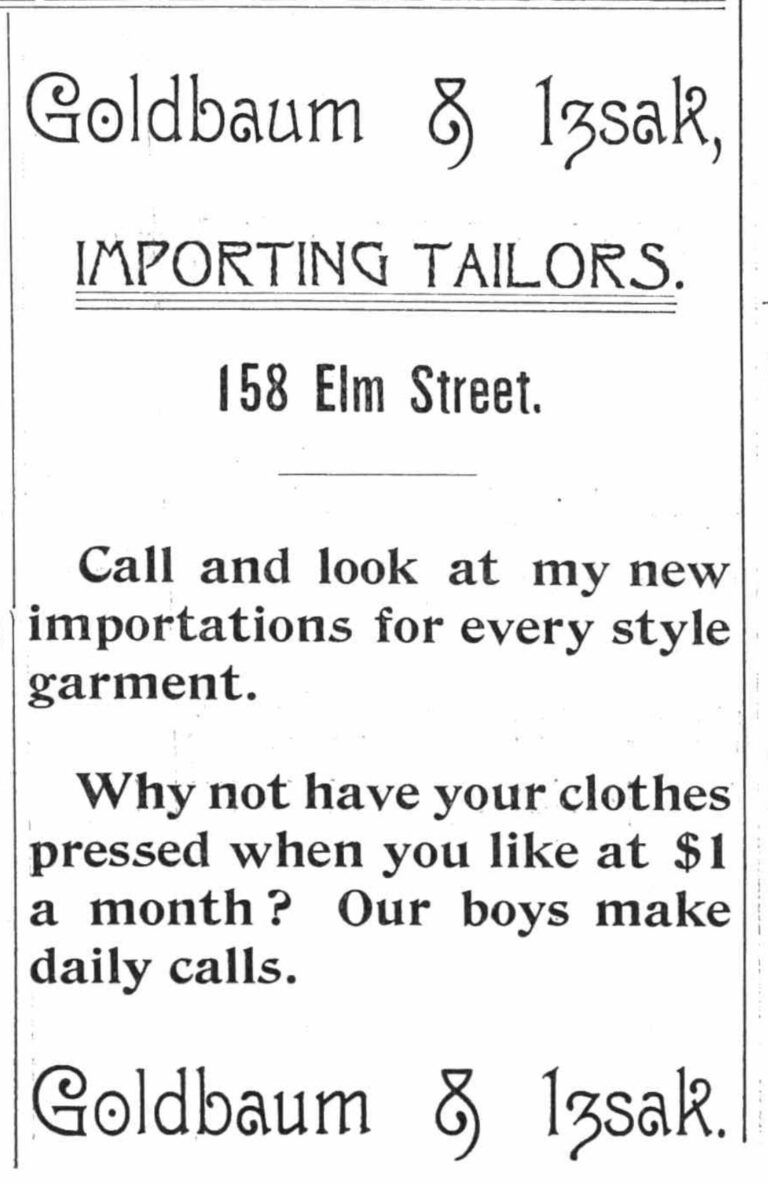
The Yale Daily News, 4 November 1896
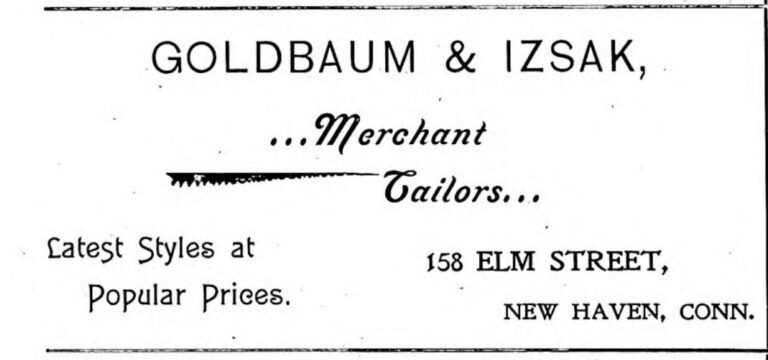
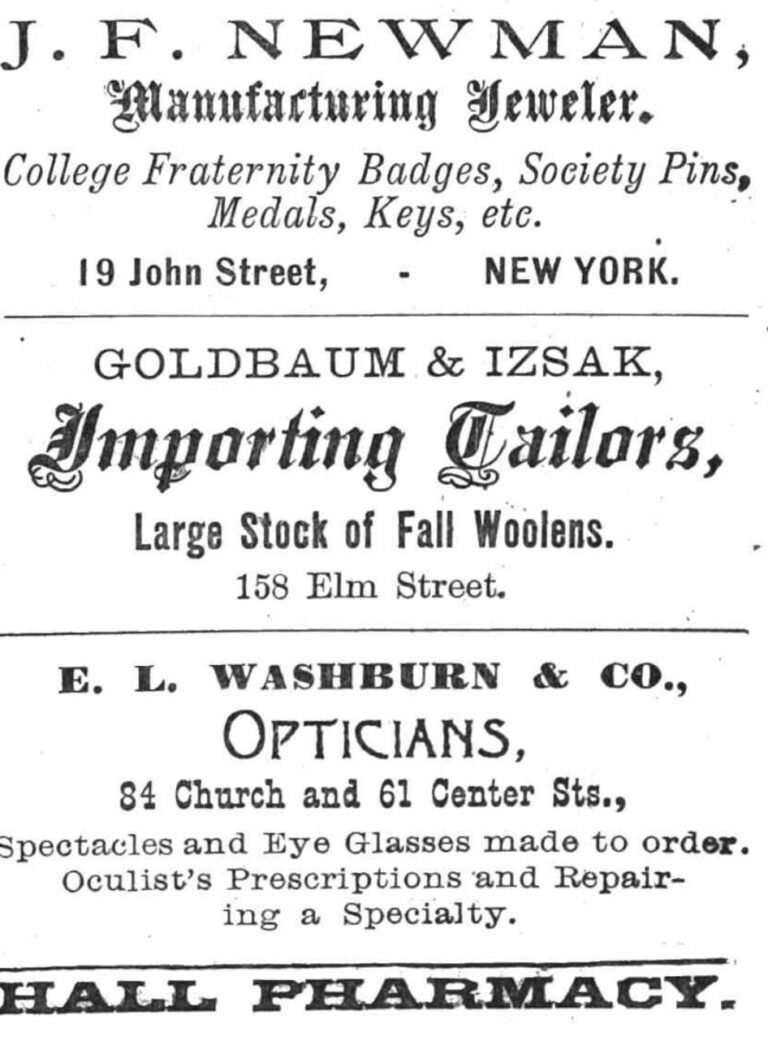
The Yale Daily News, 30 June 1897
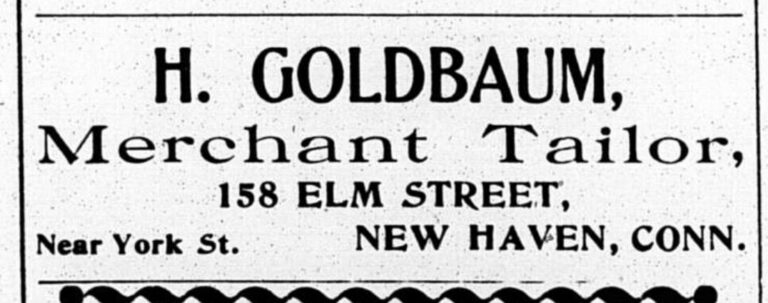
The Yale Daily News, 11 January 1898
The Yale Daily News, 29 June 1899
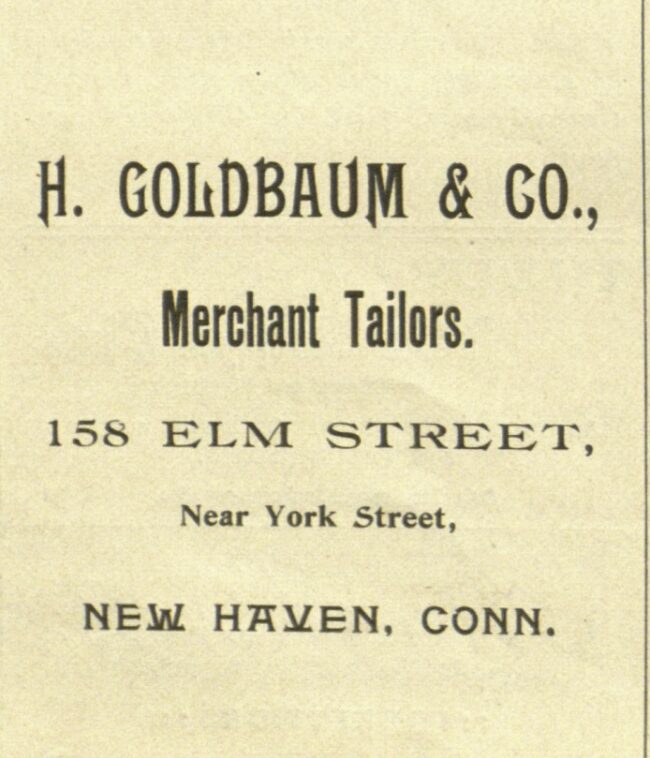
The earliest point at which the move to 158 Elm Street—the birthplace of J. Press—can be confirmed with certainty is 1900. The location of the business between 1896 and 1899 cannot be established, but it is possible that it had already been operating there as early as 1895.
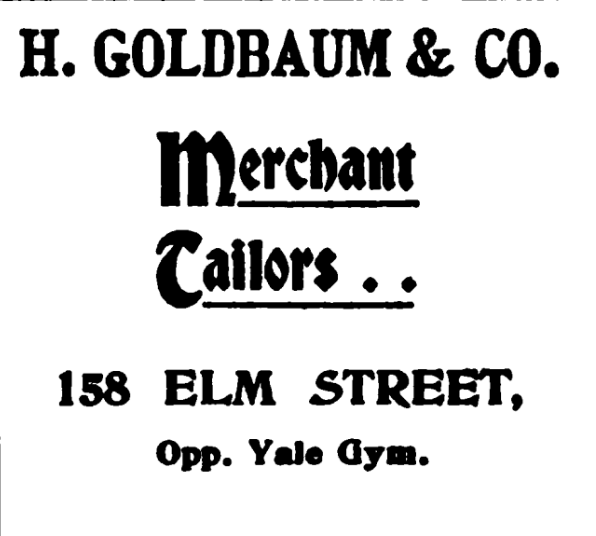
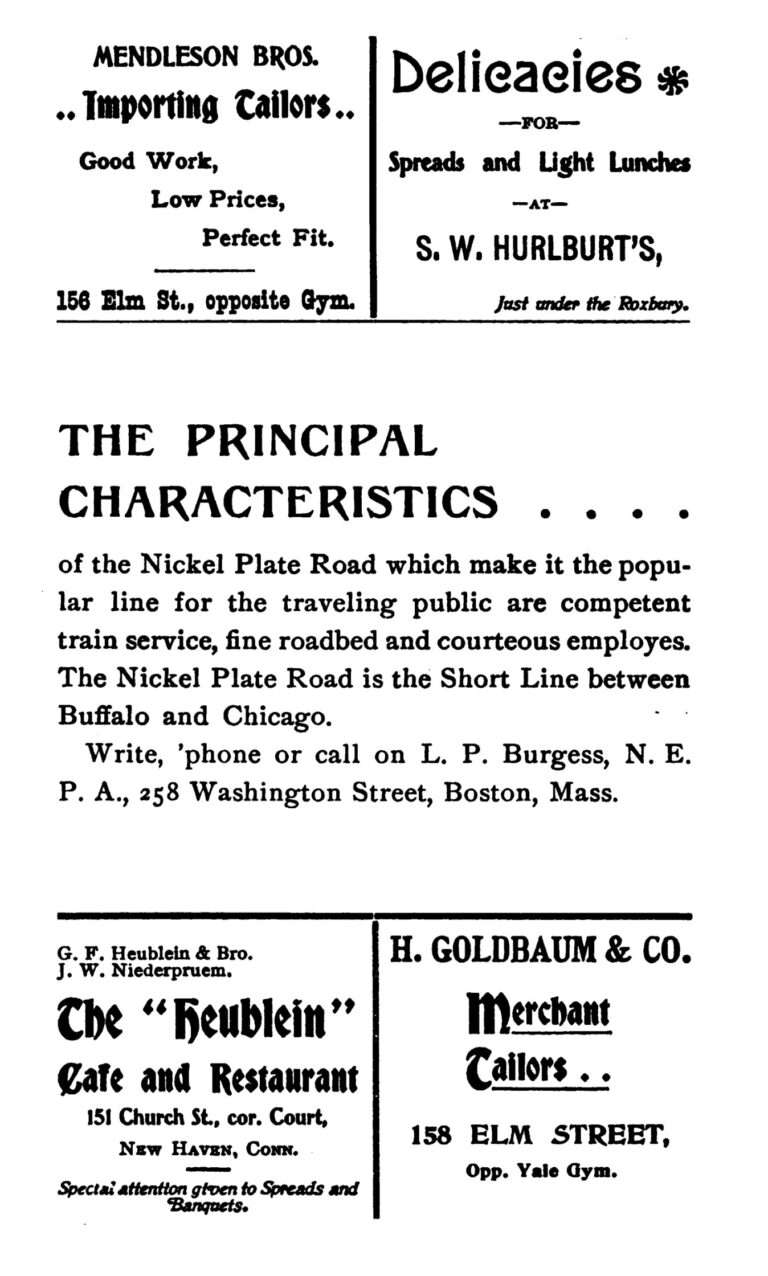
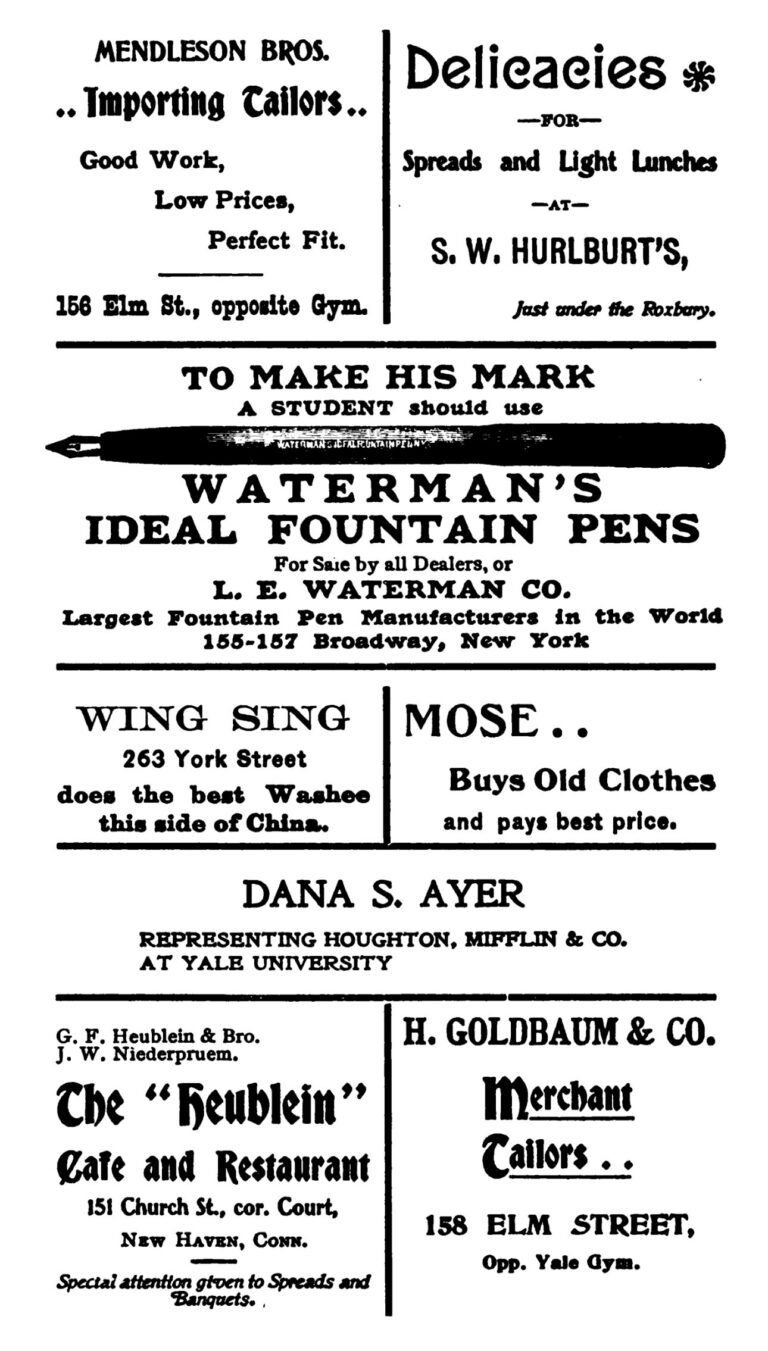
The Yale courant v.38 Apr 19 1902
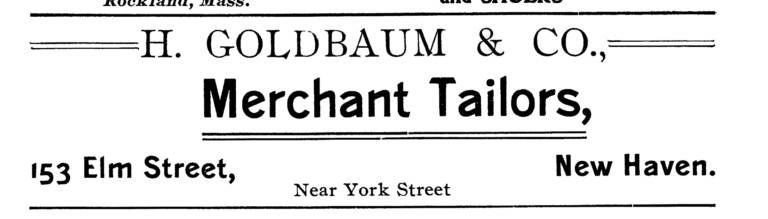
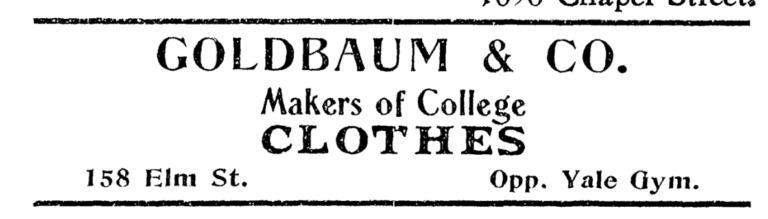

According to Yale-related publications, the business continued to operate under the name H. Goldbaum until around October 1903. Even allowing for a margin of several months due to advertising lead times, the name appears to have remained in use until sometime between June and October of that year. It can therefore be inferred that Jacobi Press either joined the business after the middle of 1903 or had only by then established a relationship of sufficient trust with Goldbaum for his name to be added to the firm’s name. On this evidence, the claim that the business was founded in 1902 must itself be regarded with considerable skepticism.
This appears to be the basis for the claim, noted at the beginning of this section, that the business was founded in 1903. The “Founded in 1903” wording used in later advertisements was likely derived from this interpretation. From Goldbaum’s perspective, he was also involved in the management of another business, Goldbaum & Rapoport, which continued to operate even after the dissolution of Goldbaum & Press. This suggests that his role may have been less that of a full-time partner in the new firm than that of someone supporting Jacobi Press. Given the chronology, I believe the more plausible interpretation is that Goldbaum eventually entrusted his own shop to Press as his successor.
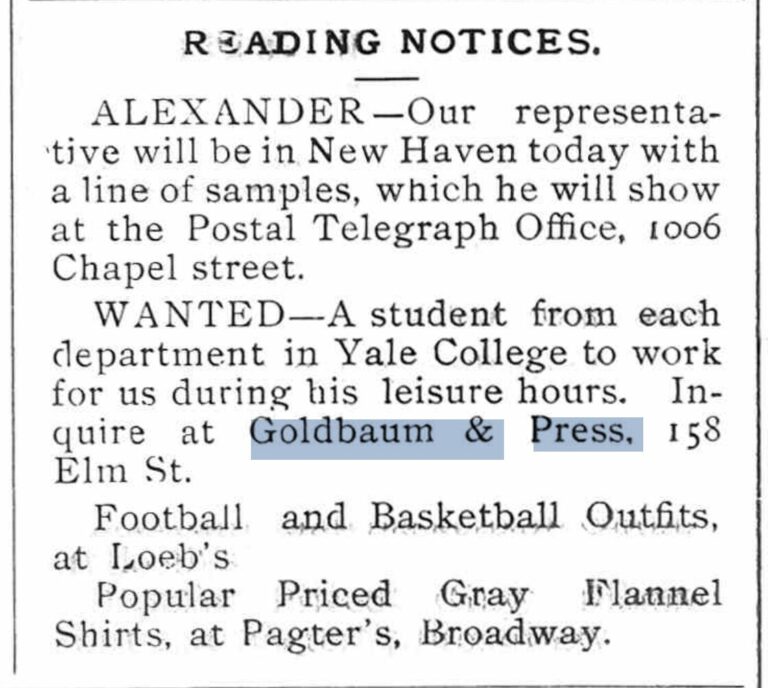
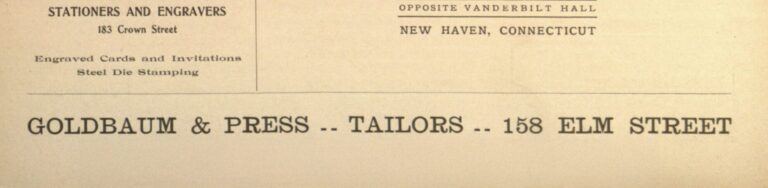
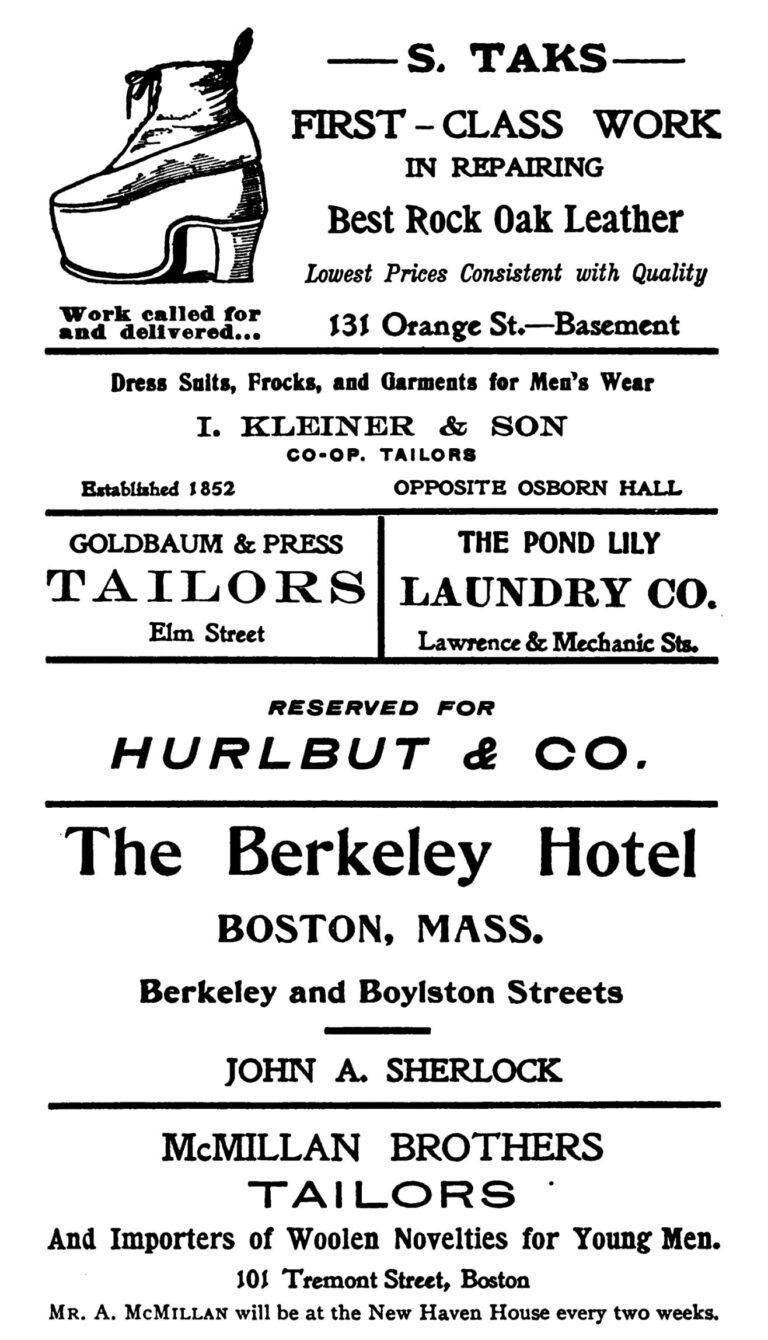
The Yale Daily News, Apr /24/1904
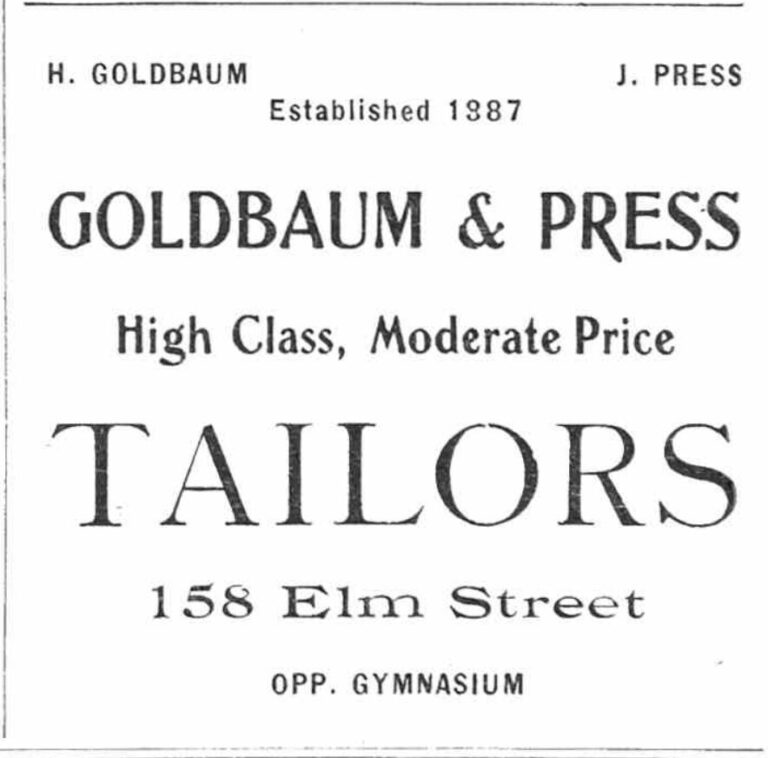
Even when viewed without preconceptions, I believe this advertisement reveals how highly Goldbaum regarded Jacobi Press and how much confidence he placed in him. This is the only advertisement I have found that gives 1887 as the founding year. It was also considerably larger and more prominent than the advertisements for Goldbaum & Rapoport, which may suggest that greater importance was attached to this business.
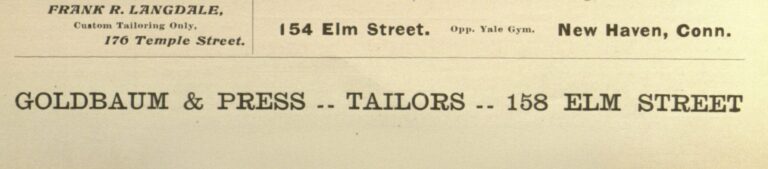
The Yale record v. 33, no. 15, 6/3/1905
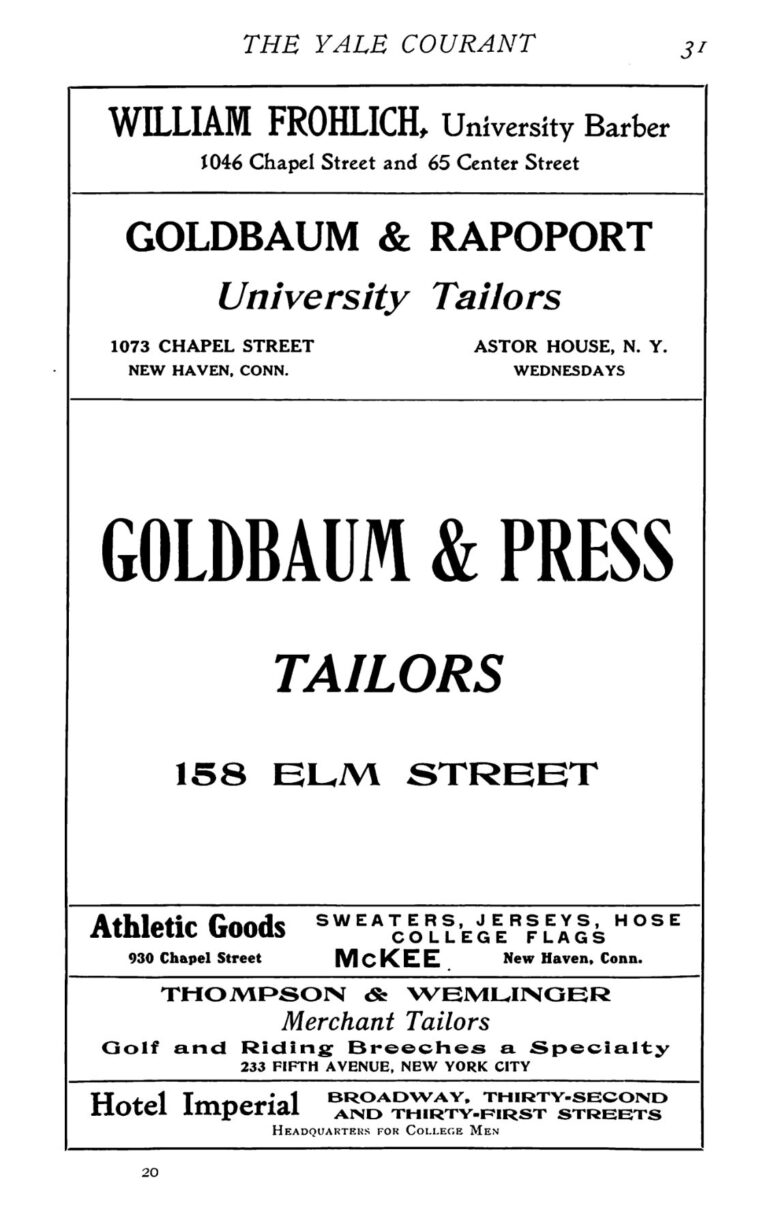
This advertisement provides perhaps the clearest example. Although it was placed jointly under both names, “PRESS” is displayed much more prominently. Could this not be interpreted as an indication of the high expectations Goldbaum placed on him?
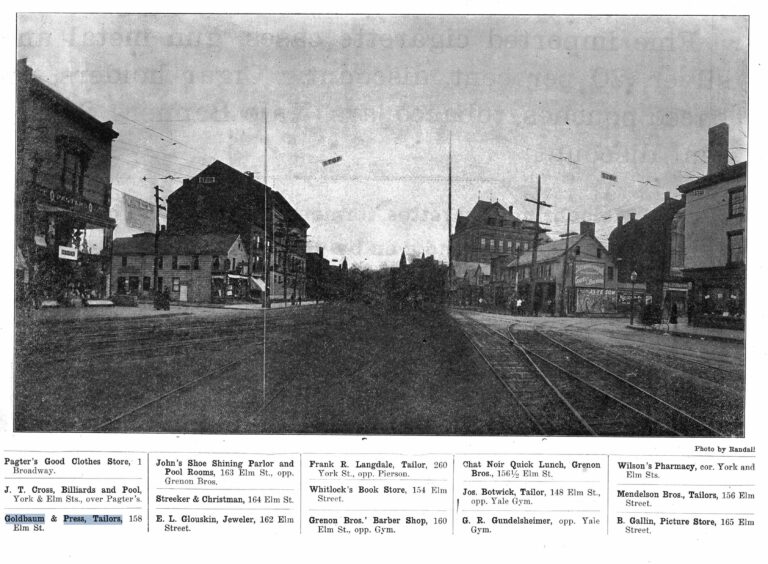
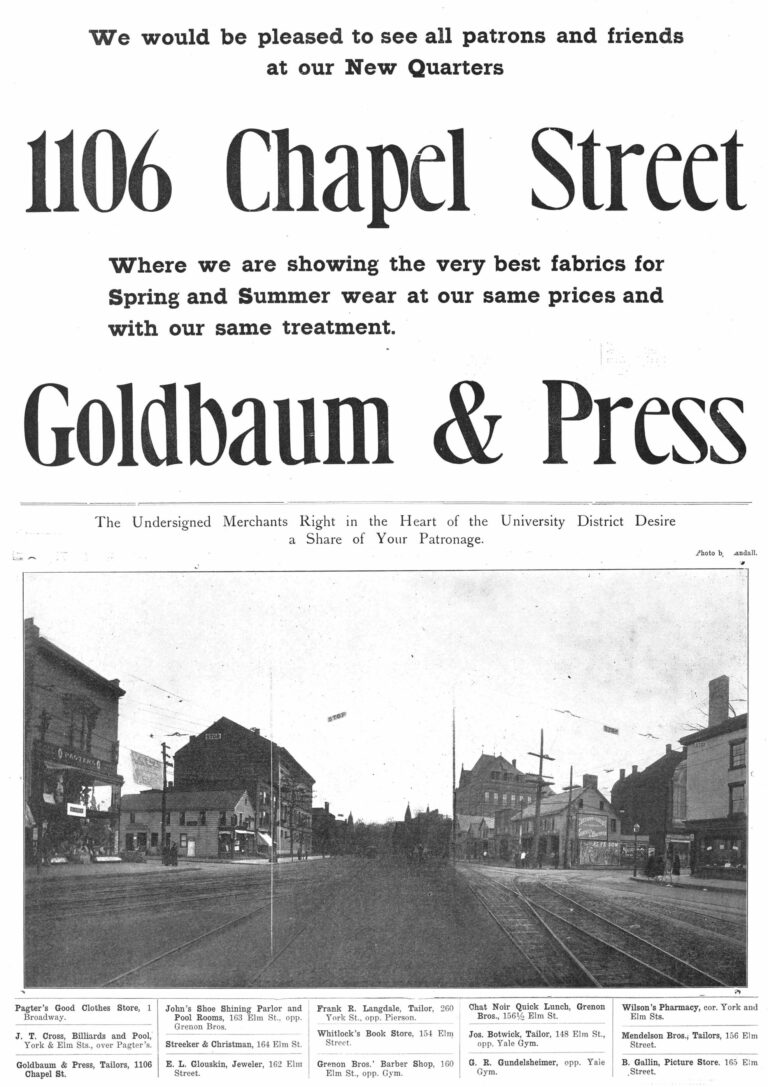
This article reports that new premises were completed in March 1907 and that a new Goldbaum & Press shop opened at 1106 Chapel Street. An advertisement published only two months earlier, in January, still listed the Elm Street address, which suggests how much hope they placed in this new shop. This is merely my own speculation, but I wonder whether Mr. Goldbaum truly believed that Jacobi Press would carry the business into the future.
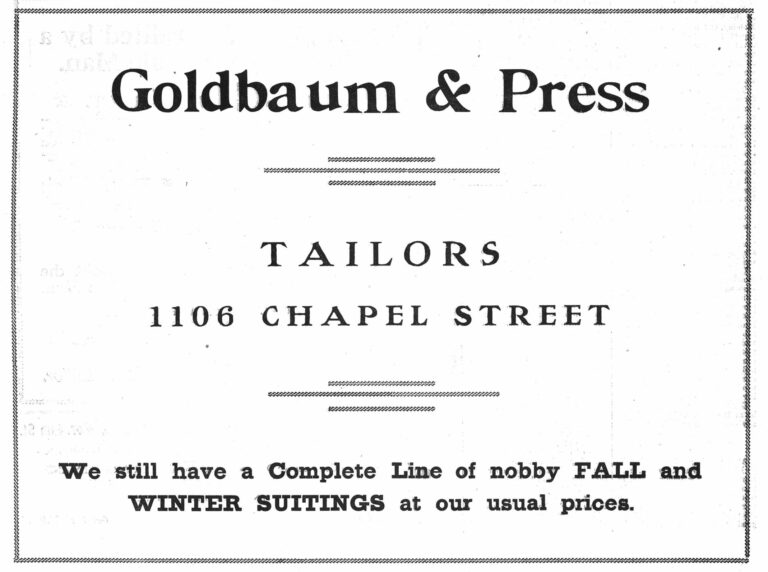
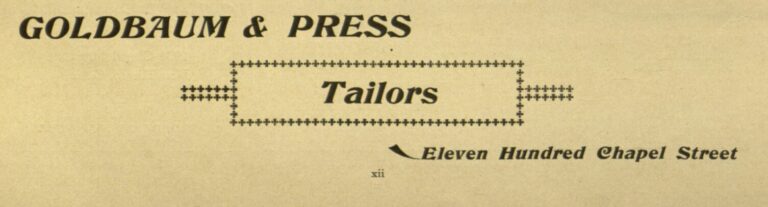
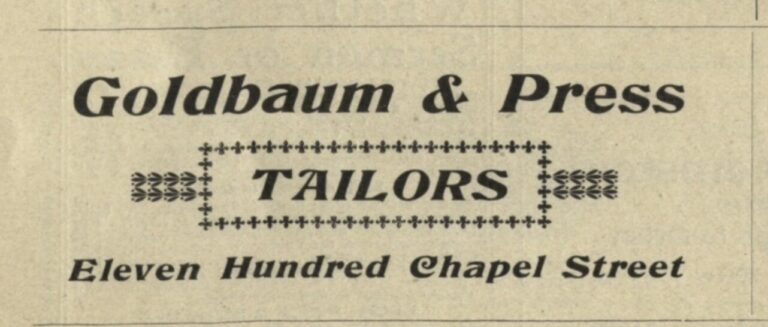
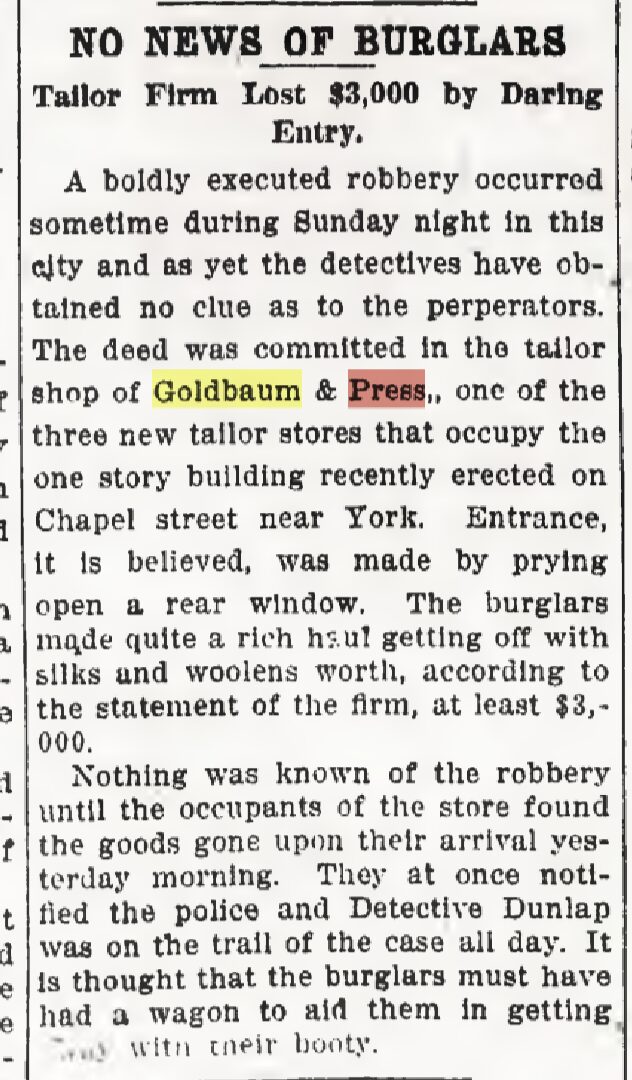
This incident, which occurred in August 1907, may have caused a rift between the two men. The burglary reportedly resulted in losses of $3,000, equivalent to approximately $105,000 today. The theft occurred at their newly opened shop on Chapel Street near York Street, and there is no doubt that the firm suffered a substantial loss.
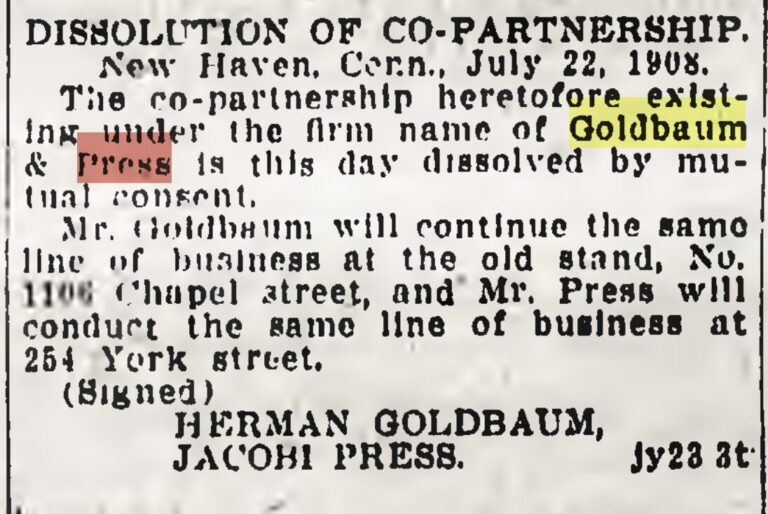
This newspaper advertisement announces the dissolution of their partnership, approximately one year after the burglary. Although I place very little trust in Richard Press’s memoir of the company’s founding period, I wonder whether the reference to “debt” may have originated in the “new premises” and the “burglary.” In any case, it is a fact that Goldbaum & Press, which had begun with such high expectations, came to an end after only five years.
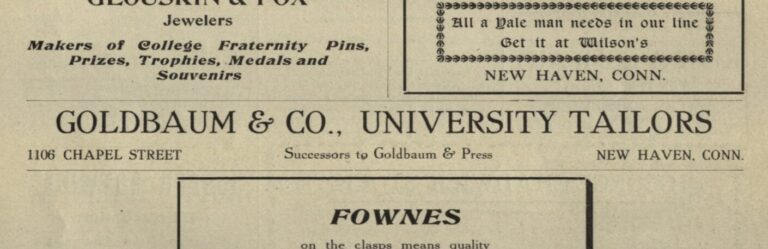
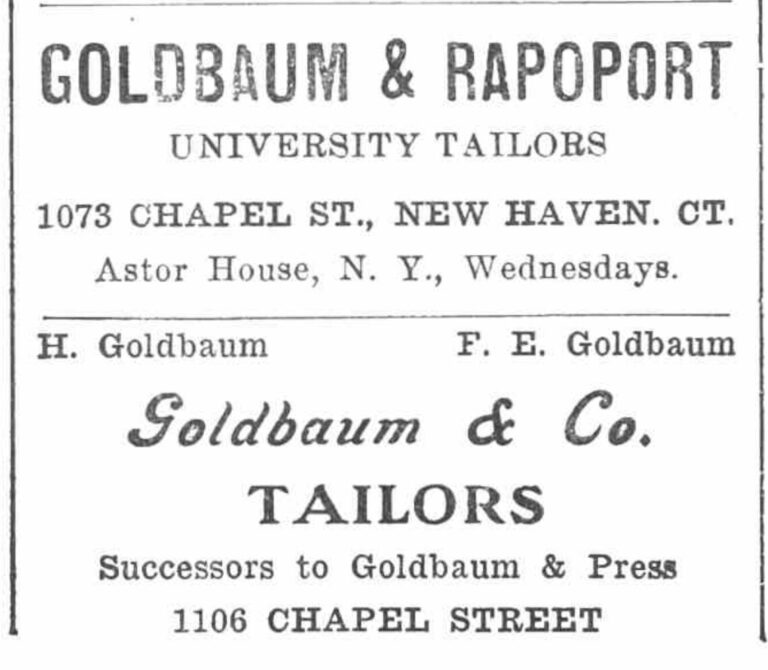
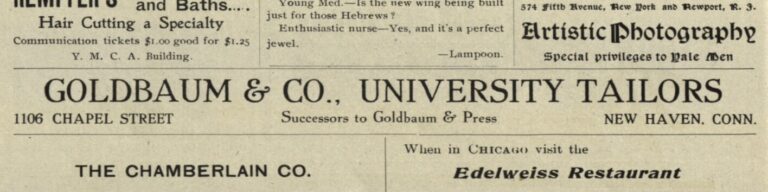
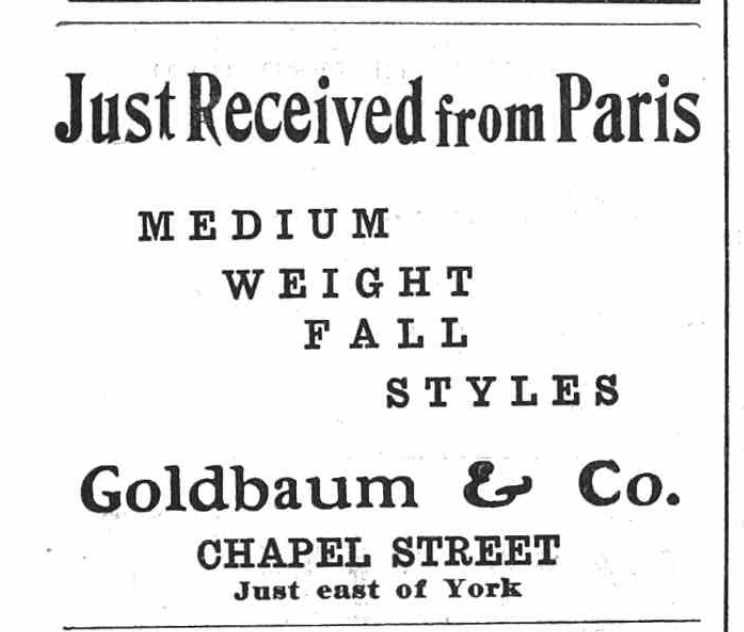
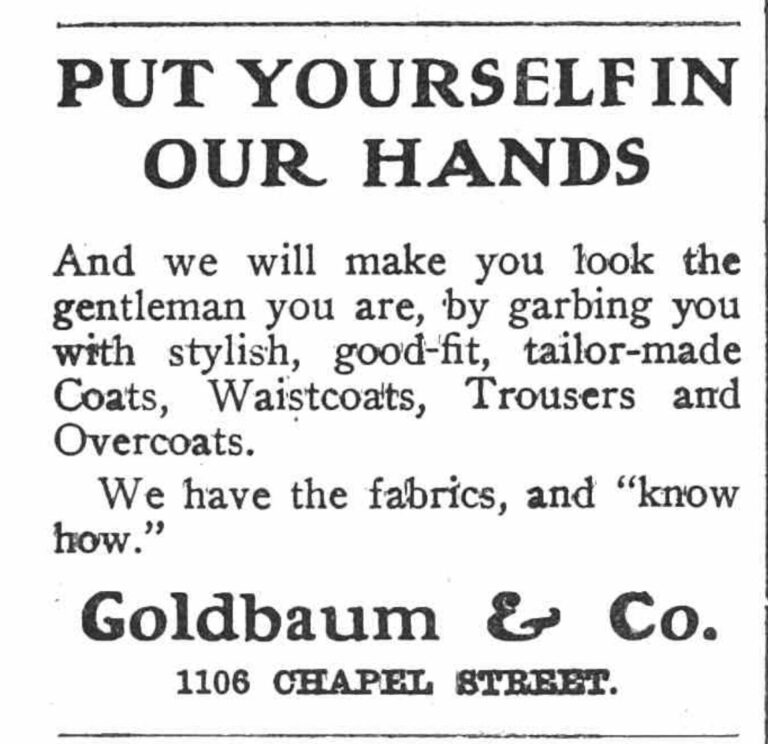

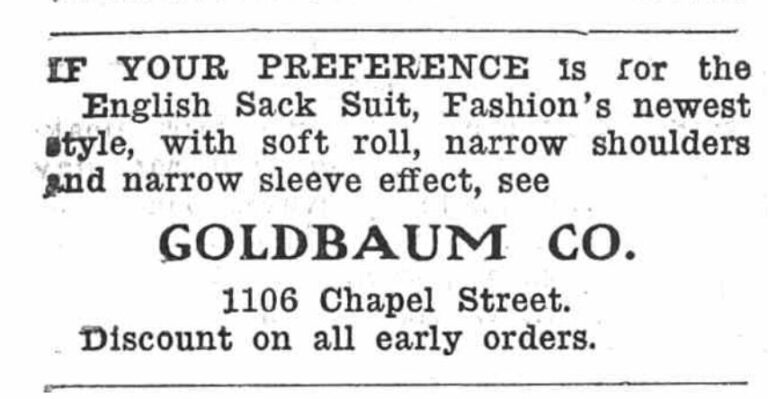
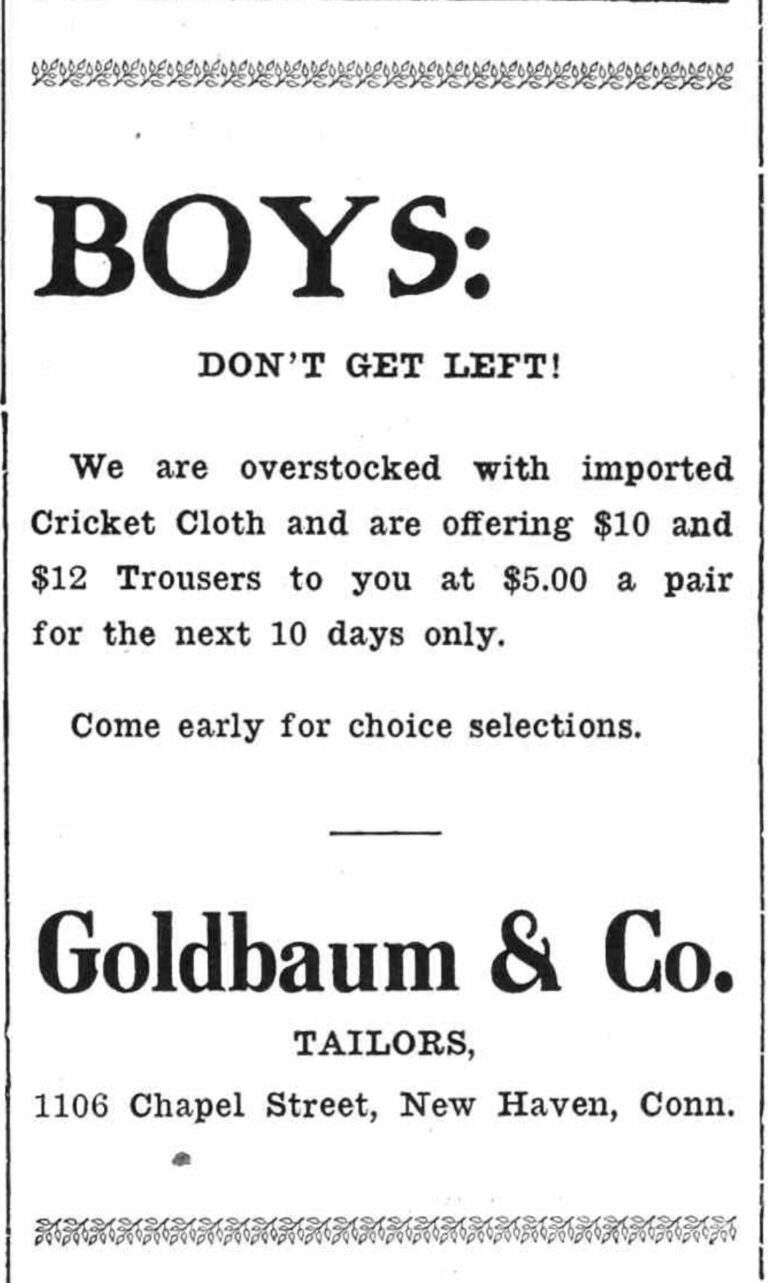
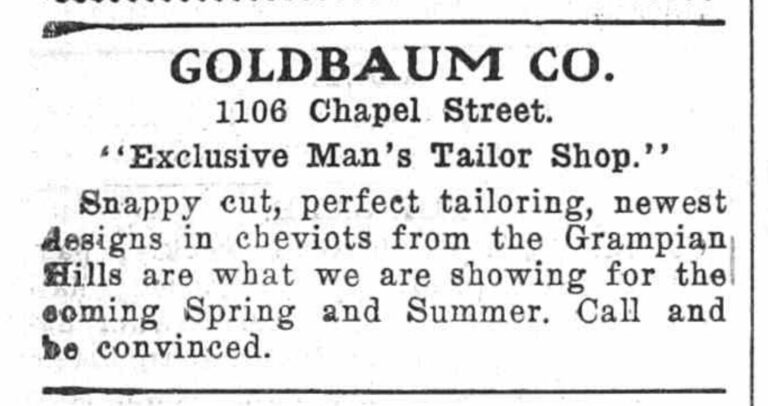


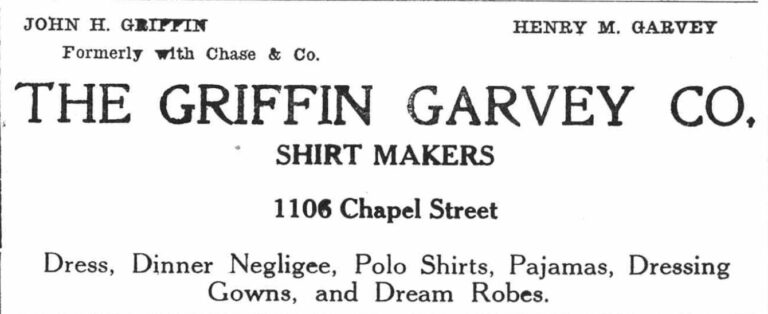
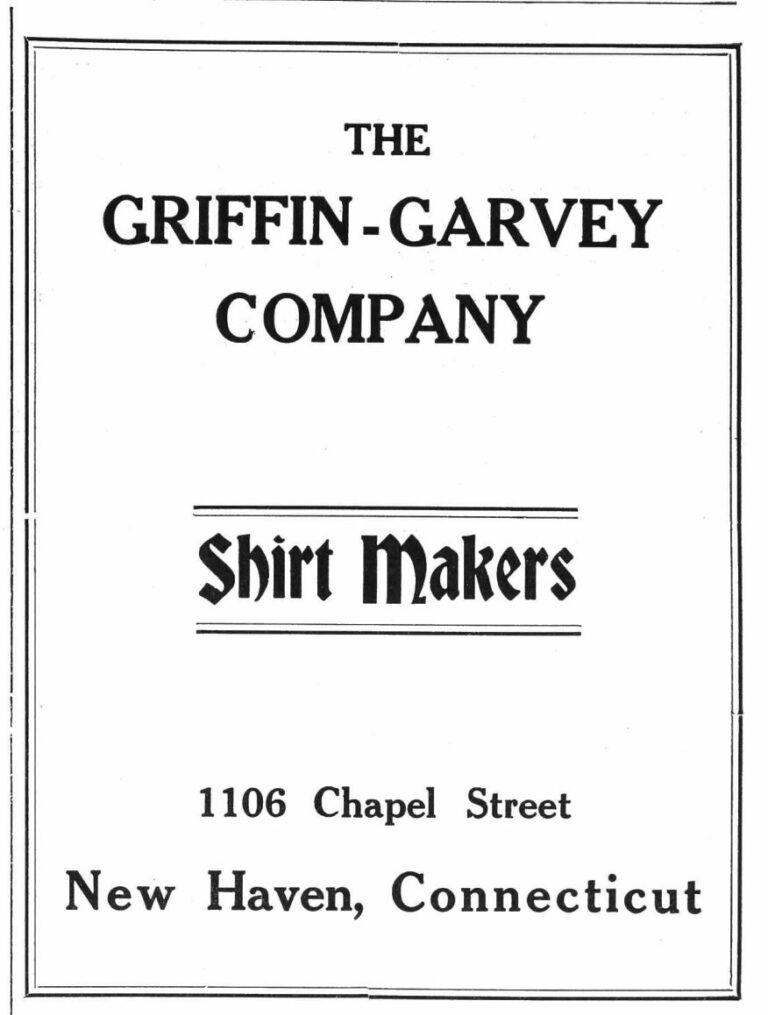
Although the building was three stories high, making it difficult to reach a definitive conclusion from the address alone, the occupant of the same Chapel Street address unfortunately appears to have changed around 1912. Since no trace of Goldbaum & Co. can be found after 1912, the business may have come to an end at that point. Meanwhile, J. Press appears to have grown increasingly popular, as indicated by its multiple advertisements. The other branch, Goldbaum & Rapoport, also began to break apart, and the Goldbaum name disappeared from that business as well in the latter half of 1910. It would be fair to say that the story of the Goldbaum family had largely come to an end by this point.
The J. Press story began the turn of the century, serendipitously around the corner from the current J. Press quarters, on College Street. JC Goldbaum was a bespoke tailor on Chapel Street who had sold to Yale students since the Civil War. Grandfather Jacobi Press learned both tailoring and the English language as an intern in Goldbaum’s second-floor quarters. Two years after arriving in New Haven an immigrant from the Pale of Russia, he knocked on doors showing swatches to students in the Yale dorms at the same time while he was running Goldbaum’s tailor shop.
My grandfather was a dapper man, carefully decked out in three-piece English woolens, garnering his wardrobe as if to-the-manner born of Professor William Lyon Phelps, Coach Walter Camp, and other notables on the Yale campus. He adopted the gift of gab and a quick sense of humor, and soon was regularly invited to serve the tweed-clad elites on bended knee. He also drummed up most of Goldbaum’s business. The older gentleman obliged Grandpa’s acumen, selling him what had become Goldbaum & Press in 1902, which then became J. Press.
Jacobi’s big break came in 1902. Since the Civil War septuagenarian merchant tailor Herman Goldbaum had owned and operated a shop on 150 Elm Street, just off the Yale campus in downtown New Haven. The turn of the century found Goldbaum embroiled in debt and looking for a way out of his financial predicament. A local needle and thread supplier stuck with Goldbaum’s IOUs was impressed with young Press’ Middletown tailoring potential and arranged a meeting between the aspiring 20-year-old and the debt-ridden 72-year-old. A future partnership agreement was negotiated pursuant to Press bringing in enough new business to settle Goldbaum’s financial abyss.
[…]
The training he received at his brothers’ emporium in Middletown provided Jacobi Press enough tailoring experience to process all the new orders he nudged on the Yale campus. Jake Press’ outgoing personality and personal magnetism brought him instant campus celebrity. Meanwhile, Herman Goldbaum’s septuagenarian disabilities forced the youthful entrepreneur to do his own cutting, make deliveries, work nights as well as Sundays, keep the books, pay the bills, buy all the woolen and trimmings, as well as attend to the family needs of wife Jenny and their children Marion and Irving. Fortunately my father Paul arrived in 1911, during more prosperous times.
By 1908 the Herman Goldbaum obligations were met and all bills paid in full. The firm Goldbaum & Press was dissolved in a very unbusinesslike manner. No lawyers assisted the transaction. The partners flipped a coin for each piece of goods, shook hands, and divided the assets. Together with the money earned after paying off Goldbaum’s debts, Grandpa gathered enough financial strength to buy an older tailoring firm on York Street, Smith & Murray, that his pals told him was in trouble. The eponymous J.Press was thus born under his sole ownership.
Every time I read this passage, I feel deeply saddened. Looking at the history that followed, there is no denying that J. Press became a successful brand, rose to become Yale’s foremost tailor, and dressed presidents and Hollywood stars. The fact that it still exists more than a century later can only be described as miraculous.
However remarkable the founder’s grandfather may have been, I believe it is wrong to construct a narrative out of lies and, in doing so, disparage someone to whom he owed so much. Had it not been for the robbery, this might instead have become an extraordinary and inspiring story: a talented young immigrant tailor succeeding an experienced craftsman who had been in business since the 1890s, and even being provided with a new shop.
It is always the stories of the victors that survive. I despise this fabricated narrative from the bottom of my heart.
When J. Press was first introduced in Japan, the company claimed to have been founded sometime in the 1860s. However, by the time it entered the Japanese market in earnest in the 1970s, the stated founding year had shifted to 1902. In reality, the business is confirmed to have begun in 1903 as a partnership with Mr. Goldbaum under the name Goldbaum & Press. It was in 1908, when that partnership was dissolved, that Jacobi Press began operating independently at 254 York Street. It is unclear what exactly their stated date of 1902 was intended to refer to. However, if it marked the year in which Jacobi Press joined Goldbaum’s business, it could hardly be regarded as the company’s founding year.
If a historically accurate founding year is to be established, I believe it should be one of the following:
・1887 — H.Goldbaum & co founded his business
・1903 — J.PRESS (Goldbaum & Press) began, as documented in advertisements
・1908 — Jacobi Press separated from Goldbaum
Furthermore, Richard Press’s disrespectful memoir contains numerous falsehoods and amounts to an overblown fairy tale that lacks credibility.
J. Press is a brand that I may look into again eventually, but right now, my only real interest is in the manufacturers it contracted to make its clothes, so I am not sure whether I will actually end up researching J. Press any further. It is simply no longer that important a brand to me.
(Even though I still have a few J. Press pieces in my wardrobe.)
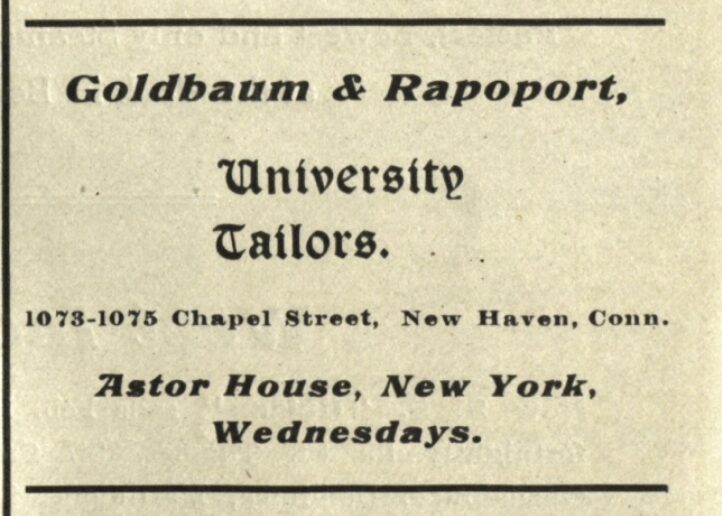
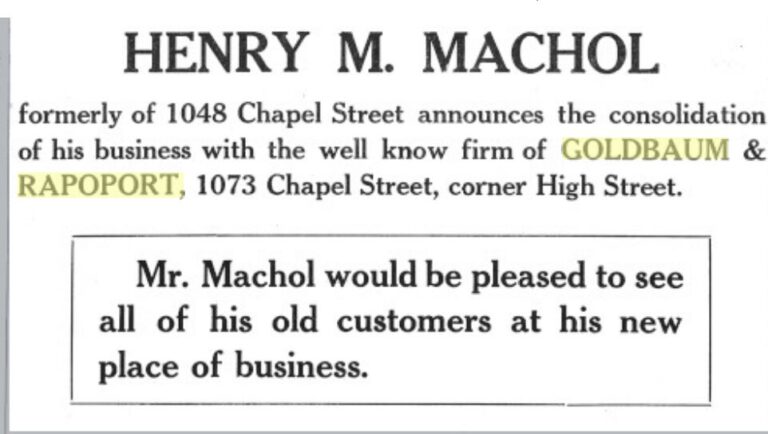
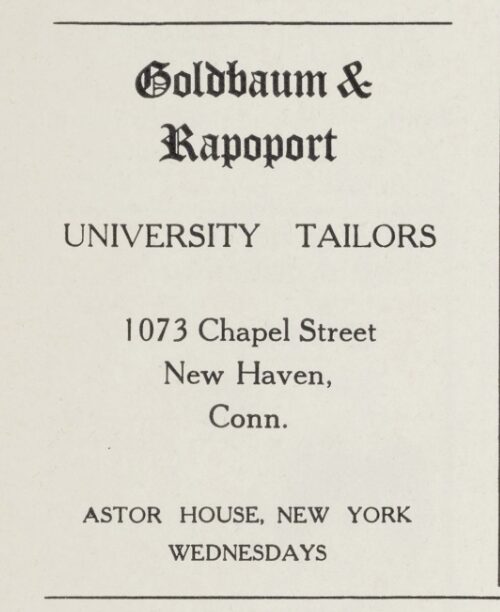
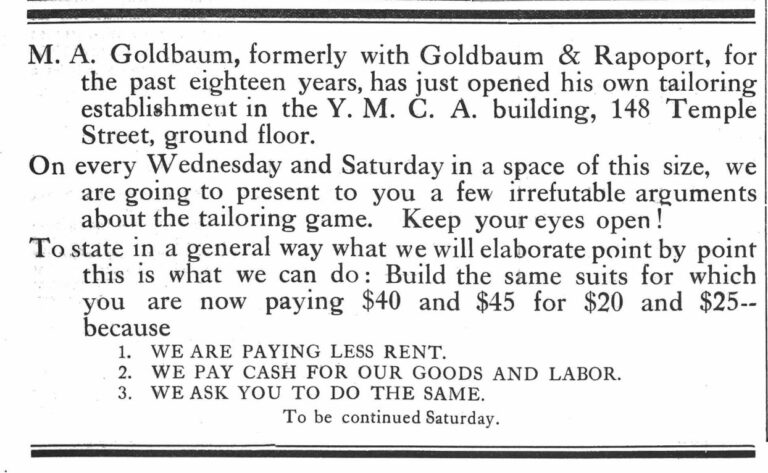
GOLDBAUM & RAPOPORT
I had hoped to research their history as well, but so little material has come to light that I think I will leave the subject aside for the time being. It appears that they, too, went their separate ways after Mr. Goldbaum’s death. I sincerely believe that Mr. Goldbaum was a remarkable man.
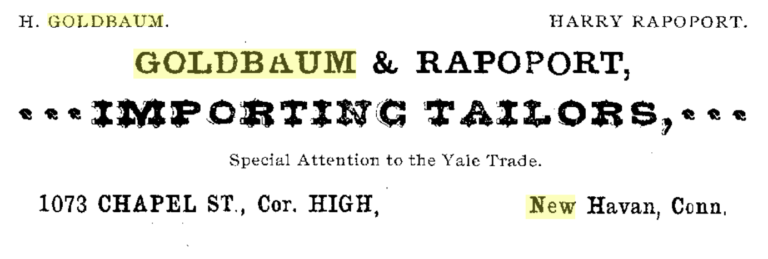
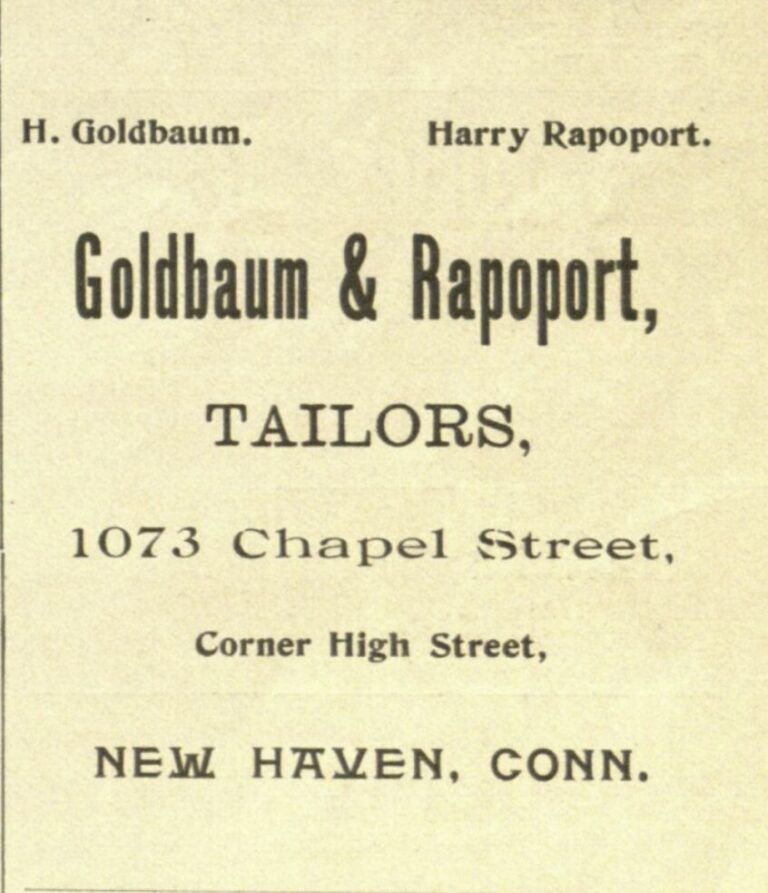
The Yale record v. 29, no. 1, 10/13/1900
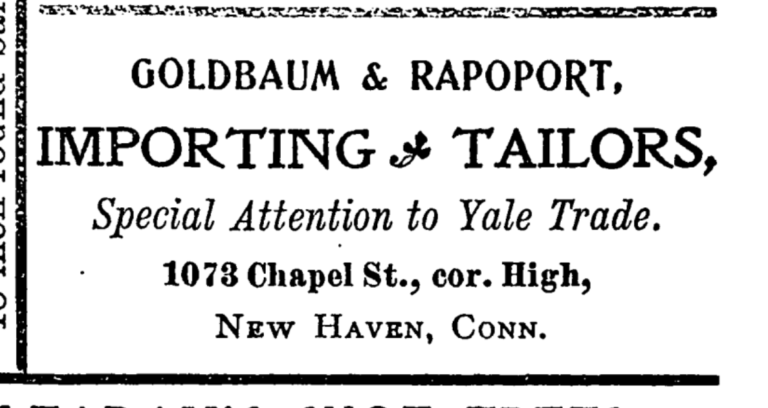
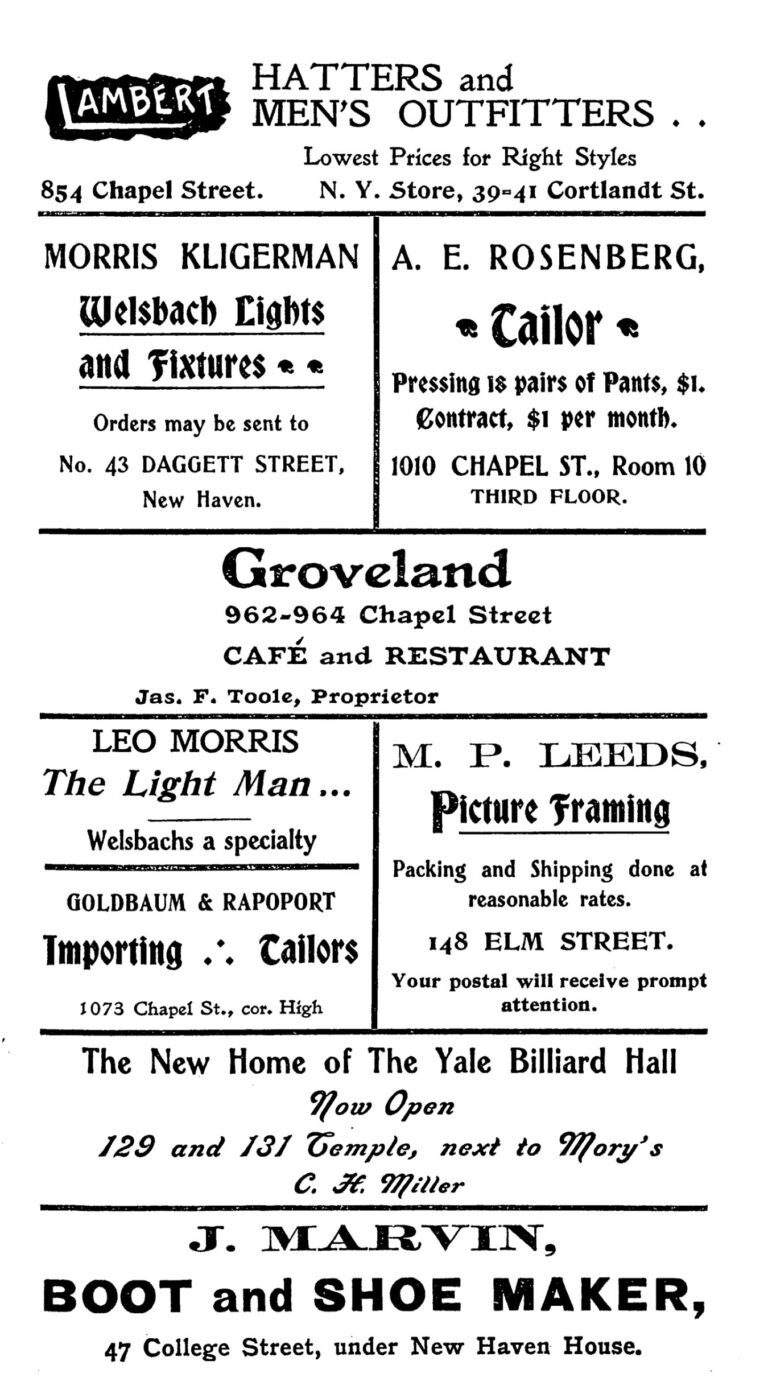
The Yale courant v.37 Nov / 2 / 1901
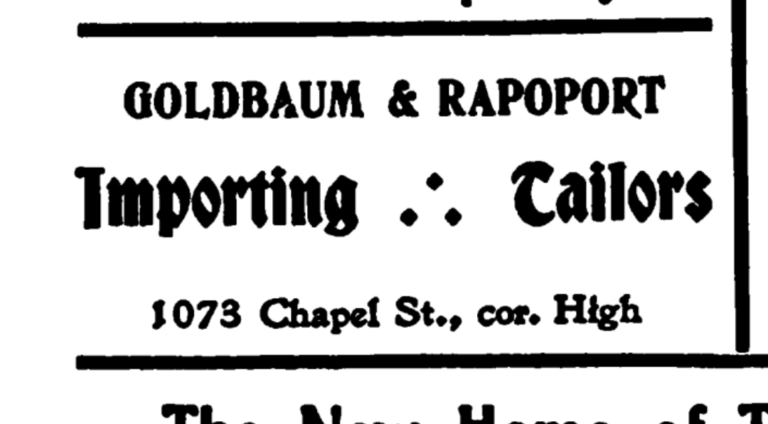
The Yale record v. 41, no. 1, 10/25/1912
The Yale record v. 29, no. 1, 10/13/1900
The Yale courant v.37 Nov / 2 / 1901
The Yale record v. 41, no. 1, 10/25/1912
The Yale record v. 42, no. 16, 5/29/1914
recommend
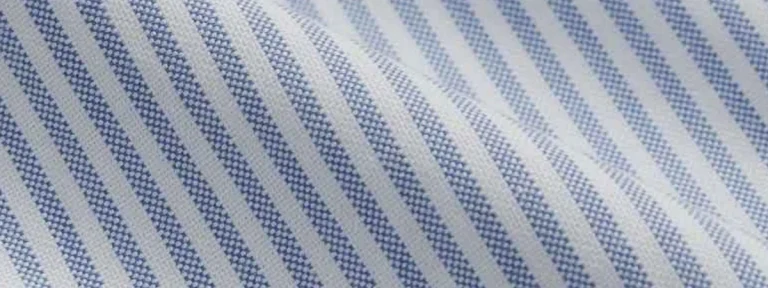
OXFORD CLOTH WAS ...
The only remaining shirting
We love Oxford cloth. Closely associated with the button-down shirt, this fabric is said to have originated in Britain in the 19th century. With more than a century of history behind it, we examine the deeper meaning behind a well-known story: that among the four so-called “university fabrics”—Oxford, Cambridge, Harvard, and Yale—Oxford is the only one that has survived to the present day.
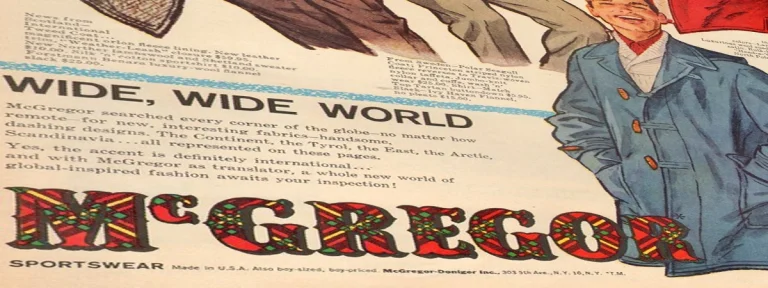
McGREGOR
An American giant, not just DRIZZLER®
We know little about the history of the brand McGregor. Evolving alongside American sportswear and linking functionality with everyday life, it mirrors twentieth-century popular culture. It may seem outdated compared to today’s sports manufacturers, yet its trajectory—shaped by material innovations and corporate transformations—offers a key to understanding the American apparel industry. Let us now explore the history of this American giant, once the world’s largest sports brand.