
OXFORD CLOTH WAS ...
The only remaining shirting
JAN – 2026 30 MINS READ
We love Oxford cloth. Closely associated with the button-down shirt, this fabric is said to have originated in Britain in the 19th century. With more than a century of history behind it, we examine the deeper meaning behind a well-known story: that among the four so-called “university fabrics”—Oxford, Cambridge, Harvard, and Yale—Oxford is the only one that has survived to the present day.
According to a friend at UNIQLO, the Oxford button-down has long remained the top-selling shirt in their lineup. It works for casual wear and business settings alike, and ultimately, people love it for its versatility and just-right degree of casualness. In Japan especially, where Ivy style is a fashion staple, it’s a fabric that simply cannot be left out. These days, we even see ‘non-iron Oxford cloth,’ which seems contradictory.
But why is it that when people say Ivy, they mean Oxford cloth? Brands like Brooks Brothers and J.Press certainly played a key role. Still, why did traditional American brands choose Oxford cloth in the first place, and why is it the only one that survived? I have long heard—from mentors and magazines alike—that it was born in Scotland, that David & John Anderson (DJA) created four university-named fabrics, and that only one survived. Old fashion magazines certainly repeat this story. When something is told like a legend, I cannot help but feel that the history of the winners is often hidden within it, and this time, I decided to investigate it properly.
OXFORD CLOTH
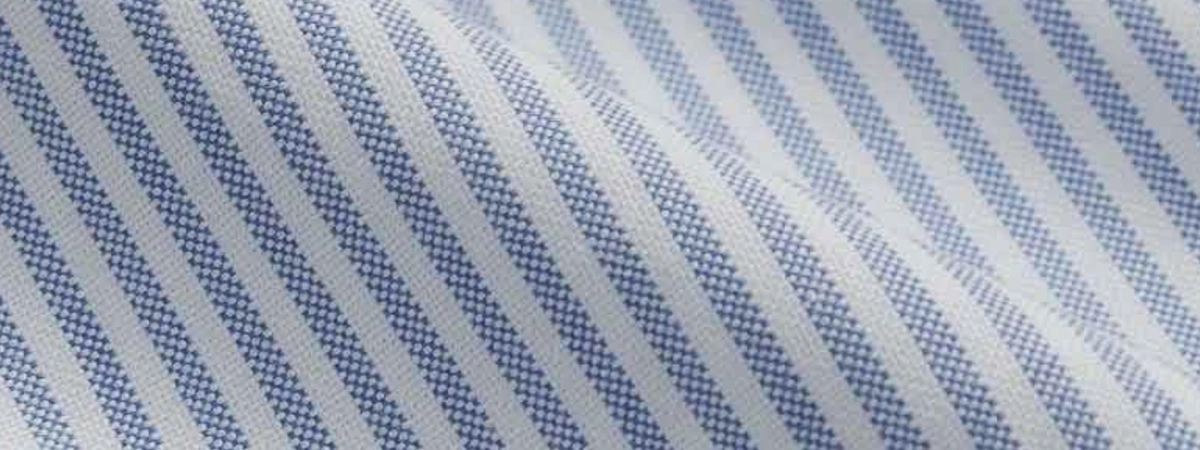
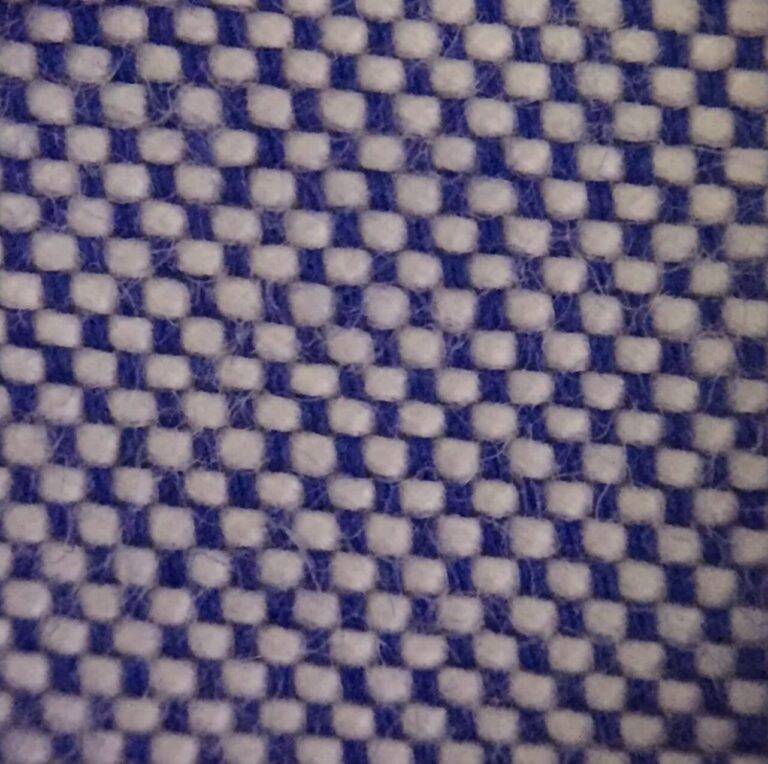
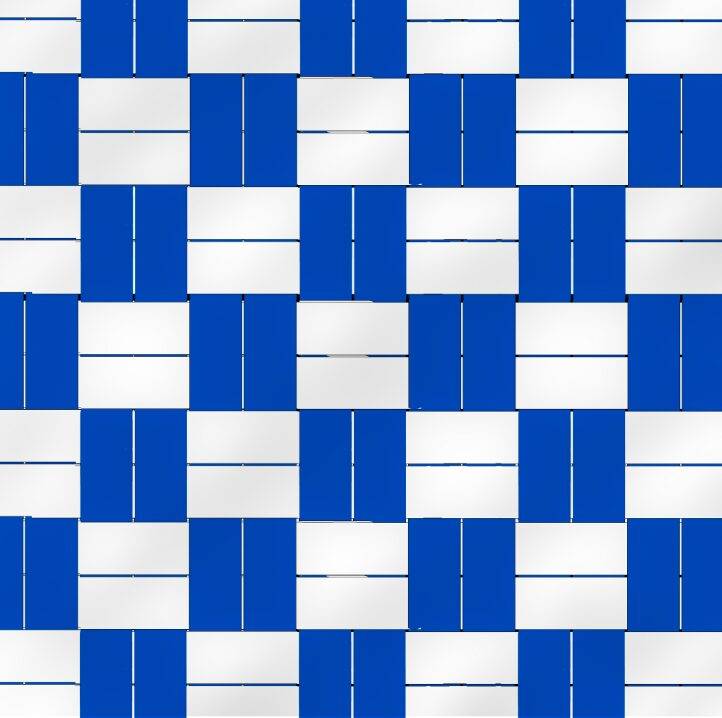
Oxford cloth is a woven fabric primarily used for shirting, characterized by a basket-weave (panama) structure that combines coarse yarns with finer yarns to create a surface texture and durability not found in plain weave. In general, either the warp or the weft employs a heavier yarn, while the opposing direction uses two finer yarns woven together. This construction produces the distinctive, slightly mottled visual effect in which lighter threads appear to speckle the surface.
Traditionally, the material is made from 100% cotton, valued for its breathability and moisture absorbency, which allow it to balance everyday comfort with practical durability. It tends to retain its shape well after washing and maintains a moderate firmness, making it well suited to ironing and to preserving a natural, structured appearance.
In the late 19th century, within the British and export-oriented shirting market, the name “Oxford” circulated as one of a group of fabric designations derived from university names. By the early twentieth century, it became firmly established in the American market as the standard material for button-down shirts. Owing to its versatility, bridging casual and semi-formal dress, it has since remained a representative and enduring shirting fabric. Beyond apparel, from the latter half of the twentieth century onward, synthetic-fiber Oxford weaves have also been adopted in industrial and utility applications, including bags, tents, and protective covers that require a balance of durability and lightness. In this way, Oxford has come to denote not only a classic shirting cloth but also a broader category of woven materials defined by their structural and functional qualities.
OXFORD CLOTH
PINPOINT OXFORD
Pinpoint Oxford is a fabric woven with finer yarns and a higher weave density than standard Oxford cloth. As a result, its surface is smoother and more uniform, and it tends to be lighter in weight and thinner in feel. In both appearance and wear, it conveys a slightly more dress-oriented impression than classic Oxford.
ROYAL OXFORD
Royal Oxford is an Oxford-derived fabric woven with a more complex, decorative structure, giving the surface a subtle luster and a notably smooth hand. Because the weave pattern is visually apparent, its appearance is often compared to that of a dobby fabric, and it is generally positioned as a more refined and luxurious shirting material than standard Oxford.
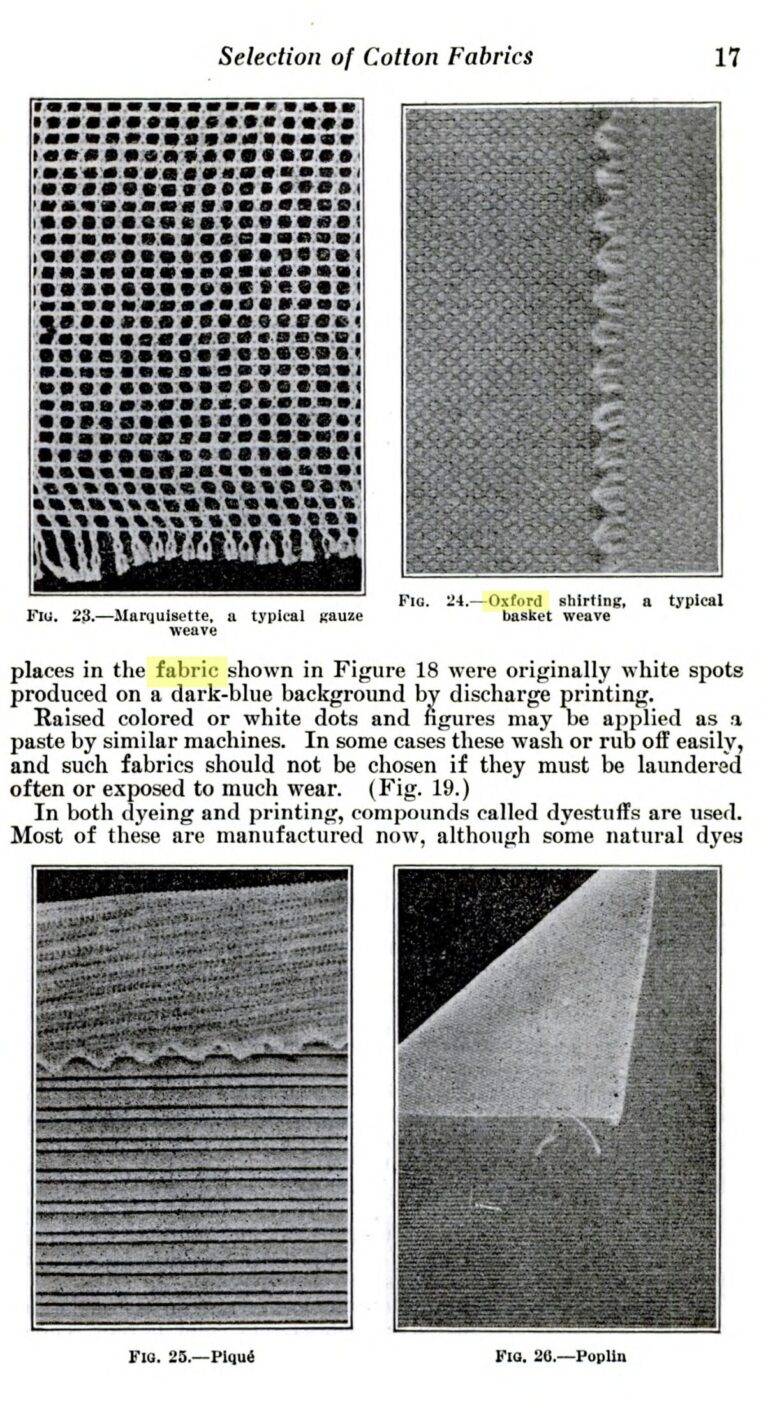
Farmers’ bulletin no.1449: rev.(1931)
1923
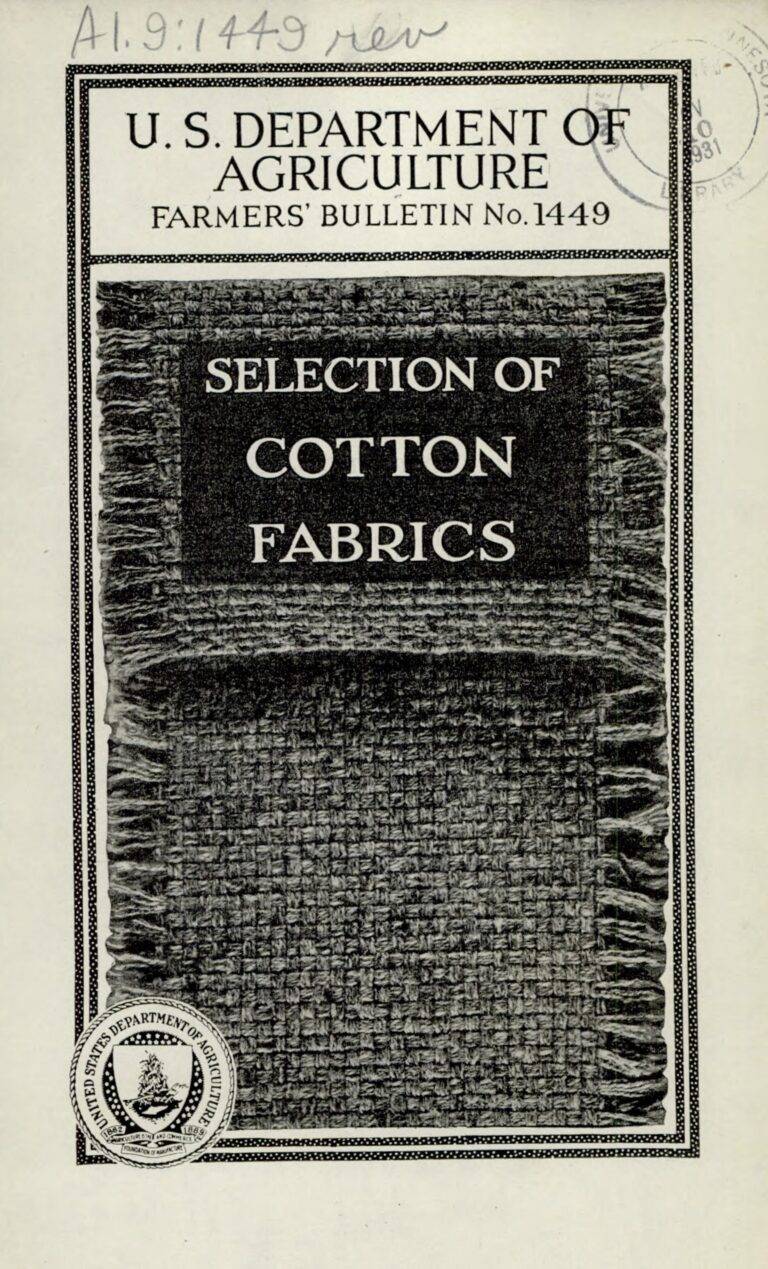
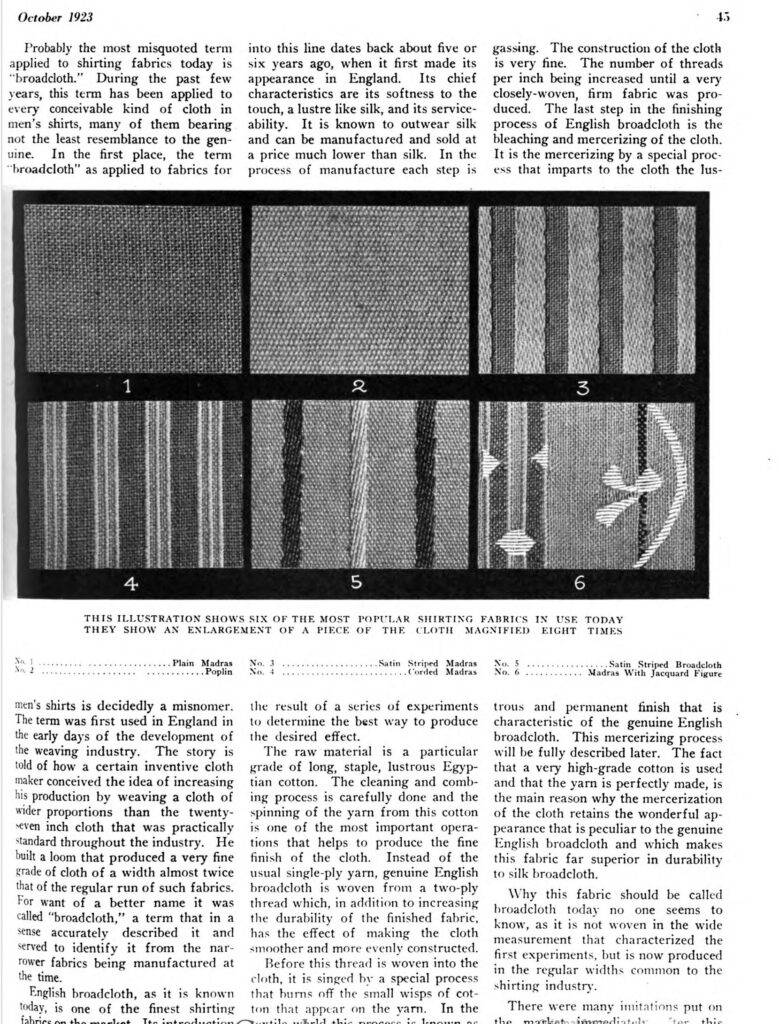
I found an article from 1923. It reads as follows:
“Today we have broadcloths, Oxford cloths, Cambridge cloths, poplins, and a host of other non-descriptive trade names that mean absolutely nothing as far as the manufacture of the cloth is concerned, but are simply misnomers applied to ordinary madras constructions for which no other name could be found.”
“The origin of ‘Oxford’ cloth is not hard to trace. Several years ago a shirt manufacturer in England who desired to secure the patronage of the students in the famous British university, brought out a fabric that was characterized by its rough texture and by the similarity of the construction to what is known as basket-weave. This cloth was given the trade name ‘Oxford,’ and immediately found great favor among the students…”
“The same story is told of the origin of Cambridge cloth, which was made by another manufacturer to cater to the wants of the students at that university.”
MADE FOR STUDENTS
The origin of “Oxford” cloth is not hard to trace. Several years ago a shirt manufacturer in England who desired to secure the patronage of the students in the famous British university, brought out a fabric that was characterized by its rough texture and by the similarity of the construction to what is known as basket-weave. This cloth was given to the trade name “Oxford” and immediately found great favor among the students. It was originally made up in a greyish colored fabric and the shirts were made with a soft attached collar. The fabric, being rather coarse and strong, was very suitable for this particular trade as the students were known to be “hard on their clothes.” The same story is told of the origin of Cambridge cloth, which was made by another manufacturer to cater to the wants of the students at that university. The basic construction of all these cloths was practically the same as the first madras cloths. Various experiments were tried by many manufacturers. The number of threads per inch in the warp and in the filling was varied but all the time the technical construction of the cloth was not unlike the construction of the first fabrics that came from the city of Madras.
If one reads this article closely, it almost suggests that both “Oxford” and “Cambridge” are nothing more than trade names with no real technical meaning—that in the end, everything is simply being called “madras.” This raises the question of how deeply the author actually understood fabric structures.
And yet, the same piece goes on to state quite clearly that Oxford cloth originated with a shirt manufacturer in England, and that Cambridge cloth, likewise, was created specifically for the students of the University of Cambridge.
So, is that really true?
If the author’s account is accurate, then it would undermine a commonly repeated narrative:
“It all began when 19th-century Scottish spinning and weaving firms (often said to include David & John Anderson) sought to differentiate their products by marketing fabrics named after four elite universities: Oxford, Cambridge, Harvard, and Yale.”
If so, that familiar story would have to be reconsidered.
So what, in fact, is the truth?
1922
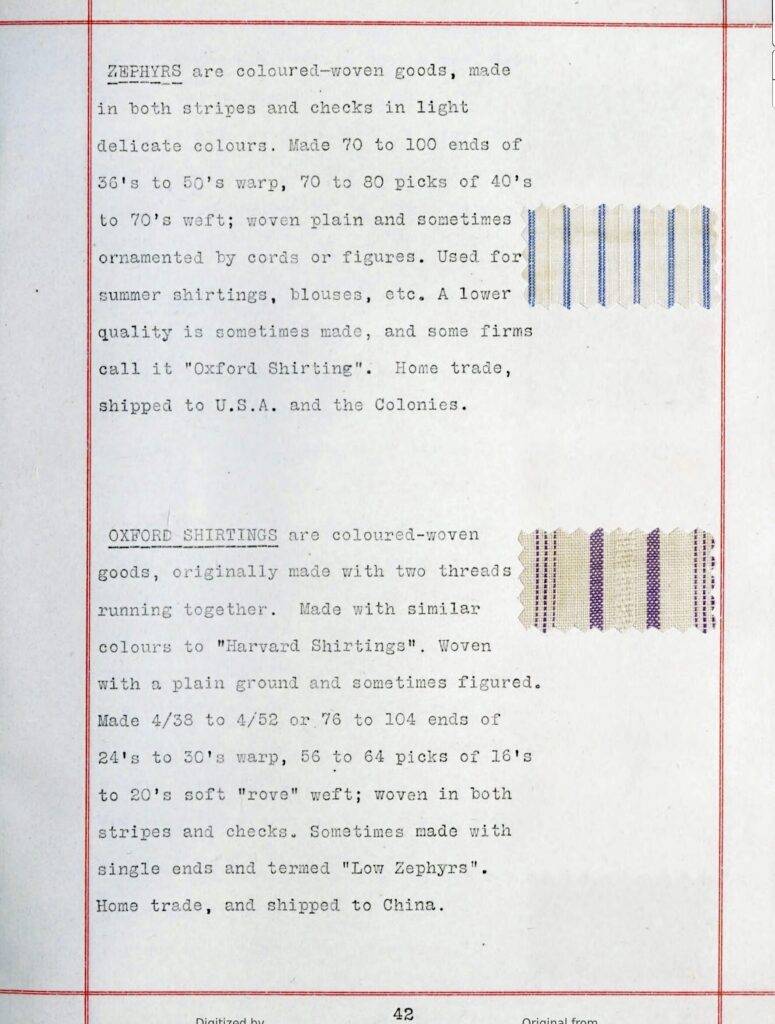
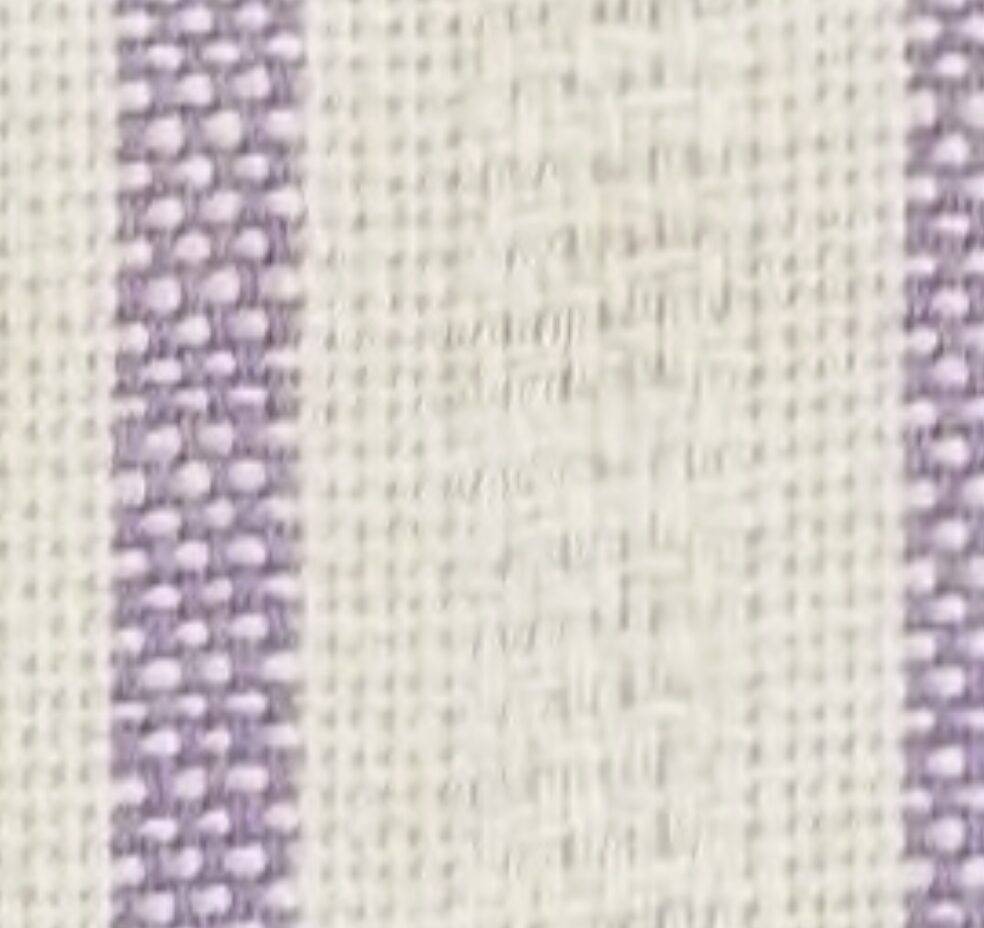
・Warp: 24’s to 30’s.
・Weft: 16’s to 20’s soft “rove” weft.
It appears to be a 2×2 plain weave when magnified.
1910s
Advertisements in the Lindsay Post published in Lindsay, Ontario, in May 1917 and July 1918 state that “Oxford shirting” was sold not as ready-made shirts but as shirting fabric, offered “per yard.”
The May 1917 advertisement describes the product as “Imported Oxford Shirting,” explicitly indicating that it was an imported fabric, specifies a width of 27 inches, characterizes it as good heavy quality in grey shades for practical use, and lists the price at 15 cents per yard.
The July 1918 advertisement notes that “Oxford shirting” in medium and dark colorings, in check patterns, was offered at 25 cents per yard.
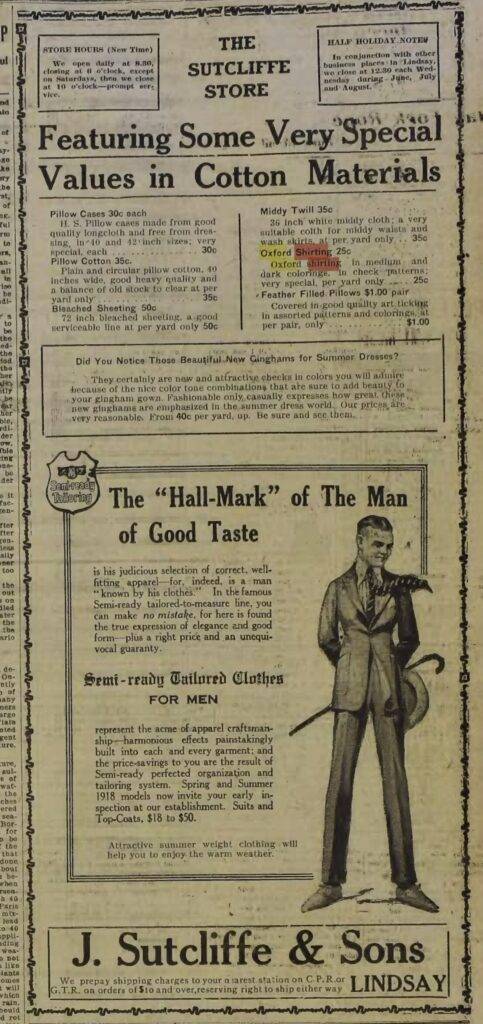
1918 Lindsay ONT Lindsay Post June 1918_17.pdf
Oxford Shirting 25c
Oxford shirting in medium and dark colorings, in check patterns; very special, per yard only, 25c
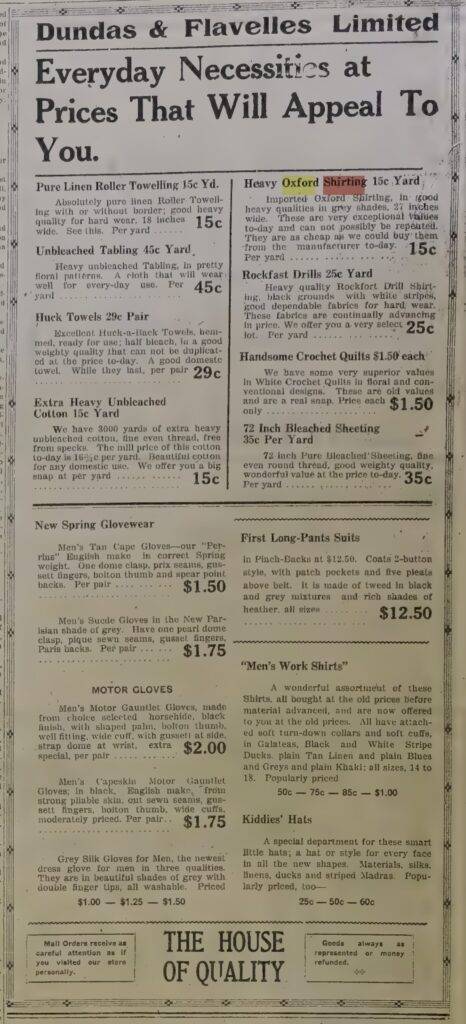
Heavy Oxford Shirting 15c Yard
Imported Oxford Shirting, in good heavy qualities in grey shades, 27 inches wide. These are very exceptional values to-day and can not possibly be repeated. They are as cheap as we could buy them from the manufacturer to-day. Per yard ………. 15c
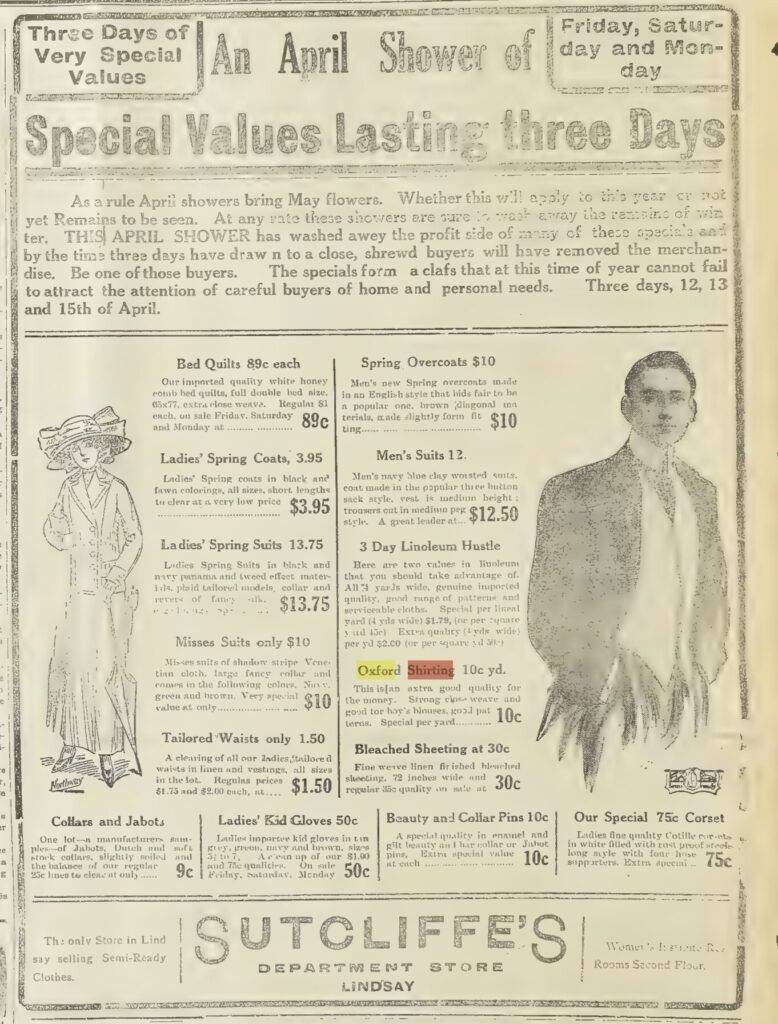
Oxford Shirting 10c yd.
This is an extra good quality for the money. Strong cloth, weave and good for boys’ blouses, good pants. Special per yard…… 10c
1914
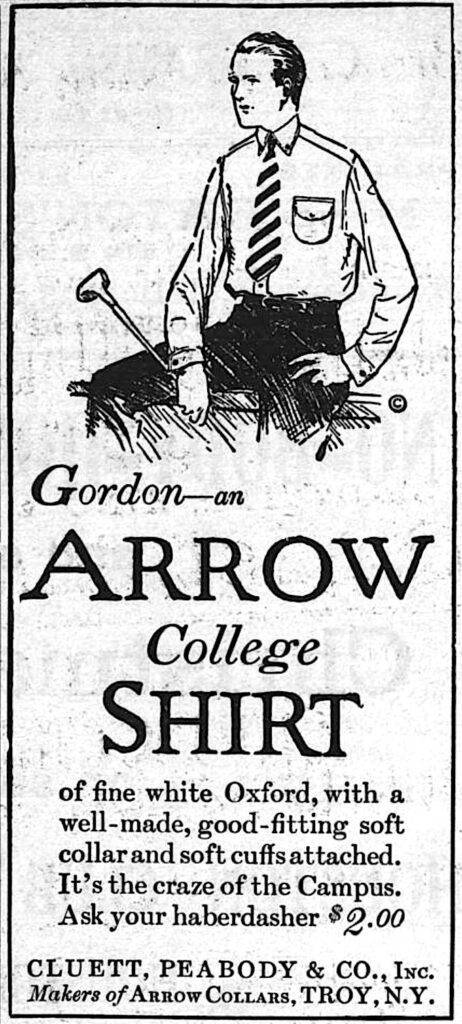
The Spread of Oxford Cloth and Button-Down Shirts in the United States
As of my current view in 2026, I believe that the original “Ivy student button-down Oxford shirt” in the United States was the GORDON model by ARROW. I understand Brooks Brothers’ claim regarding the button-down, but there are several points that remain difficult to establish with certainty: their early button-down shirts themselves are hard to locate (even though it is clear they were making shirts), and in Britain the button-down collar had already become widespread, possibly produced by makers such as Turnbull & Asser or E. Tautz. Much of what is said about these origins still rests on oral tradition rather than firmly documented evidence.
What can be stated with confidence is that by 1914, a button-down shirt made in Oxford cloth was being sold in the United States. For now, I prefer to treat this as the practical starting point for my thinking on the subject.
MORE STORY OF ARROW
Because it is a great brand, please forgive the heavy website.
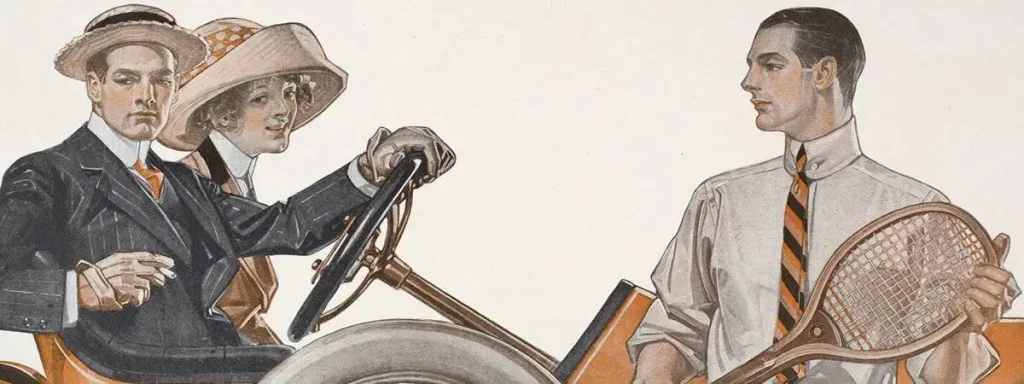
Arrow
Iconic American Shirt
1900s
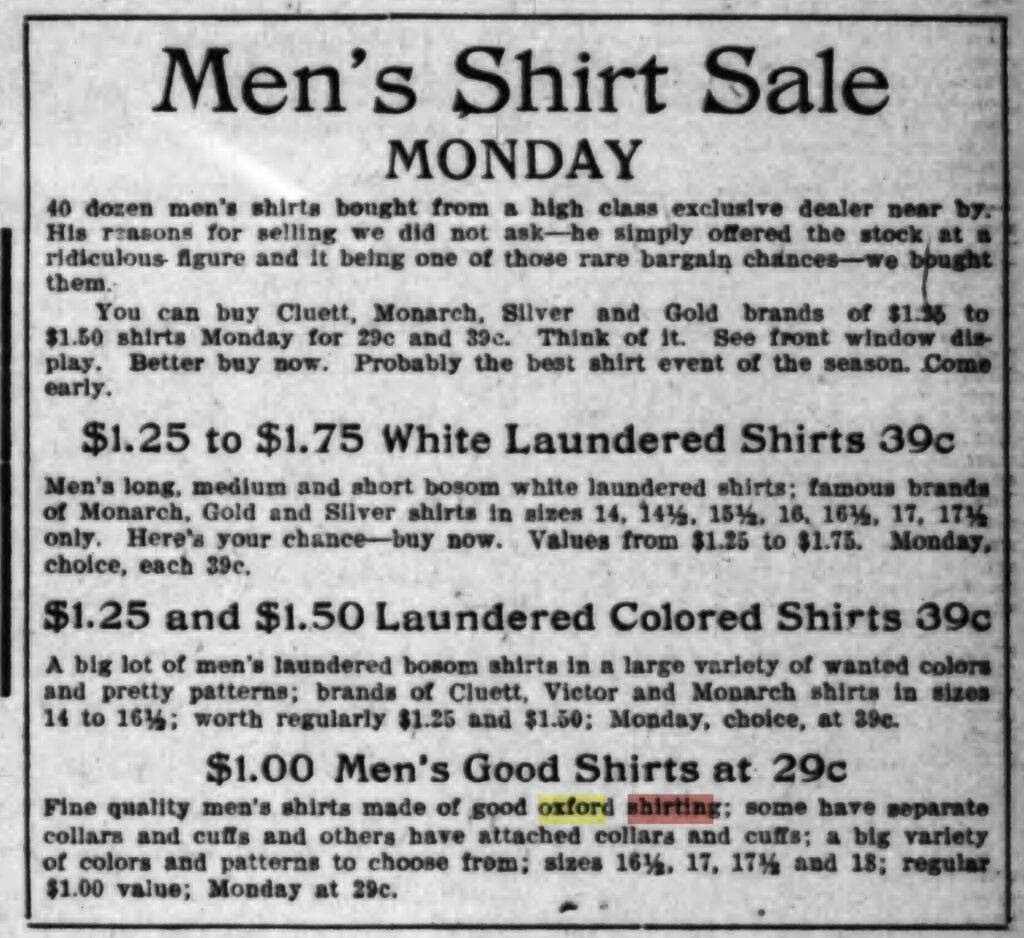
1906 Los Angeles CA Times 1906-08-26_19.pdf
$1.00 Men’s Good Shirts at 29c
Fine quality men’s shirts made of good oxford shirting; some have separate collars and cuffs and others have attached collars and cuffs; a big variety of colors and patterns to choose from; sizes 16½, 17, 17½ and 18; regular $1.00 value; Monday at 29c.
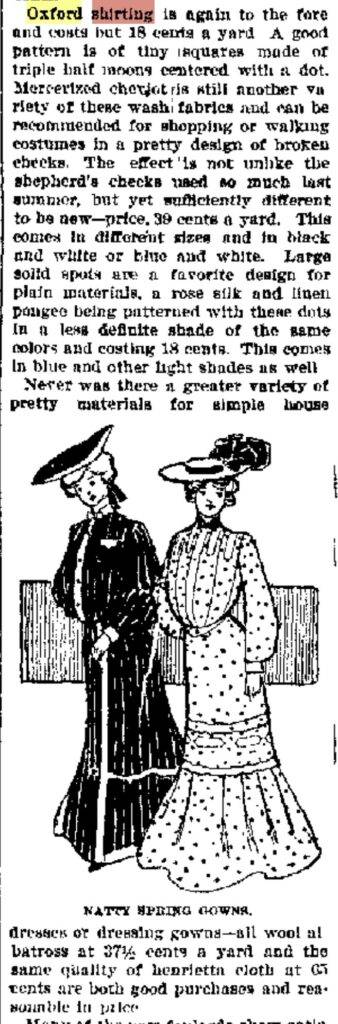
1903 Portsmouth NH Herald 1903-02-25_1.pdf
Oxford shirting is again to the fore and costs but 18 cents a yard.
A good pattern is of tiny squares made of triple half moons centered with a dot. Mercelized cheviot is still another variety of these wash fabrics and can be recommended for shopping or walking costumes in a pretty design of broken checks. The effect is not unlike the shepherd’s checks used so much last summer, but yet sufficiently different to be new—price, 39 cents a yard. This comes in different sizes and in black and white or blue and white. Large solid spots are a favorite design for plain materials, a rose silk and linen pongee being patterned with these dots in a less definite shade of the same colors and costing 18 cents. This comes in blue and other light shades as well.
1890s
1903 Portsmouth NH Herald 1903-02-25_1.pdf
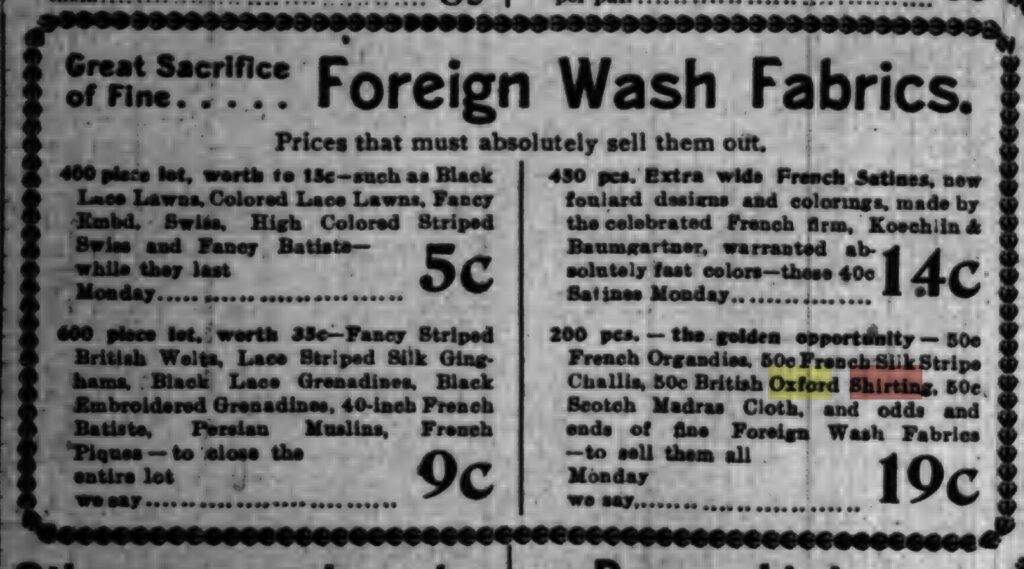
200 pcs. — the golden opportunity — 50c French Organdies, 50c French Silk Stripe Challis, 50c British Oxford Shirtings, 50c Scotch Madras Cloth, and odds and ends of fine Foreign Wash Fabrics — to sell them all Monday we say …… 19c
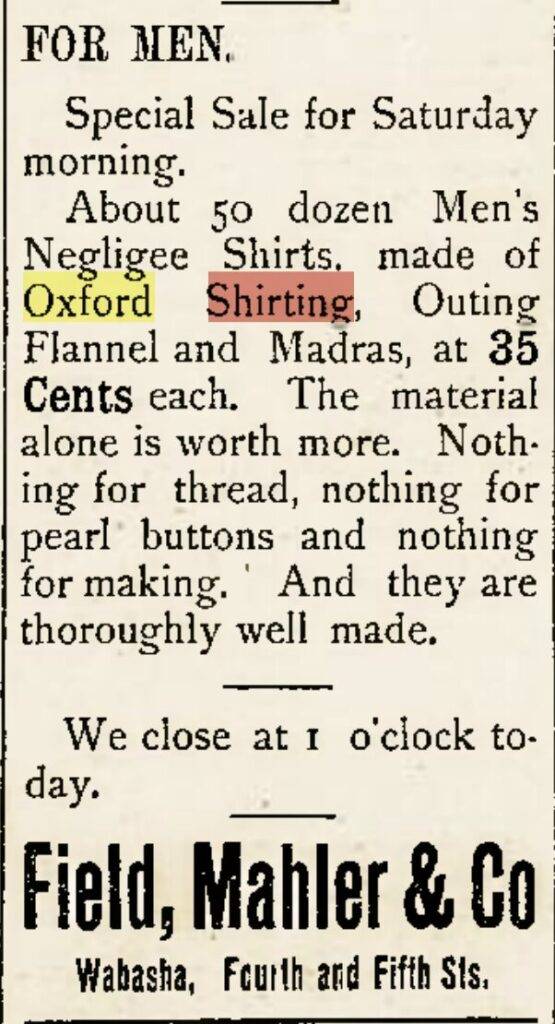
FOR MEN.
Special Sale for Saturday morning.
About 50 dozen Men’s Negligee Shirts, made of Oxford Shirting, Outing Flannel and Madras, at 35 Cents each. The material alone is worth more. Nothing for thread, nothing for pearl buttons and nothing for making. And they are thoroughly well made.
We close at 1 o’clock to-day.
Field, Mahler & Co.
Wabasha, Fourth and Fifth Sts.
1890
1890 COTTON GOODS GUIDE
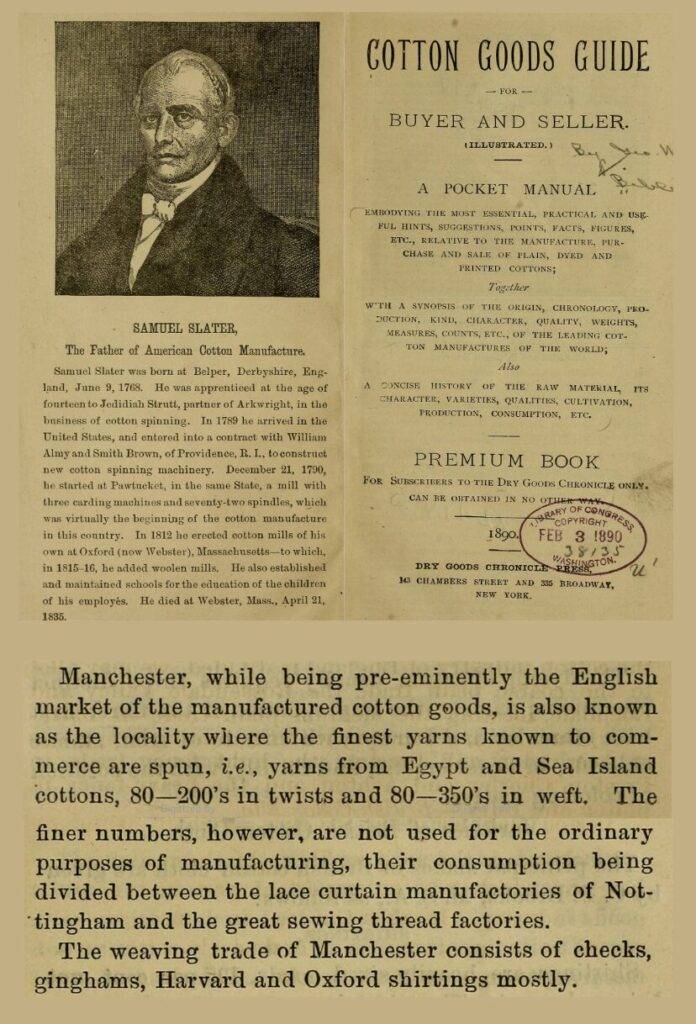
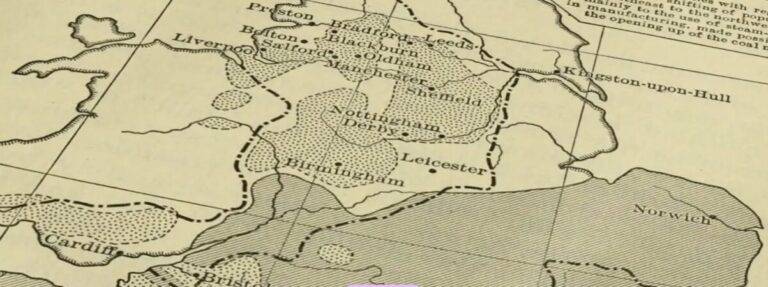
Manchester, while being pre-eminently the English market of the manufactured cotton goods, is also known as the locality where the finest yarns known to commerce are spun, i.e., yarns from Egypt and Sea Island cottons, 80—200’s in twists and 80—350’s in weft.The finer numbers, however, are not used for the ordinary purposes of manufacturing, their consumption being divided between the lace curtain manufactories of Nottingham and the great sewing thread factories. The weaving trade of Manchester consists of checks, ginghams, Harvard and Oxford shirtings mostly.
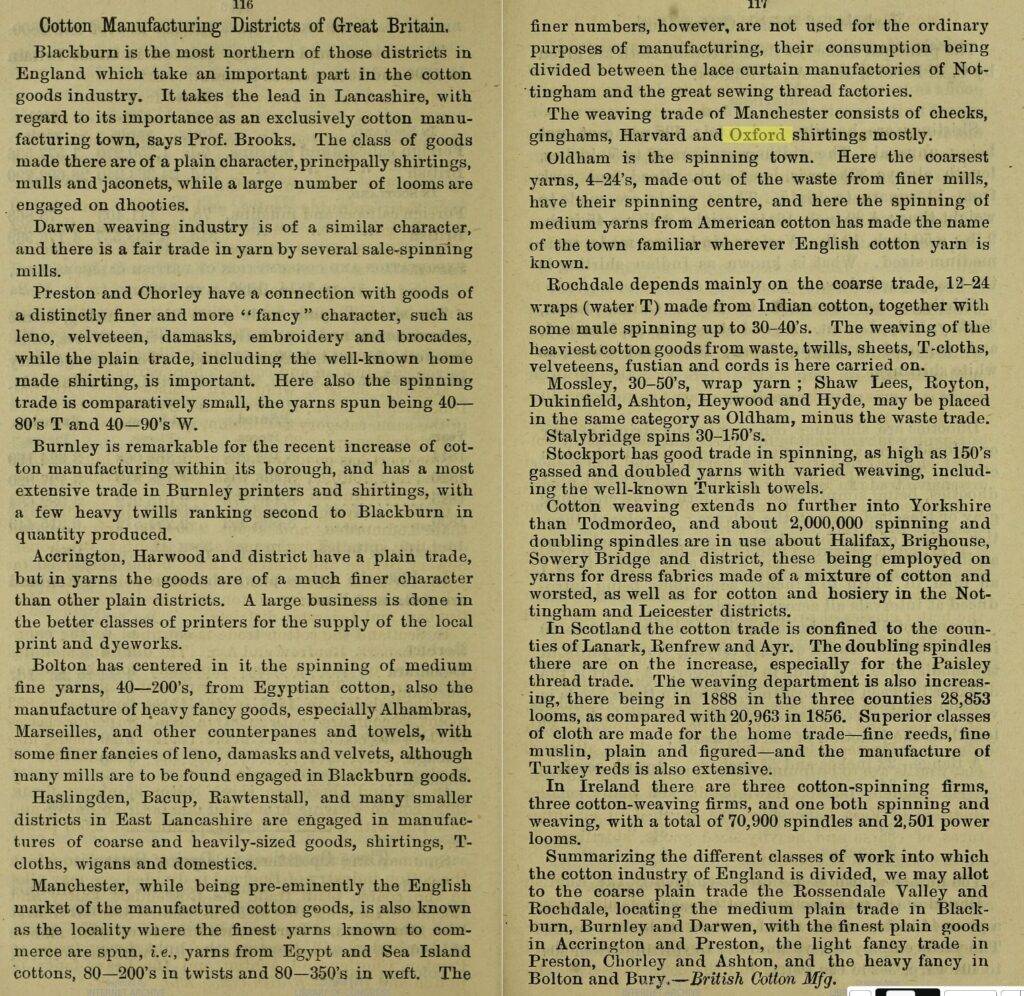
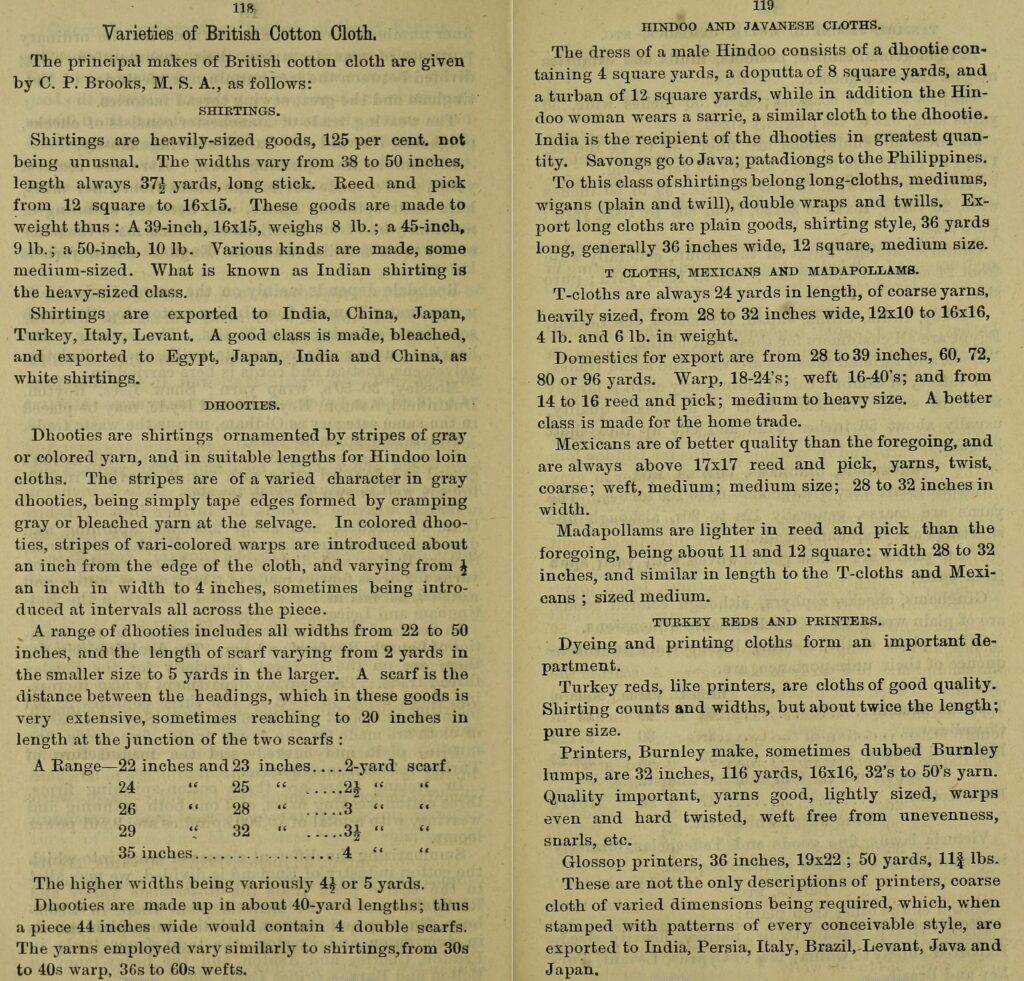
1890 COTTON GOODS GUIDE
1890
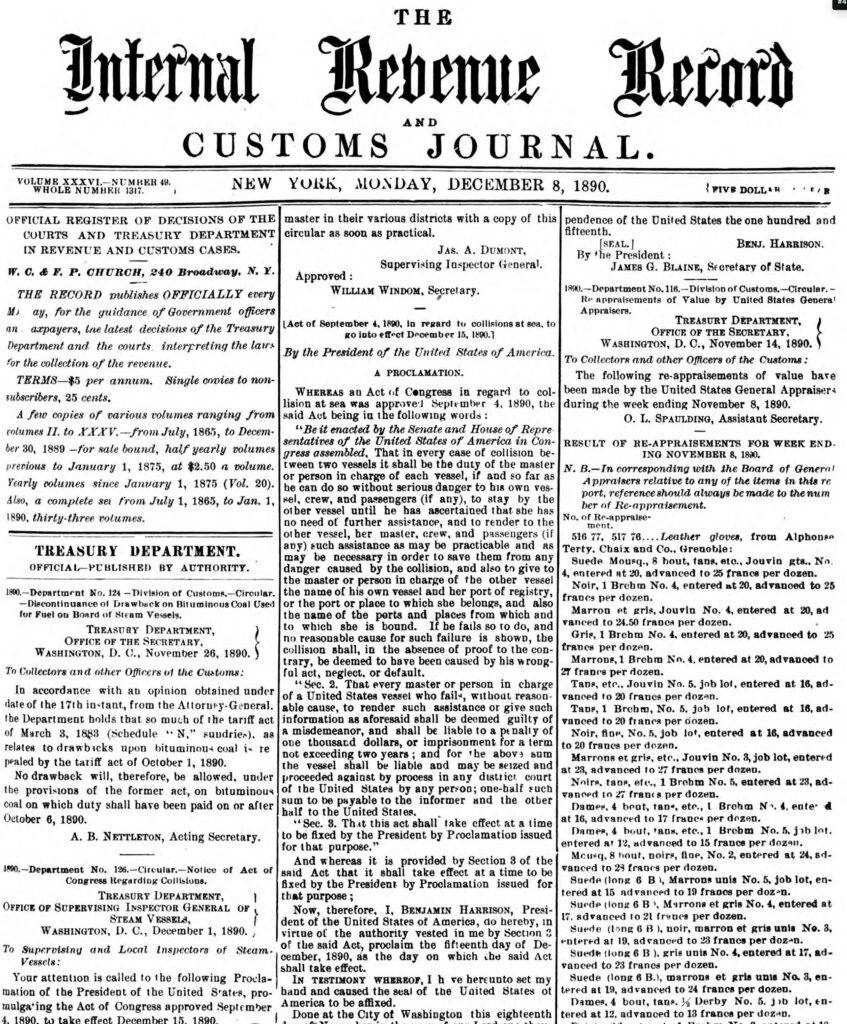
1890 The Internal Revenue Record and Customs Journal
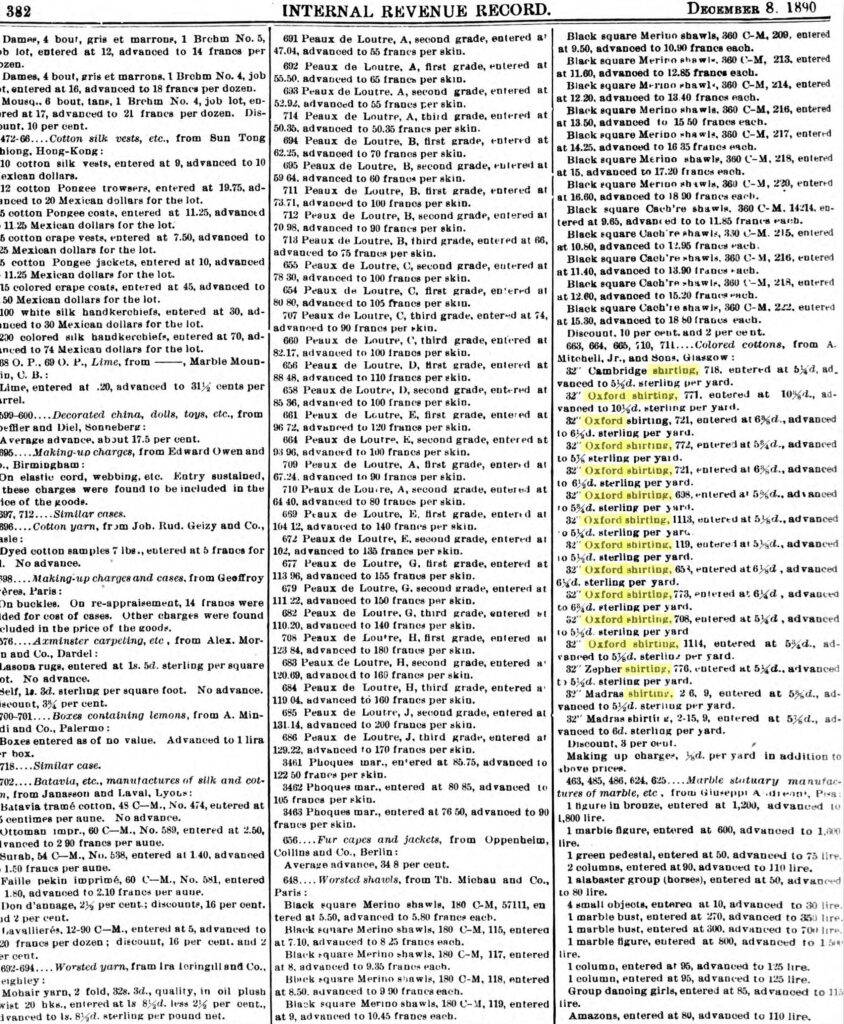
Mitchell, Jr., and Sons, Glasgow
32″ Cambridge shirting, 718, entered at 5¼ d., advanced to 5½ d. sterling per yard.
32″ Oxford shirting, 771, entered at 10½ d., advanced to 10¾ d. sterling per yard.
32″ Oxford shirting, 772, entered at 5⅜ d., advanced to 5½ d. sterling per yard.
32″ Oxford shirting, 721, entered at 6⅜ d., advanced to 6½ d. sterling per yard.
32″ Oxford shirting, 698, entered at 5¾ d., advanced to 6 d. sterling per yard.
32″ Oxford shirting, 1113, entered at 5¾ d., advanced to 6 d. sterling per yard.
32″ Oxford shirting, 119, entered at 5¾ d., advanced to 6 d. sterling per yard.
32″ Oxford shirting, 653, entered at 6¼ d., advanced to 6½ d. sterling per yard.
32″ Oxford shirting, 773, entered at 6¼ d., advanced to 6½ d. sterling per yard.
32″ Oxford shirting, 708, entered at 5¾ d., advanced to 6 d. sterling per yard.
32″ Oxford shirting, 114, entered at 5¾ d., advanced to 6 d. sterling per yard.
In the U.S. Customs Gazette dated December 8, 1890, “32-inch Oxford shirting” and “32-inch Cambridge shirting” are listed as formal product classifications, with both the declared price and the reappraised price recorded per yard (approximately 91.4 cm). This constitutes a primary source demonstrating that, by the late nineteenth century, shirtings identified as Oxford and Cambridge were not merely brand or promotional names, but recognized as standardized commodity categories within the framework of international trade and customs regulation, and were circulating in the American market.
It is also noteworthy that the importer is listed as Mitchell, Jr., and Sons, “Glasgow.”
1884 / 1888
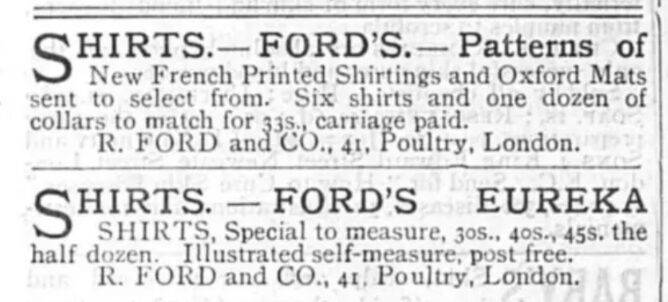
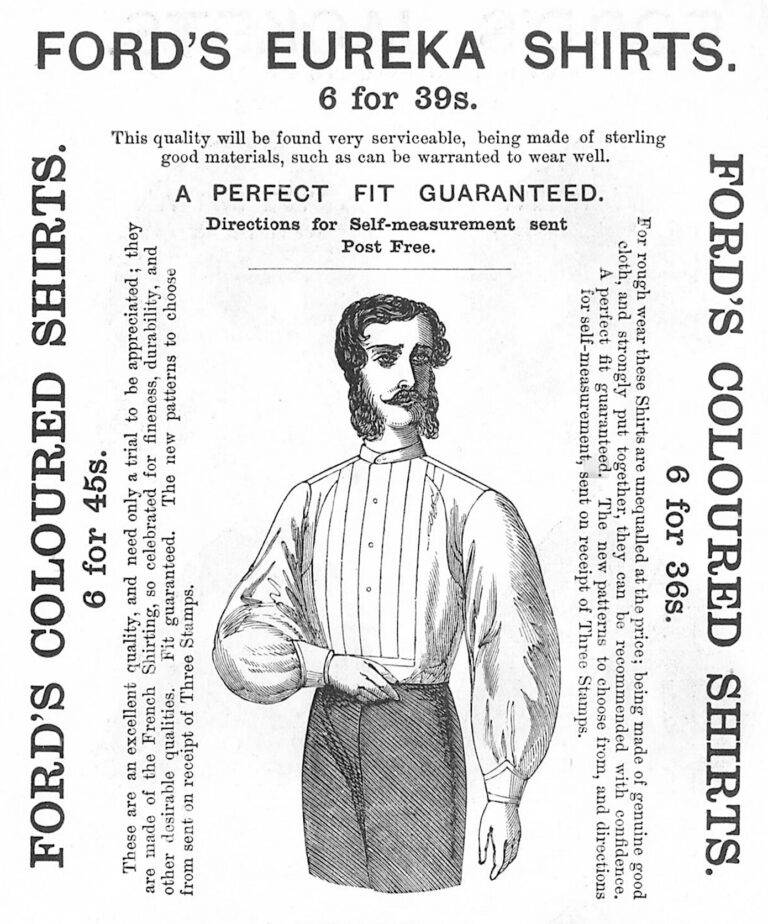
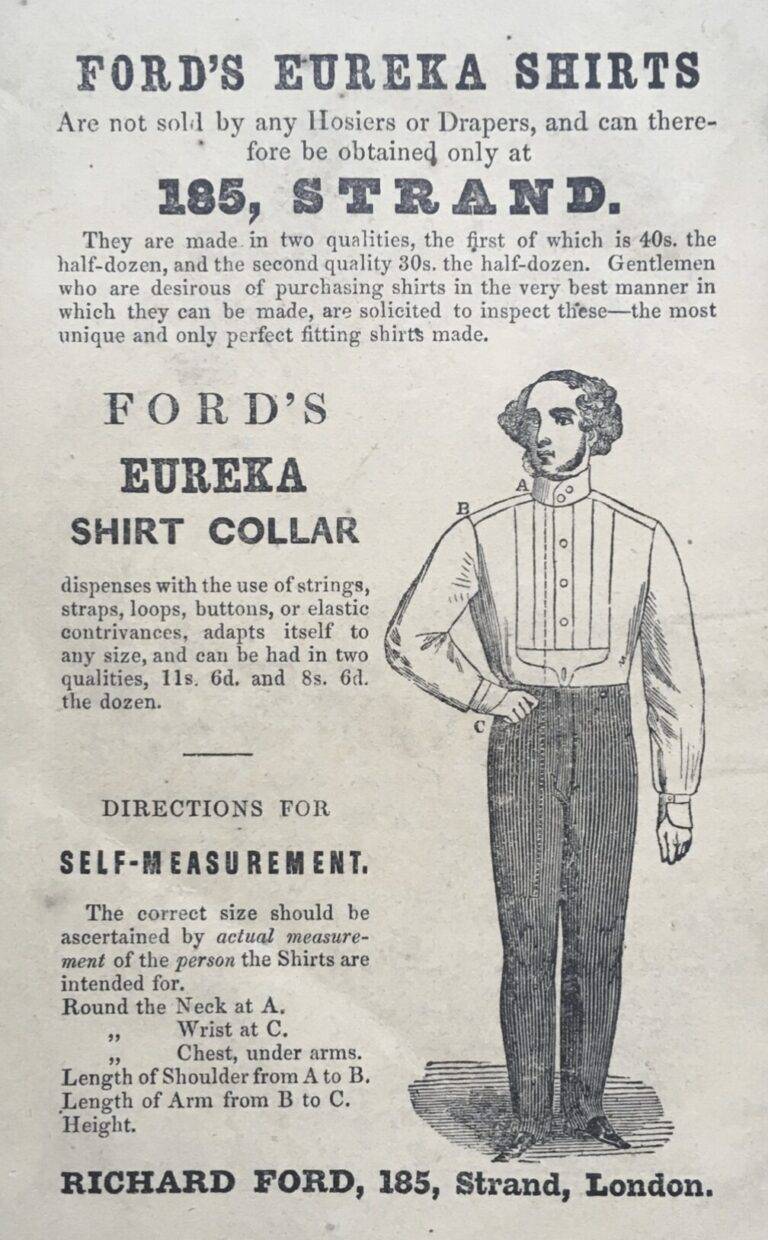
SHIRTS.—FORD’S.—Patterns of New French Printed Shirtings and Oxford Mats sent to select from. Six shirts and one dozen of collars to match for 33s., carriage paid. R. FORD and CO., 41, Poultry, London.
SHIRTS. — FORD’S EUREKA SHIRTS, Special to measure, 30s., 40s., 45s. the half dozen. Illustrated self-measure, post free. R. FORD and CO., 41, Poultry, London.
Published: Wednesday 02 July 1884
Newspaper: Sporting Life (London, England)
Advertiser: Richard Ford and Co., 41, Poultry, London.
FORD’S EUREKA SHIRTS. ‘The most perfect fitting made.’—Observer. Gentlemen are solicited to inspect the improvements made in the manufacture of FORD’S IMPROVED EUREKA SHIRTS. The new patterns of French-printed Cambridge Shirtings and the matted Oxfords for making FORD’S IMPROVED EUREKA SHIRTS, ready for inspection, or sent free post for two stamps. From the only makers, RICHARD FORD and CO., 41, POULTRY, LONDON.
Published: Wednesday 02 July 1884
Newspaper: Sporting Life (London, England)
Advertiser: Richard Ford and Co., 41, Poultry, London.
1883
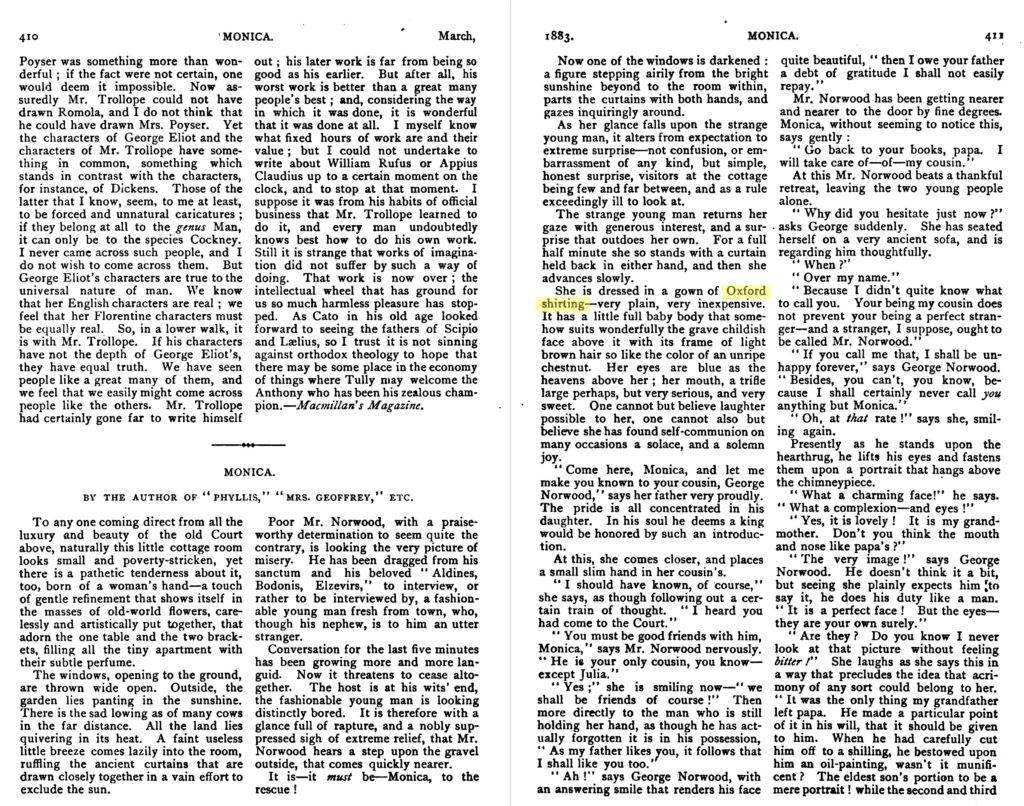
The strange young man returns her gaze with generous interest, and a surprise that outdoes her own. For a full half minute she so stands with a curtain held back in either hand, and then she advances slowly.
She is dressed in a gown of Oxford shirting—very plain, very inexpensive. It has a little full baby bodice that somehow suits wonderfully the grave childish face above it, with its frame of light brown hair so like the color of an unripe chestnut. Her eyes are blue as the heavens above her; her mouth, a trifle large perhaps, but very serious, and very sweet. One cannot but believe at first sight in her.
“Come here, Monica, and let me make you known to your cousin, George Norwood,” says her father very proudly. The pride is all concentrated in his daughter. In his soul he deems a king would be honored by such an introduction.
1882
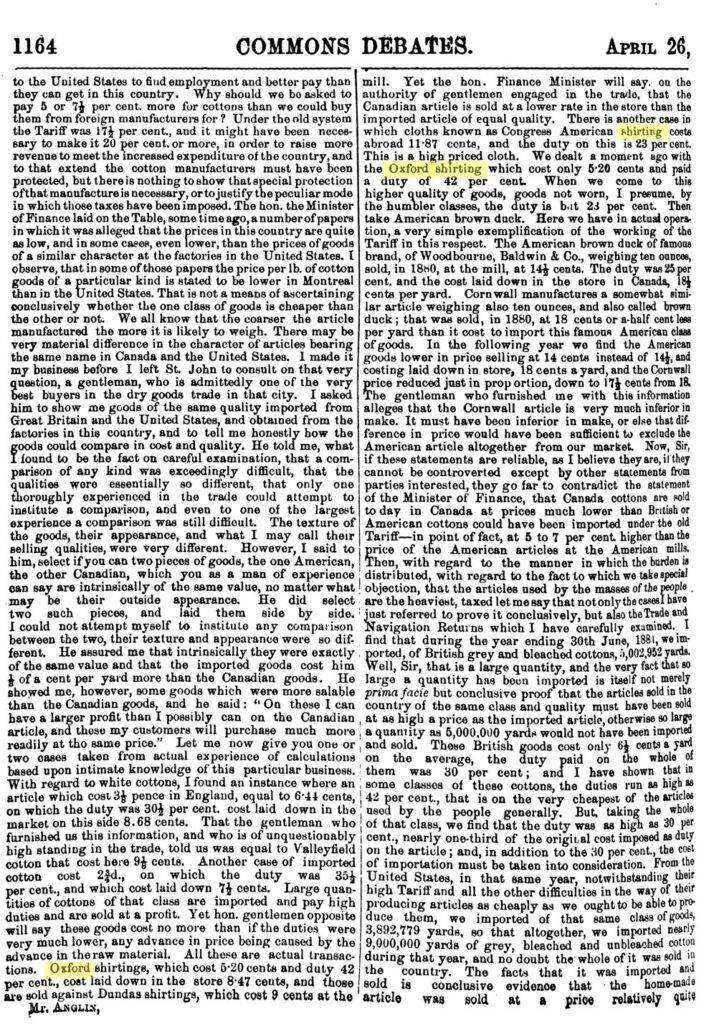
… Let me now give you one or two cases taken from actual experience of calculations based upon intimate knowledge of this particular business. With regard to white cottons, I found an instance where an article which cost 3½ pence in England, equal to 6·44 cents, on which the duty was 30½ per cent., cost laid down in the market on this side 8·68 cents. That the gentleman who furnished us this information, and who is of unquestionably high standing in the trade, told us was equal to Valleyfield cotton that cost here 9½ cents. Another case of imported cotton cost 2¾d., on which the duty was 35 per cent., and which cost laid down 7½ cents. Large quantities of cottons of that class are imported and pay high duties and are sold at a profit.
All these are actual transactions. Oxford shirtings, which cost 5·20 cents and duty 42 per cent., cost laid down in the store 8·47 cents, and those are sold against Dundas shirtings, which cost 9 cents at the mill.
Yet the hon. Finance Minister will say, on the authority of gentlemen engaged in the trade, that the Canadian article is sold at a lower rate in the store than the imported article of equal quality. There is another case in which cloths known as Congress American shirting costs abroad 11·87 cents, and the duty on this is 23 per cent. This is a high priced cloth. We dealt a moment ago with the Oxford shirting which cost only 5·20 cents and paid the duty of 42 per cent. When we come to this higher quality of goods, goods not worn, I presume, by the humbler classes, the duty is but 23 per cent.
1882
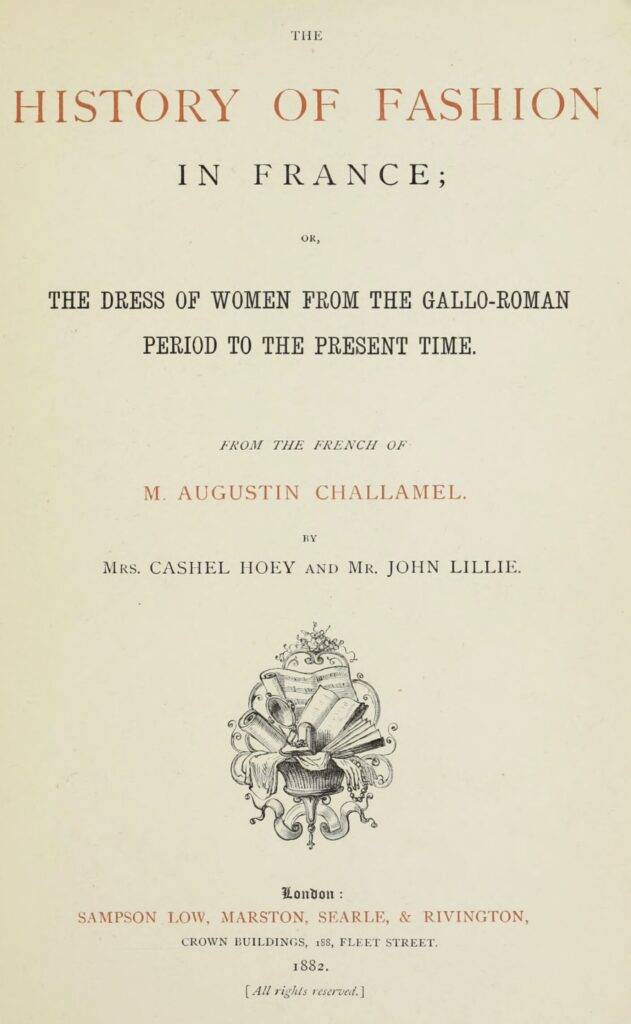
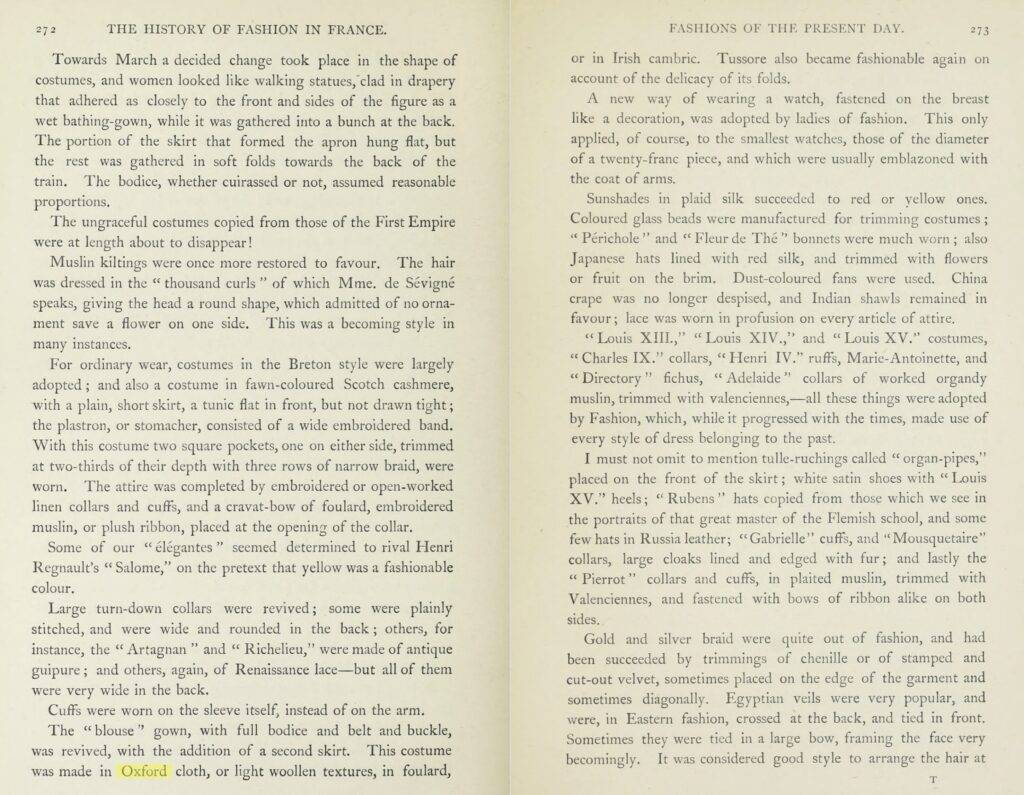
Cuffs were worn on the sleeve itself, instead of on the arm. The “blouse” gown, with full bodice and belt and buckle, was revived, with the addition of a second skirt. This costume was made in Oxford cloth, or light woollen textures, in foulard, or in Irish cambric. Tussore also became fashionable again on account of the delicacy of its folds.
1881
1881 The Girl’s own annual v.3:no.92(1881:Oct.1)-v.3:no.144(1882:Sept.30)
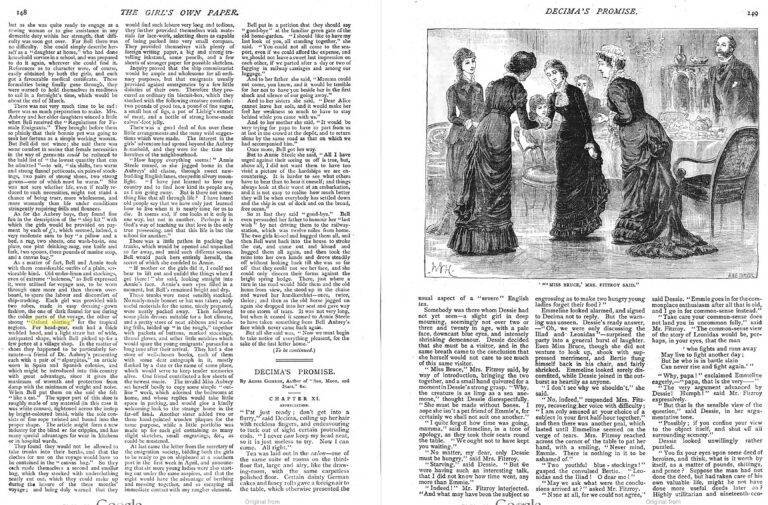
As a matter of fact, Bell and Annie took with them considerable outfits of a plain, serviceable kind. Old under-linen and stockings, even of extreme “oldness,” as Bell expressed it, were utilized for voyage use, to be worn through some more and then thrown overboard, to save the labour of ship-washing. Each girl was provided with two robes, made in easy dressing-gown fashion, the one of dark flannel for use in cold parts of the voyage, the other of strong “Oxford shirting” for the tropics, white and coloured, and a light straw hat of wide antiquated shape, which Bell picked up for a few pence at a village shop.They also took boots, each of them provided with several pairs of stout walking-shoes, and sandals for the warmer climates, and one warm jacket, with a cape to it, for cold weather.
1881
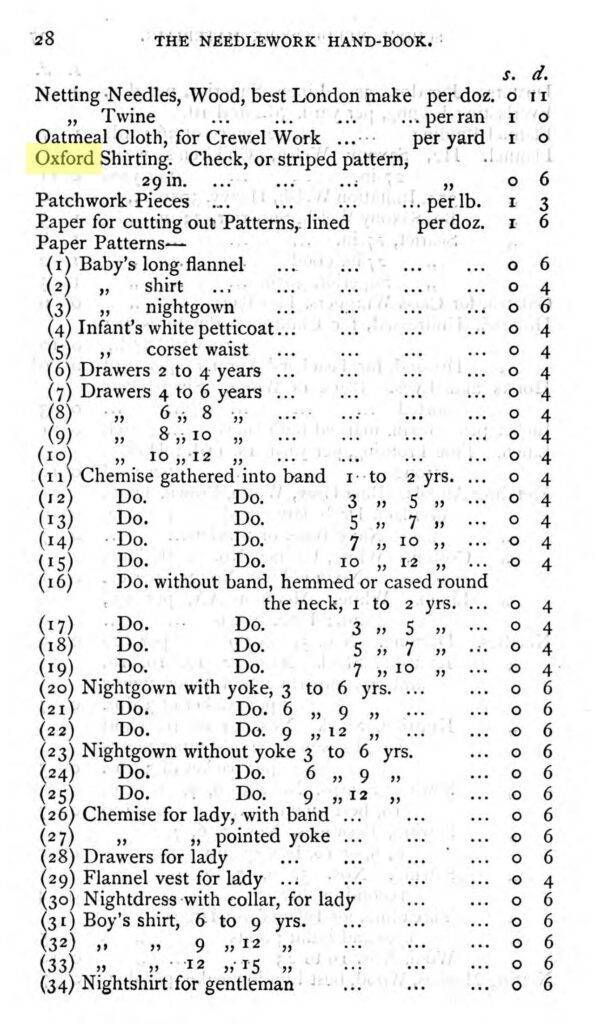
1881 The needlework hand-book
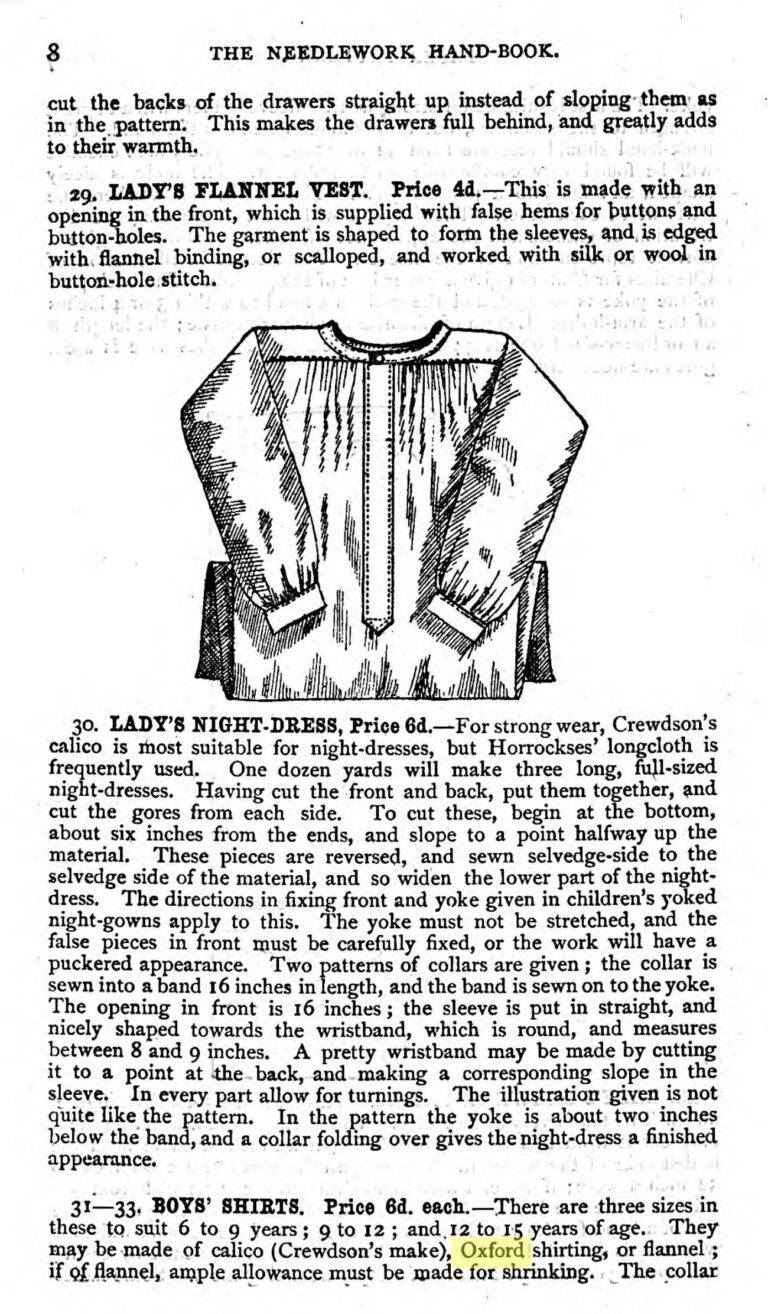
31—33. BOYS’ SHIRTS. Price 6d. each.—There are three sizes in these to suit 6 to 9 years; 9 to 12; and 12 to 15 years of age. They may be made of calico (Crewdson’s make), Oxford shirting, or flannel; if of flannel, ample allowance must be made for shrinking. The collar is shaped, and cut on the cross, and the sleeves are put in plain. The yoke is cut on the straight, and the front is gathered or pleated into the collar; the sleeve has deep binders of the same material or of calico. The wristbands vary in measurement from 6½ to 8 inches; and the collars from 14 to 16 inches; in flannel they must be cut to measure at least half an inch more. The flaps may be cut round, or left square, according to taste. This pattern is a very useful one, and the garment easy to make. It is not quite like the illustration, the pattern being cut so as to allow a few gathers or pleats in the front.
1874
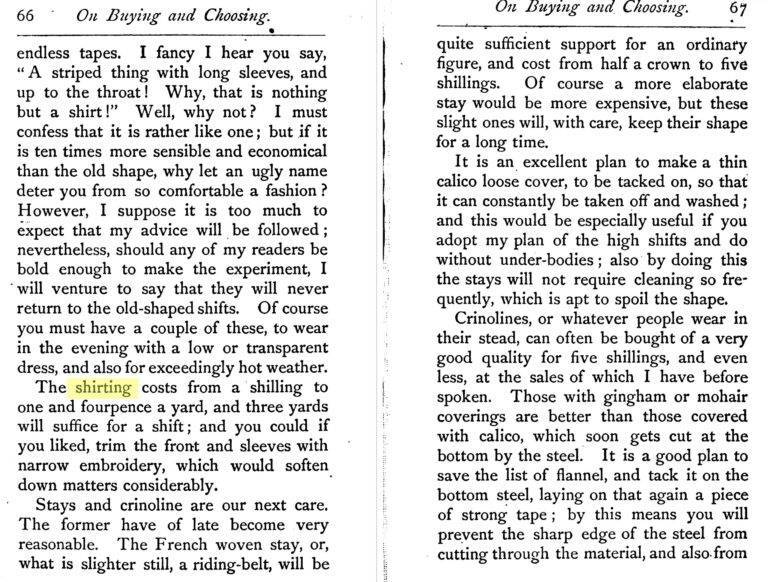
1873 T How to dress on £15 a year as a lady. By a lady. [i.e. M.W. Cook]
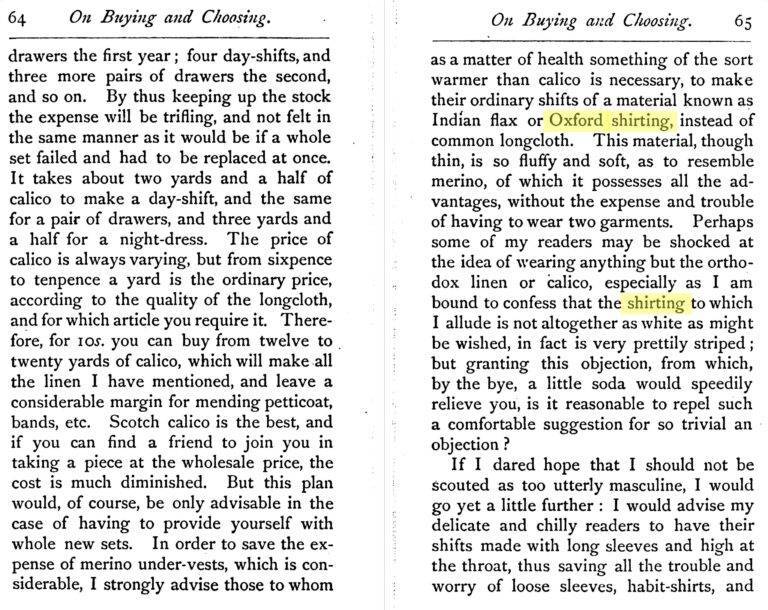
In order to save the expense of merino under-vests, which is considerable, I strongly advise those to whom as a matter of health something of the sort warmer than calico is necessary, to make their ordinary shifts of a material known as Indian flax or Oxford shirting, instead of common longcloth. This material, though thin, is so fluffy and soft, as to resemble merino, of which it possesses all the advantages, without the expense and trouble of having to wear two garments. Perhaps some of my readers may be shocked at the idea of wearing anything but the orthodox linen or calico, especially as I am bound to confess that the shirting to which I allude is not altogether as white as might be wished, in fact is very prettily striped ; but granting this objection, from which, by the bye, a little soda would speedily relieve you, is it reasonable to repel such a comfortable suggestion for so trivial an objection ?
1874
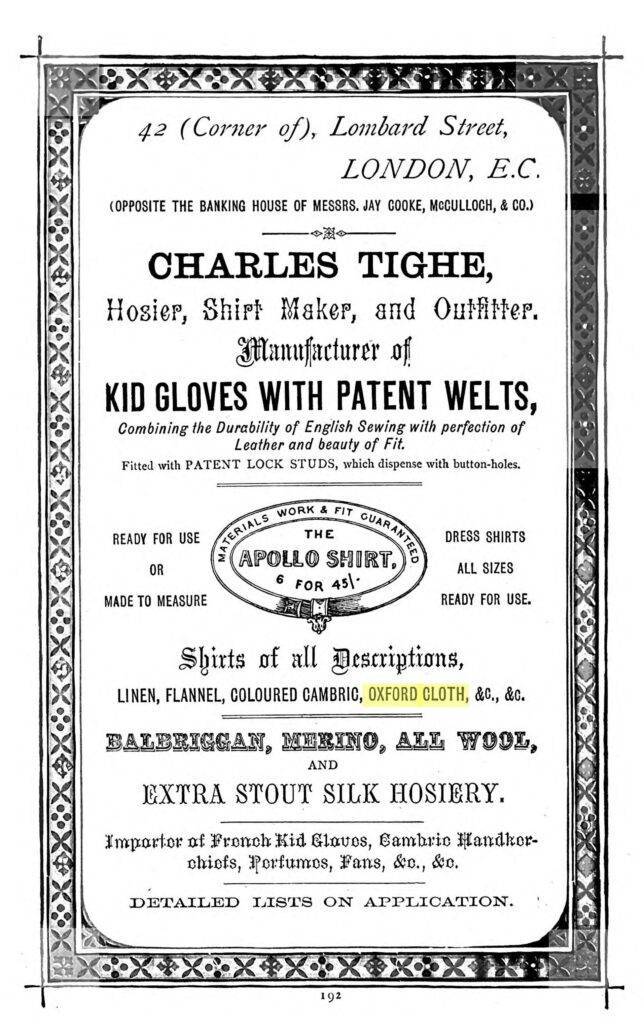
1874 London, a complete guide 1874
1872
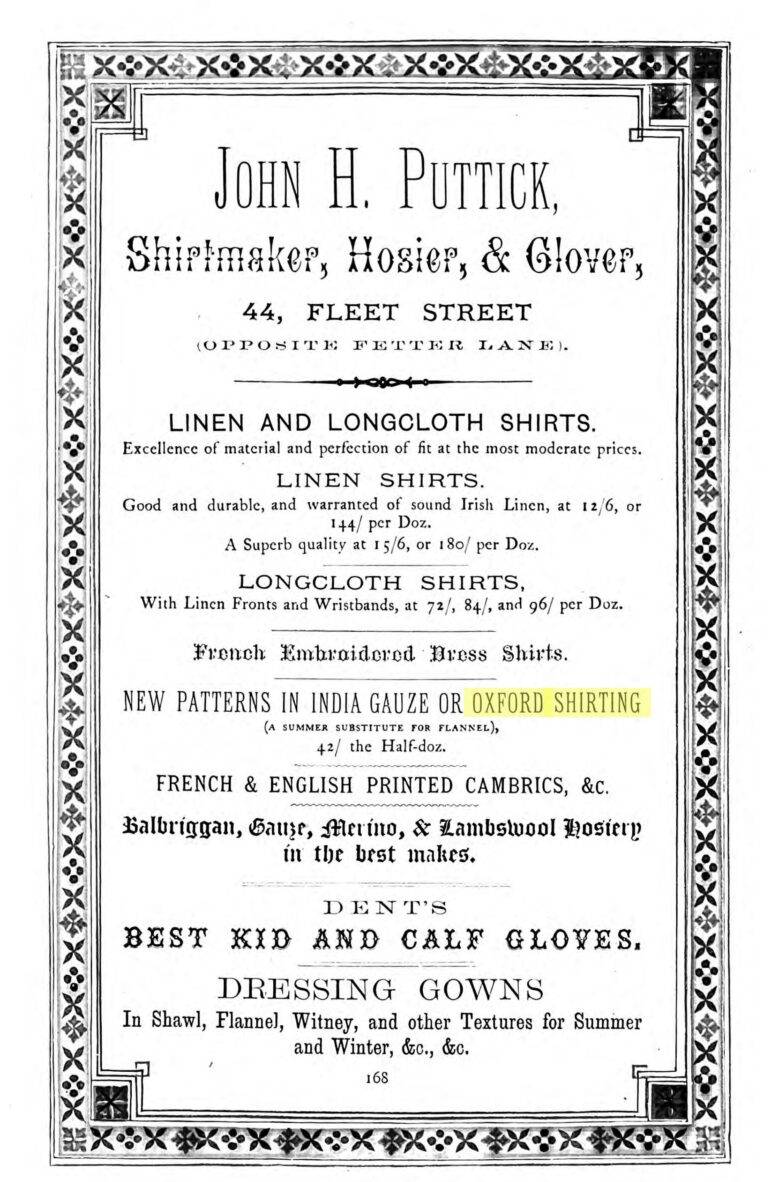
1872 London, a complete guide 1872
1869
Newspaper: London Evening Standard
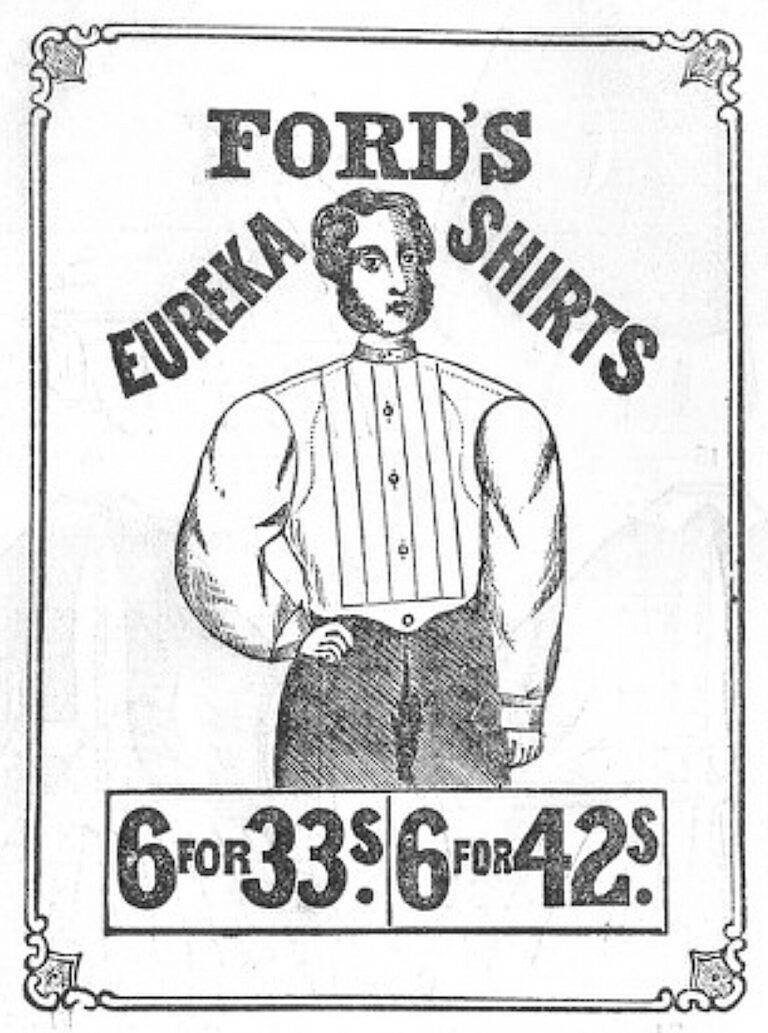
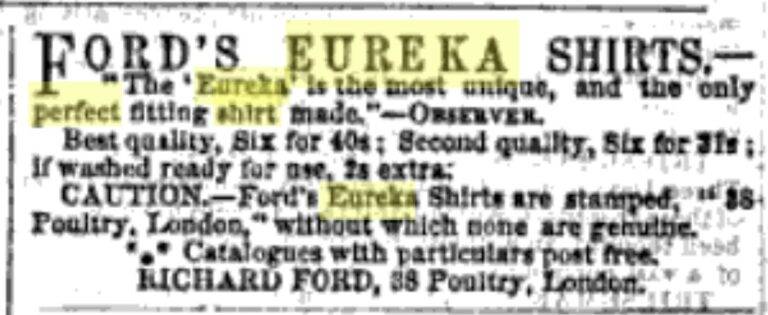
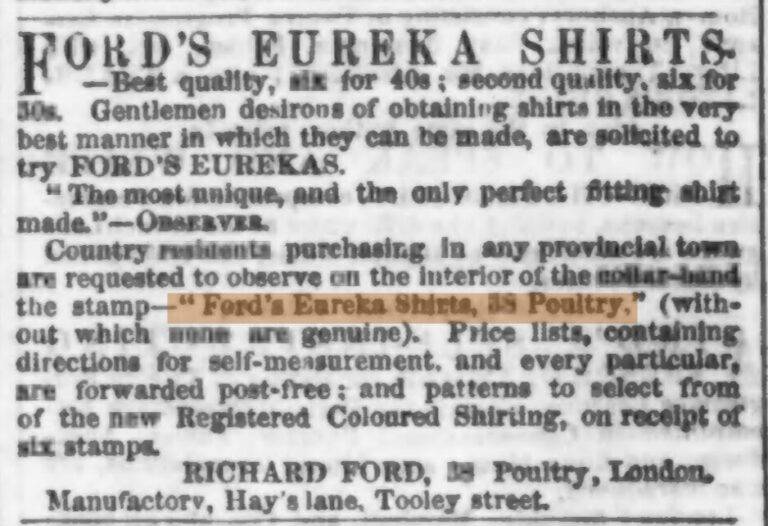
Eureka Shirts emerged in 1848 as an improved form of shirt devised by Richard Ford, distinguished by a particular shape. From the following year, 1849 onward, all of his products were sold under the unified name “Ford’s Eureka Shirts” and circulated in the market. Advertisements carried the phrase “A Perfect Fit Guaranteed,” presenting the shirts as ready-made garments that nevertheless emphasized how well they fitted the body. Buyers were sent self-measurement instructions and a price list by post, allowing them to select their shirts according to their own measurements.
With regard to materials and construction, the shirts were described as being made of “sterling good materials” and “strongly put together,” highlighting durable fabrics and solid workmanship. The choice of fabrics was not limited to plain cloth: customers could select from samples of registered patterned shirtings referred to as “Registered Coloured Shirtings.” The illustrations in the advertisements depict a shirt with a high stand collar and a vertical detail at the chest.
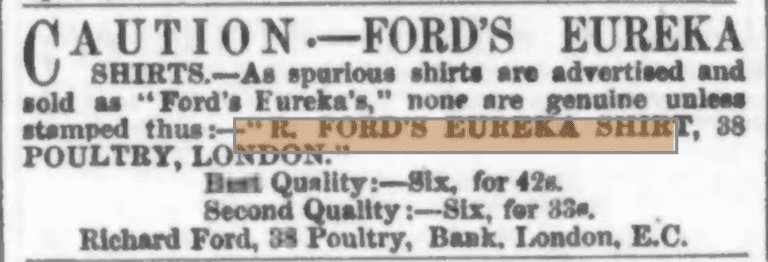
Sales were conducted in lots of six shirts, with two grades—best quality and second quality—each with its own price. As the shirts grew in popularity, imitation products began to circulate, and disputes over the use of the name eventually led to legal action.
Authenticity was indicated by a stamp placed on the inside of the collar. The words “Ford’s Eureka Shirt, London” or “33 Poultry” were enclosed within an octagonal lozenge-shaped frame, with the term “Trade Mark” printed outside it, serving as the mark of a genuine Eureka Shirt.
Conclusion — Jan. 2026
What do you think?
ABOUT THE INDUSTRIAL REVOLUTION