
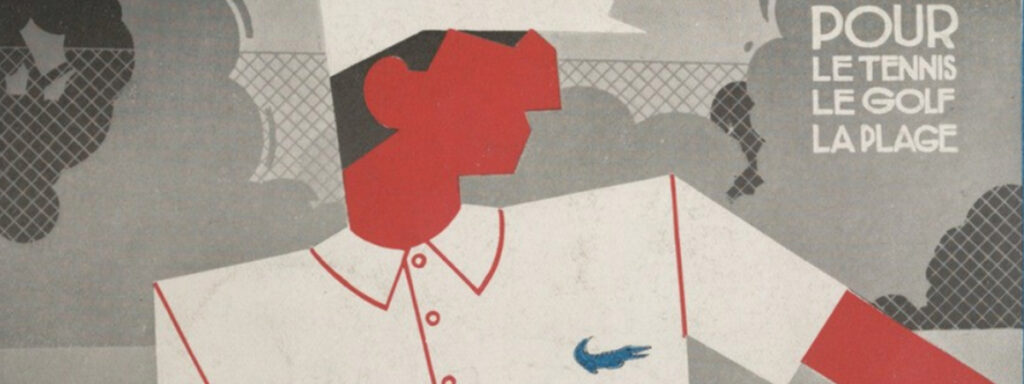
The first Lacoste
ADAM : JAN / 15 / 1934
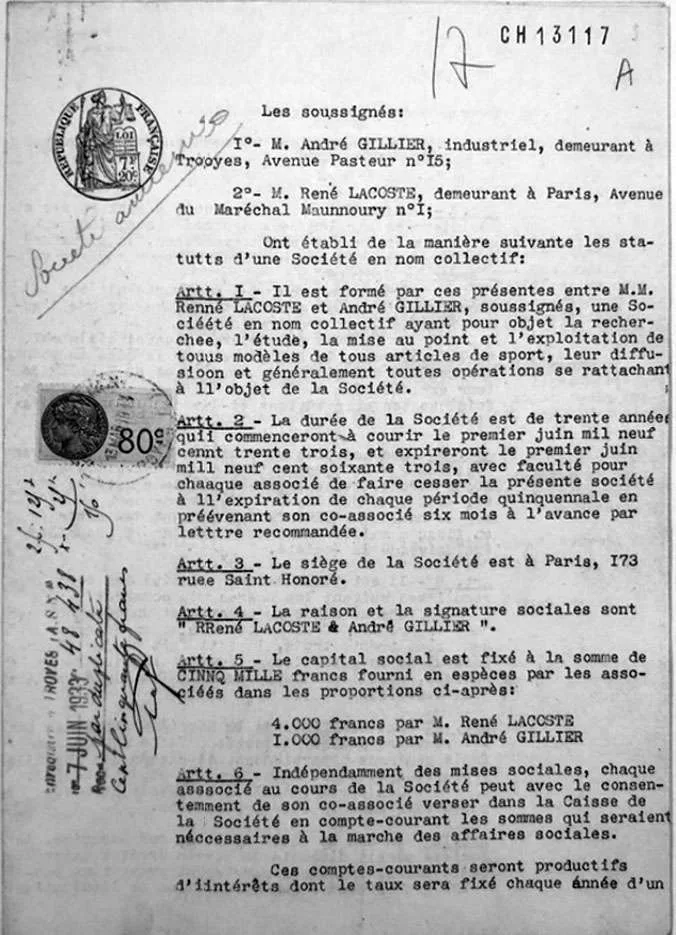
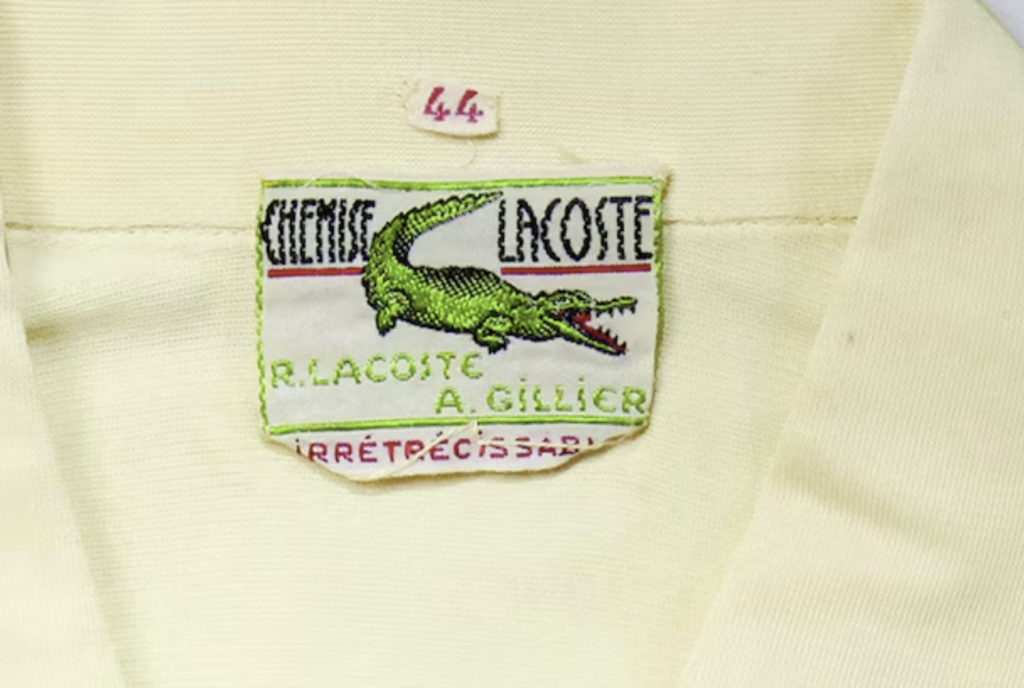
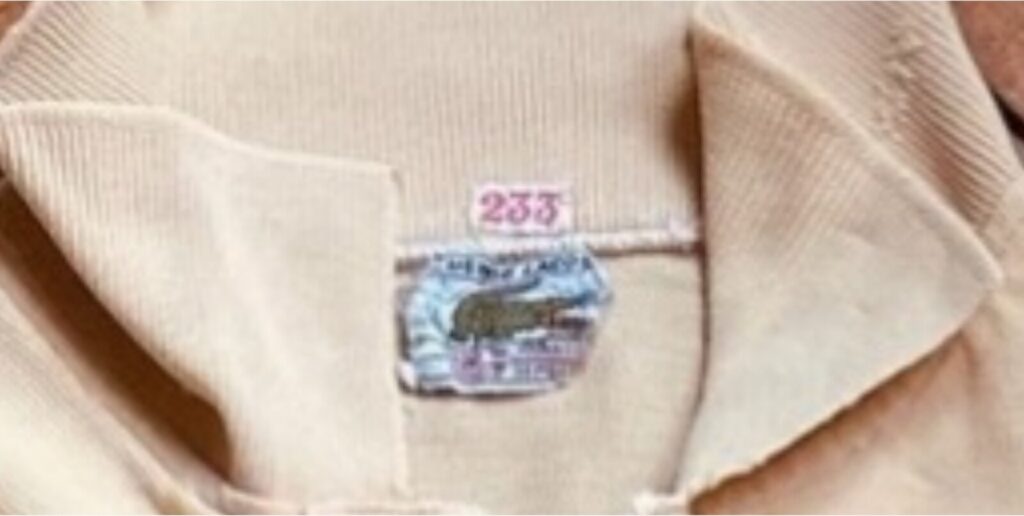
Lacoste’s website features what appears to be the oldest surviving Lacoste polo shirt. André Gillier’s name still appears on the label. It is dated to 1934, but there must also have been versions without a chest pocket, so other early examples may surface in the future.
The important point is that this differs from the claim that the L.12.12 has remained unchanged since the company’s founding — especially in terms of the three-button placket and four-hole buttons.

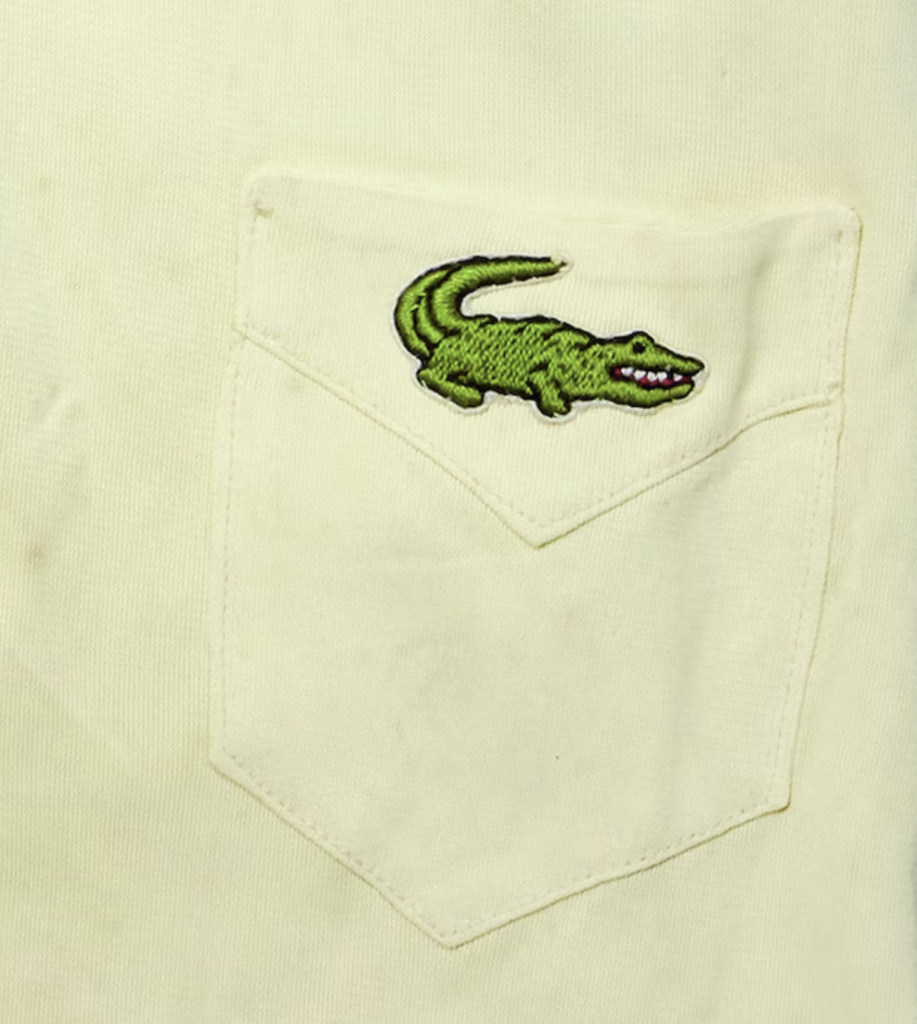
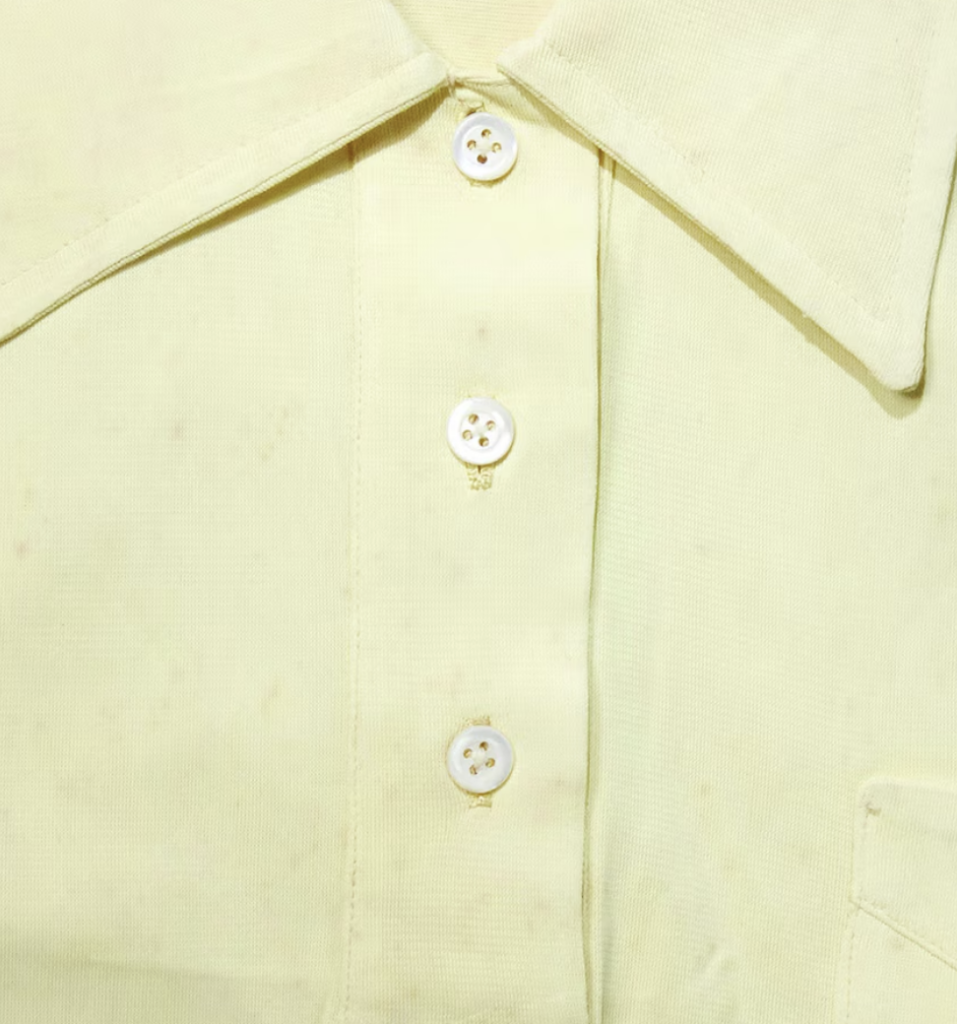
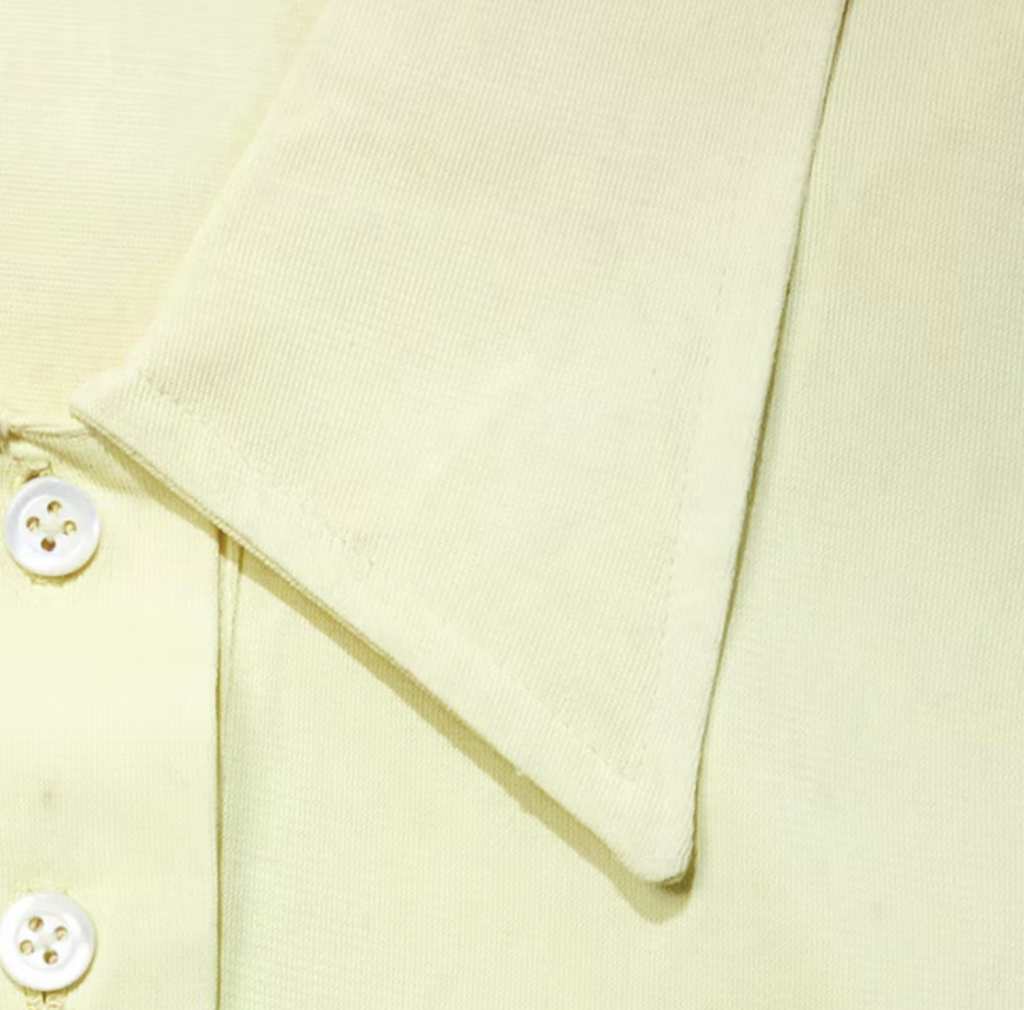
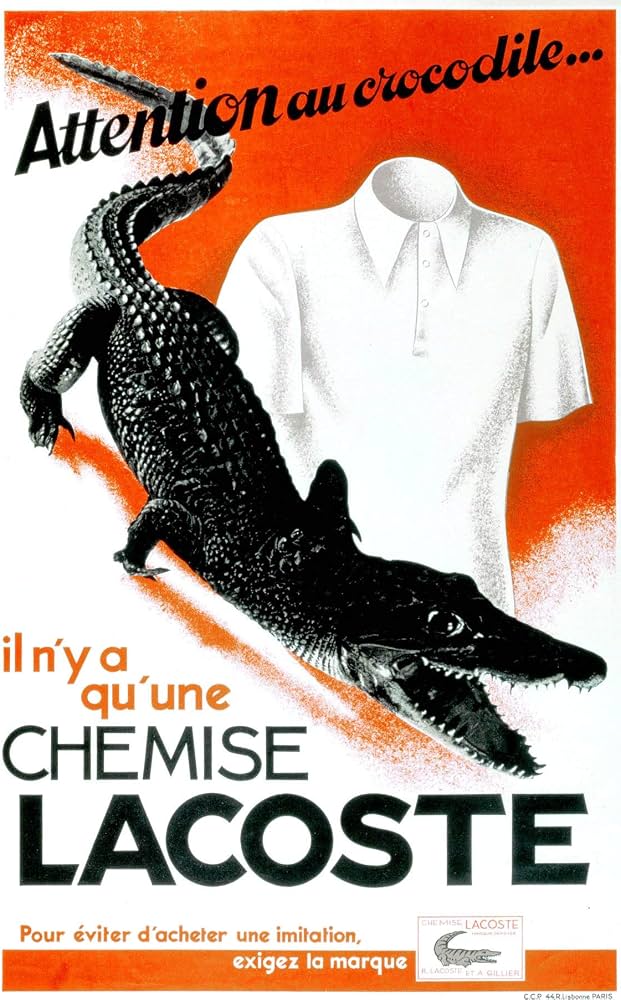
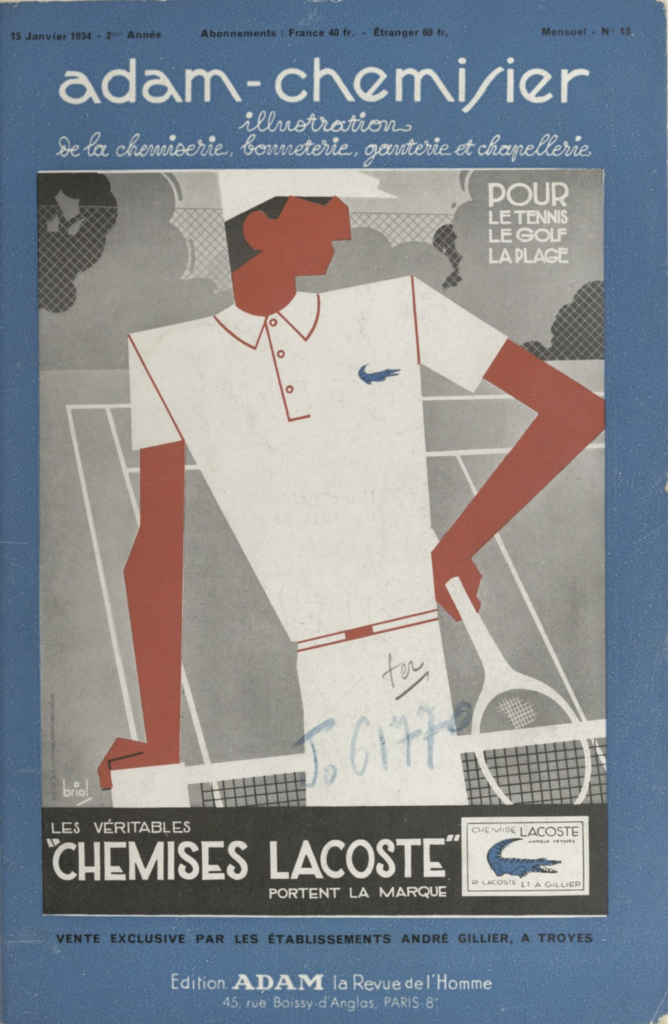
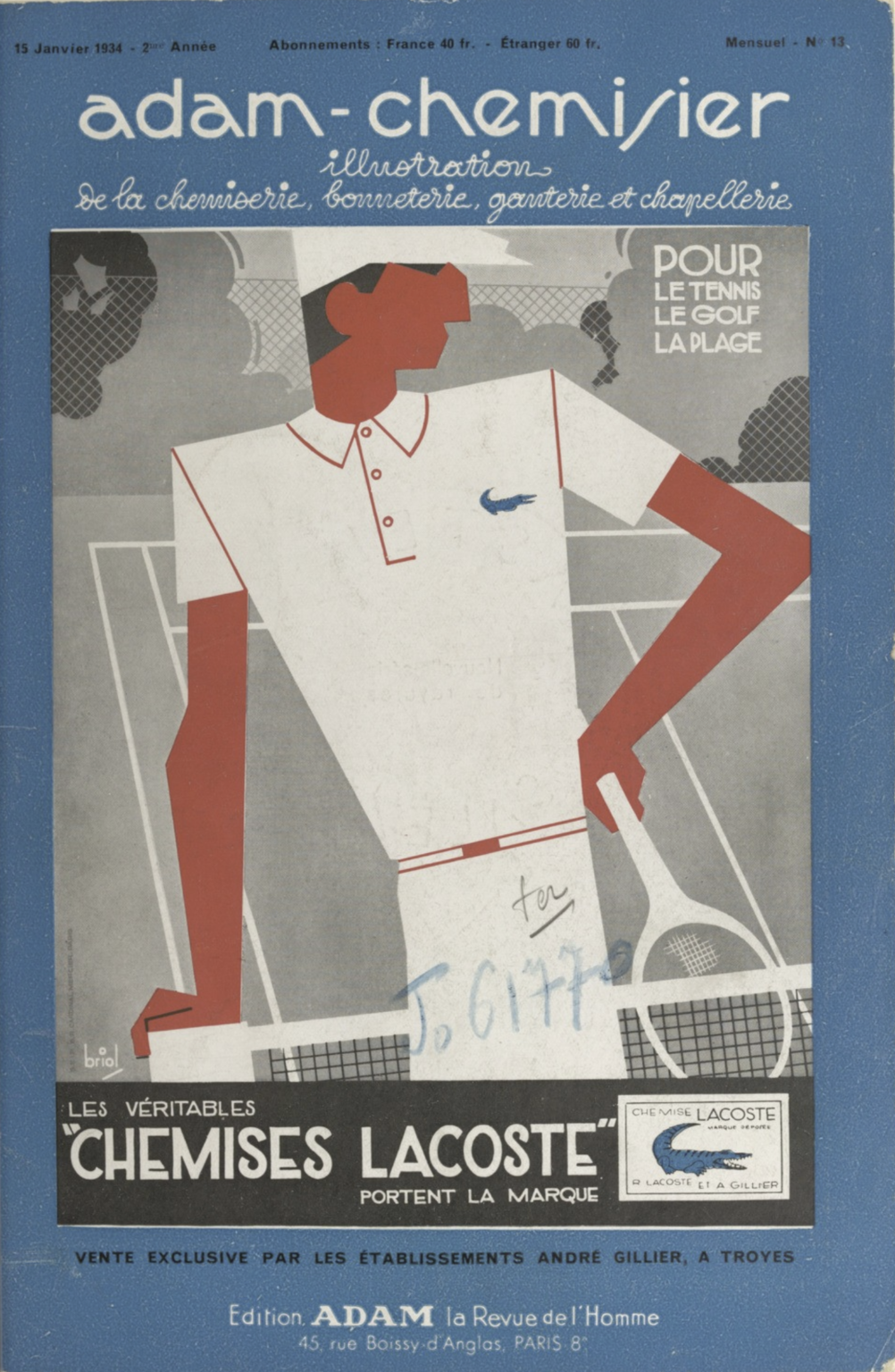
A special shirt-focused supplement to the French fashion magazine Adam. The 1934 issue was essentially a full-scale promotional showcase for Lacoste. In that sense, 1934 might even be called “Year One” of the polo shirt.
In reality, however, it appears that by this time polo shirts had already begun to spread through the market in Britain, the United States, and France as casual summer shirts, replacing conventional woven shirts. Judging from this feature, it is clear that many brands had already entered the polo shirt market.
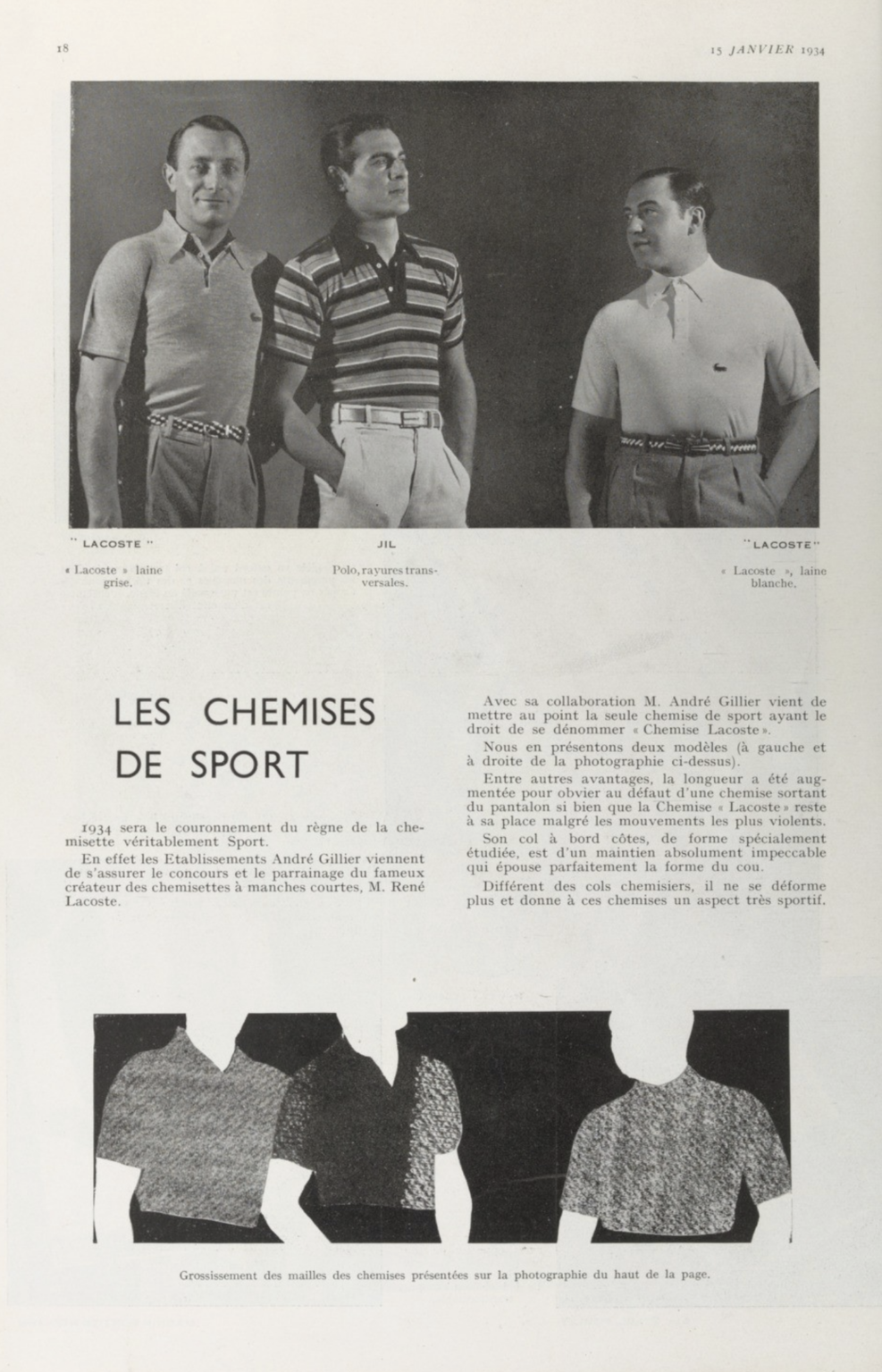
1934 will mark the crowning point of the reign of the truly sporting short-sleeved shirt.
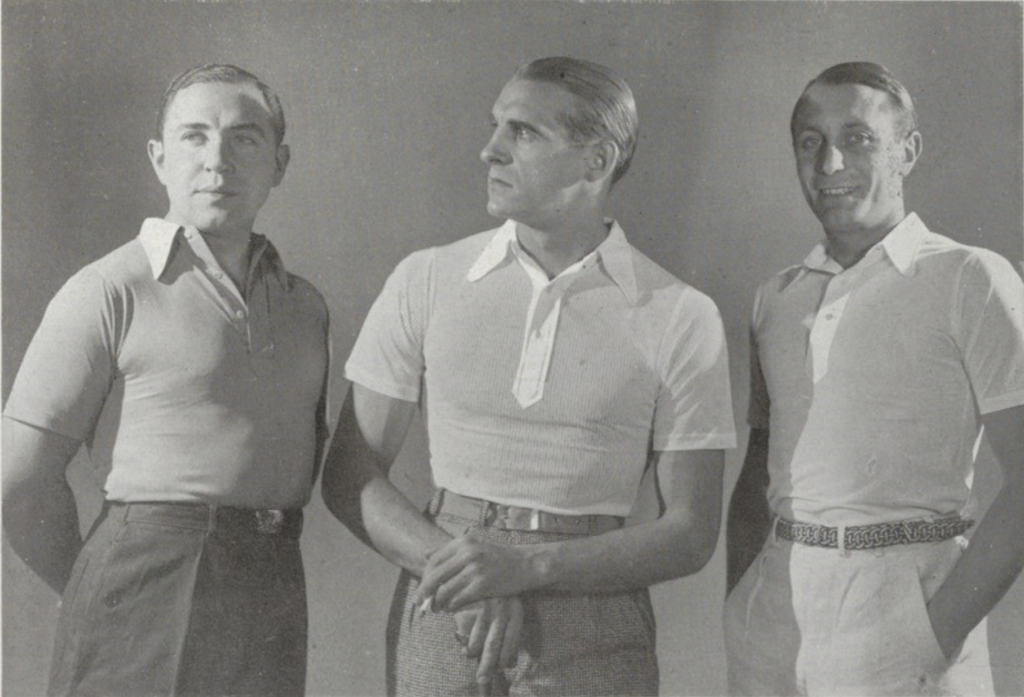
Indeed, Établissements André Gillier has just secured the collaboration and patronage of the famous creator of the short-sleeved shirt, Mr. René Lacoste.With his collaboration, Mr. André Gillier has just perfected the only sport shirt entitled to bear the name “Chemise Lacoste.” We present two models here, at the left and right of the photograph above.
Among its other advantages, the shirt has been made longer in order to overcome the problem of a shirt coming out of the trousers, so that the “Lacoste” shirt remains in place even during the most vigorous movements.
Its ribbed-edge collar, specially designed, holds its shape perfectly and follows the contours of the neck exactly.
Unlike ordinary shirt collars, it no longer loses its shape and gives these shirts a distinctly sporting appearance.
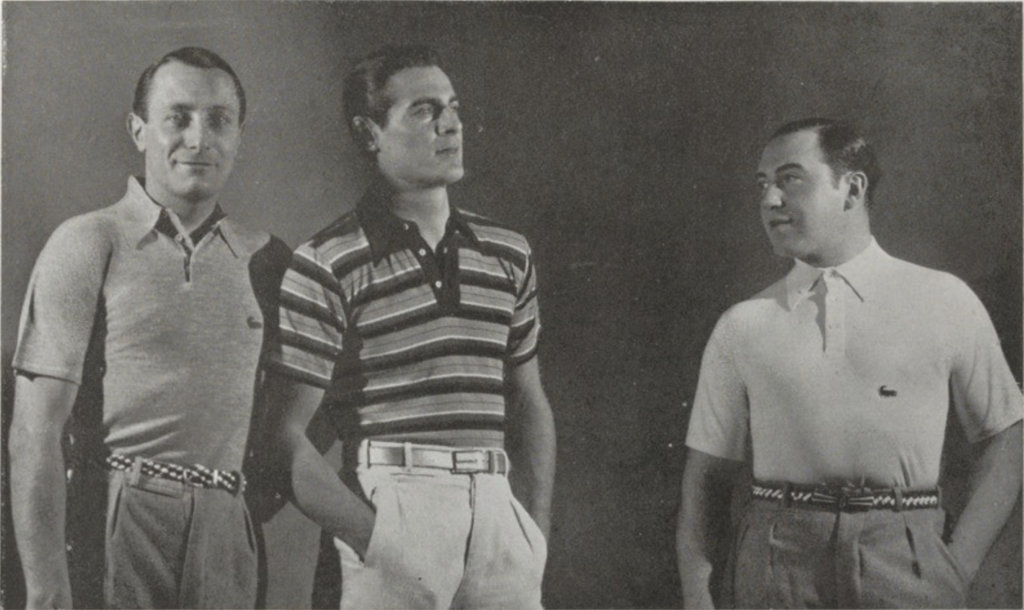
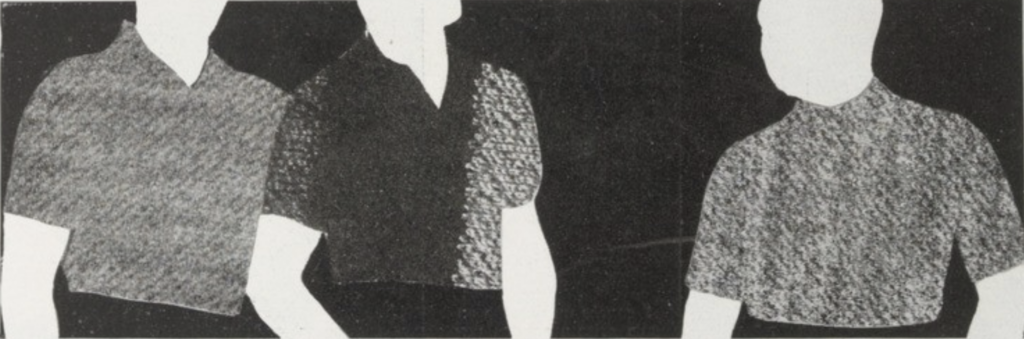
“LACOSTE” “Lacoste,” grey wool.
JIL Polo shirt, horizontal stripes.
“LACOSTE” “Lacoste,” white wool.
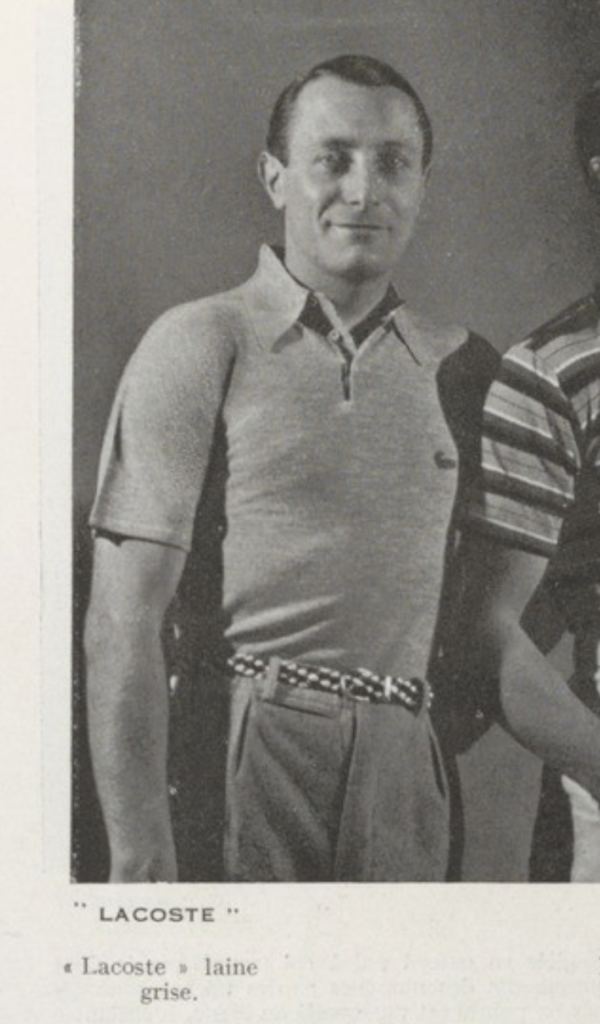
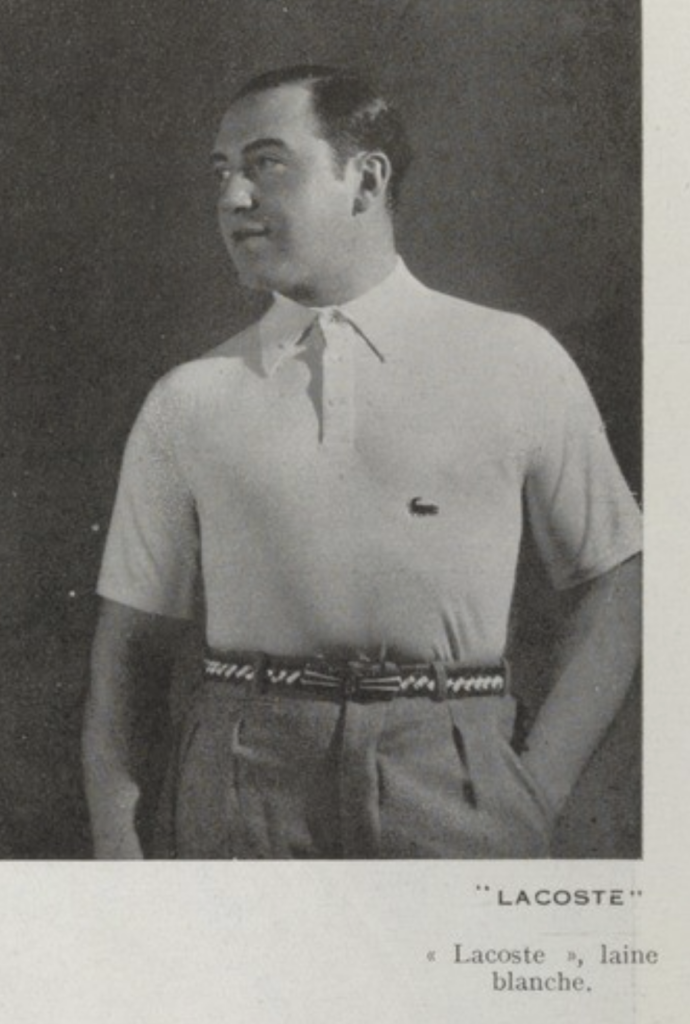
Guaranteed to be absolutely shrinkproof, these shirts, thanks to advances in dyeing, can also be guaranteed colourfast even in the brightest shades.
The symbolic “alligator” guarantees the origin of the genuine “Lacoste” shirt, which is made in all kinds of fabrics, from Sakel Peigné to matte silk, as well as linen and wool of the very finest quality.
Needless to say, Établissements André Gillier remains faithful to its “Jil” production, and this year its research into materials has enabled it to place on the market for the first time articles in knitted linen, very cool against the skin, as well as a finely striped matte silk which perfectly imitates shirting fabric.
All these creations complement the classic models that have established the worldwide reputation of this house.
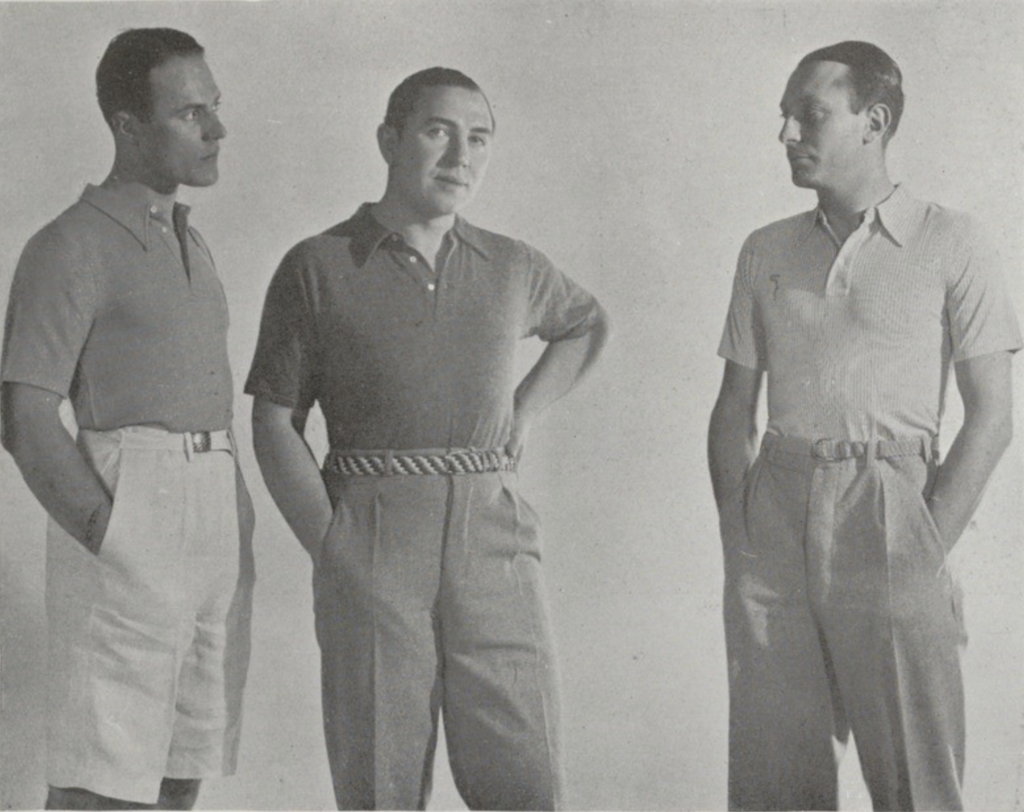
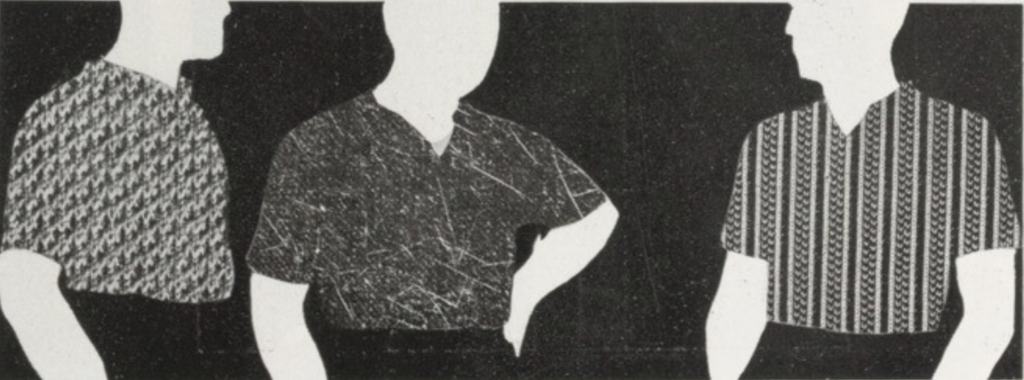
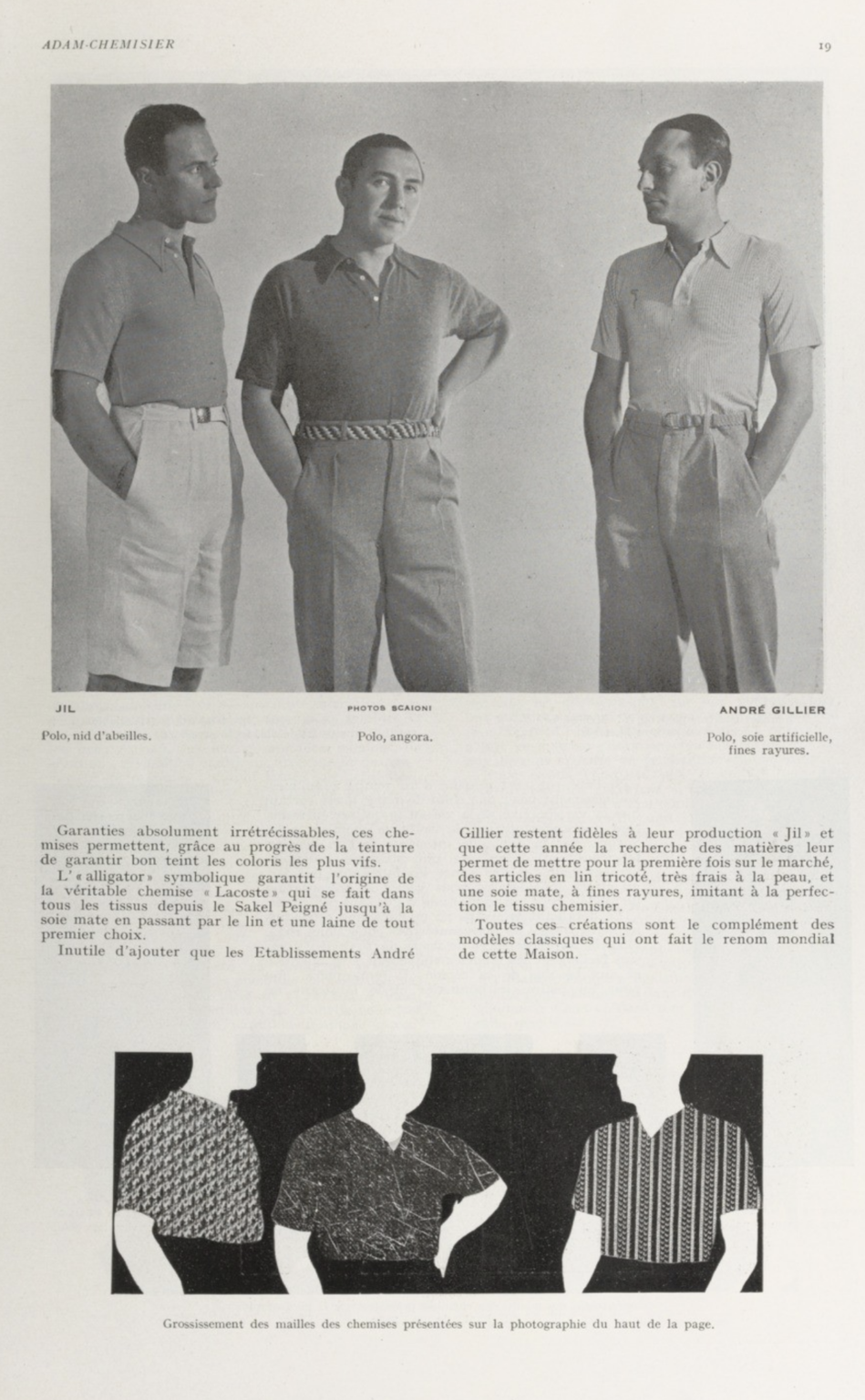
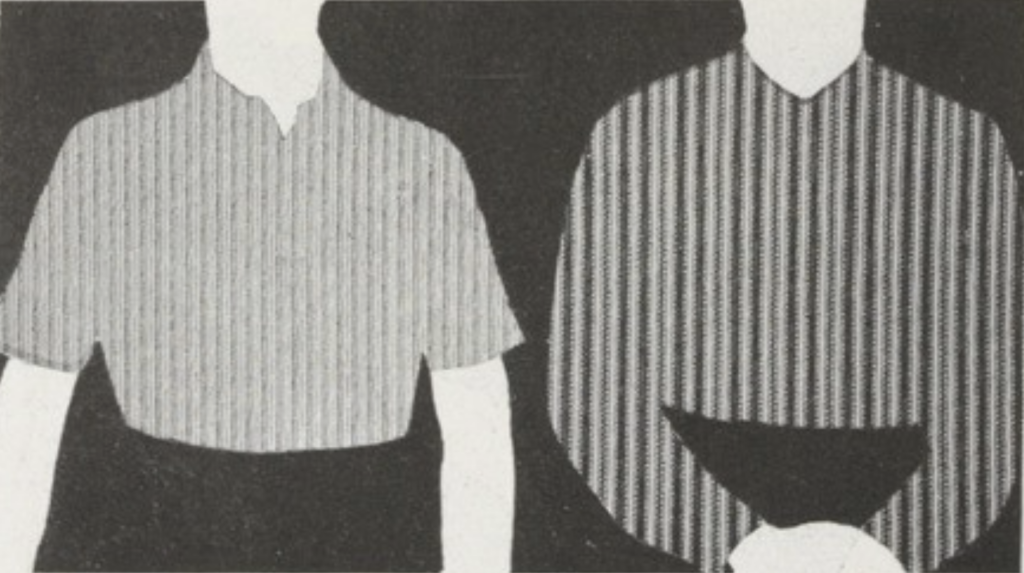
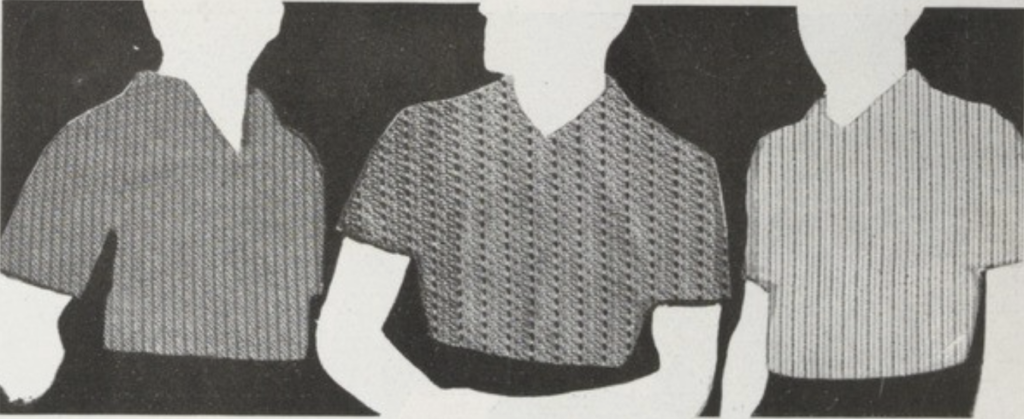
JIL Polo shirt, honeycomb knit. / Polo shirt, angora / ANDRÉ GILLIER Polo shirt, artificial silk, fine stripes.
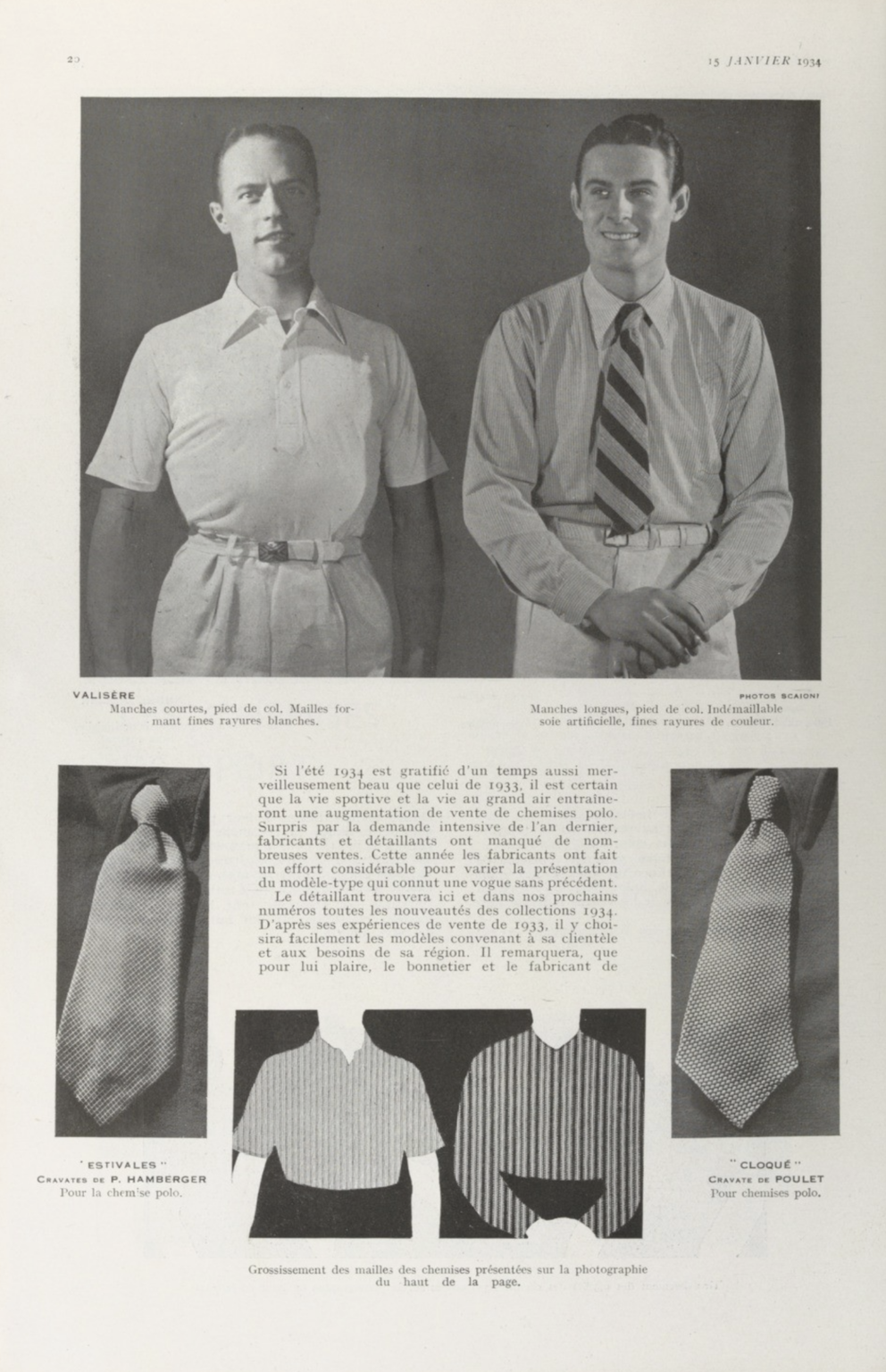
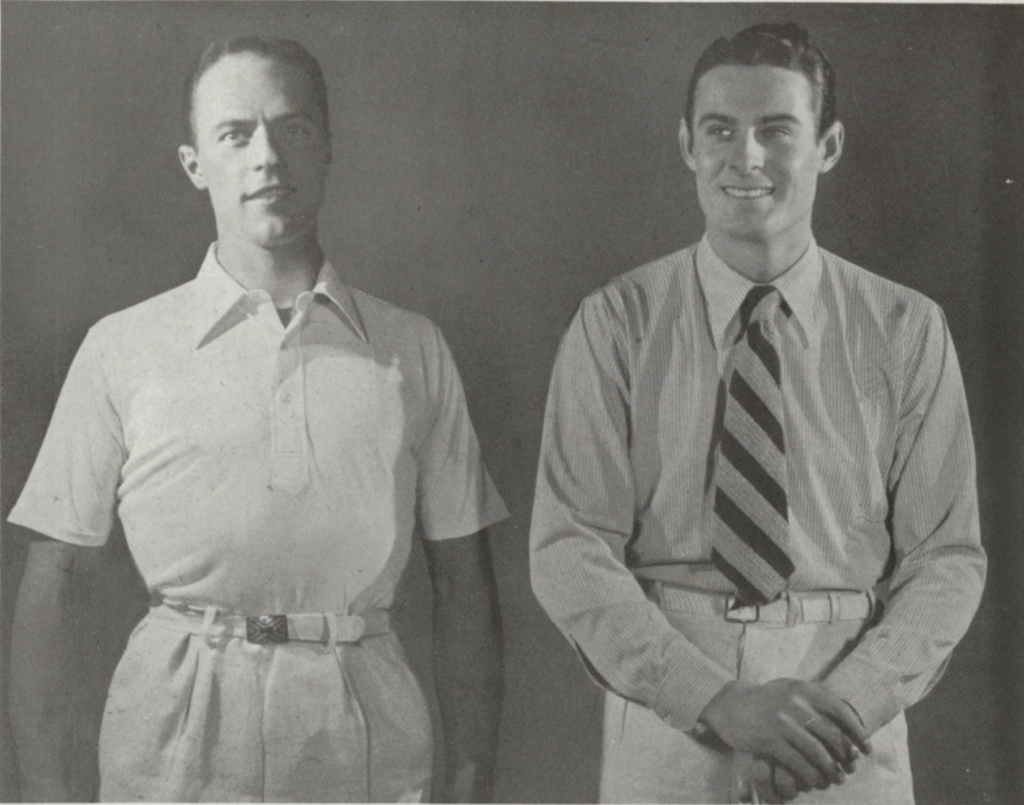
VALISÈRE
Short sleeves, collar stand. Knitted structure forming fine white stripes.
Long sleeves, collar stand. Run-resistant artificial silk, fine coloured stripes.
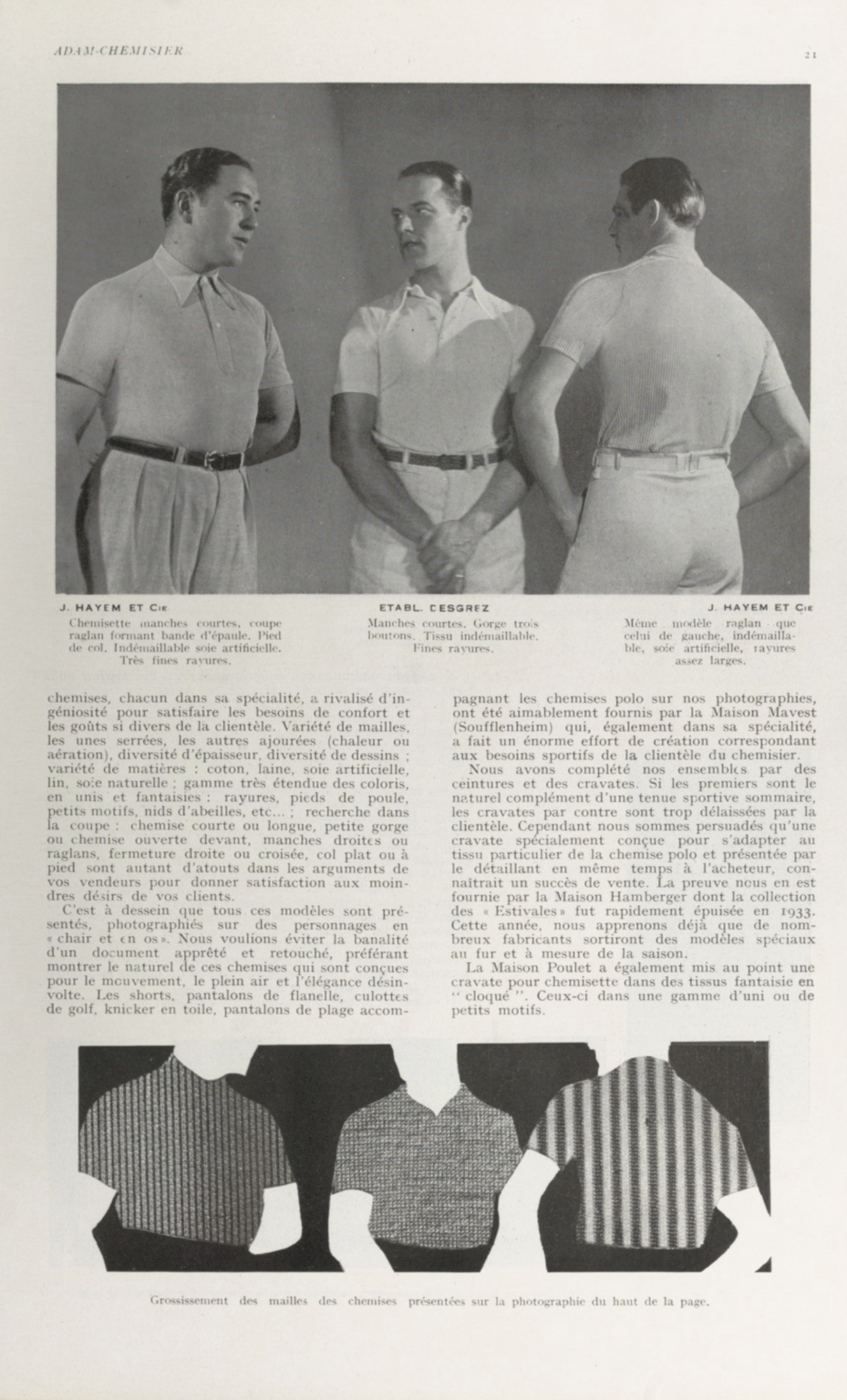
Shirt and knitwear manufacturers, each in his own speciality, have competed in ingenuity to satisfy the demand for comfort and the widely differing tastes of customers.
There is a variety of knitted structures, some close-knit and others openwork (for warmth or ventilation); differences in thickness and in design; a variety of materials—cotton, wool, artificial silk, linen and natural silk; an extremely wide range of colours, both plain and patterned—stripes, houndstooth, small motifs, honeycomb patterns, etc.
There is also experimentation in cut: short or long shirts, short plackets or fully front-opening shirts, straight or raglan sleeves, straight or crossover fastenings, flat collars or collars with stands—all of which provide salesmen with arguments for satisfying even the smallest wishes of their customers.
All these models have deliberately been photographed on real, “flesh-and-blood” people. We wished to avoid the banality of a staged and retouched presentation, preferring instead to show the natural character of shirts designed for movement, the outdoors and relaxed elegance.
The shorts, flannel trousers, golf breeches, canvas knickerbockers and beach trousers accompanying the polo shirts in our photographs were kindly supplied by Maison Mavest of Soufflenheim.
We have completed the outfits with belts and ties. While belts are the natural complement to a simple sporting outfit, ties, by contrast, are too often neglected by customers.
We are nevertheless convinced that a tie specially designed to suit the particular fabric of the polo shirt, and presented by the retailer at the same time as the shirt, would enjoy considerable sales success.
Proof of this is supplied by Maison Hamberger, whose “Estivales” collection sold out rapidly in 1933.
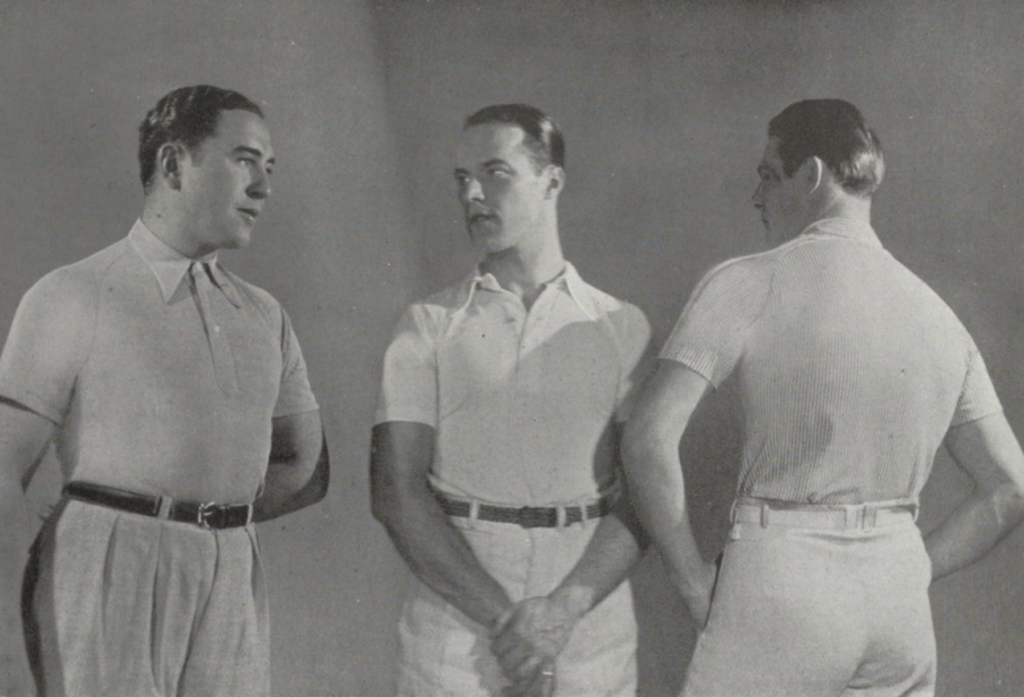
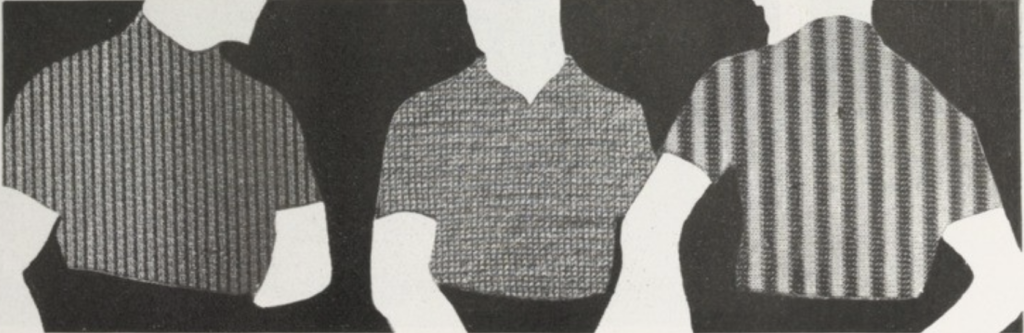
J. HAYEM ET Cie
Short-sleeved shirt, raglan cut forming a shoulder band. Collar stand. Run-resistant artificial silk. Very fine stripes.
ETABL. CESGREZ
Short sleeves. Three-button placket. Run-resistant fabric, fine stripes.
J. HAYEM ET Cie
Same raglan model as the one on the left; run-resistant artificial silk with fairly broad stripes.
We also find supporting evidence in the interview kindly granted to us by Mr. Pierre Apfel, vice-president of the Paris Trade Association of Manufacturers of Ties, Scarves and Mufflers.
Here is his reply:
“Since you ask me for my opinion on wearing the shirt known as the Lacoste shirt and on its effect on tie sales, here is my view:
Yes, I am in favour of this shirt, whose advantages scarcely need to be listed any longer, especially during the warm season. To oppose this fashion and try, in the heat of summer, to return to starched shirts, high stiff collars and top hats would be a futile advertising effort and sheer nonsense.
But what must be done is to prevent dress from lapsing into sloppiness. Fashion and good taste go hand in hand. Provided the eye is not offended, it becomes accustomed to novelty. Look at women’s fashion, which changes almost every season, and let us admit that, although at the launch of a new trend we may smile at it, we soon come to recognize that it is ‘chic’—not out of snobbery, but because of taste, harmony, and the way of wearing clothes, the secret of which French women possess.
The same is true of men’s fashion; a short-sleeved shirt…”
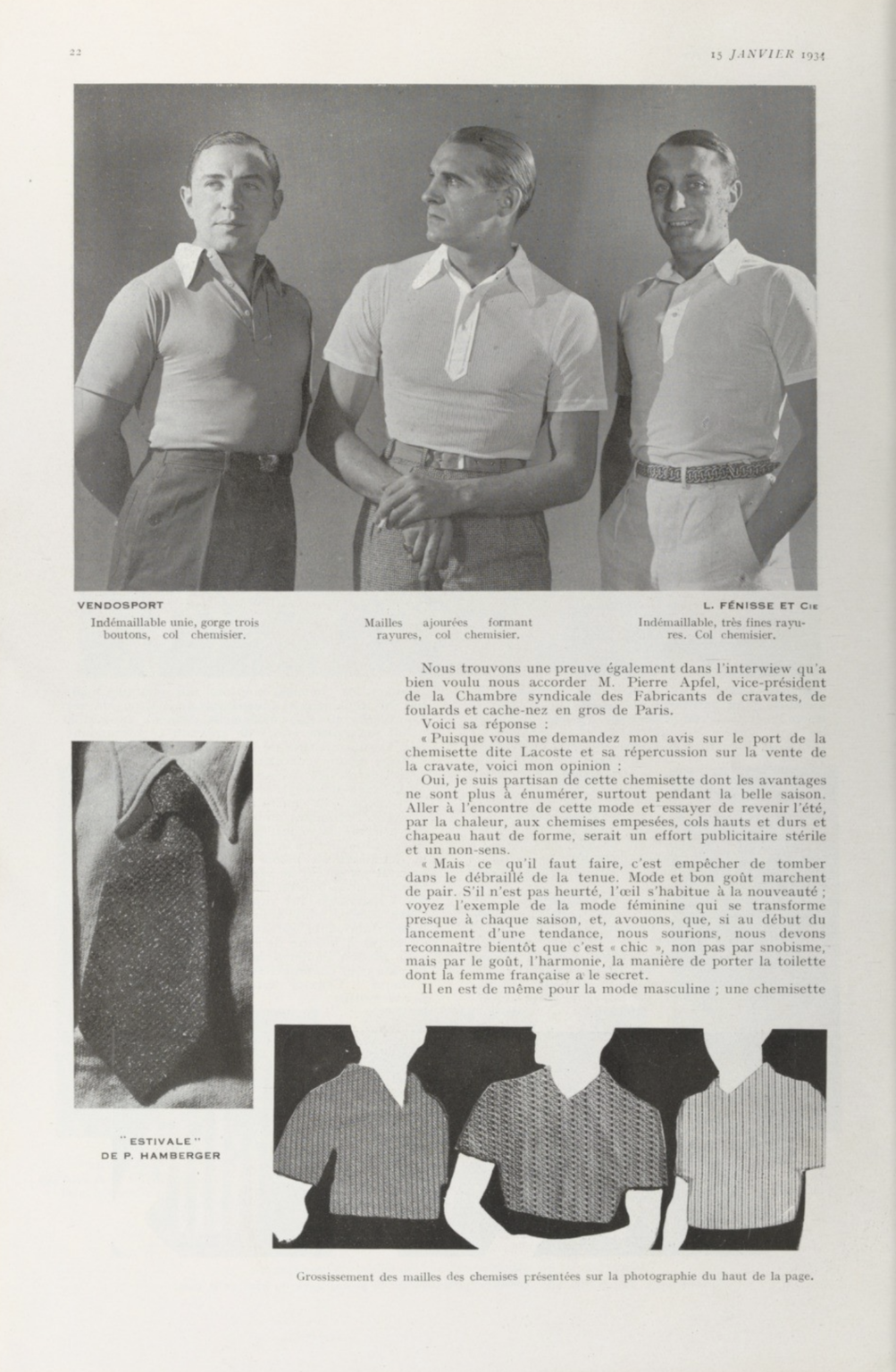
VENDOSPORT
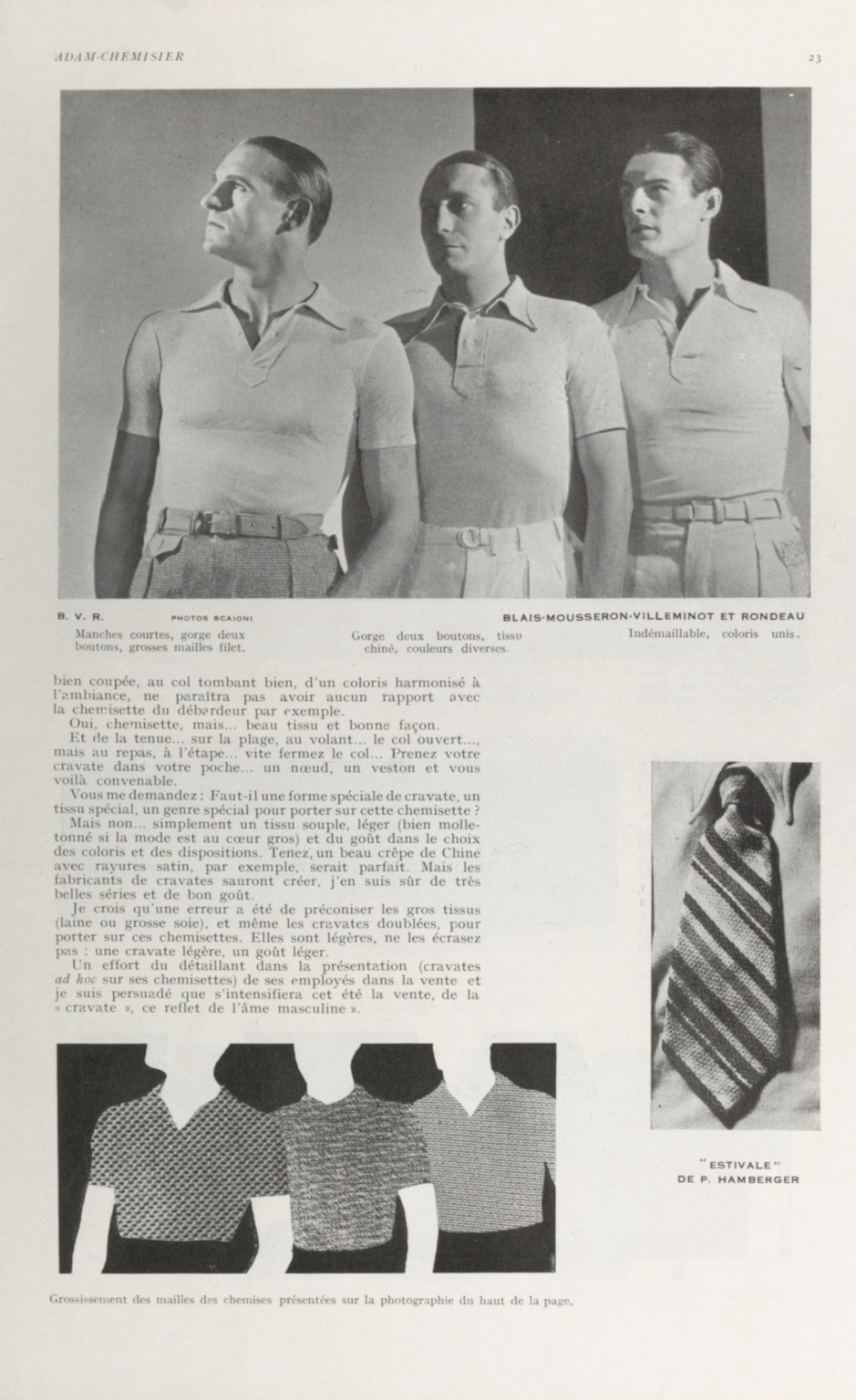
Plain run-resistant fabric, three-button placket, shirt collar.
Openwork knitted structure forming stripes, shirt collar.
L. FÉNISSE ET Cie
Run-resistant fabric, very fine stripes. Shirt collar.
…well cut, with a collar that falls properly, and in a colour harmonized with its surroundings, will bear no resemblance at all to, for example, the sleeveless shirt of a dock worker.
Yes, a short-sleeved shirt—but fine fabric and good workmanship.
And proper dress… on the beach, at the wheel… the collar open… but at a meal, at a stop on the journey… quickly close the collar. Take your tie from your pocket… tie a knot, put on a jacket, and there you are, properly dressed.
You ask me: Is a special shape of tie, a special fabric, or a special type required to wear with this shirt?
No… simply a soft, lightweight fabric, well padded if the fashion is for a fuller knot, and good taste in the choice of colours and patterns. A fine crêpe de Chine with satin stripes, for example, would be perfect. But tie manufacturers will know how to create, I am sure, very attractive and tasteful ranges.
I believe it has been a mistake to recommend heavy fabrics—wool or heavy silk—and even lined ties to wear with these shirts. They are light; do not weigh them down: a light tie, a light touch.
With some effort by the retailer in presentation—ties specially selected for these shirts—and by his employees in selling them, I am convinced that sales of the ‘tie’, that reflection of the masculine soul, will increase this summer.
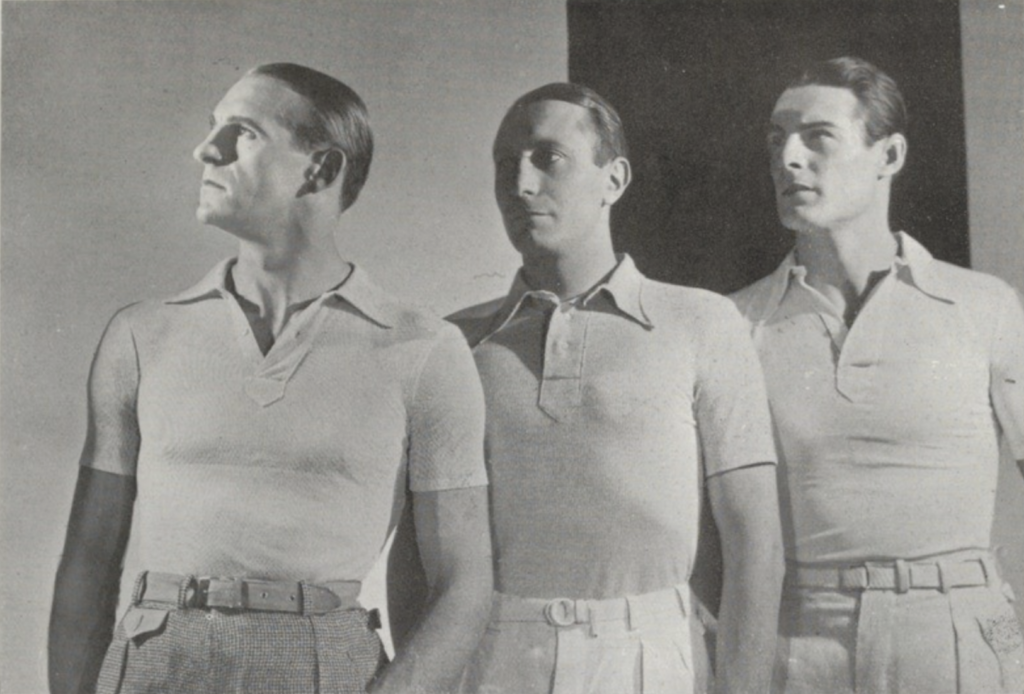
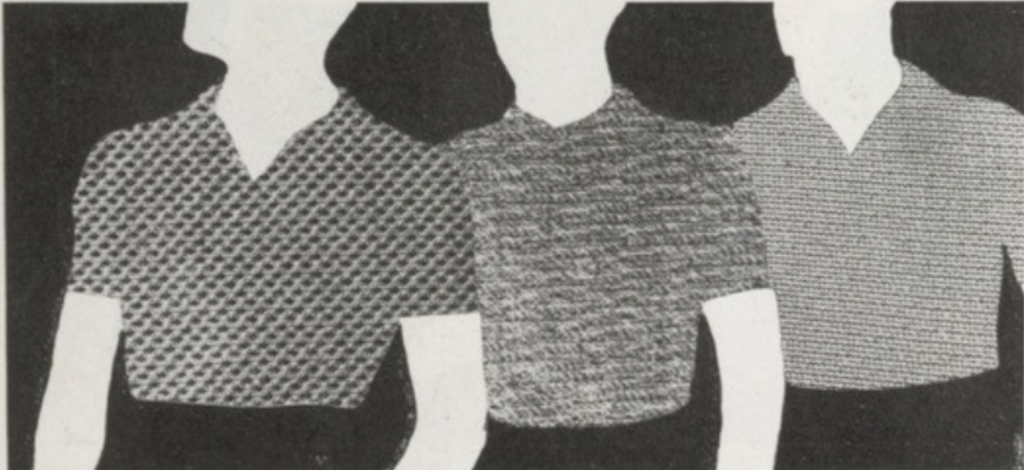
B. V. R.
Manches courtes, gorge deux boutons, grosses mailles
filet.PHOTOS SCAIONI
Gorge deux boutons, tissu chiné, couleurs diverses.
BLAIS-MOUSSERON-VILLEMINOT ET RONDEAU
Indémaillable, coloris unis.
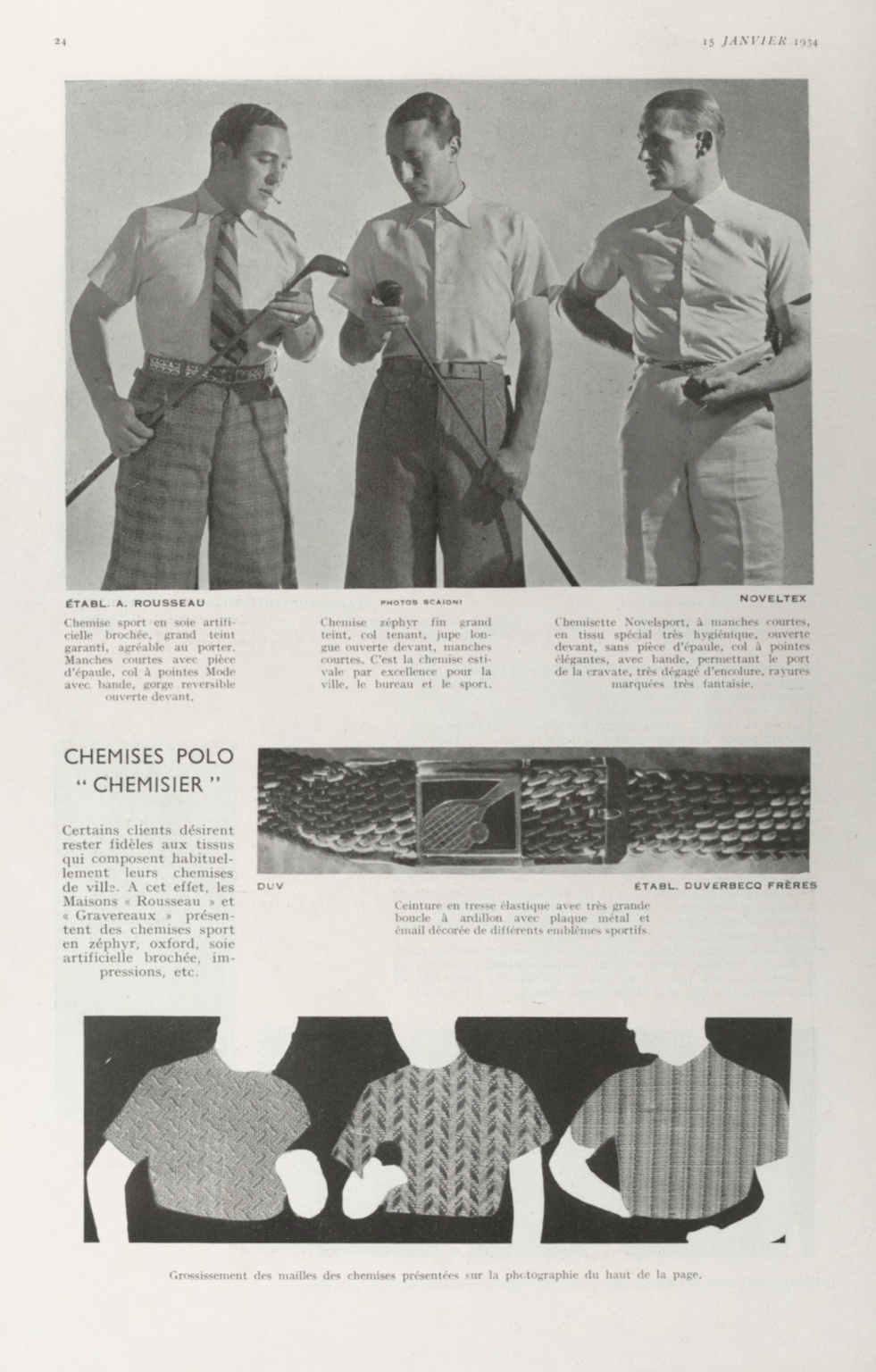
Some customers wish to remain faithful to the fabrics normally used for their town shirts. For this purpose, the firms Rousseau and Gravereaux offer sport shirts in zephyr, Oxford, figured artificial silk, printed fabrics, etc.
ÉTABL. A. ROUSSEAU
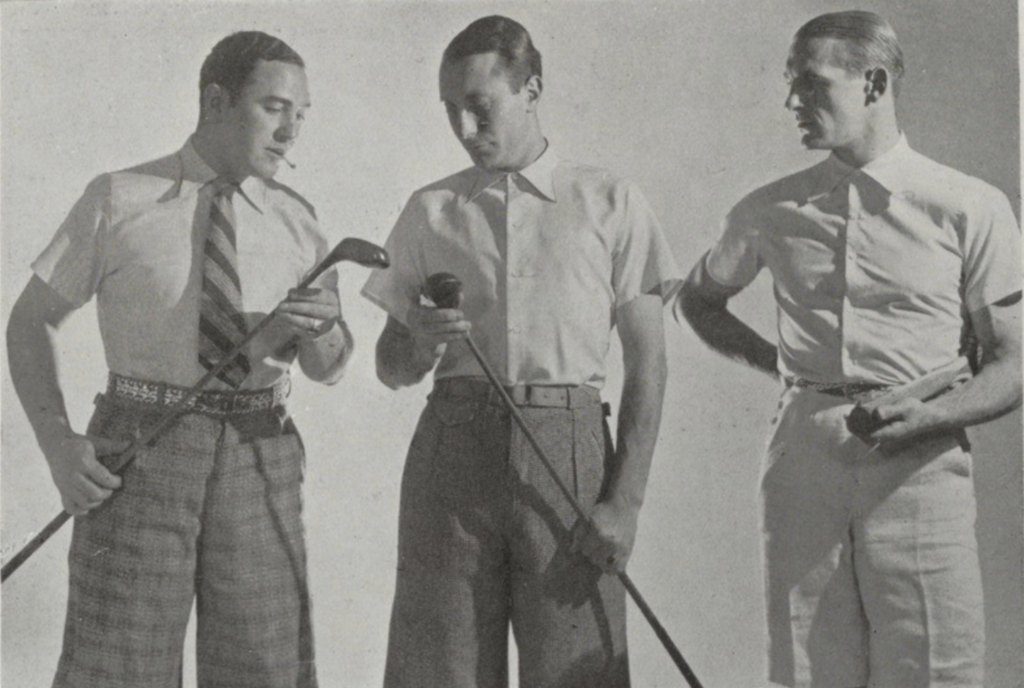
Sport shirt in figured artificial silk, guaranteed colourfast and comfortable to wear. Short sleeves with shoulder pieces, fashionable pointed collar with collar band, reversible placket opening at the front.
PHOTOS SCAIONI
Fine zephyr shirt, guaranteed colourfast, with a stand collar, long shirt-tail, open front, and short sleeves. This is the summer shirt par excellence for town, office, and sport.
NOVELTEX
Novelsport short-sleeved shirt, made of a special highly hygienic fabric, open at the front, without shoulder pieces, with an elegant pointed collar and collar band allowing a necktie to be worn, cut very open at the neck, with bold decorative stripes.
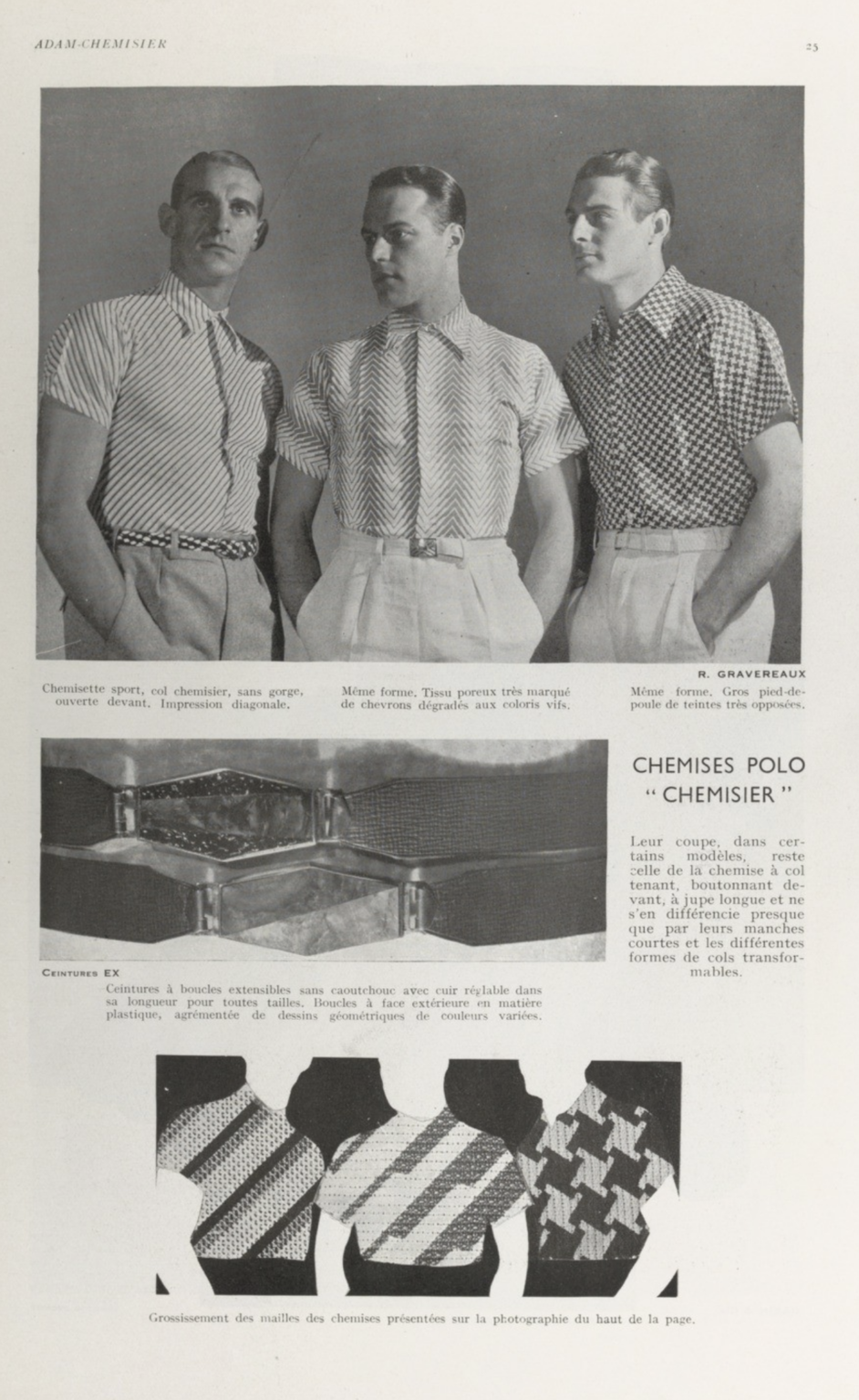
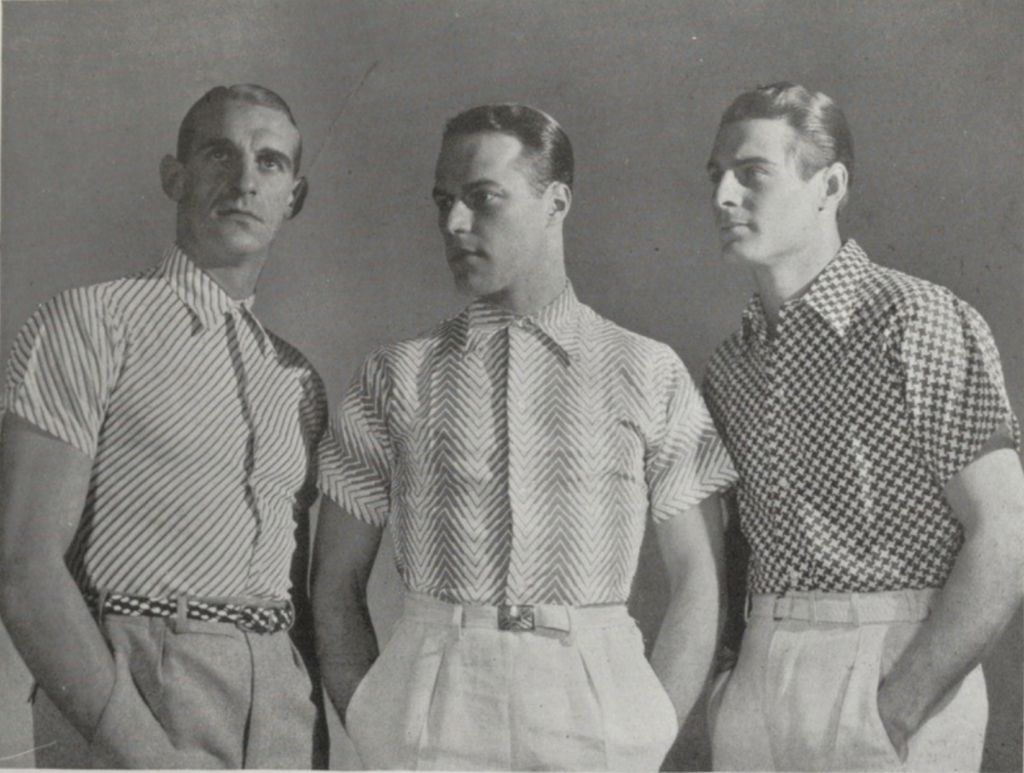
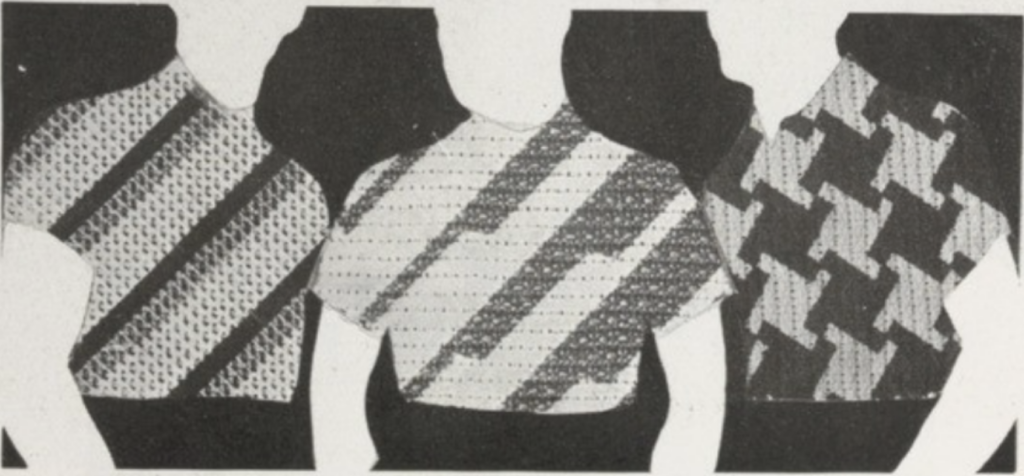
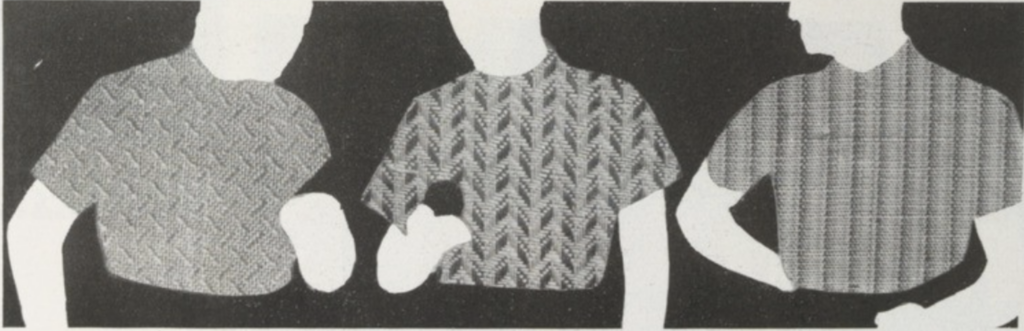
Sport shirt, shirt-style collar, without a placket, open at the front. Diagonal print.
Same shape. Highly porous fabric with strongly defined graduated chevrons in bright colours.
R. GRAVEREAUX
Same shape. Large houndstooth pattern in strongly contrasting shades.
As this full-page advertisement and accompanying feature in Adam from 1934 clearly show, the polo shirt had already become quite widespread by the 1930s.
There is no doubt that René Lacoste was one of the pioneers in wearing this type of shirt in competitive tennis. At the same time, however, André Gillier’s JIL brand was also of great importance in the early development of the garment.
Above all, I want to state this emphatically: the L.12.12, which has since been turned into a central part of the Lacoste brand narrative, did not yet exist in that form at this point. What we actually see at the outset is something quite different — a three-button shirt made of wool, and not even knitted in piqué.
In other words, the starting point was fundamentally different from the standardized L.12.12 story that is so often presented today.
André Gillier died on May 16, 1935. He had an eldest son, Jean Gillier, born in 1908. Therefore, the “J. Gillier” in the advertisement reading “R. Lacoste & J. Gillier” most likely refers to Jean Gillier, although this still needs to be confirmed through corporate records or similar documentation. This suggests that the model bearing this label is most likely a second-generation model.
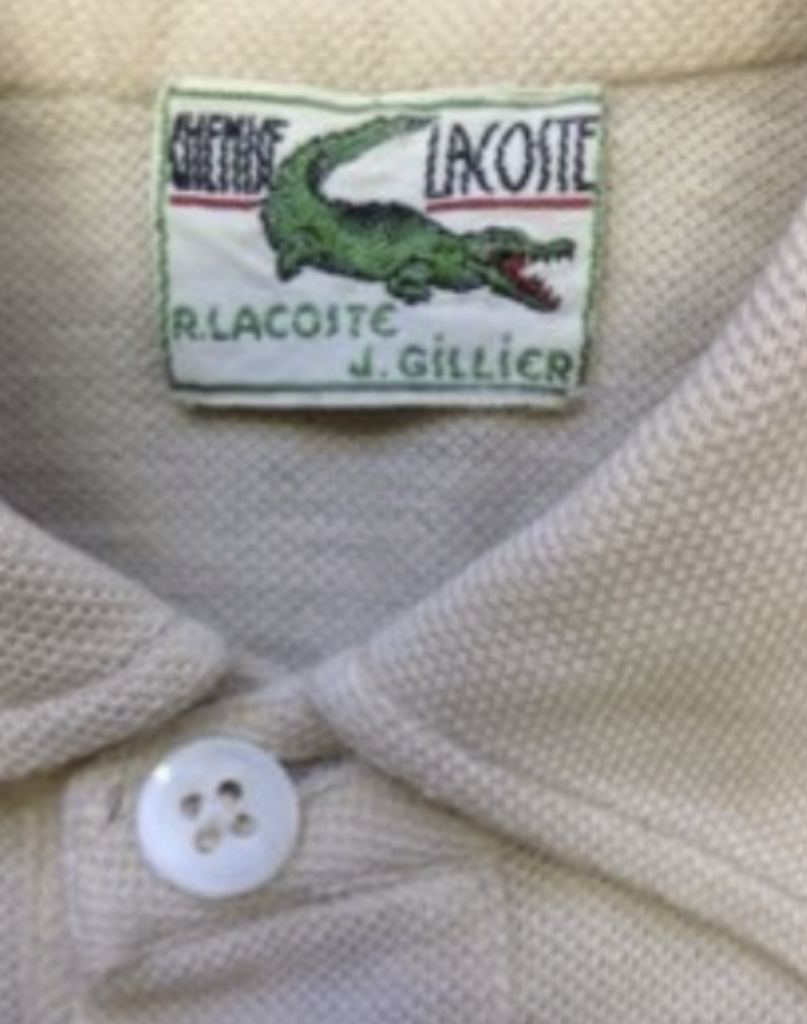
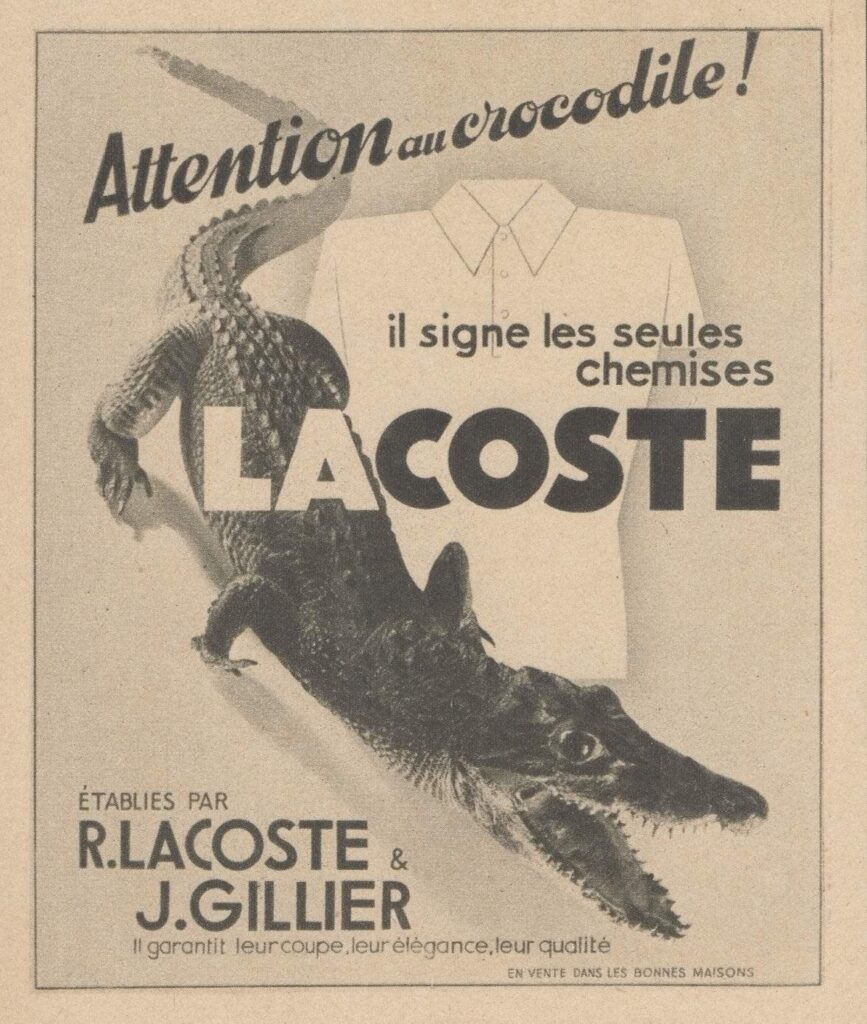
Advert 1937
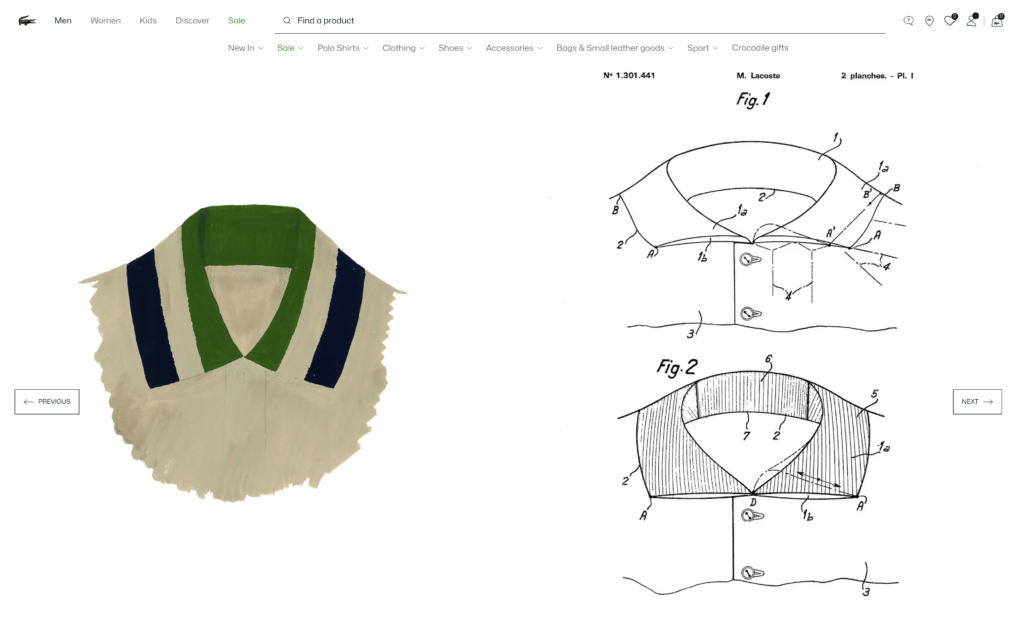
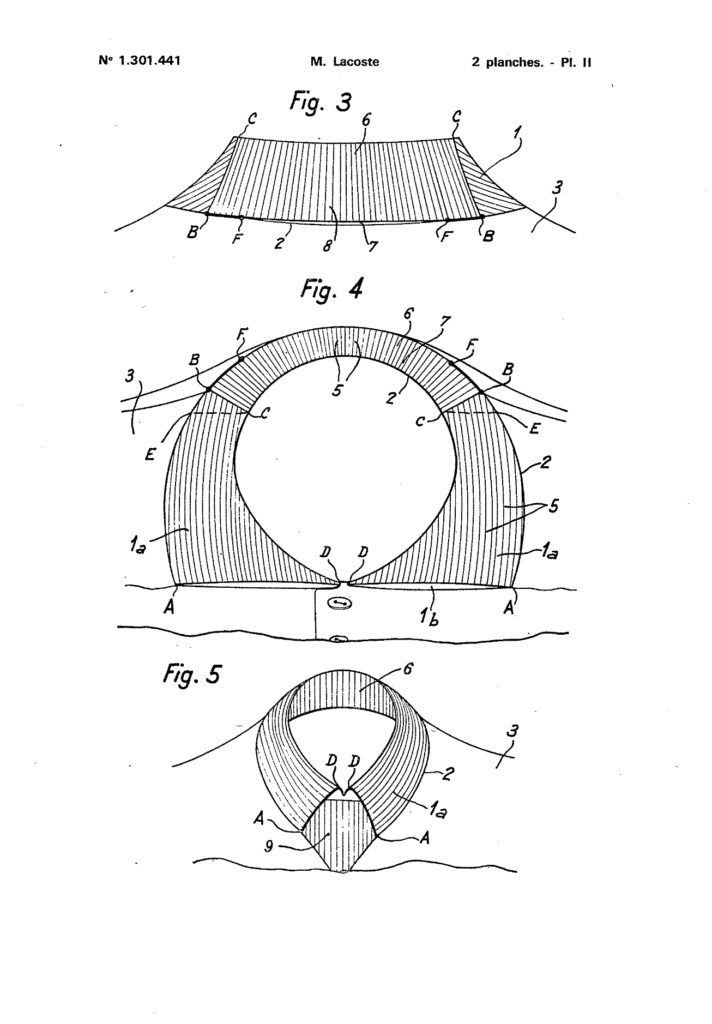
This patent drawing, which is often cited when explaining the history of Lacoste, is, I believe, one of the main reasons for the misconception that Lacoste “invented the polo shirt by adding a knitted collar to a T-shirt-style, crew-neck jersey.”
However, this patent was filed in 1961 and granted in 1962. Its purpose was not to “add a collar to a crew-neck jersey.” Rather, it concerned a collar construction in which elastic collar sections absorbed the tension created when the collar was pulled by a tightened necktie, thereby preventing wrinkling or gathering in the front of the shirt.
The patent does mention the use of rib-knitted fabric for the collar, but the important point is that this was not an invention of the knitted collar itself. It was an invention of a specific collar construction designed to solve a problem associated with wearing a necktie.
1. **Patent number**: FR1301441A
2. **Title of invention**: *Perfectionnements apportés aux chemises** “Improvements to shirts”
* More naturally: “Improvements in shirts”
3. **Inventor**: LACOSTE JEAN RENE
4. **Filing date / Priority date**: July 7, 1961
5. **Publication date**: August 17, 1962
6. **IPC classification**: A41B 3/00 (shirts and similar garments)
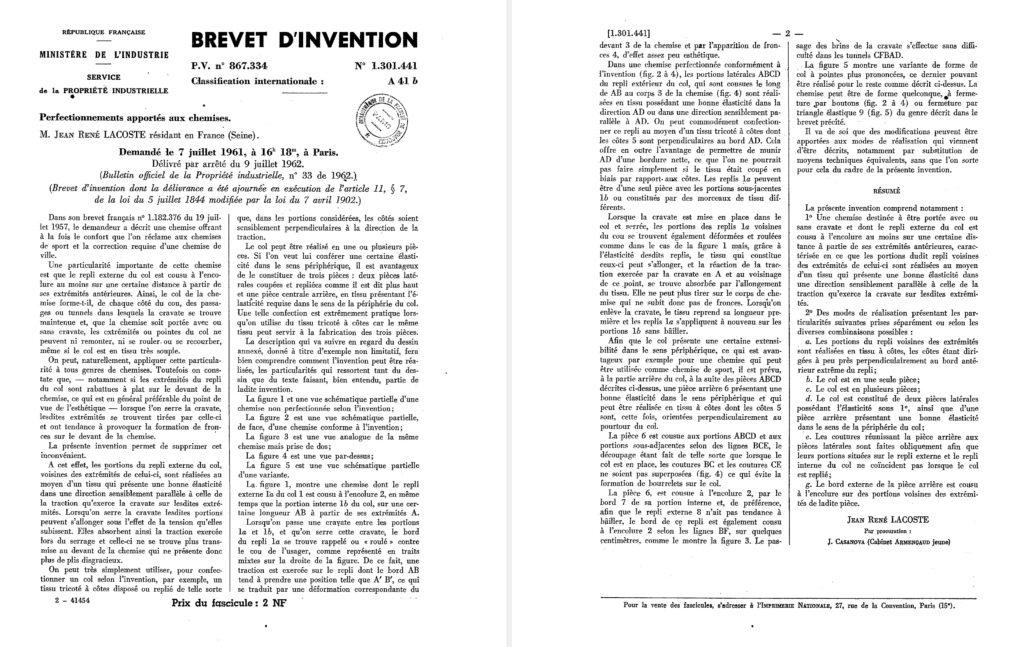
Perfectionnements apportés aux chemises.
Dans son brevet français n[deg] 1.182.376 du 19 juillet 1957, le demandeur a décrit une chemise offrant à la fois le confort que l’on réclame aux chemises de sport et la correction requise d’une chemise de ville.
Une particularité importante de cette chemise est que le repli externe du col est cousu à l’encolure au moins sur une certaine distance à partir de ses extrémités antérieures. Ainsi, le col de la chemise forme-t-il, de chaque côté du cou, des passages ou tunnels dans lesquels la cravate se trouve maintenue et, que la chemise soit portée avec ou sans cravate, les extrémités ou pointes du col ne peuvent ni remonter, ni se rouler, ou se recourber, même si le col est en tissu très souple.
On peut, naturellement, appliquer cette particularité à tous genres de chemises. Toutefois on constate que, – notamment si les extrémités du repli du col sont rabattues à plat sur le devant de la chemise, ce qui est en général préférable du point de vue de l’esthétique – lorsque l’on serre la cravate, lesdites extrémités se trouvent tirées par celle-ci et ont tendance à provoquer la formation de fronces sur le devant de la chemise.
La présente invention permet de supprimer cet inconvénient.
A cet effet, les portions du repli externe du col, voisines des extrémités de celui-ci, sont réalisées au moyen d’un tissu qui présente une bonne élasticité dans une direction sensiblement parallèle à celle de la traction qu’exerce la cravate sur lesdites extrémités. Lorsqu’on serre la cravate lesdites portions peuvent s’allonger sous l’effet de la tension qu’elles subissent. Elles absorbent ainsi la traction exercée lors du serrage et celle-ci ne se trouve plus transmise au devant de la chemise qui ne présente donc plus de plis disgracieux.
On peut très simplement utiliser, pour confectionner un col selon l’invention, par exemple, un tissu tricoté à côtes disposé ou replié dé telle sorte que, dans les portions considérées, les côtés soient sensiblement perpendiculaires à la direction de la traction.
Le col peut être réalisé en une ou plusieurs pièces. Si l’on veut lui conférer une certaine élasticité dans le sens périphérique, il est avantageux de le constituer de trois pièces : deux pièces latérales coupées et repliées comme il est dit plus haut et une pièce centrale arrière, en tissu présentant l’élasticité requise dans le sens de la périphérie du col.
Une telle confection est extrêmement pratique lorsqu’on utilise du tissu tricoté à côtes car le même tissu peut servir à la fabrication des trois pièces.
La description qui va suivre en regard du dessin annexé, donné à titre d’exemple non limitatif, fera bien comprendre comment l’invention peut être réalisée, les particularités qui ressortent tant du dessin que du texte faisant, bien entendu, partie de ladite invention.
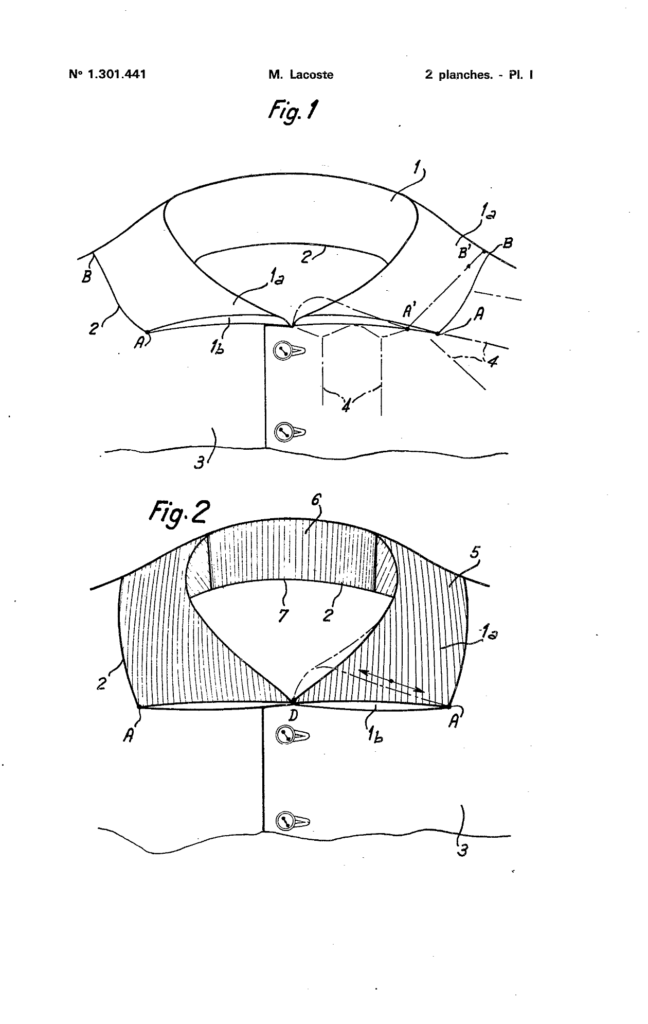
La figure 1 et une vue schématique partielle d’une chemise non perfectionnée selon l’invention; La figure 2 est une vue schématique partielle, de face, d’une chemise conforme à l’invention; La figure 3 est une vue analogue de la même chemise mais prise de dos; La figure 4 est une vue par-dessus; La figure 5 est une vue schématique partielle d’une variante.
La- figure 1, montre une chemise dont le repli externe 1a du col 1 est cousu à l’encolure 2, en même temps que la portion interne 1b du col, sur une certaine longueur AB à partir de ses extrémités A.
Lorsqu’on passe une crayate entre les portions la et 1b, et qu’on serre cette cravate, le bord du repli la se trouve rappelé ou roulé contre le cou de l’usager, comme représenté en traits mixtes sur la droite de la figure. De ce fait, une traction est exercée sur le repli dont le bord AB tend à prendre une position telle que A’ B’, ce qui se traduit par une déformation correspondante du
devant 3 de la chemise et par l’apparition de fronces 4, d’effet assez peu esthétique. Dans une chemise perfectionnée conformément à l’invention (fig. 2 à 4), les portions latérales ABCD du repli extérieur du col, qui sont cousues le long de AB au corps 3 de la chemise (fig. 4)’ sont réalisées en tissu possédant une bonne élasticité dans la direction AD ou dans une direction sensiblement parallèle à AD. On peut commodément confectionner ce repli au moyen d’un tissu tricoté à côtes dont les côtes 5 sont perpendiculaires au bord AD. Cela offre en outre l’avantage de permettre de munir AD d’une bordure nette, ce que l’on ne pourrait pas faire simplement si le tissu était coupé en biais par rapport. aux côtes. Les replis la peuvent être d’une seul pièce avec les portions sous-jacentes 1b ou constitués par des morceaux de tissu différents. Lorsque la cravate est mise en place dans le col et serrée, les portions des replis la voisines du cou se trouvent également déformées et roulées comme dans le cas de la figure 1 mais, grâce à l’élasticité desdits replis, le tissu qui constitue ceux-ci peut s’allonger, et la réaction de la traction exercée par la cravate en A et au voisinage de ce .point, se trouve absorbée par l’allongement du tissu. Elle ne peut plus tirer sur le corps de chemise qui ne subit donc pas de fronces. Lorsqu’on enlève la cravate, le tissu reprend sa longueur première et les replis la s’appliquent à nouveau sur les portions 1b sans bâiller. Afin que le col présente une certaine extensibilité dans le sens périphérique, ce qui est avantageux par exemple pour une chemise qui peut être utilisée comme chemise de sport, il est prévu, à la partie arrière du col, à la suite des pièces ABCD décrites ci-dessus, une pièce arrière 6 présentant une bonne élasticité dans le sens périphérique et qui peut être réalisée en tissu à côtes dont les côtes 5 sont, cette fois, orientées perpendiculairement au pourtour du col. La pièce 6 est cousue aux portions ABCD et aux portions sous-adjacentes selon des lignes BCE, le découpage étant fait de telle sorte que lorsque le col est en place, les coutures BC et les coutures CE ne soient pas superposées (fig. 4) ce qui évite la formation de bourrelets sur le col. La pièce 6, est cousue à l’encolure 2, par le bord 7 de sa portion interne et, de préférence, afin que le repli externe 8 n’ait pas tendance à bâiller, le bord de ce repli est également cousu à l’encolure 2 selon les lignes BF, sur quelques centimètres, comme le montre la figure 3. Le passage des brins de la cravate s’effectue sans difficulté dans les tunnels CFBAD.
– La figure 5 montre une variante de forme de col à pointes plus prononcées, ce dernier pouvant être réalisé pour le reste comme décrit ci-dessus. La
ture ,par boutons (fig. 2 à 4) ou fermeture par triangle élastique 9 (fig. 5) du genre décrit dans le brevet précité. Il va de soi que des modifications peuvent être apportées aux modes de réalisation qui viennent d’être décrits, notamment par substitution de moyens techniques équivalents, sans que l’on sorte pour cela du cadre de la présente invention. RÉSUMÉ La présente invention comprend notamment :
1. Une chemise destinée à être portée avec ou sans cravate et dont le repli externe du col est cousu à l’encolure au moins sur une certaine distance à partie de ses extrémités antérieures, caractérisée en ce que les portions dudit repli voisines des extrémités de celui-ci sont réalisées au moyen d’un tissu qui présente une bonne élasticité dans une direction sensiblement parallèle à celle de la traction qu’exerce la cravate sur lesdites extrémités.
2. Des modes de réalisation présentant les particularités suivantes prises séparément ou selon les diverses combinaisons possibles : a. Les portions du repli voisines des extrémités sont réalisées en tissu à côtes, les côtes étant dirigées à peu près perpendiculairement au bord antérieur extrême-du repli; b. Le col est en une seule pièce; c. Le col est en plusieurs pièces; d. Le col est constitué de deux pièces latérales possédant l’élasticité sous 1[deg], ainsi que d’une pièce arrière présentant une bonne élasticité dans le sens de la périphérie du col; e. Les coutures réunissant la pièce arrière aux pièces latérales sont faites obliquement afin que leurs portions situées sur le repli externe et le repli interne du col ne coïncident pas lorsque le col est replié ; g. Le bord externe de la pièce arrière est cousu à l’encolure sur des portions voisines des extrémités de ladite pièce.
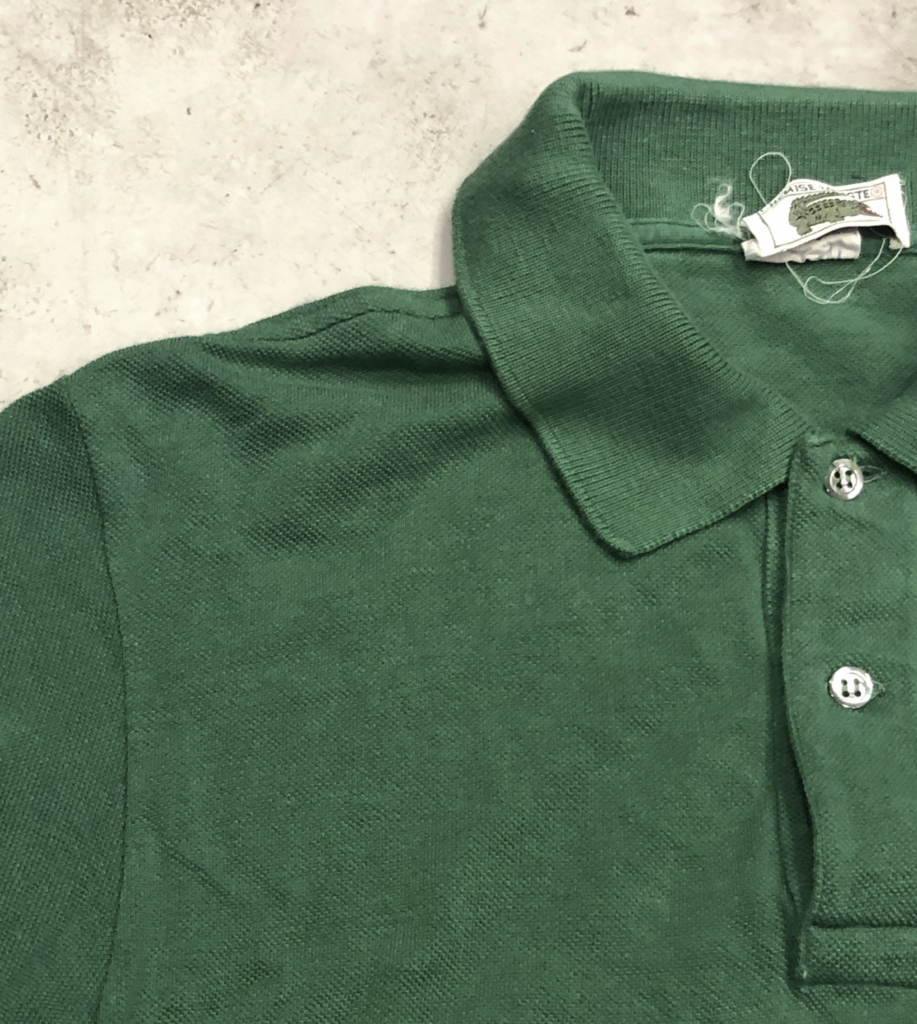
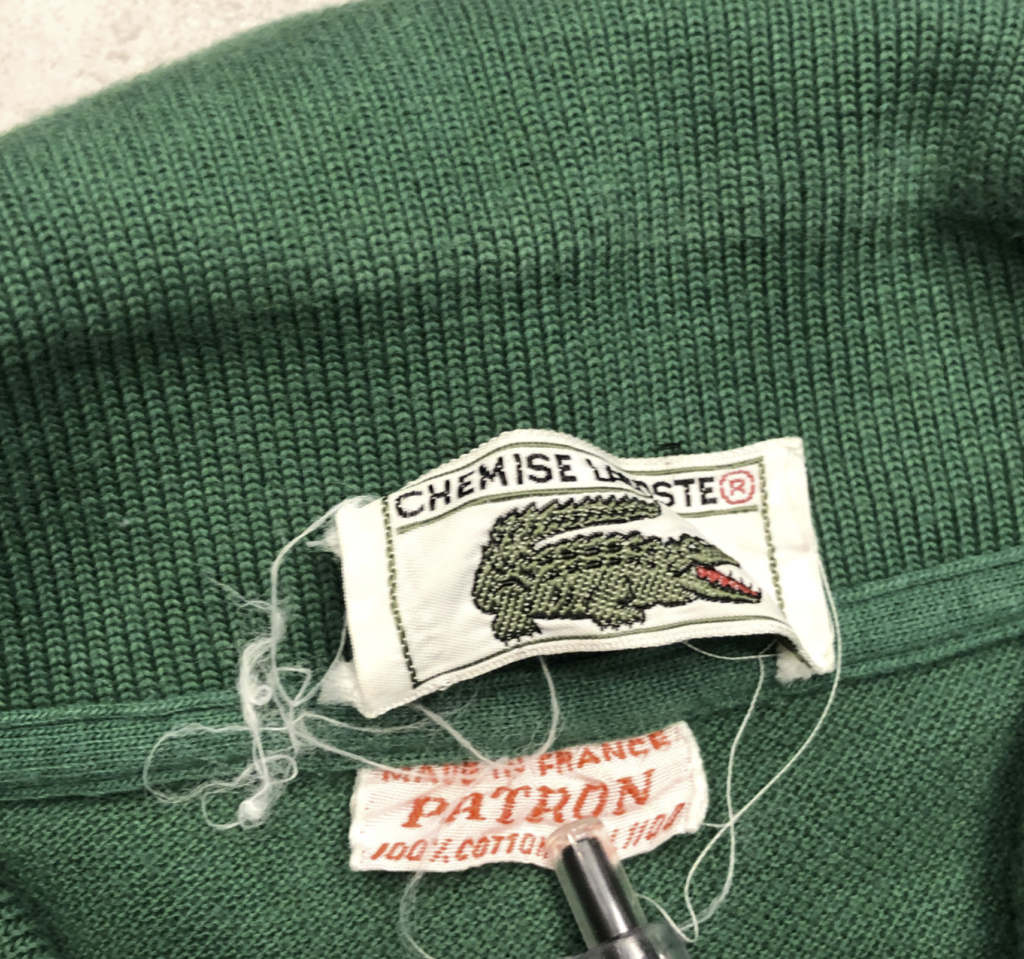
1960s~70s LACOSTE
I came across the following claim in one of Japan’s largest and most influential business newspapers:
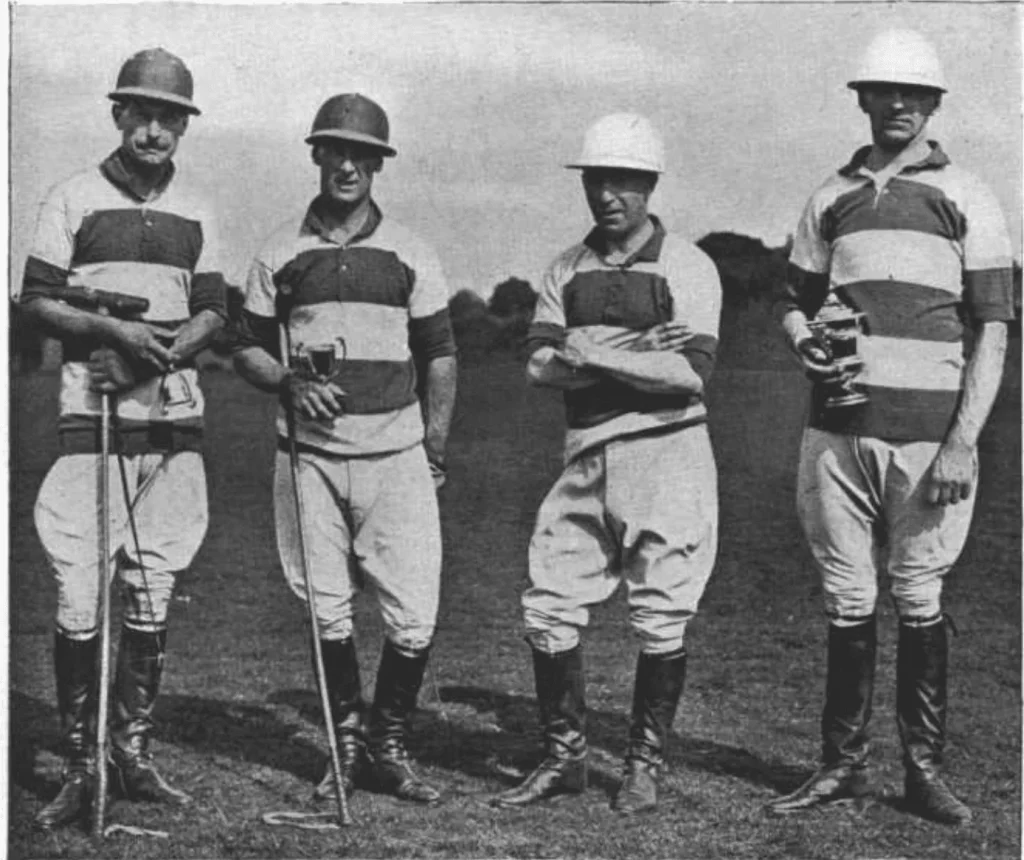
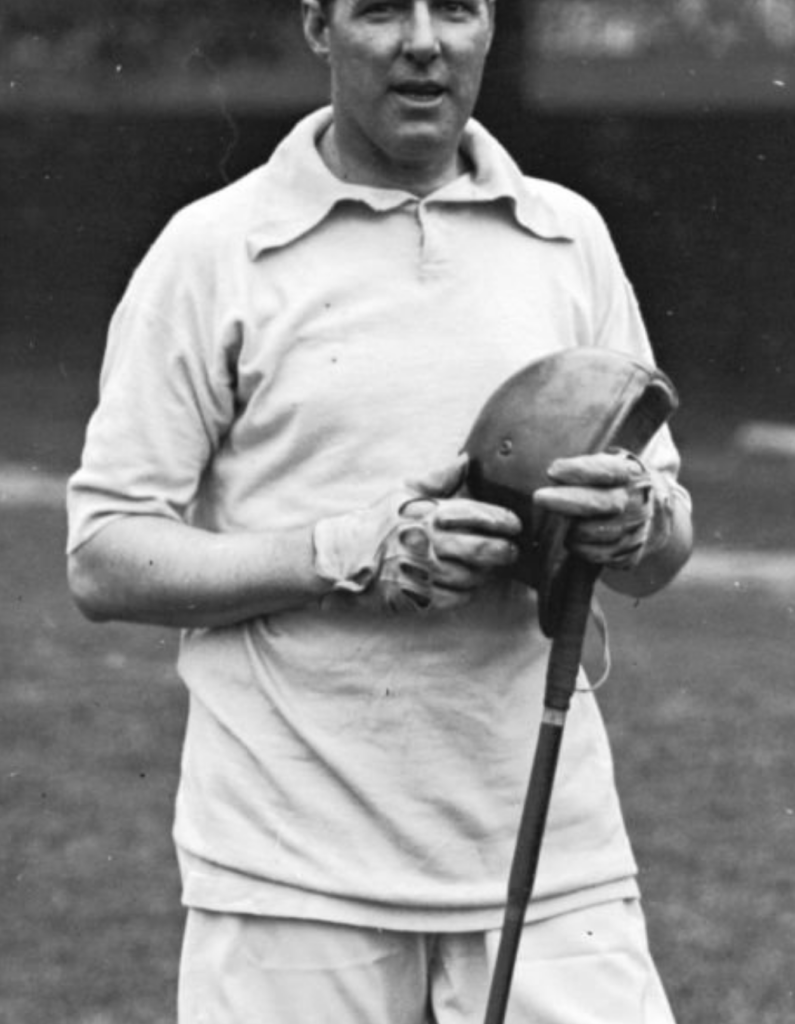
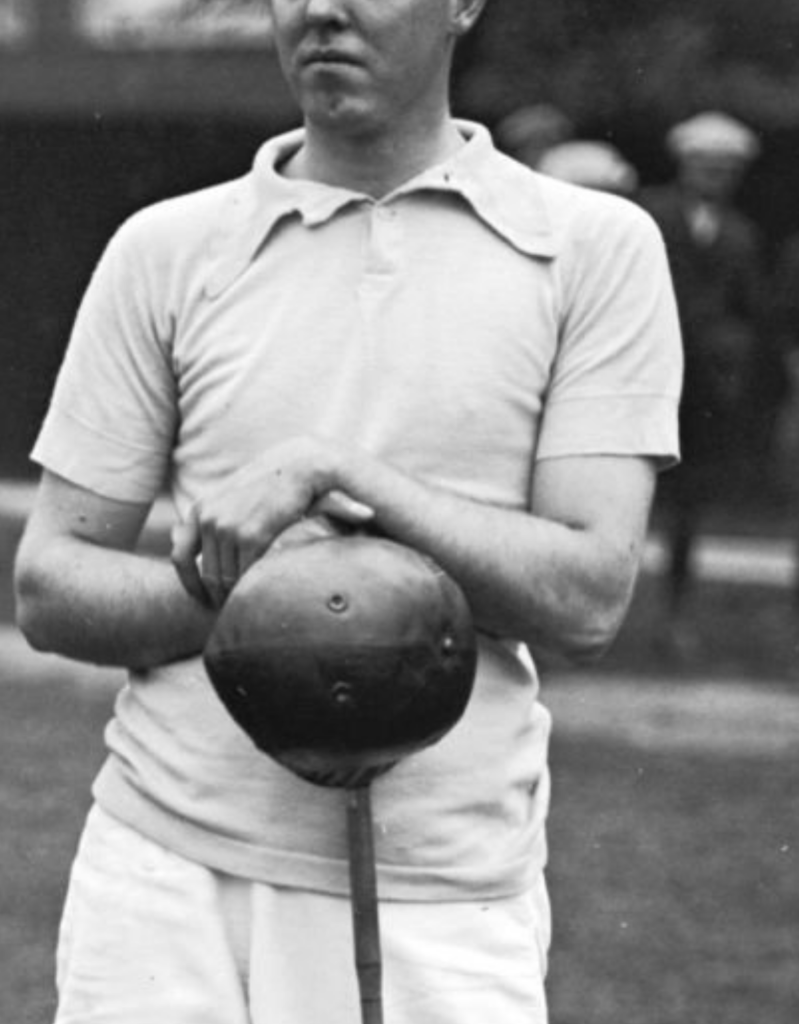
“In 1927, polo players were only wearing T-shirt-like, collarless shirts, and I [René Lacoste] added a collar to create what became the modern polo shirt.” It is extremely frustrating to see a journalist at such a major Japanese financial newspaper repeat and perpetuate a claim like this as historical fact.
There is ample historical evidence showing that collared shirts were already being worn by polo players before 1927. A newspaper of this stature should not simply reproduce a brand’s retrospective account without properly examining the historical record.
If you are going to write about the history of something, please do the research properly before publishing it. This is not a matter of interpretation; it is a matter of checking the historical evidence.
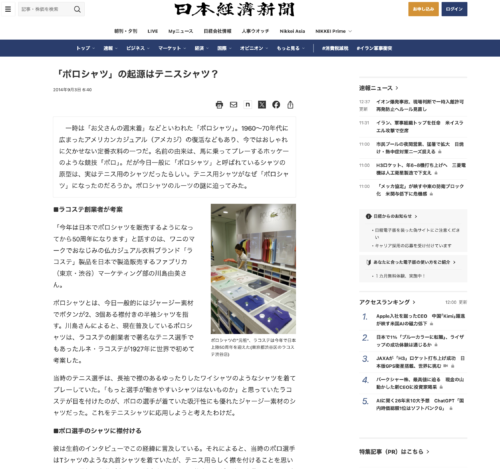
Invented by the Founder of Lacoste
“This year marks the 50th anniversary of the sale of polo shirts in Japan,” says Yumi Kawashima of the marketing department at Fabrica, the Tokyo-based company that manufactures and sells products in Japan for the French casualwear brand Lacoste, famous for its crocodile logo.
Today, the term “polo shirt” generally refers to a short-sleeved shirt made of jersey fabric, with a collar and two or three buttons at the neck. According to Kawashima, the polo shirt in its present, widely recognized form was first invented in the world in 1927 by René Lacoste, the founder of Lacoste and a celebrated tennis player.
At the time, tennis players competed in loose-fitting, long-sleeved, collared shirts resembling dress shirts. Lacoste, wondering whether there might be a shirt that would allow players greater freedom of movement, turned his attention to the jersey shirts worn by polo players, which were also highly absorbent. He conceived the idea of adapting this type of shirt for tennis.
Adding a Collar to the Polo Player’s Shirt
Lacoste himself discussed the origins of the shirt in an interview during his lifetime. According to his account, polo players at the time wore round-necked shirts resembling T-shirts, and he came up with the idea of adding a collar to make the garment more suitable for tennis. At first, he had the shirt made for his own use while playing matches under the blazing sun. It attracted attention, however, and he later established a manufacturing company with a friend. In 1933, the shirt was introduced to the general public.
The product was originally called the “Chemise Lacoste” (“Lacoste Shirt”), and its first advertising slogan read: “For tennis, golf, and marine sports.” Curiously, there was no mention whatsoever of polo. Even today, polo shirts are sometimes referred to as “tennis shirts” or “golf shirts.” But why, then, did they come to be known as “polo shirts” in the first place? Kawashima says that “when Lacoste began selling them in Japan 50 years ago, they were already being called polo shirts.” To investigate further, we consulted a specialist reference work: Esquire’s Encyclopedia of 20th Century Men’s Fashions, published in the United States in 1973 and devoted to the history of twentieth-century menswear. According to the book, shirts corresponding to today’s polo shirt were already being worn by tennis players in Britain and the United States by 1928, and were being sold by many American retailers. The term “polo shirt” is said to have begun spreading around this period.
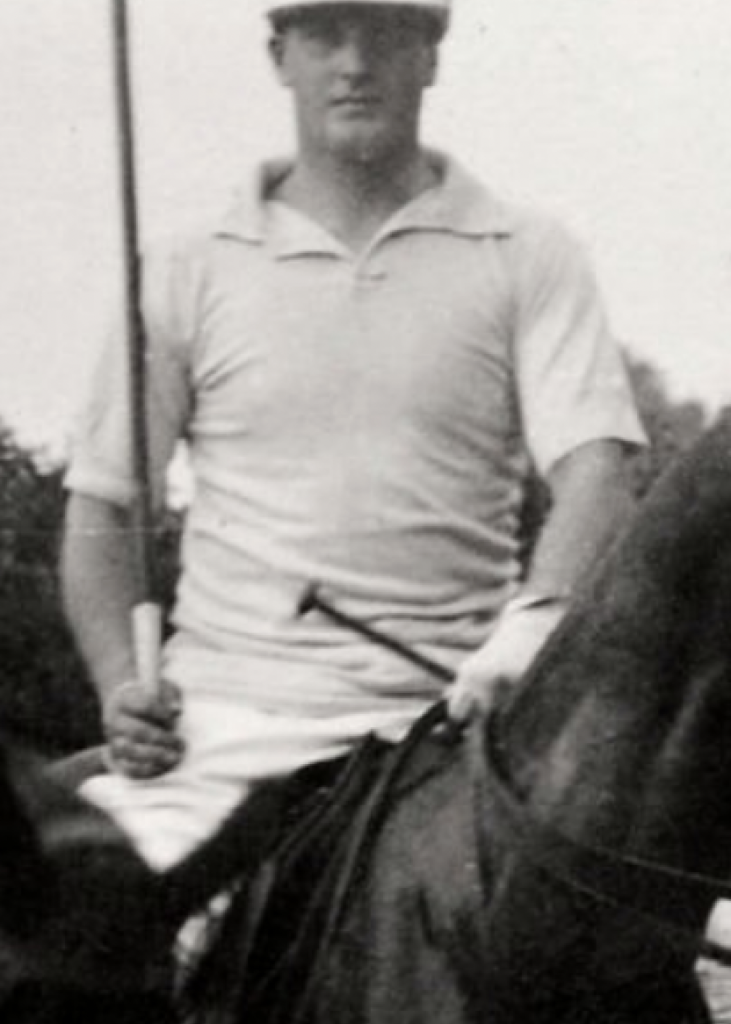
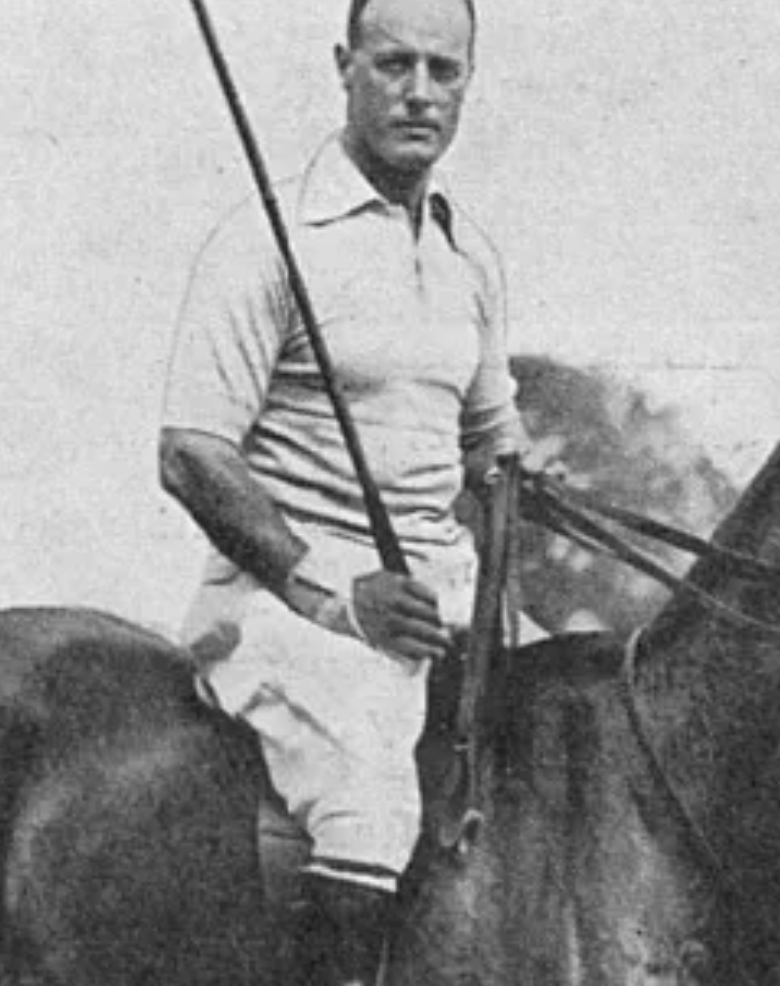
There has long been a theory that polo players themselves had originally worn similar shirts. Lacoste’s own comments, however, suggest another possible interpretation.
The modern polo shirt may initially have spread through its popularity among tennis players. Later, when polo players themselves began wearing the same style, polo effectively appropriated the garment from tennis, and the name “polo shirt” came to prevail.
recommend
RENÉ LACOSTE:
hIS TRUE HISTORY
McGREGOR
An American giant, not just DRIZZLER®
We know little about the history of the brand McGregor. Evolving alongside American sportswear and linking functionality with everyday life, it mirrors twentieth-century popular culture. It may seem outdated compared to today’s sports manufacturers, yet its trajectory—shaped by material innovations and corporate transformations—offers a key to understanding the American apparel industry. Let us now explore the history of this American giant, once the world’s largest sports brand.