SERO
Another orthodox path.
JAN – 2026 20 MINS READ
Sero Shirtmakers was established in New Haven, Connecticut. Its founding is often regarded as part of a broader turning point in the development of Ivy League–style American shirtmaking. The founder, Morris Shapiro, had previously been associated with Bernard Gantmacher at the Par-Ex Shirt Company. While the Gantmacher family went on to launch GANT, Shapiro established Sero as an independent venture, pursuing his own approach to shirtmaking.
As you know, New Haven is a cornerstone of Ivy style history.
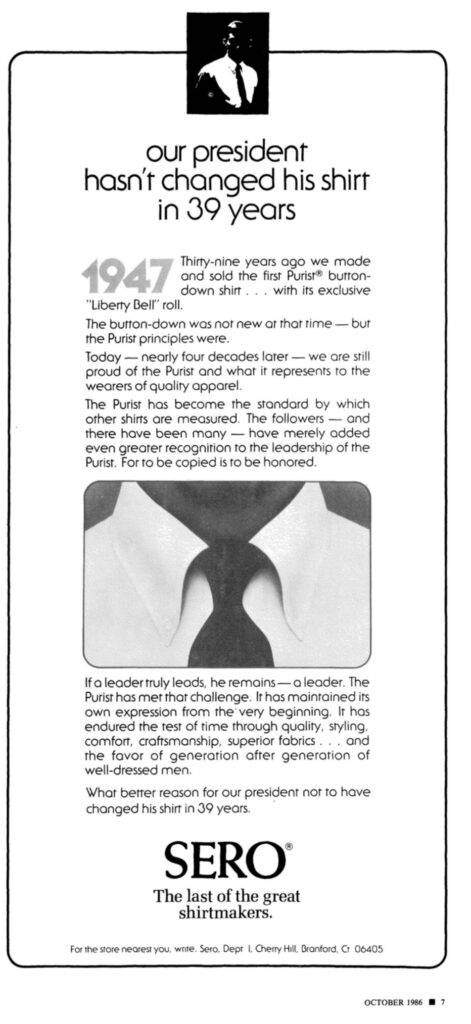
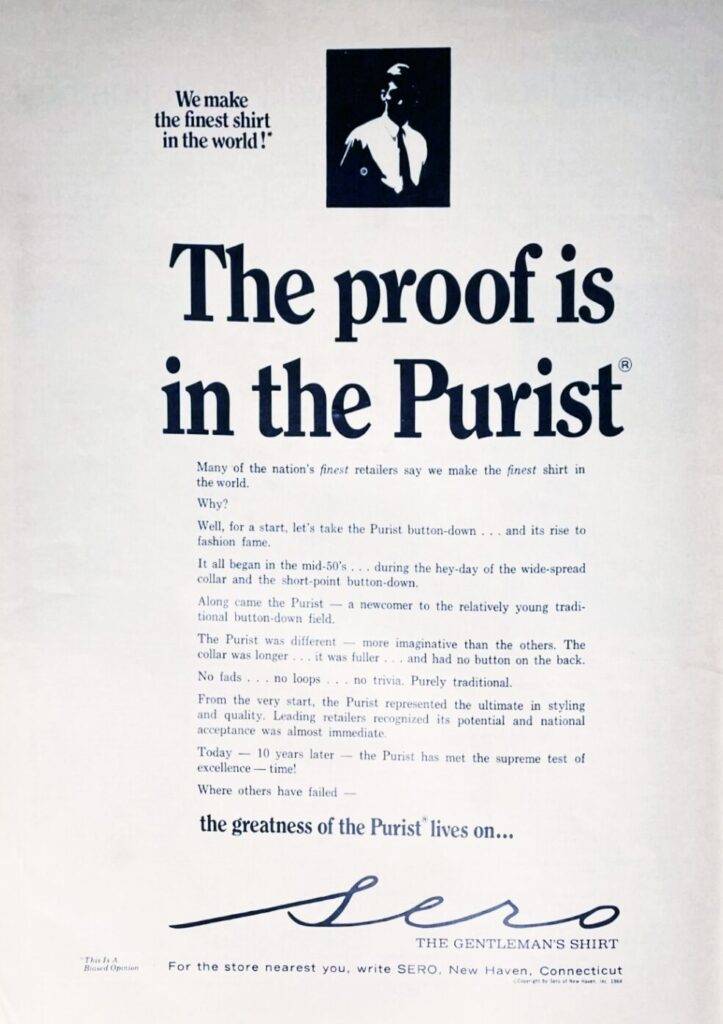
It is more than just a university town; it is the place where shirts, ties, tailoring, and campus culture solidified into the “form” of American tradition. While J. Press and GANT took center stage at Yale, captivating generations of students and alumni, another shirtmaker played a vital, yet different role in the shadows. That maker is SERO. Before the brand established its own name, its founder, Morris Shapiro, had already introduced the first “Purist” button-down shirt. A 1986 advertisement captured their philosophy with striking directness:
“Our president hasn’t changed his shirt in 39 years.”
“Thirty-nine years ago we made and sold the first Purist® button-down shirt…”
“The Purist has become the standard by which other shirts are measured.”
This was not a claim to follow fashion, but a declaration of a shirtmaker whose mission was to remain the definitive standard. If GANT symbolized the Ivy League on the front stage, SERO existed in the space between retailer and factory, quietly upholding the tradition as the ultimate “standard product.” Let us take a closer look at SERO—the “other” shirtmaker that supported the Ivy legacy from the other side.
1928
In post–World War I New York, Morris Shapiro was involved in the shirt-manufacturing trade and worked in collaboration with Bernard Gantmacher. In the early 1920s, the two are said to have established the Par-Ex Shirt Company in Brooklyn, New York (as noted in retrospective accounts, although primary documentation has not yet been identified).
In the late 1920s(27 or 28) —Par-Ex is understood to have relocated its manufacturing operations to New Haven, Connecticut.
At the time, New Haven was known as a center of the shirt industry, supported by a skilled sewing workforce.The Par-Ex Shirt Company did not operate under a consumer-facing brand, but functioned as a dedicated manufacturer producing shirts for retail clients.
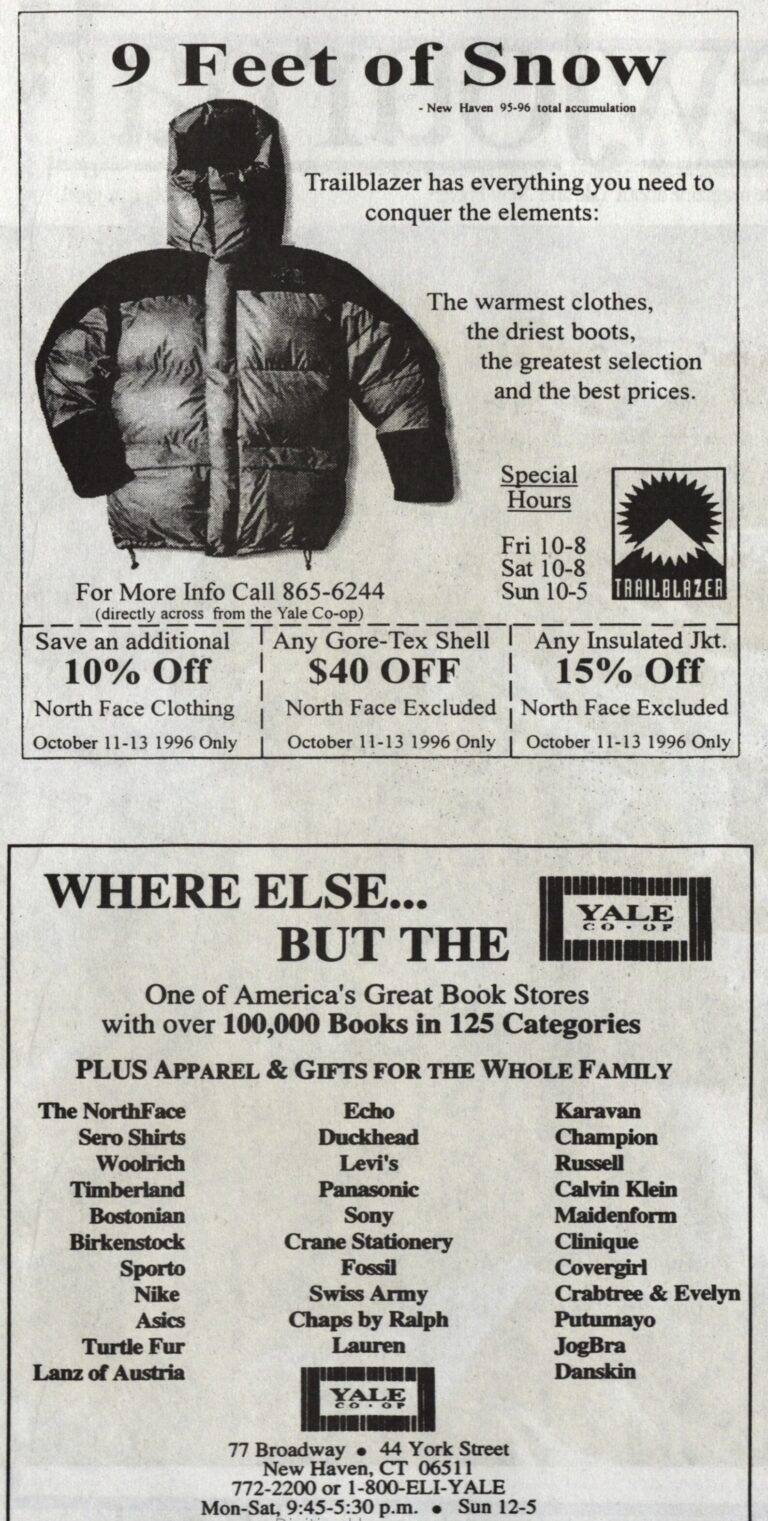
Trade accounts and memoirs mention that Par-Ex supplied shirts to retailers such as Brooks Brothers, J. Press, and the Yale Co-op, indicating that the company was recognized within the industry as a manufacturing entity capable of meeting the standards of high-end retailers.
Par-Ex Shirt Company was established in the early 1920s in Brooklyn, New York, by Bernard Gantmacher and Morris Shapiro as a purely manufacturing-oriented enterprise without a consumer-facing brand. From the outset, the company operated as a contract factory, supplying dress shirts to department stores, retailers, and private labels rather than selling under its own name—a model that would today be described as OEM or white-label production. Within this framework, the value of Par-Ex lay not in brand narrative, but in production discipline, consistency of quality, and technical reliability.
Around 1927, Par-Ex relocated its manufacturing operations to Wooster Street in New Haven, Connecticut. At the time, New Haven was one of the principal centers of the shirt industry in the northeastern United States, supported by a large and highly skilled garment workforce, much of it drawn from Italian immigrant communities. Through this move, Par-Ex became embedded in what could be described as a “factory city” industrial ecosystem, in which labor, material supply, and retail and wholesale networks were structurally interconnected, further reinforcing the company’s identity as a manufacturing-driven enterprise.
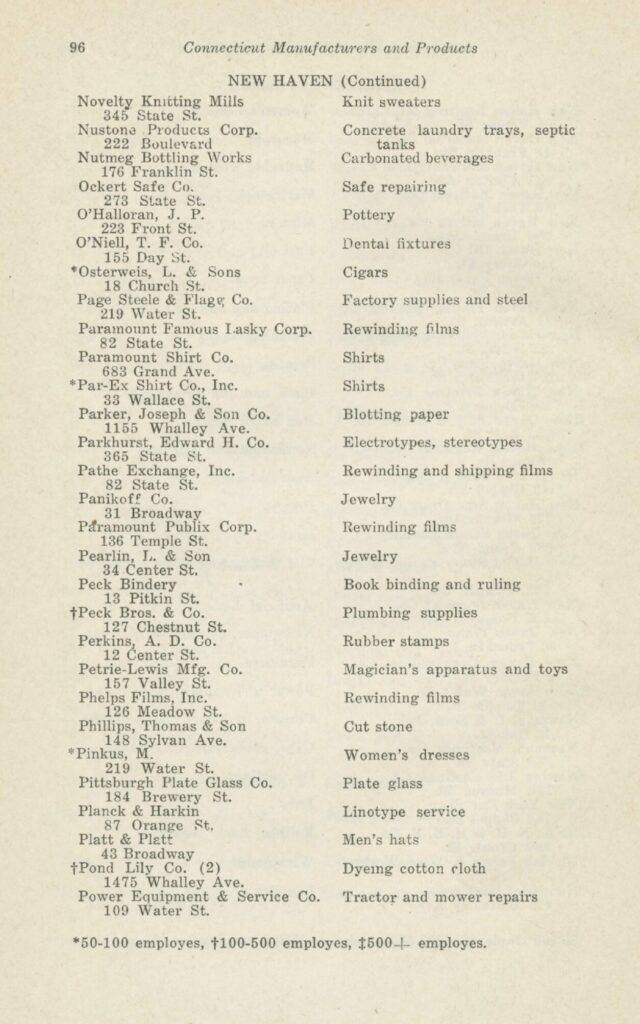
List of Connecticut manufacturers and their products. 1930/31
During the Second World War, production had to be sustained under conditions of material rationing and fluctuating labor availability, yet Par-Ex is reported to have continued supplying shirts to prominent retailers such as Brooks Brothers and J. Press, as well as to university-affiliated outlets including the Yale Co-op. From a SERO-side perspective, Par-Ex in this era functioned not as a visible brand, but as a standard-setting producer operating behind the scenes, supporting what would later be recognized as the foundations of Ivy style. The continuity of form, fit, and construction in these shirts was maintained not by trademarks, but by the factory floor itself.
After the war, as the American ready-to-wear market expanded rapidly and casualization and national distribution networks took hold, differences in strategic outlook within Par-Ex began to surface. With the increasing involvement of Bernard Gantmacher’s sons, Marty and Elliot, a vision gained momentum that extended beyond contract manufacturing toward the creation of an independent, consumer-facing brand capable of capturing not only manufacturing value but also cultural presence and market recognition. For Morris Shapiro, by contrast, shirtmaking remained centered on precision in production and the maintenance of quality standards, with greater significance placed on preserving a “correct” industrial benchmark than on pursuing market dominance through branding. This divergence in values gradually developed into a decisive tension within the partnership.
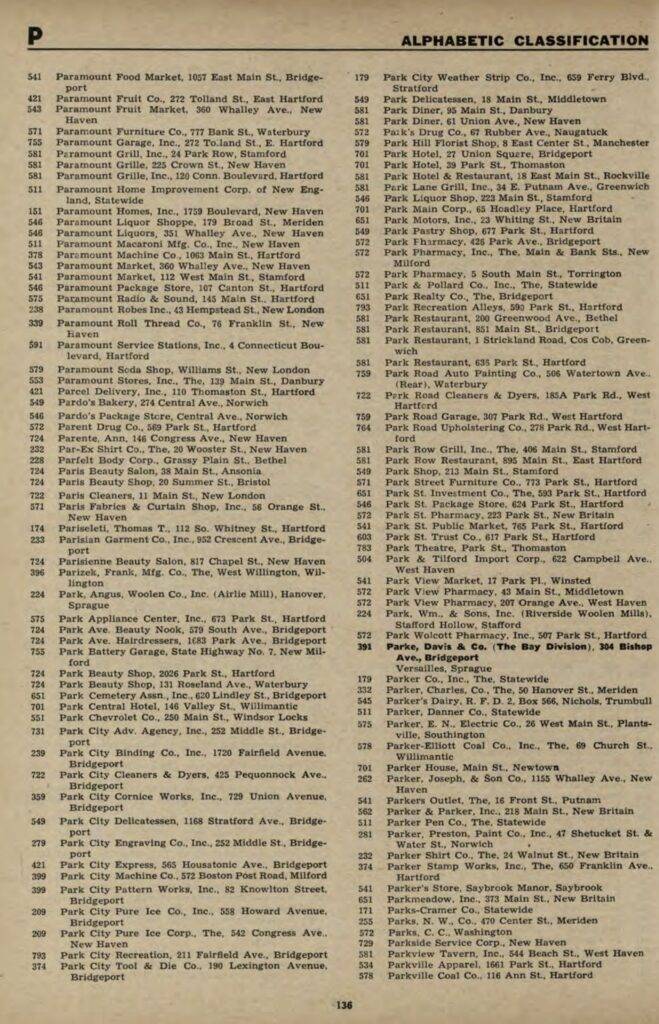
According to the 1942 records, it is established as a fact that Par-Ex was already operating out of 20 Wooster St. during the early stages of World War II.
PAR-EX SHIRT FACTORY IN NEWHAVEN
[Research Record: The Origins of Par-Ex Shirts, Inc. and Isadore S. Horowitz]
■ Source:
The Cumulative Daily Digest of Corporation News, Vol. 2 (1928)
■ 1928 Record: Birth of the Corporation
This source records that in 1928, Par-Ex Shirts, Inc. was registered in the State of Connecticut as a new incorporation.
・Incorporation: Formally incorporated in 1928.
・Principal Officer: Isadore S. Horowitz is explicitly listed as the official incorporator and principal representative at the time of formation.
・Location: New Haven, Connecticut (162 James Street listed as the operating address).
■ Profile of Isadore S. Horowitz
In this source, Horowitz appears as a prominent figure within New Haven’s Jewish business community.
・Community Network: At the time, the apparel industry—particularly in New York and New Haven—was shaped by strong networks of Jewish immigrants and their descendants, and Horowitz occupied a central position within this network.
・Public-Facing Authority: He held the social standing and practical authority to handle external affairs such as financing, legal matters, and negotiations with government and military agencies. His presence enabled Par-Ex to establish itself as one of the region’s leading manufacturing centers.
・Historical Role: Even after the company’s relocation to “50 Greene Street” noted in records from 1963, he continued to preserve the Par-Ex name, carrying its technical expertise and professional connections forward into the broader tradition of New Haven shirtmaking—including the lineage that would later encompass SERO. He can be regarded as a “true key figure” in the industrial history of the region.
1st Official Corporate Seat: New Haven
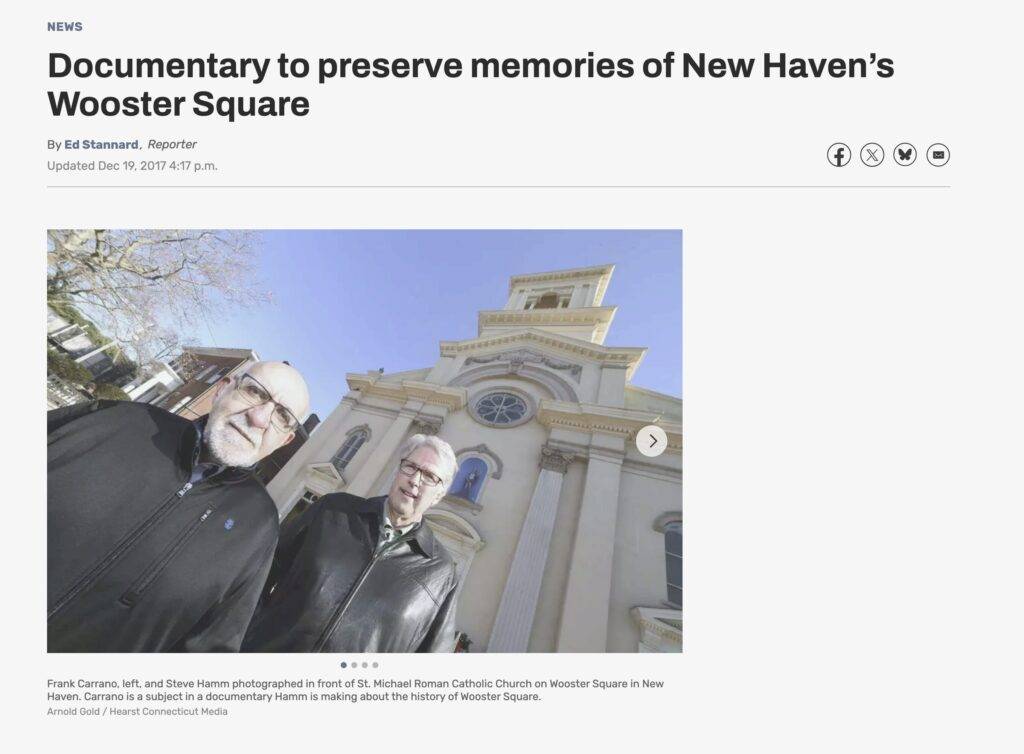
Following the end of World War II, the next generation returned to New Haven, each embarking on a distinct path. According to testimony from Richard Press (former owner of J. Press), Bernard Gantmacher arranged for his sons, Marty and Elliot, to serve an apprenticeship in the stockroom of the J. Press store on York Street upon their return from service. This was not a training in sewing techniques, but rather a period of immersion in the “front stage” of the retail world—a firsthand opportunity to absorb the tastes and preferences of the Yale student body.
Meanwhile, Morris’s son, Seymour Shapiro, led a carefree student life, later humorously remarking in his own memoirs that he had “majored in being expelled.” However, carrying with him a firsthand sensibilities of the Ivy League atmosphere, he immersed himself in the rigorous production environment of his father Morris’s factory during the late 1940s. It is reasonable to consider that the fusion of these two elements—his innate understanding of student tastes and the uncompromising manufacturing discipline instilled by his father—formed the practical foundation for what would later become SERO’s hallmark “Purist” standard.
In 1948, immediately preceding the formal dissolution of the partnership in 1949, the Par-Ex Shirt Company was embroiled in a fierce confrontation with the Amalgamated Clothing Workers of America (ACWA) over wage revisions and working conditions. As the garment industry in New Haven faced a surge of unionization, Par-Ex was documented as a primary party in legal proceedings seeking injunctions against strikes and picketing.It is highly probable that this specific industrial conflict served as the practical catalyst for the separation of the two families.
At the time, the legal authority (President) was held by Isadore S. Horowitz, a prominent figure in the New Haven Jewish business community who stood at the forefront of manufacturing operations and labor negotiations. The Shapiro family was deeply integrated into this “logic of the factory.” Conversely, for the Gantmacher family—who were increasingly focused on expanding into university markets and retail networks in the post-war era—the chronic labor disputes and inherent manufacturing risks likely appeared as a “shackle” hindering brand growth.Through the legal challenges of 1948, the divergence between the Shapiro side’s priority on “maintaining the factory” and the Gantmacher side’s strategic orientation toward “decoupling risk to prioritize the brand narrative” reached an irreparable stage.
The formal dissolution in 1949 was not a sudden personal fallout. Rather, it appears to have been the final result of a fundamental choice in business philosophy: whether to persist as a manufacturing entity or to evolve into a brand-centric enterprise, made in the face of the “pragmatic crisis” presented by the previous year’s labor disputes.
■ References and Sources
The following materials serve as the factual basis for this account:
The Cumulative Daily Digest ofCorporation News, Vol. 2 (1928)
・Primary documentation regarding the formal incorporation of Par-Ex Shirts, Inc.
in the State of Connecticut and the representative authority of Isadore S. Horowitz.
New Haven Register Archives
・Press records of labor disputes in New Haven’s shirt industry circa 1948,
including legal litigation between various manufacturers (including Par-Ex) and the ACWA.
Labor Relations Reference Manual, Vol. 22 (1948)
Official legal records and reports concerning labor practices, injunctions, and collective bargaining during the period.
1949
In 1949, the partnership between Morris Shapiro and Bernard Gantmacher, who had built the Par-Ex Shirt Company together, quietly came to an end.This year marked not merely a business separation, but a defining moment that can be understood as a generational and functional turning point in the American shirt industry. From the prewar years through the postwar period, Par-Ex had possessed two distinct faces. The Gantmacher family took charge of the “front stage,” working through university markets and retail networks—within the campus culture centered on Yale and institutions such as J. Press—to frame the shirt as a matter of style. By contrast, the Shapiro family remained with the factory, assuming responsibility for sewing and quality control, and for sustaining the product as a matter of structure—as a standard. The parting of 1949 was also a choice made by the next generation. Bernard Gantmacher’s sons stepped away from the logic of the factory and chose to establish the shirt not as a mere product, but as a brand. That year, they formally launched GANT of New Haven, using university cooperatives and specialty stores as their base, and moved onto the public stage as a symbol of Ivy style. Meanwhile, the Shapiro side did not relinquish its manufacturing lineage.
After the separation, Morris Shapiro preserved Par-Ex as a production base, and on the foundation of its craftsmanship and traditions of quality control, something would take form a few years later—brought to fruition by his son, Seymour Shapiro. What guided this path was not a pursuit of fashion, but a commitment to maintaining a standard through structure and technique. This division was neither defeat nor rupture. It was the outcome of two families, born from the same point of origin, choosing different roles through the will of a new generation. GANT became a brand defined by narrative, while SERO became a standard defined by structure, known primarily to those who understood the craft behind it.
1949, then, was the year in which the American Ivy shirt split into
the one that would be spoken about, and the one that would quietly support it.
MORE HISTORY OF GANT
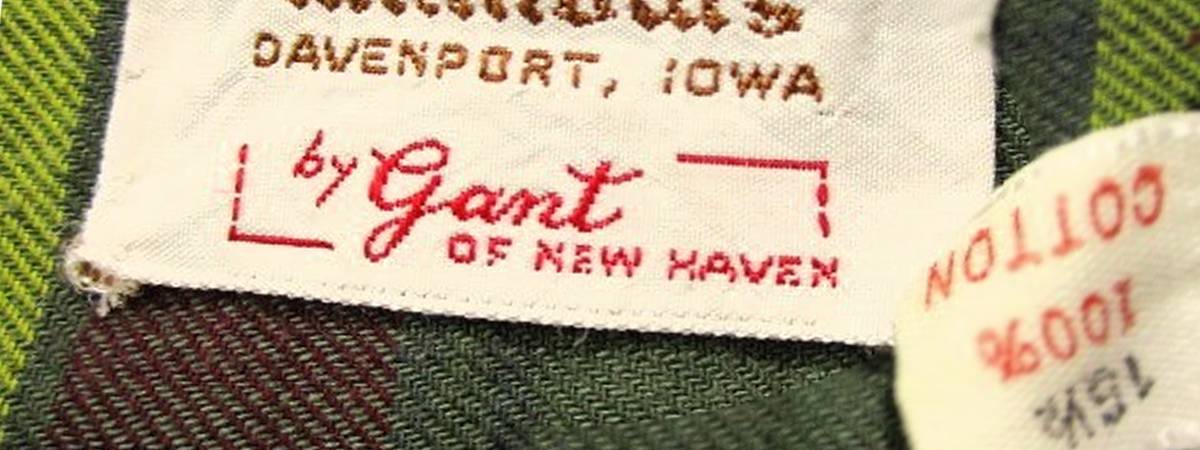
GANT
IVY’s Standard Shirt Maker
1950
1954
n 1954, the Sero Shirtmakers brand was finally launched. As many would recognize, the name “Sero” was naturally derived from the initials and name of its founder, Seymour Shapiro.
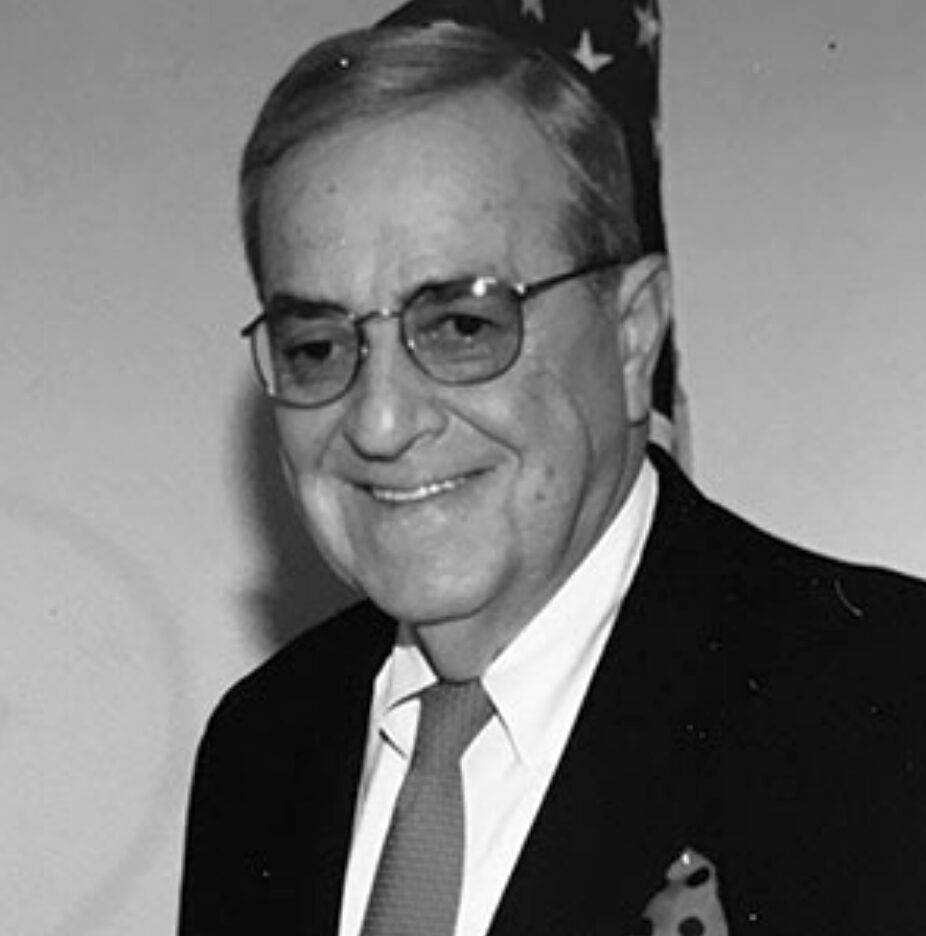
Born in Brooklyn in 1928, Seymour Shapiro was a true icon of American apparel. After humorously claiming he “majored in being expelled” from two universities, he channeled his rebellious energy into founding Sero Shirtmakers in 1954.
While it remains unclear from current records to what extent his father, Morris Shapiro, was involved in the factory operations at this stage, Seymour’s own memoirs credit the brand’s founding to his own initiative. It is highly possible that he drew inspiration from the success of GANT, which had branched off from Par-Ex in 1949 and seen rapid growth. This move by Seymour would eventually lead to a rivalry that split the Ivy League shirt market in two, with Sero becoming one of the most defining names of the era.
SERO 1956
1959 AD
1959 The New Yorker September 19, 1959
1960
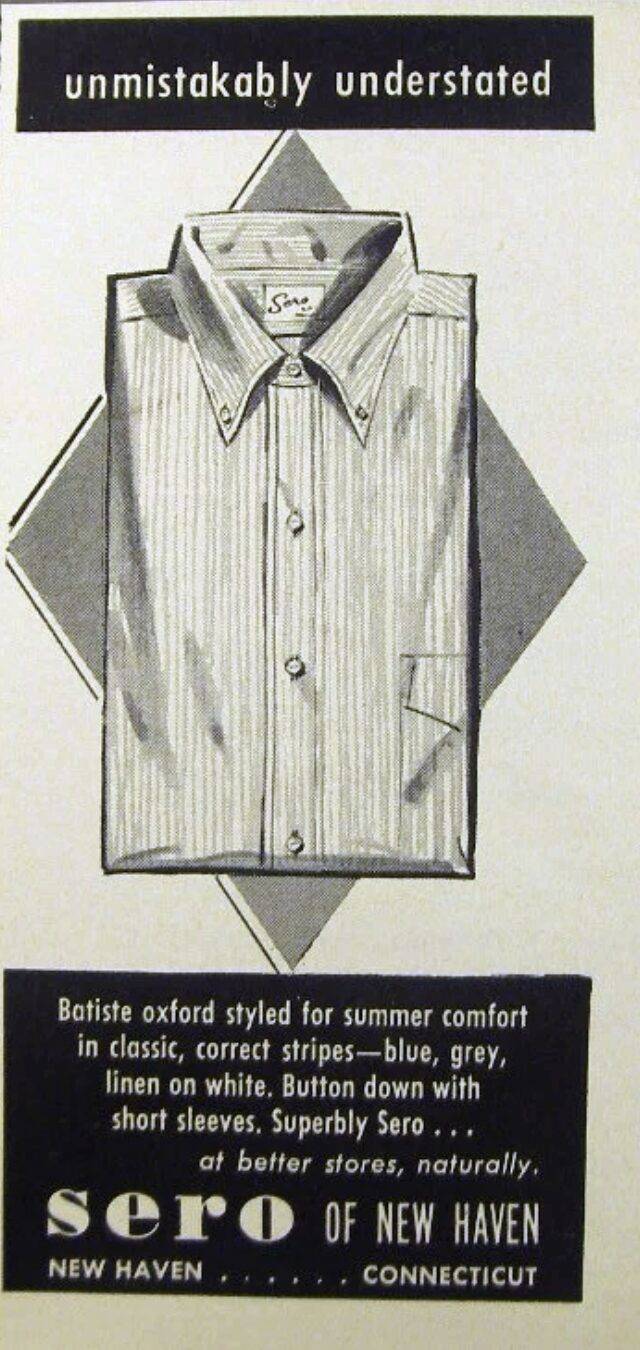
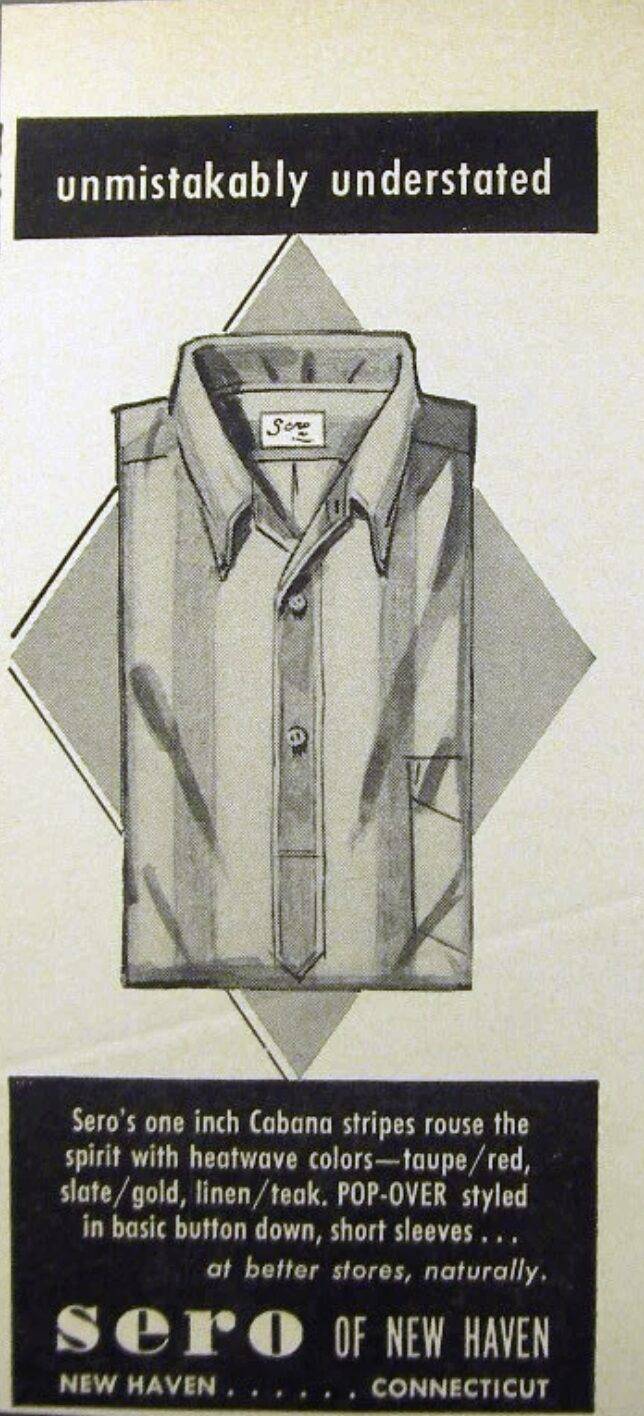
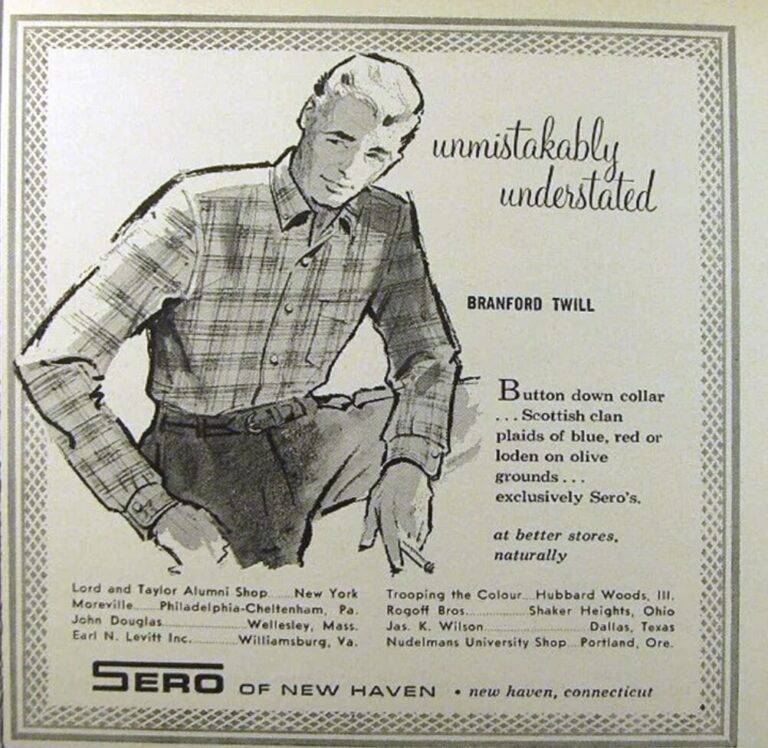
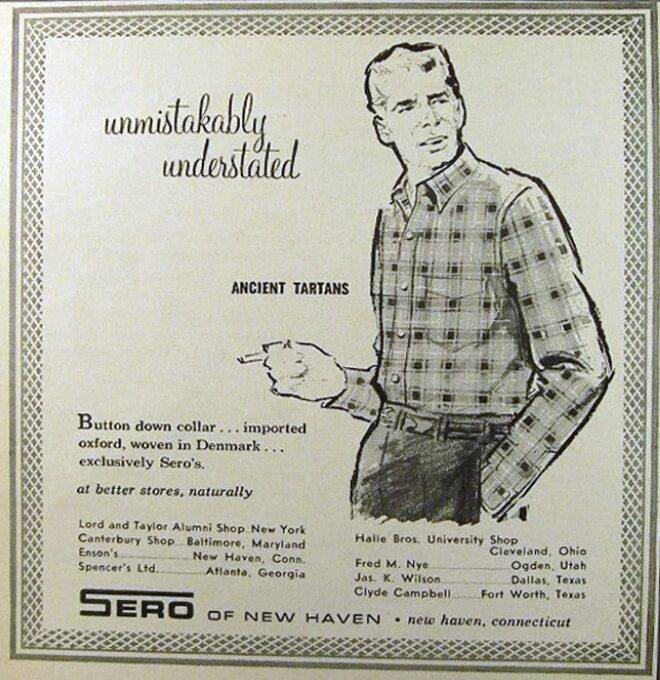
As the 1960s approached, the American Ivy scene entered a period of transition. At its center stood Sero Shirtmakers, based in New Haven. Even amid a phase of rapid expansion, what they steadfastly preserved was an aesthetic that refused to shout—a belief in restraint.
“Unmistakably Understated” — Pride in Restraint
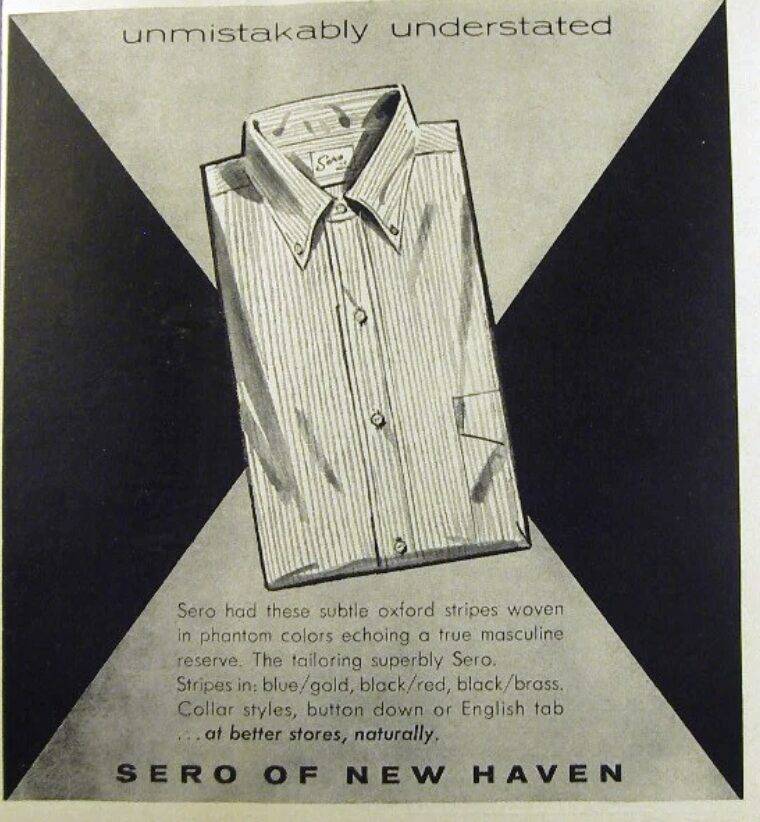
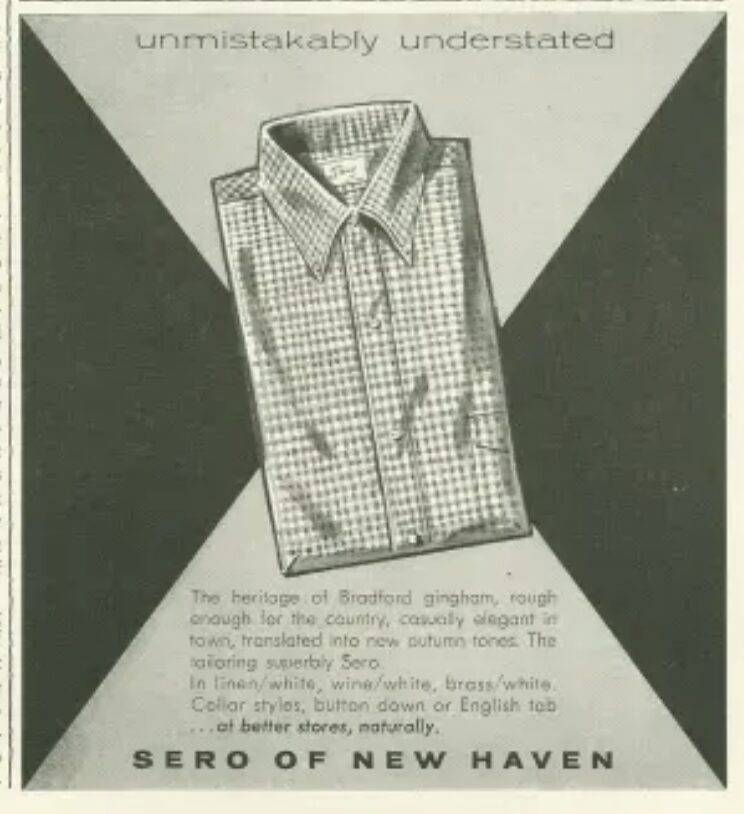
The message running through their advertisements was always “unmistakably understated.” It was the flip side of absolute confidence in meticulous tailoring—superbly tailored—and in a sense of color that others could not easily replicate.
Innovation in “Color” and “Weave”
Sero approached the “expression” of a shirt almost scientifically.
・Phantom Colors:Deep, dimensional “phantom” Oxford stripes in combinations such as blue/gold and black/red.
・Bradford Gingham:A fabric that transformed rustic country ruggedness into urban elegance through autumnal tones like wine/white and brass/white.
・Pride in Imported Materials: The adoption of Wamsutta’s finest Pima cotton, “PEEM ELITE,” in pursuit of exceptional softness and luster.
Expanding Style, with Intention
While keeping the button-down as its core tradition, Sero never stopped pushing forward.
A Range of Collars:
Alongside the classic button-down, the brand introduced what were then cutting-edge English tab collars and snap tabs, answering the diverse needs of modern gentlemen.
The Birth of LADY SERO:
Building on the rigorous tailoring of the men’s line, Sero launched a women’s collection that added a cinched waist and a touch of “feminine imagination,” expanding Ivy style beyond men alone and into something shared by families and partners.
The Destination Called “First Class”
From campaigns evoking jet-setters in partnership with TWA (Trans World Airlines) to placement in some 5,000 leading stores nationwide, the phrase tucked into the corner of their ads—“at better stores, naturally.”—carried the unwavering pride of Seymour Shapiro. Even as the company grew into a major manufacturer employing 1,500 people, it reflected a clear sense of where, and by whom, their shirts ought to be chosen.
A few years after this “quiet revolution,” the legendary “The Purist” would be released into the world as one of the definitive expressions of the button-down.
1960s PAR-EX FACTORY (SERO FACTORY)
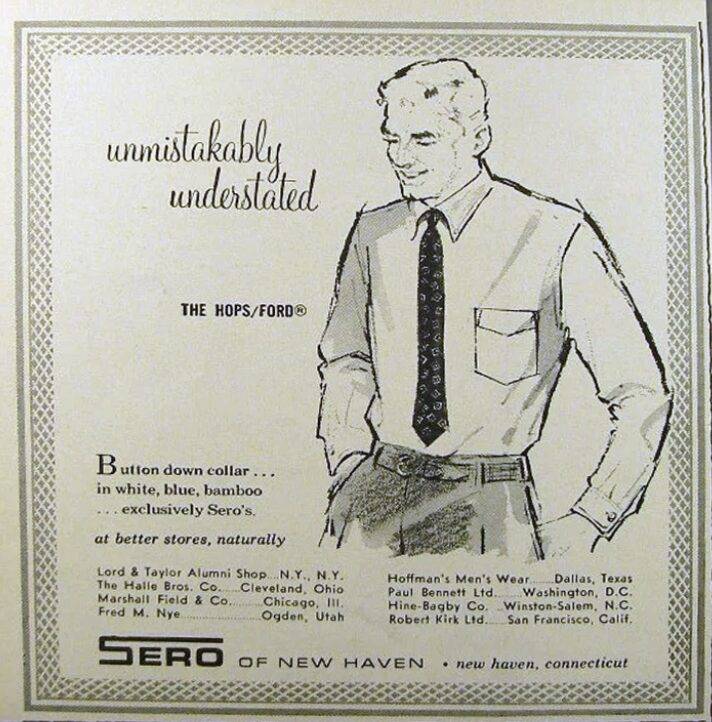
1960 AD
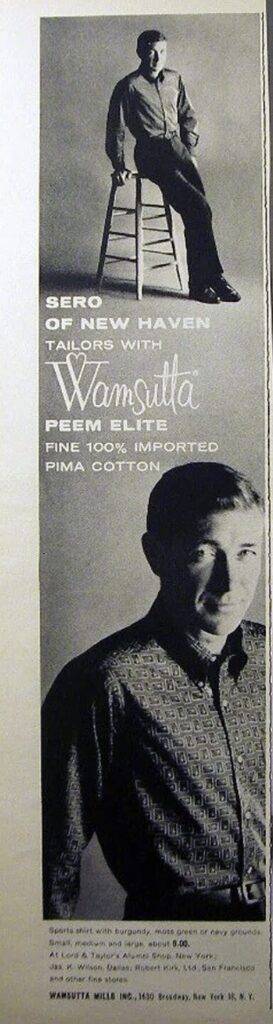
1960 AD
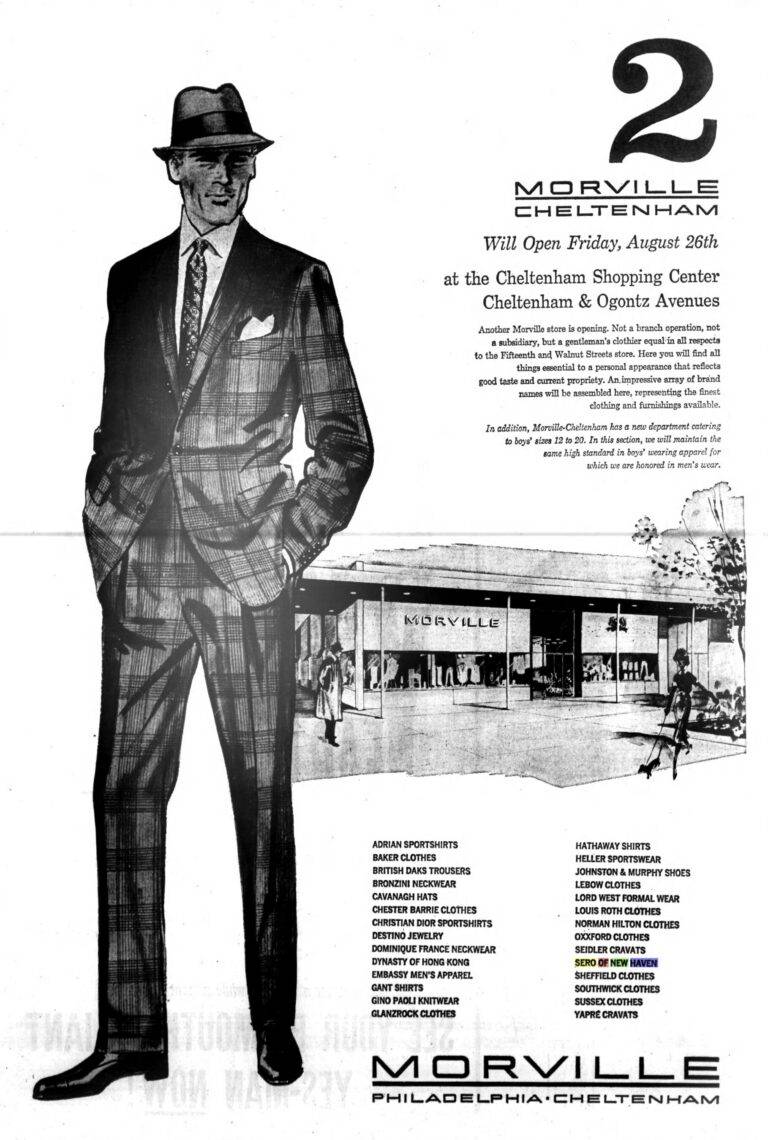
1960 Philadelphia PA Inquirer 1960 a – 6323.pdf
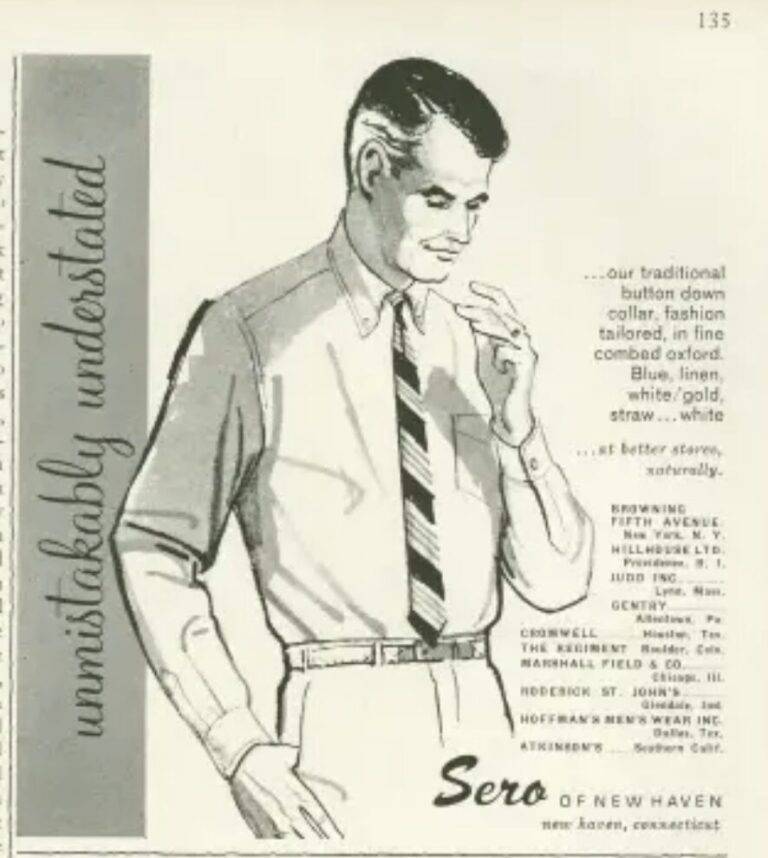
1961 The New Yorker September 9, 1961
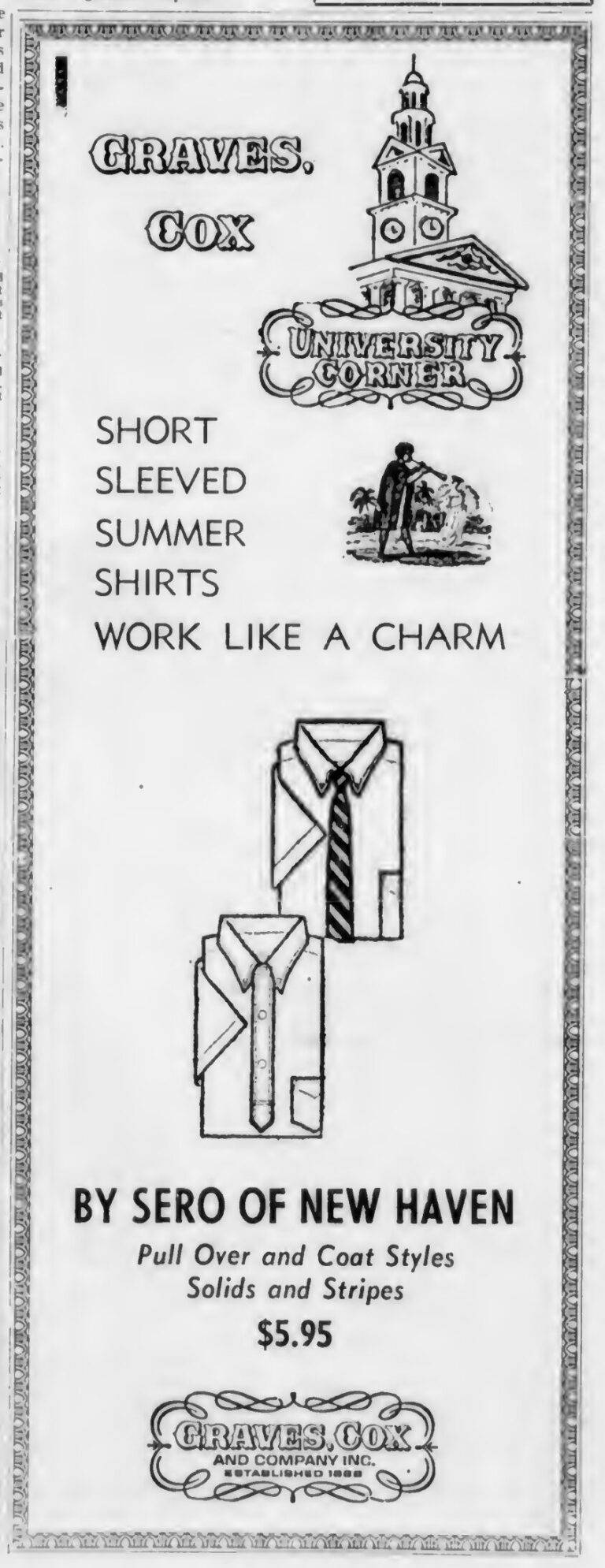
1961 The Kentucky KERNEL University of Kentucky Fair THURSDAY, MAY 11, 1961
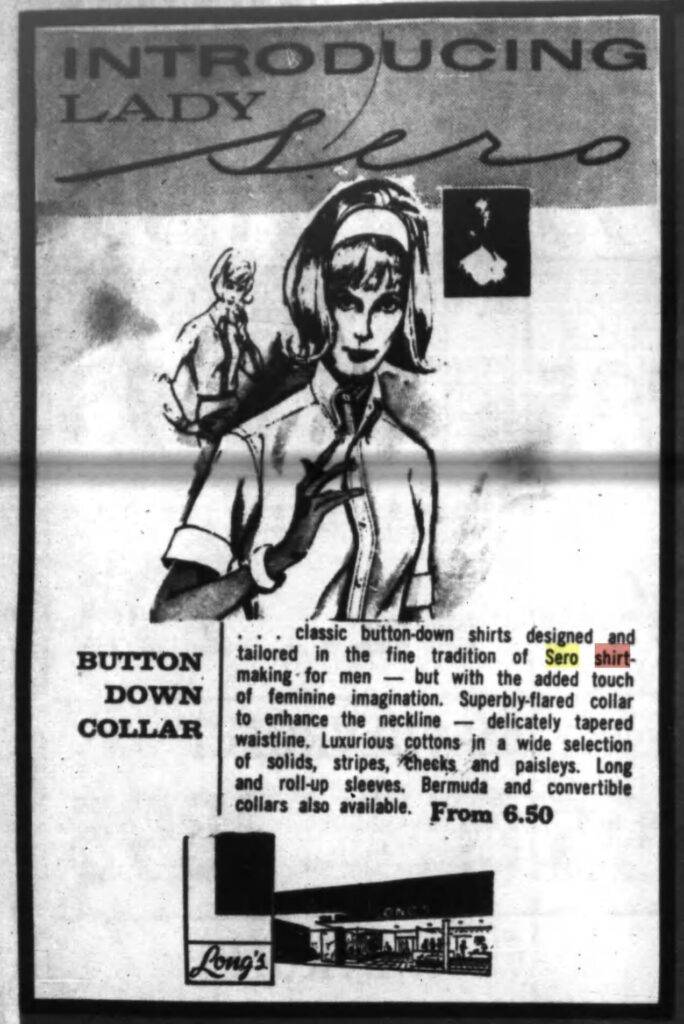
1961 The Kentucky KERNEL University of Kentucky Fair THURSDAY, MAY 11, 1961
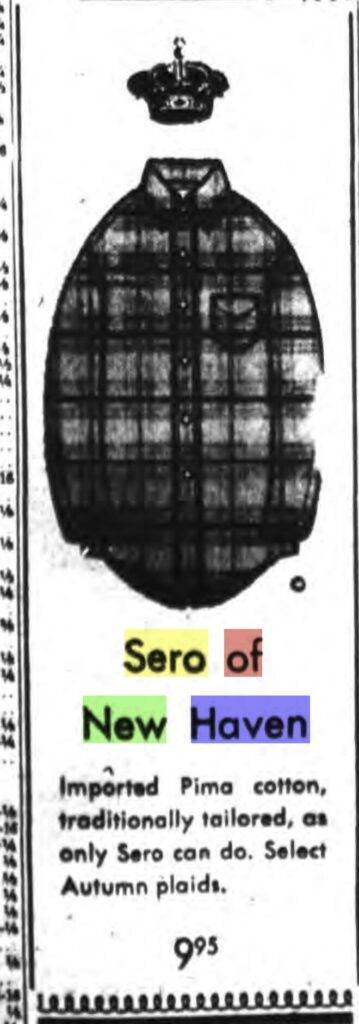
1962 Albany NY Knickerbocker News 1962 b – 2176.pdf
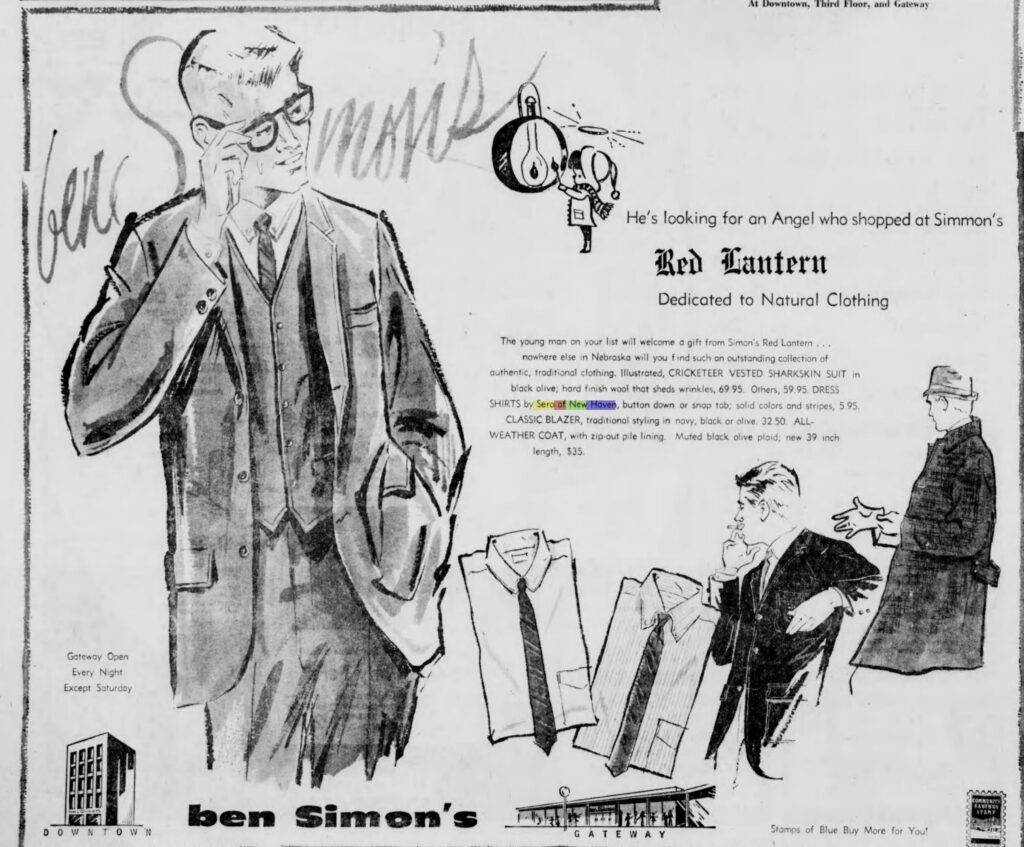
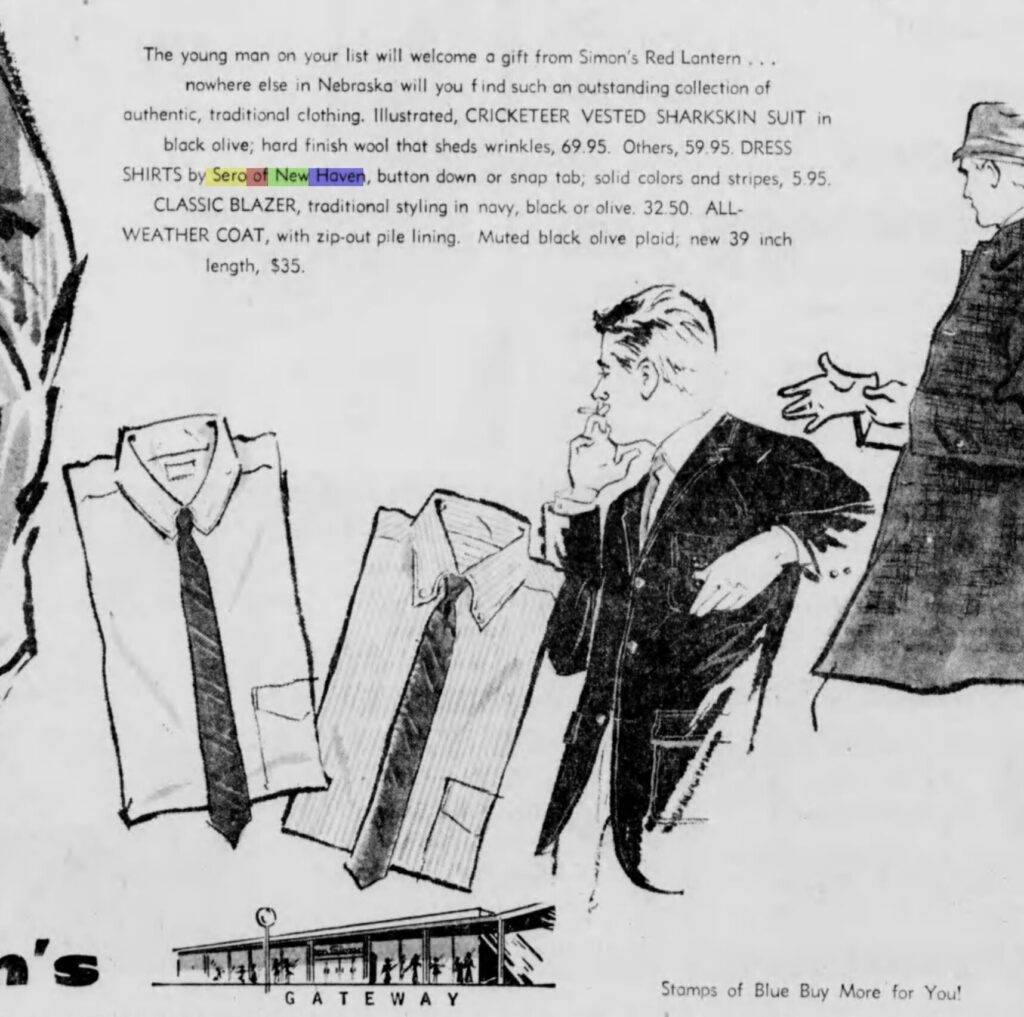
1962 Lincoln NB Star 1962-11-30_10.pdf
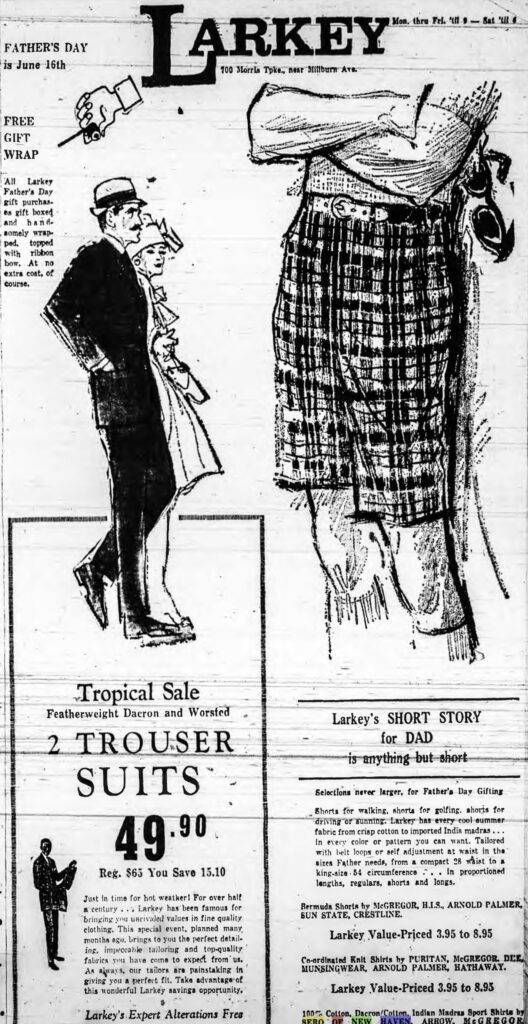
1963 Summet NJ Herald 1963 01905.pdf
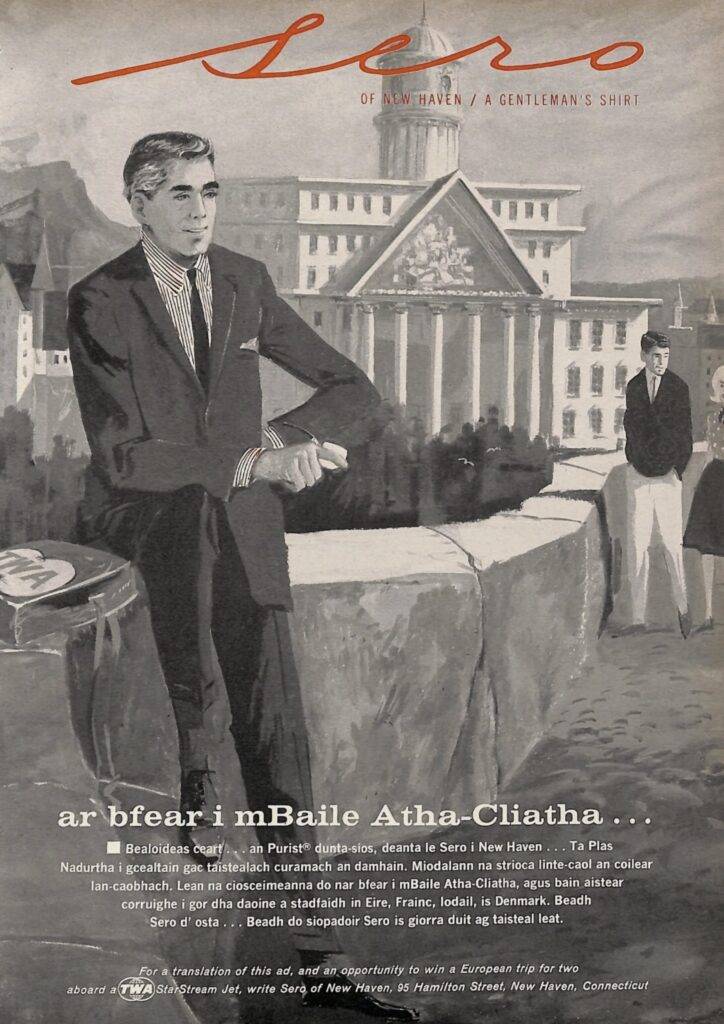
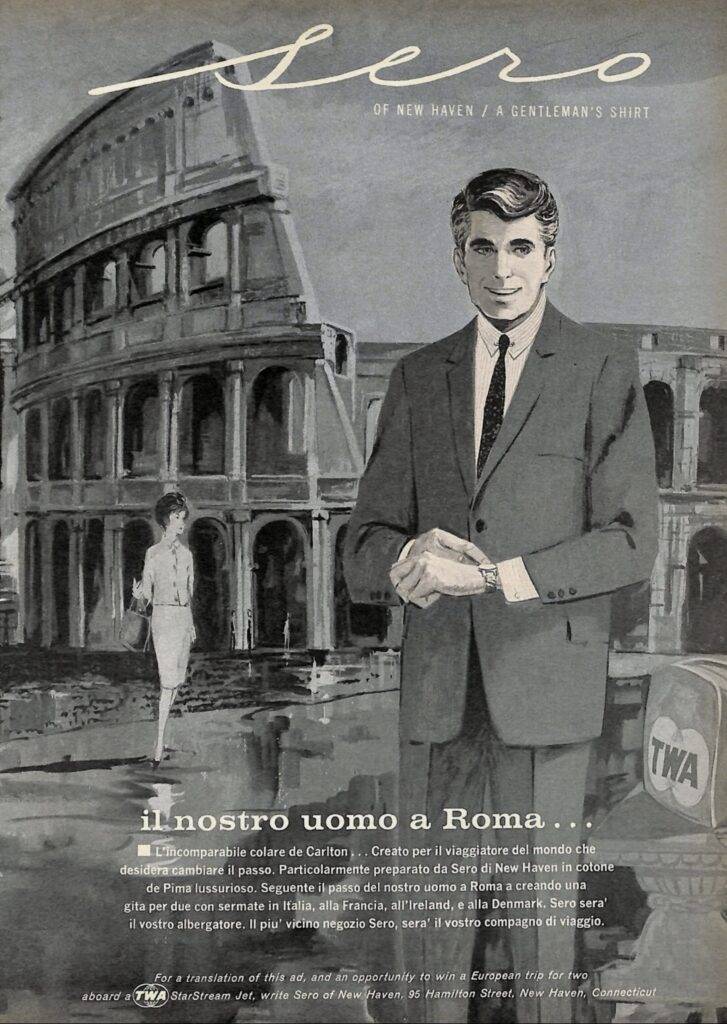
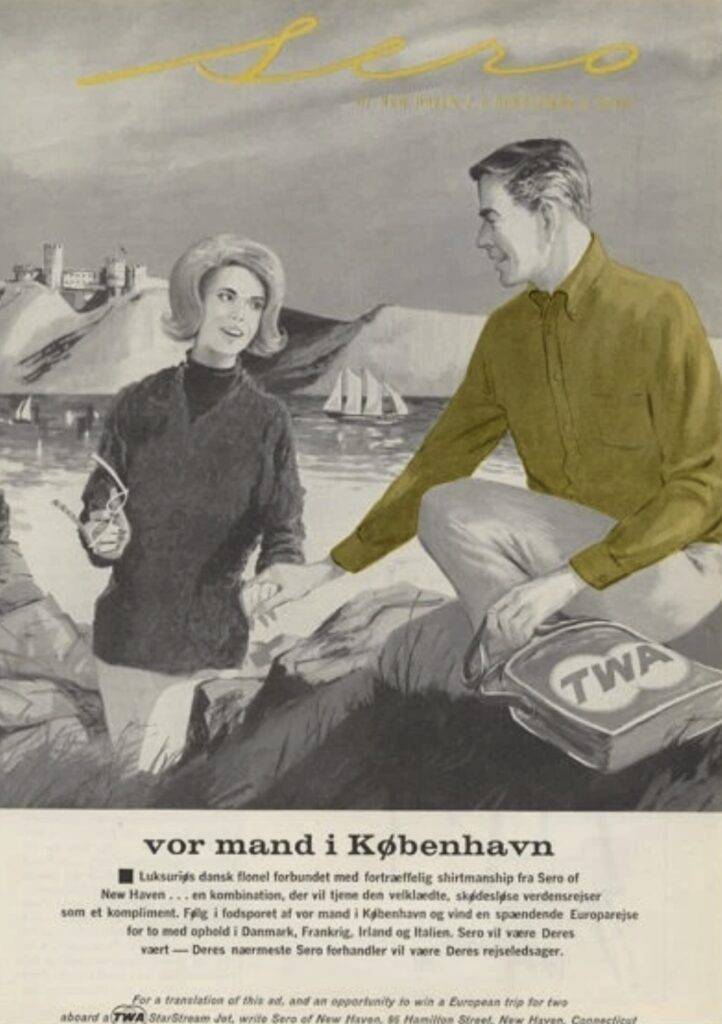
1964 AD
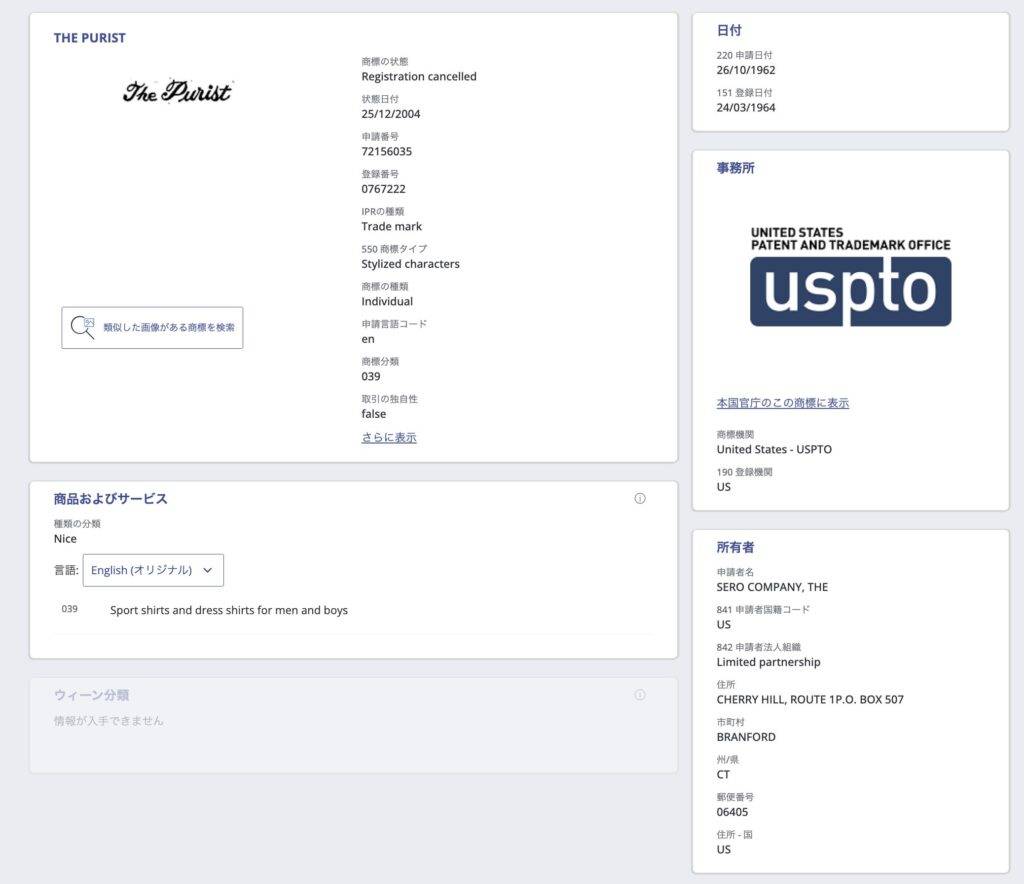
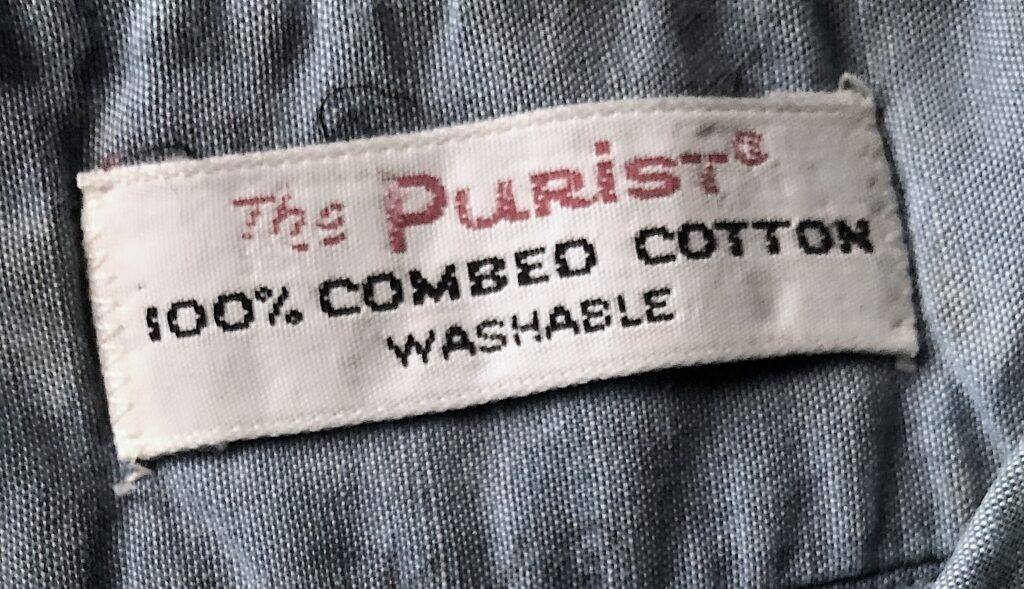
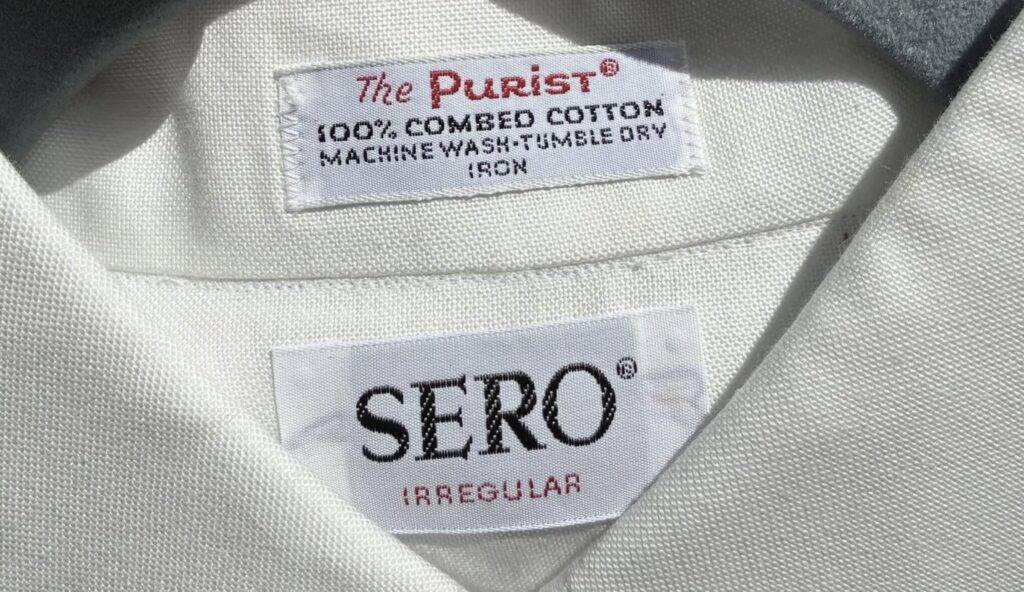
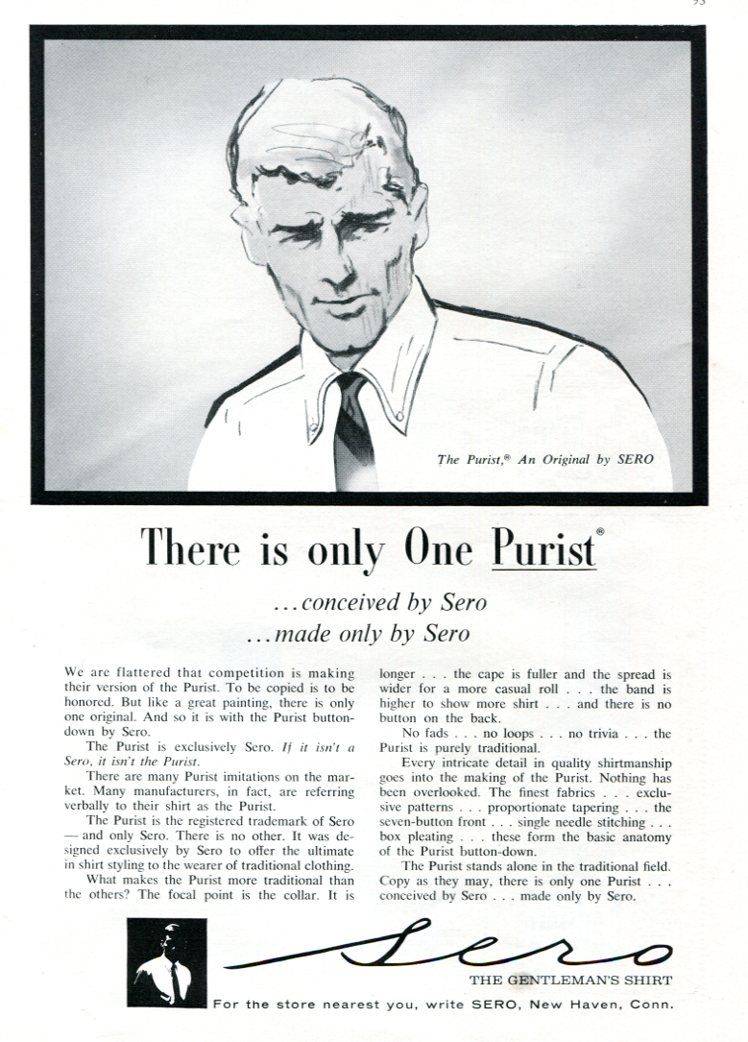
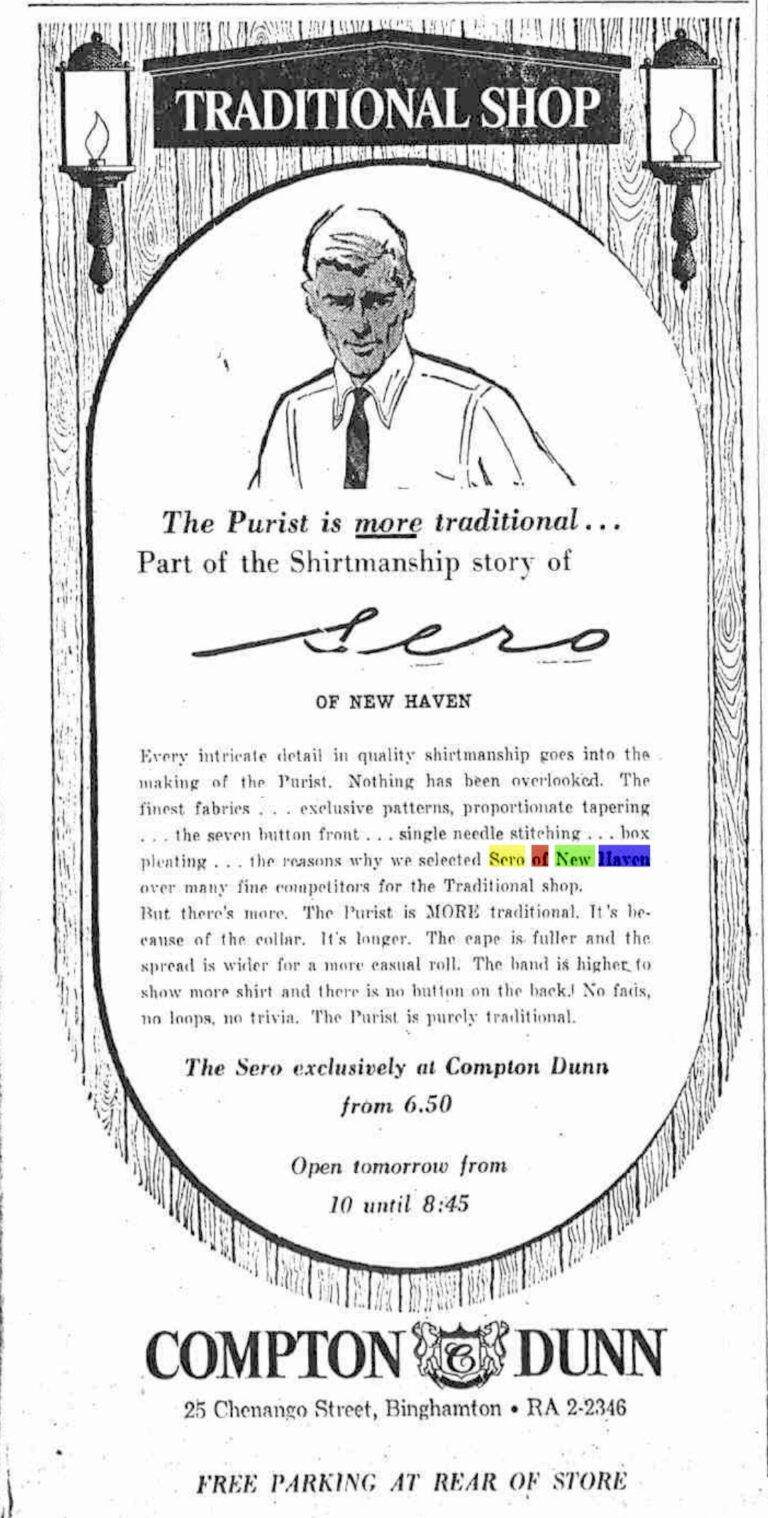
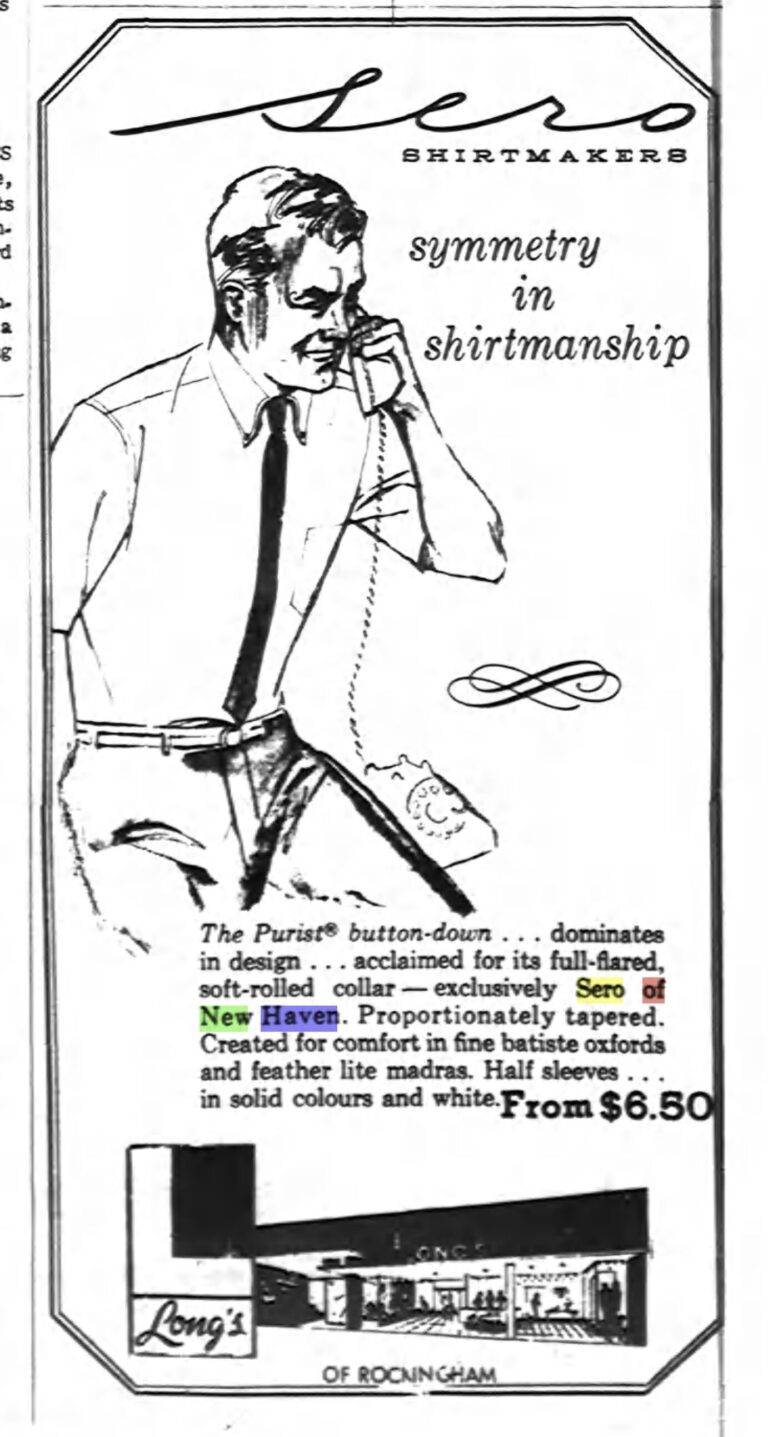
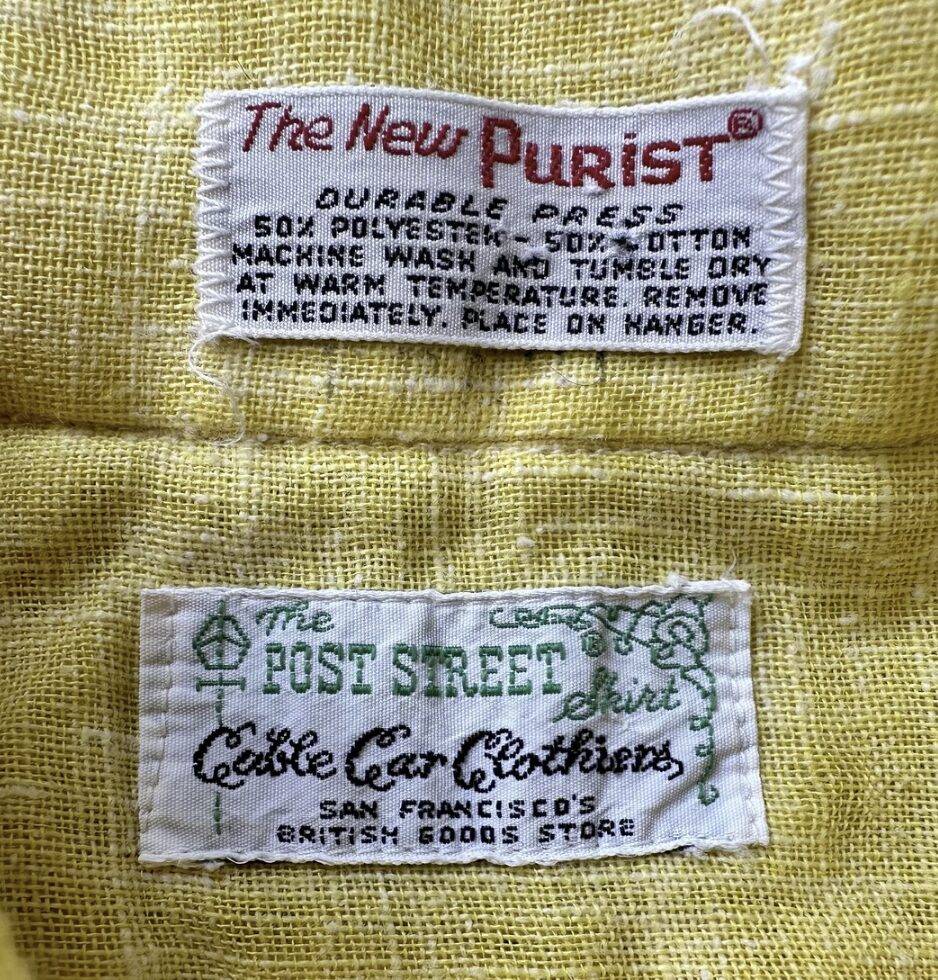
The defining feature of “The Purist” is its distinctive collar curve known as the “Liberty Bell” roll. This tradition dates back to the very first “The Purist” button-down shirts made in 1947 and represents a specification unique to Sero.
Key Characteristics of “The Purist”
1. Collar Design
Pursuing a strictly traditional style, the collar is defined by a distinctive geometry.
・Longer points: The collar points are designed to be longer than those of typical shirts.
・Full-flared: The collar cape (the folded section) is fuller and more rounded.
・Wide spread: The opening between the points is set wider to create a relaxed, casual roll.
・High collar stand: The band is set higher to give the neckline a more pronounced presence.
2. Specifications & Details (An Aesthetic of Elimination)
・To remain purely traditional, all transient trends and unnecessary ornamentation are removed.
・No back button: There is no button at the back of the collar.
・No locker loop: The hanger loop on the back is omitted.
・No trivia: Any fad-driven or decorative details are excluded.
3. Tailoring & Construction
・Built on the fundamentals of high-quality shirtmaking (shirtmanship).
・Seven-button front: The placket features seven buttons.
・Single-needle stitching: Finished with precise, single-needle seams.
・Box pleat: A traditional box pleat is used at the back.
・Proportionate taper: A balanced, gently tapered silhouette.
4. Fabrics
・Premium materials: Fine batiste Oxford, featherweight madras, and high-grade broadcloth.
Together, these features have established “The Purist” as a benchmark standard for the traditional dress shirt.
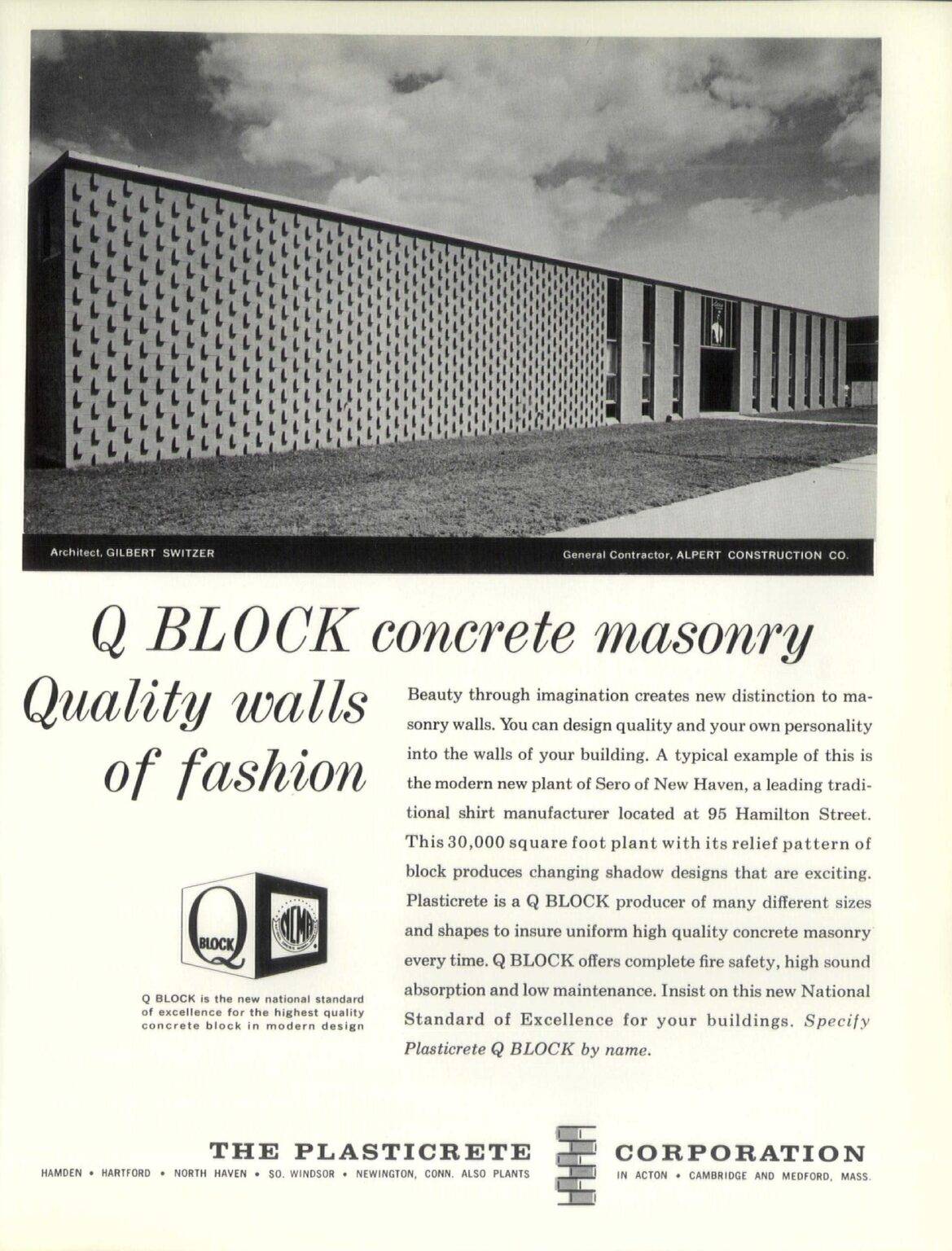
1. A New Landmark for Tradition and Innovation
・Brand Context: In 1965, Sero of New Haven, a premier manufacturer of traditional Ivy League-style shirts, established its state-of-the-art 30,000-square-foot plant at 95 Hamilton Street.
・Symbolism: This facility represented a major expansion for the company, blending their heritage of craftsmanship with cutting-edge industrial architecture.
2. Architectural Innovation by Gilbert Switzer
・Design Philosophy: Designed by architect Gilbert Switzer, the building moved away from the drab look of traditional factories, treating the exterior as a canvas for modern design.
・The Shadow Effect: By utilizing “Q BLOCK” concrete masonry with a unique relief pattern, the walls produced “changing shadow designs.” This allowed the building’s appearance to transform throughout the day as the sun moved.
3. Superior Performance via “Q BLOCK”
・Material Quality: The Plasticrete Corporation’s Q BLOCK was marketed as the “National Standard of Excellence,” offering three key industrial benefits:
・Fire Safety: Providing total protection for the manufacturing facility.
・Acoustics: High sound absorption to create a better working environment.
・Durability: Low maintenance requirements for long-term efficiency.
4. Conclusion
The 1965 Sero plant stands as a quintessential example of Mid-Century Modern industrial design, proving that a factory could be both a high-performance machine and a “wall of fashion.”
CONNECTICUT ARCHITECT SEVENTY-FIVE CENTS JULY-AUGUST, 1965
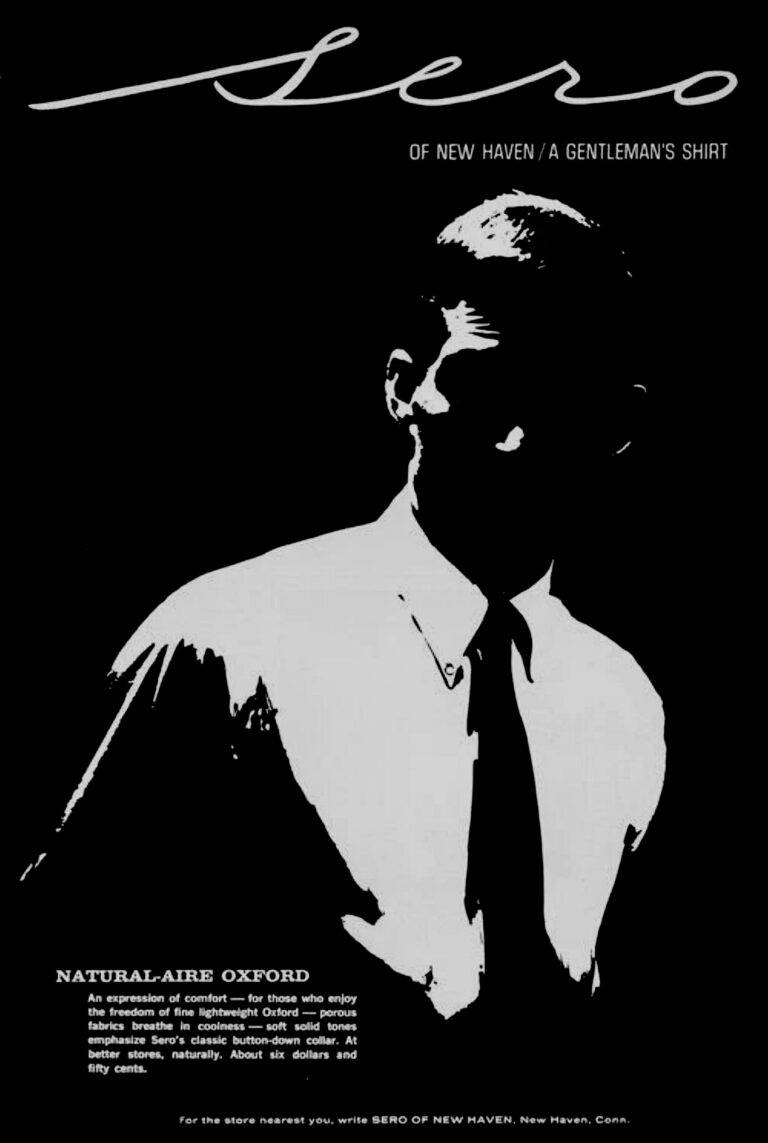
1965 SERO AD
1966 Binghamton NY Press Grayscale 1966 a – 3772.pdf
1966 Rockingham NC Richmond County Journal 1966 Apr-Jun – 0408.pdf
1966 Sayville NY Suffolk County News 1963 Nov-Jan 1966 Grayscale – 0904.pdf
1966 Rockingham NC Richmond County Journal 1966 Apr-Jun – 0096.pdf
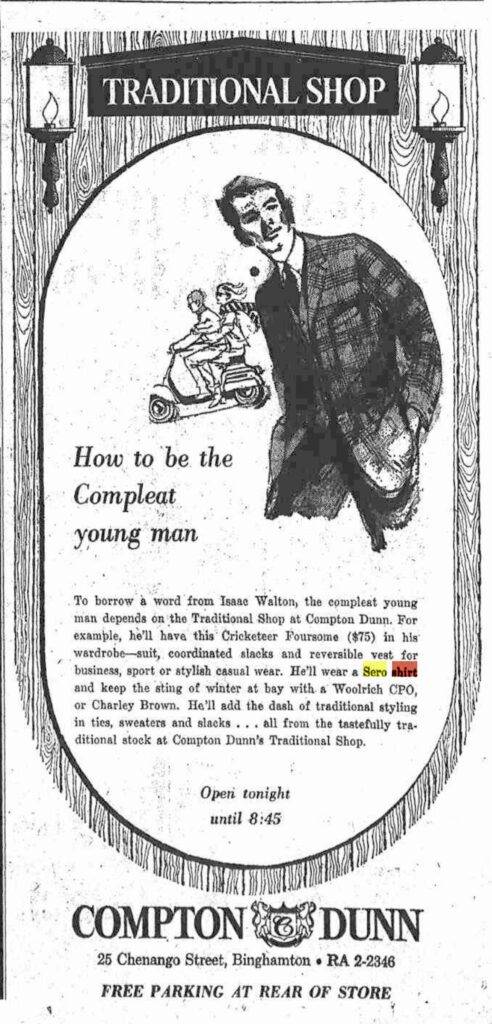
1966 Binghamton NY Press Grayscale 1966 a – 5644.pdf
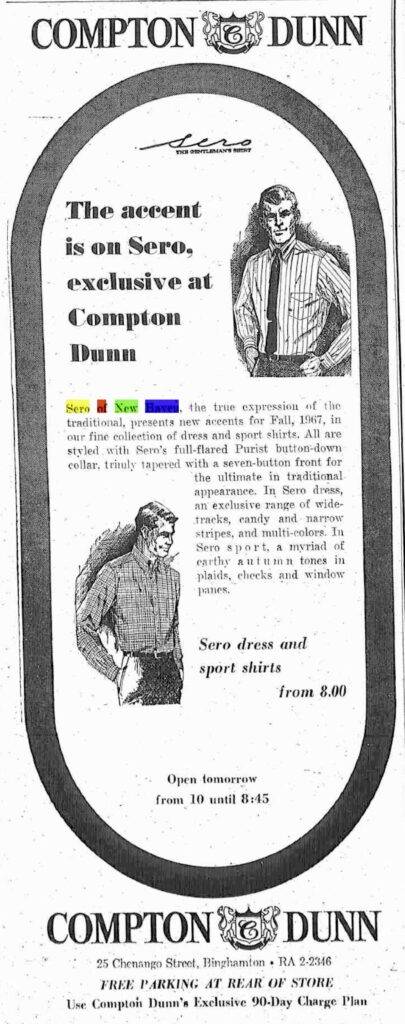
1967 Binghamton NY Press Grayscale 1967 b – 0789.pdf
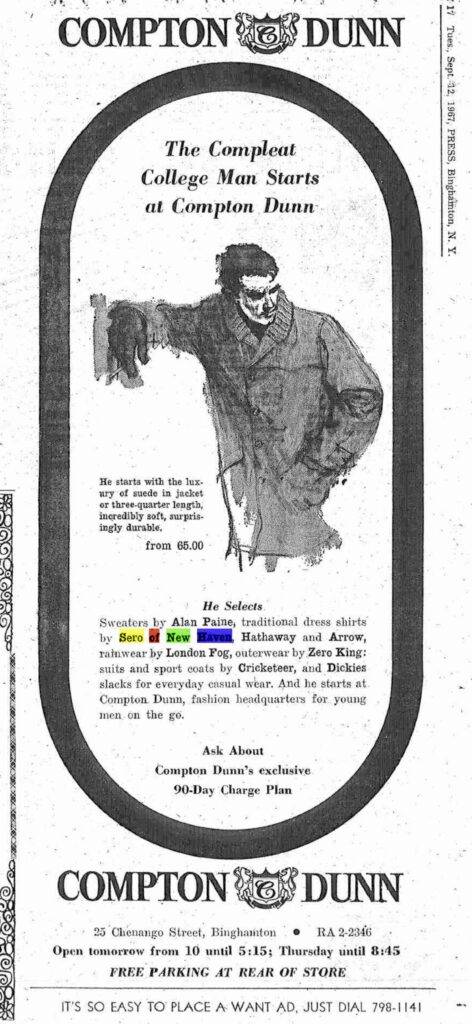
1967 Binghamton NY Press Grayscale 1967 b – 0309.pdf
1967 Philadelphia PA Inquirer 1967 08400.pdf
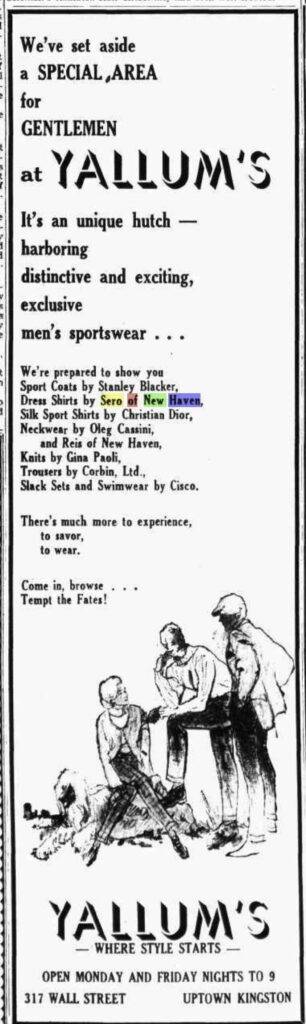
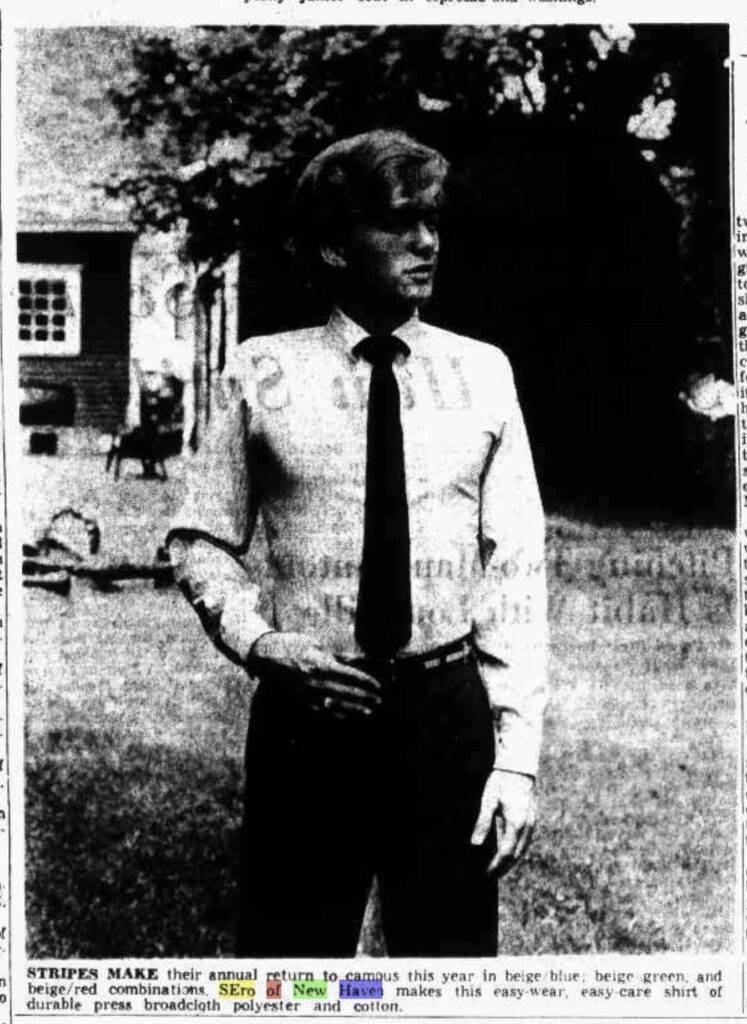
1967 Kingston NY Daily Freeman 1968 Grayscale – 4836.pdf
1968
SERO was acquired by NAC
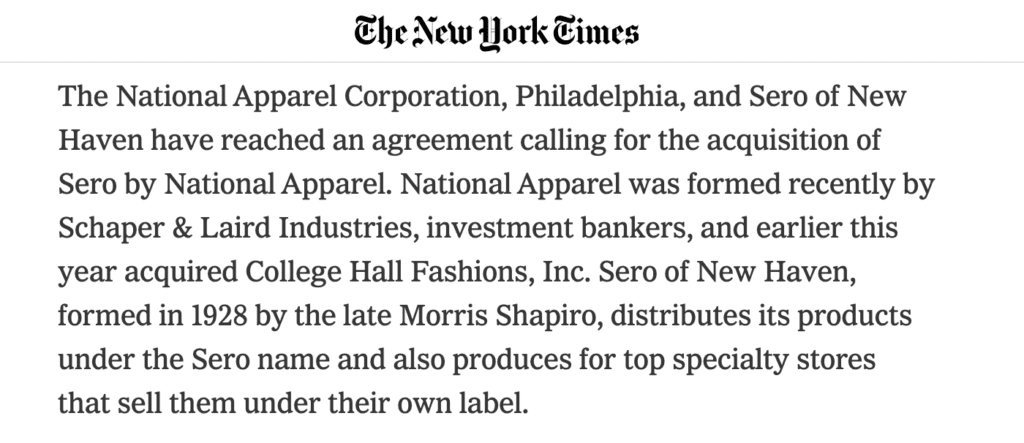
In that year, the Philadelphia-based investment bank Schaper & Laird Industries established a new holding company, National Apparel Corporation (NAC). NAC was not conceived as a manufacturer or retailer in its own right; rather, it was designed as a financial and managerial platform intended to acquire existing apparel companies and to oversee them through centralized ownership, capital allocation, and corporate governance.
One of the earliest cornerstones of NAC was College Hall Fashions, Inc. College Hall Fashions was known as an apparel company supplying Ivy-influenced menswear primarily to college cooperatives and specialty stores, and it operated as a vertically connected enterprise with both manufacturing facilities and an established sales network. By bringing College Hall Fashions under its control early in the year, NAC secured not merely a collection of factories or brand names, but the foundational structure of a corporate group that already incorporated active distribution channels.
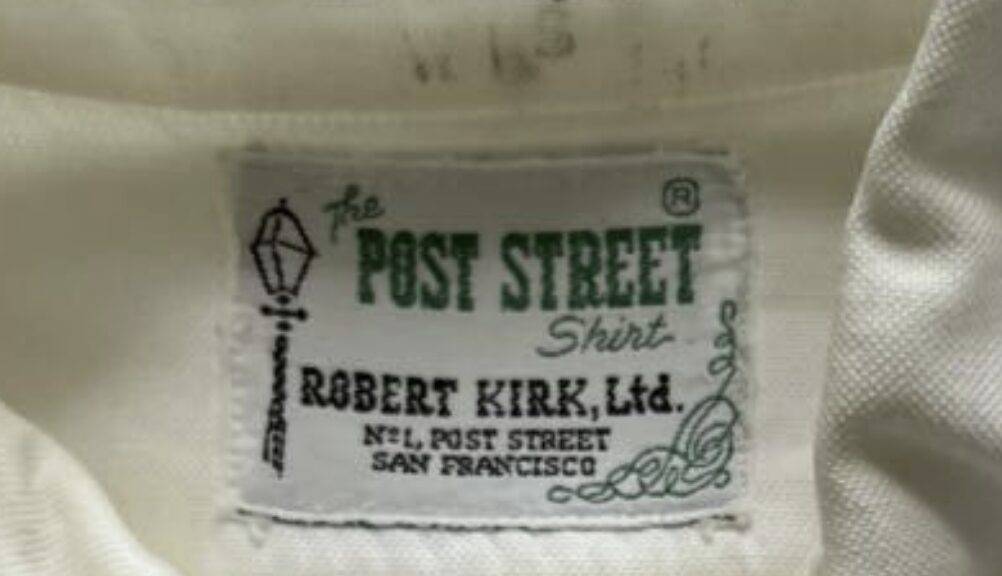
Later that same year, NAC acquired Sero of New Haven, a long-established shirt manufacturer with its production base in Connecticut. From the late 1960s into the early 1970s, Robert Kirk was subsequently added to the group. Throughout the 1970s, industry advertisements and corporate materials consistently employed parallel designations such as:
“Robert Kirk — A Division of National Apparel Corporation” and
“Sero of New Haven — A Division of National Apparel Corporation.”
Under this structure, NAC did not function as a consumer-facing brand. Instead, it operated behind the scenes as a capital-centered core, integrating and managing manufacturing assets, brand equity, and the sales network mediated through College Hall Fashions as a unified system. The objective was a vertically aligned corporate model, linking factories (production), brands (reputation and narrative), and distribution channels (college cooperatives, specialty stores, and department stores) within the framework of a single holding company.
The role of Schaper & Laird Industries, as an investment bank, was not to engage in shirt design or retail operations, but to manage the apparel group from a financial and governance perspective—through capital financing, execution of acquisitions, appointment of management, and corporate restructuring. As a result, companies such as SERO and Robert Kirk transitioned from independently run, founder-led manufacturing enterprises into divisions operating under the control of financial capital by the 1970s.
1968 AD
1969 Philadelphia PA Inquirer 1969 20655.pdf
1969 Randolph NY Register 1968-1969 Grayscale – 1097.pdf
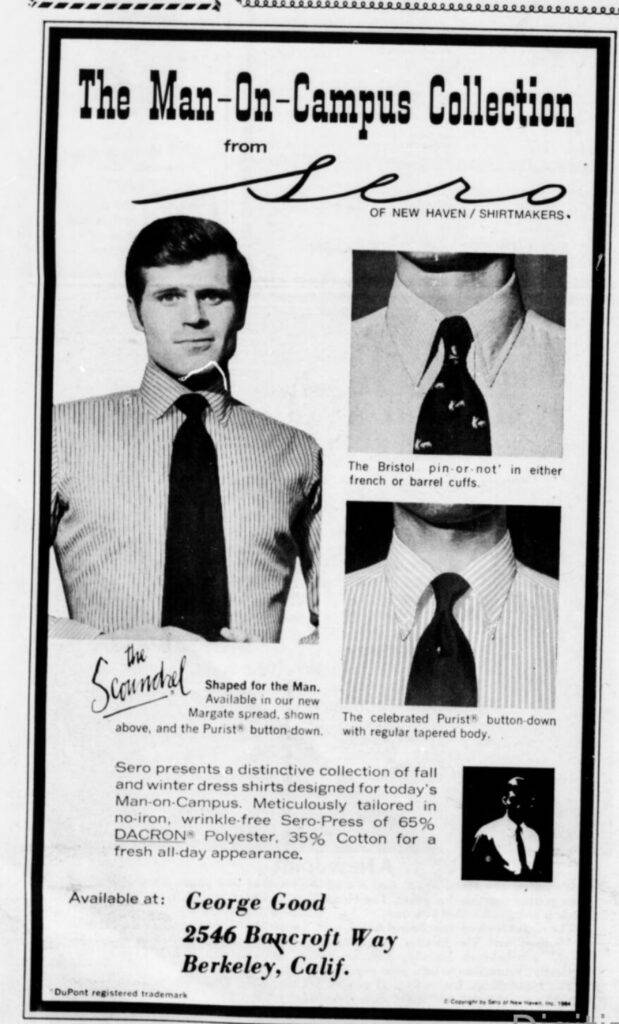
1969 The Daily Californian 1969-10-08 Wed Oct. 8, 1969
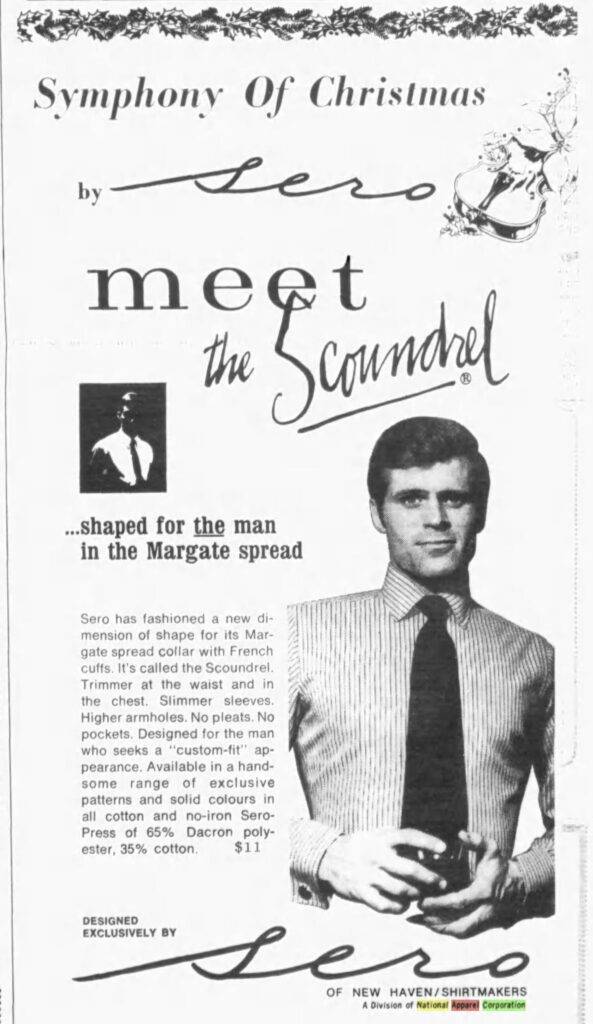
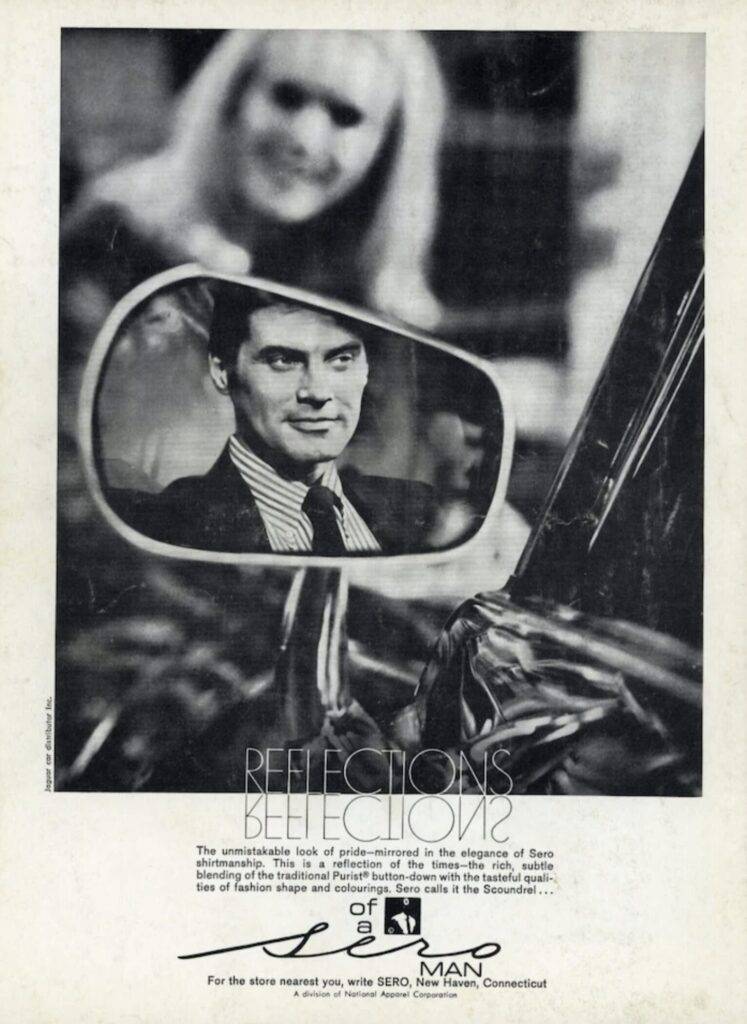
1969 August 17, 1969 Pre Season Football Program NY jets vs NY Giants at Yale
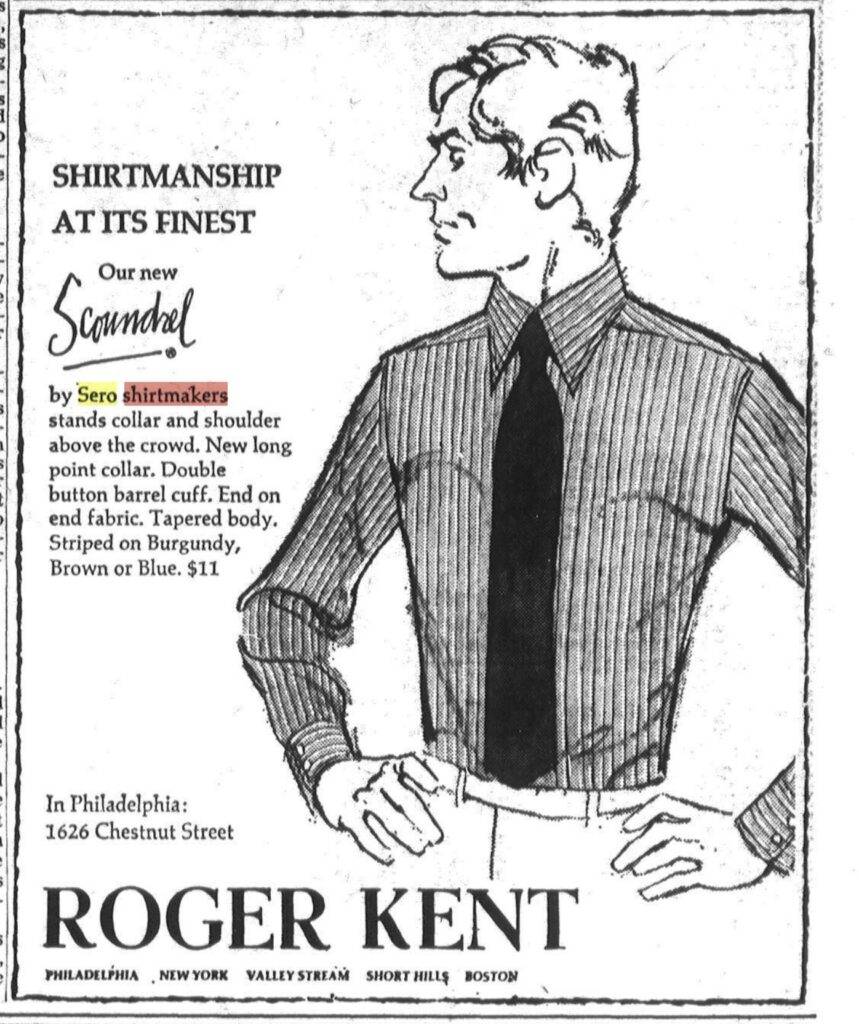
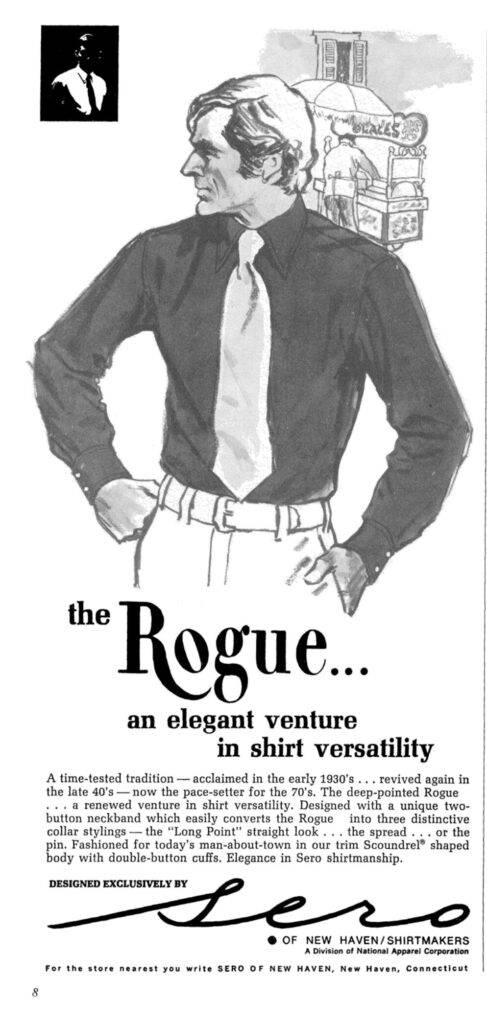
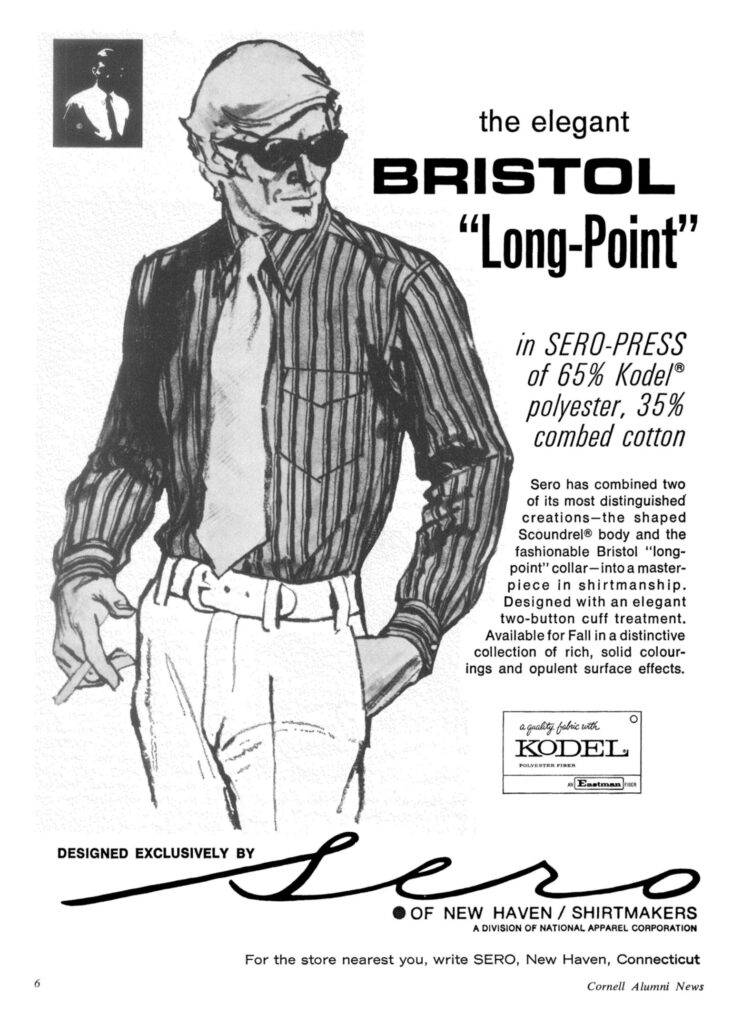
Scoundrel was a shirt model name developed in the late 1960s, during the period when Sero of New Haven came under the umbrella of the National Apparel Corporation (NAC), and it functioned as a persona symbolizing a “new type of man” set in deliberate contrast to the traditional Purist. While the word itself dictionary-wise means a “rogue” or “rascal,” in SERO’s advertising context it was not used negatively, but rather to portray a modern, urban, and subtly rebellious gentleman—one who wears impeccably traditional tailoring while stepping just beyond established conventions.
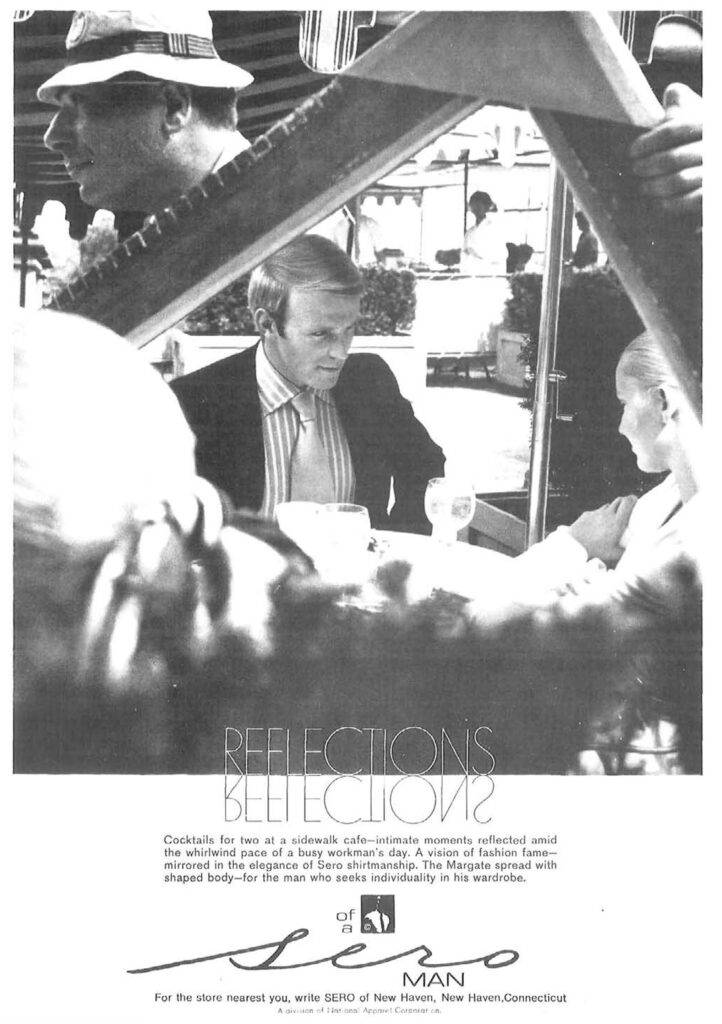
In 1968, when SERO entered NAC’s corporate structure, the company shifted from a family-led, factory-centered shirtmaker to a member of a nationwide apparel group oriented toward broad distribution and branding. This transition coincided with a moment in American society marked by student movements, countercultural currents, and a broader shift from campus-centered identity toward urban cultural expression. Phrases that appear in SERO’s advertisements, such as “Man-on-Campus” and “Reflections,” clearly reflect an acute awareness of this generational and cultural change.
In a 1969 newspaper advertisement, Scoundrel is presented under the headline “Shirtmanship at its finest,” with its defining specifications spelled out: a long-point collar, a tapered body, end-on-end fabric, and double-button barrel cuffs. The standards of quality and construction remain firmly traditional, yet the proportions and visual character position the model as sharper, more fashion-conscious, and distinctly contemporary.
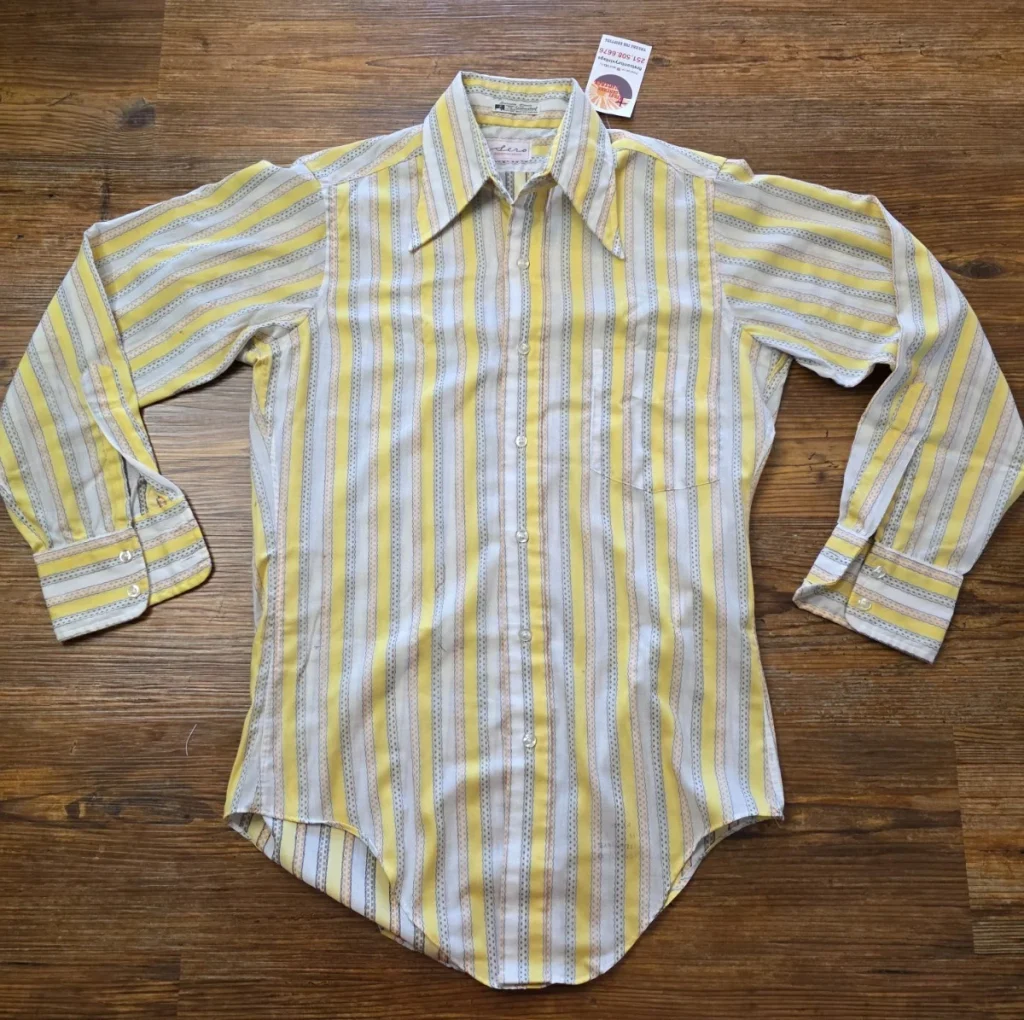
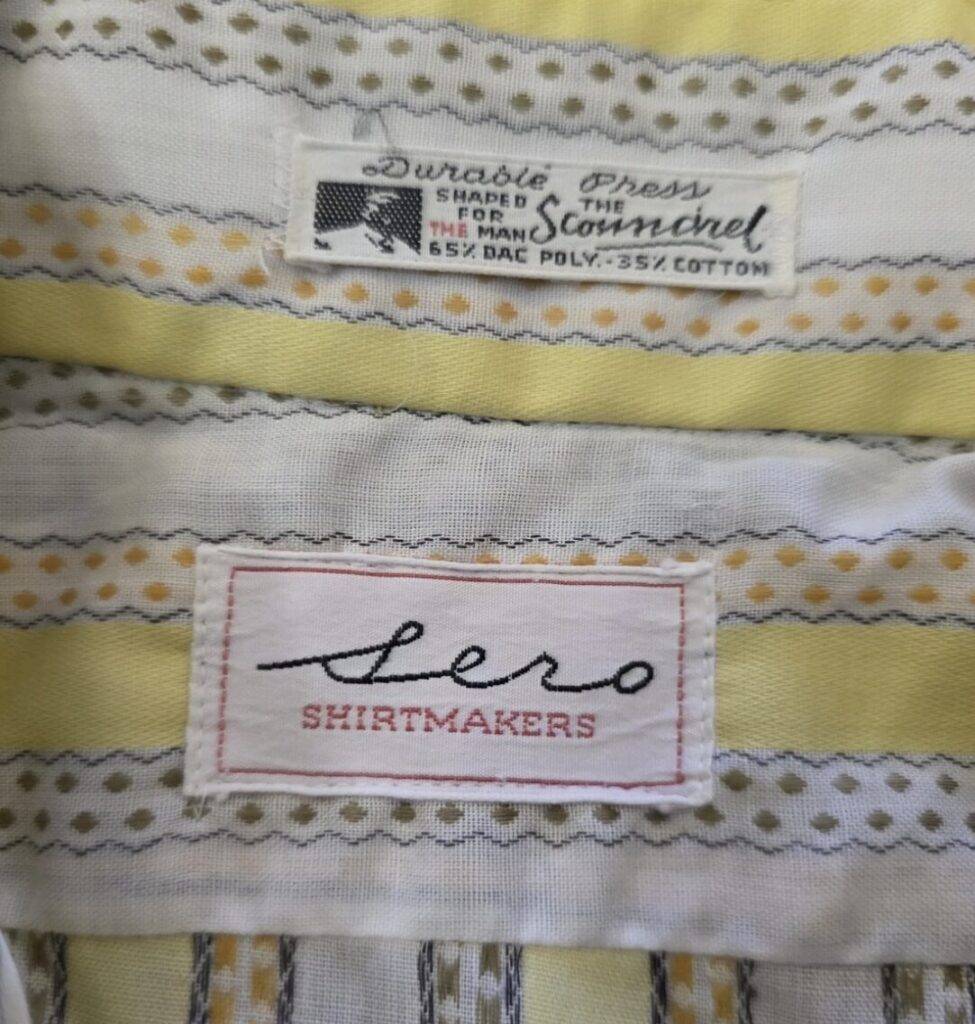
This naming strategy deliberately establishes a contrast: Purist = tradition and orthodoxy, versus Scoundrel = deviation and individuality. At a moment when SERO’s corporate realignment under NAC intersected with the broader social and cultural transformations of the late 1960s, the brand presented a dual message to a new generation of consumers—rebellious in spirit, yet elegant in form.
1970
The Last Golden Age
In 1970, as SERO had come fully under the umbrella of NAC and the operation of its new factory was beginning to find its rhythm, the company was reaching the height of its momentum. During this period, SERO established strong ties with partners such as College Hall Fashions, and, backed by the power of capital, its growth and presence in the market were at their most pronounced.
The era itself was one of profound upheaval. The deepening of the Vietnam War, the shock of the oil crisis, and the rise of countercultural movements rooted in the hippie era all contributed to a fundamental shaking of America’s established values. In fashion as well, the conservative framework of “Ivy” began to fracture, giving way to freer and more diverse styles. Against this backdrop, SERO deliberately continued to champion the name “The Purist,” positioning itself as the absolute standard of the traditional dress shirt and maintaining its dominance in that space.
This was a time when New Haven still reigned as a stronghold of Ivy tradition, and SERO carried that pride almost single-handedly. Yet that very brilliance also foreshadowed the closing chapter of traditional manufacturing in the city. After GANT’s acquisition in 1979, which was followed by the sudden closure of its New Haven factory, SERO would increasingly stand as the last Ivy-trad shirt factory in the area—becoming, in effect, a living repository of “old-fashioned American craftsmanship.”
It was, in every sense, the final golden age in which SERO burned most brightly.
1969 Philadelphia PA Inquirer 1969 15902.pdf
1970 Buffalo NY Courier Express 1970 c – 2186.pdf
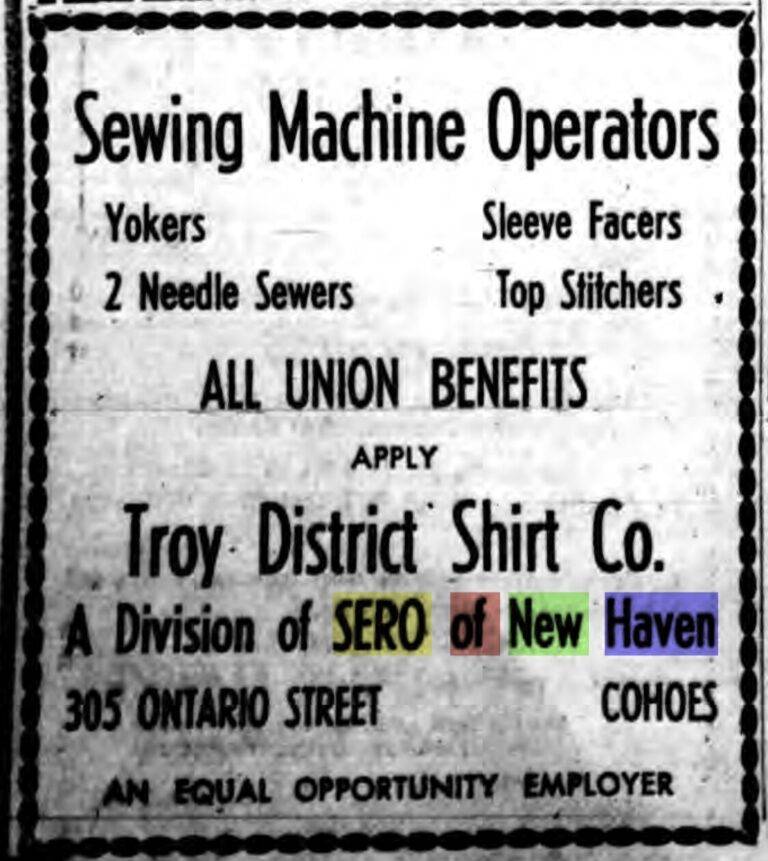
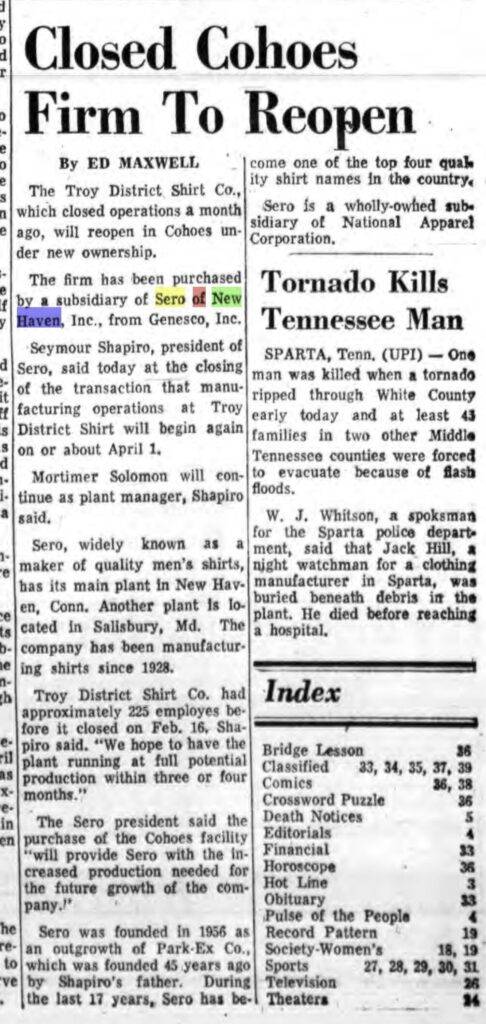
The Troy District Shirt Co.,which closed operations a month ago, will reopen in Cohoes under new ownership. The firm has been purchased by a subsidiary of Sero of New Haven, Inc., from Genesco, Inc. Seymour Shapiro, president of Sero, said today at the closing of the transaction that manufacturing operations at Troy District Shirt will begin again on or about April 1. Mortimer Solomon will continue as plant manager, Shapiro said. Sero, widely known as a maker of quality men’s shirts, has its main plant in New Haven, Conn. Another plant is located in Salisbury, Md. The company has been manufacturing shirts since 1928.
Troy District Shirt Co. had approximately 225 employees before it closed on Feb. 16, Shapiro said. “We hope to have the plant running at full potential production within three or four months.”The Sero president said the purchase of the Cohoes facility “will provide Sero with the increased production needed for the future growth of the company.”Sero was founded in 1956 as an outgrowth of Park-Ex Co., which was founded 45 years ago by Shapiro’s father. During the last 17 years, Sero has be-
1970 Cornell Alumni News FEB 1970
1970 Cornell Alumni News October 1970
1970 1970/06/19
1970 1970/04
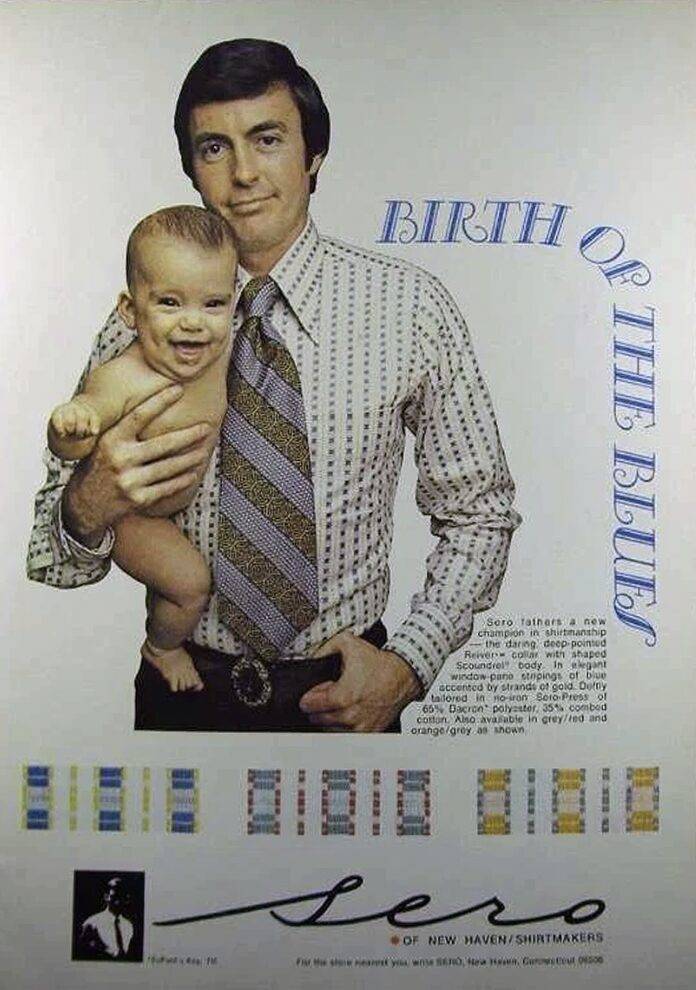
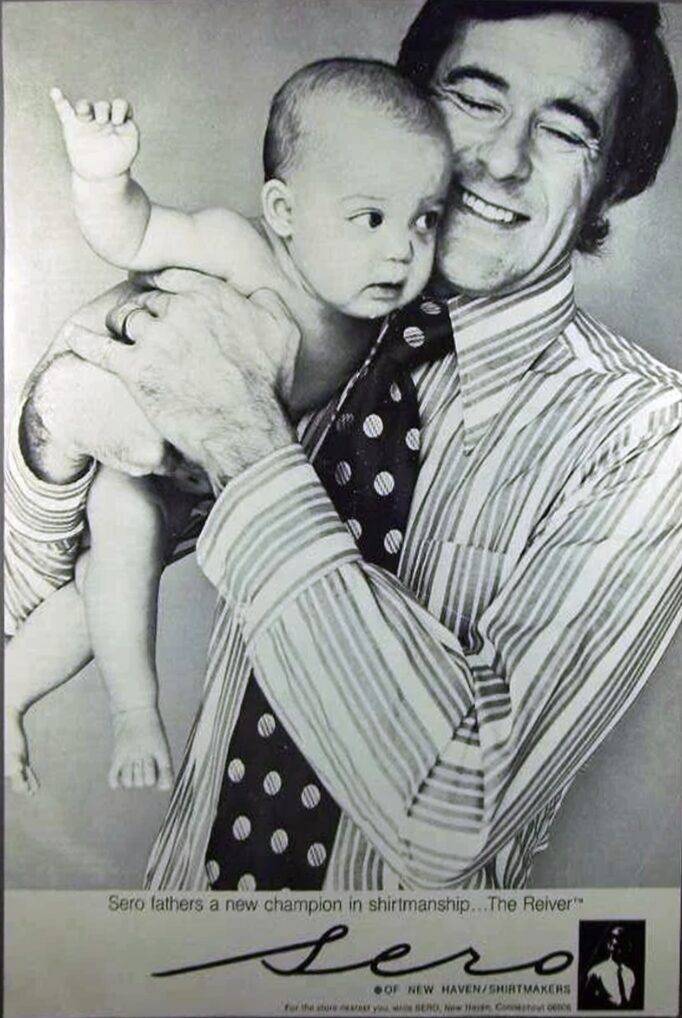
1971 AD
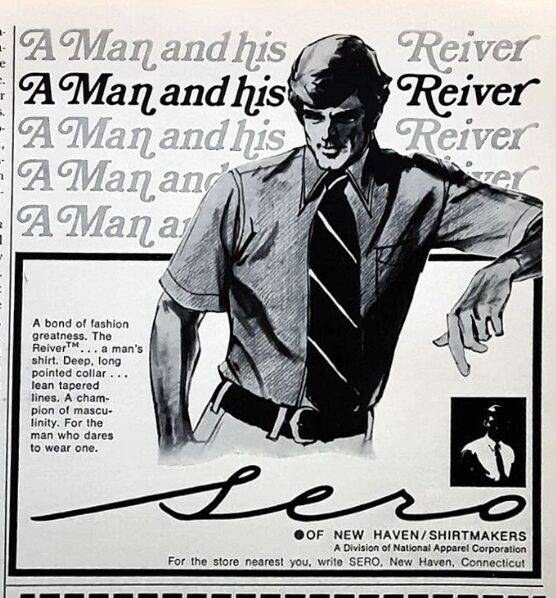
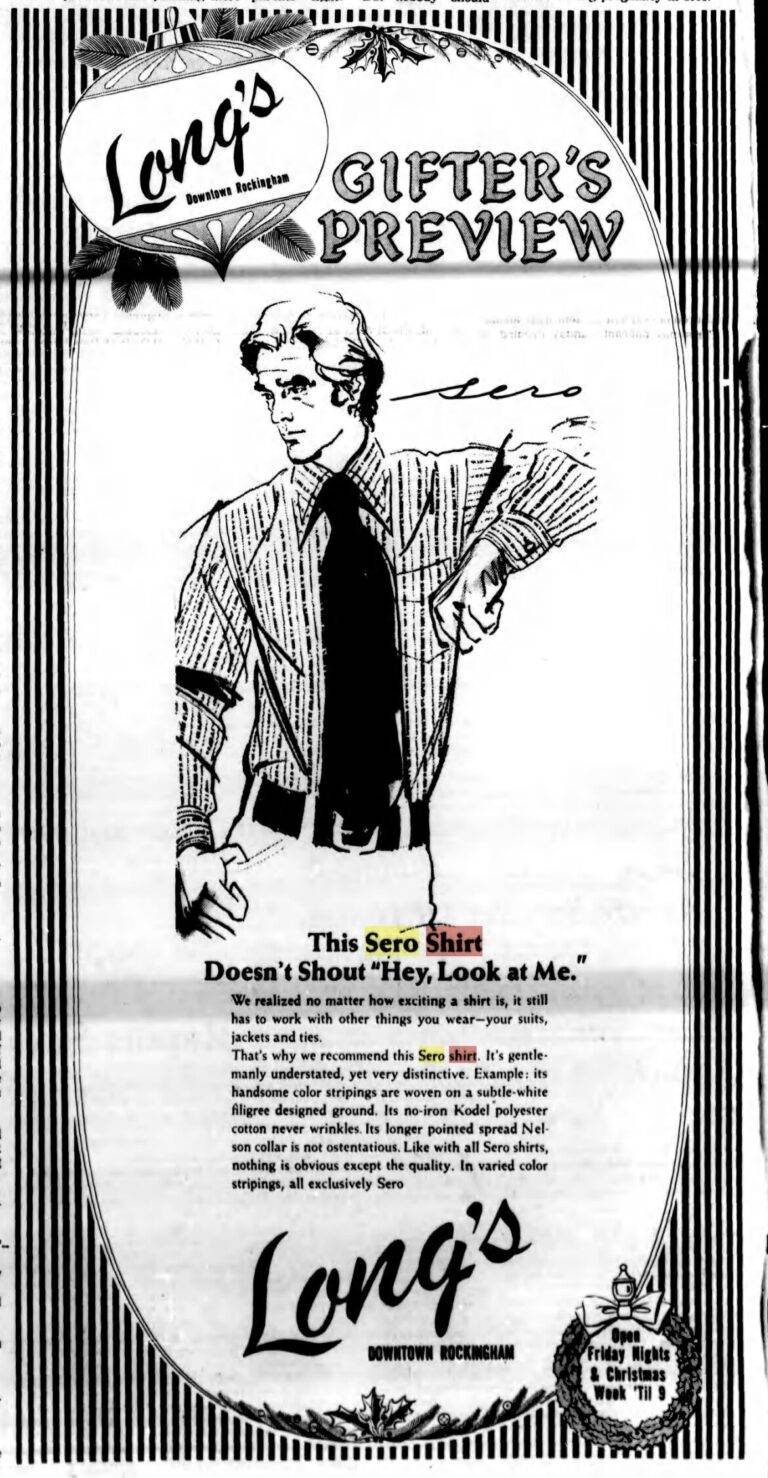
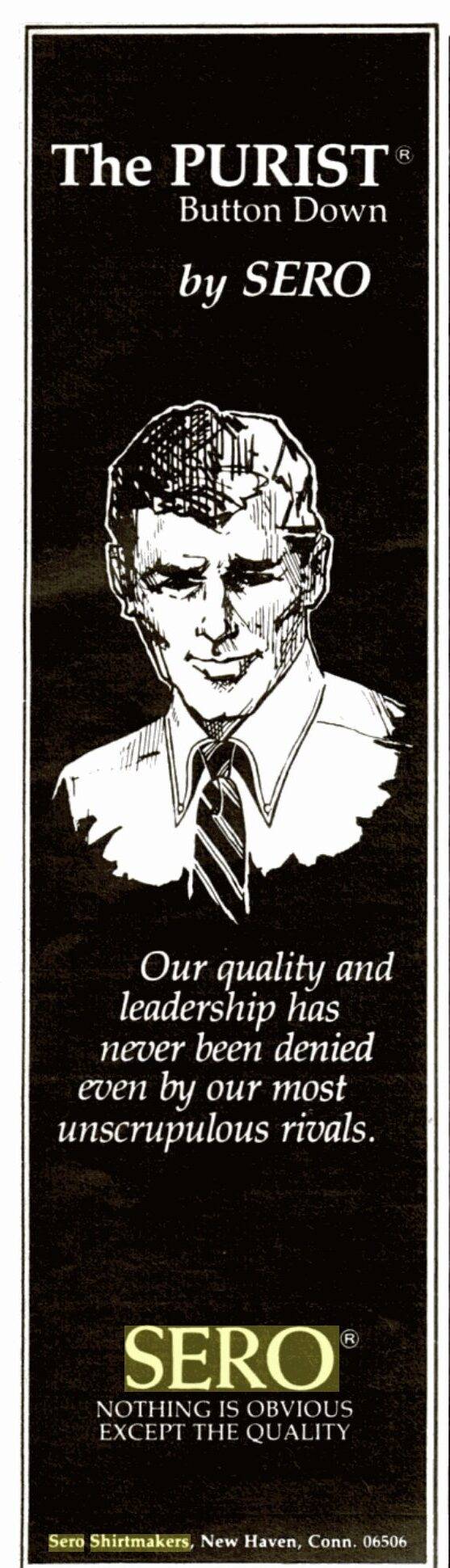
1972 Rockingham NC Richmond County Journal1972 – 4415.pdf
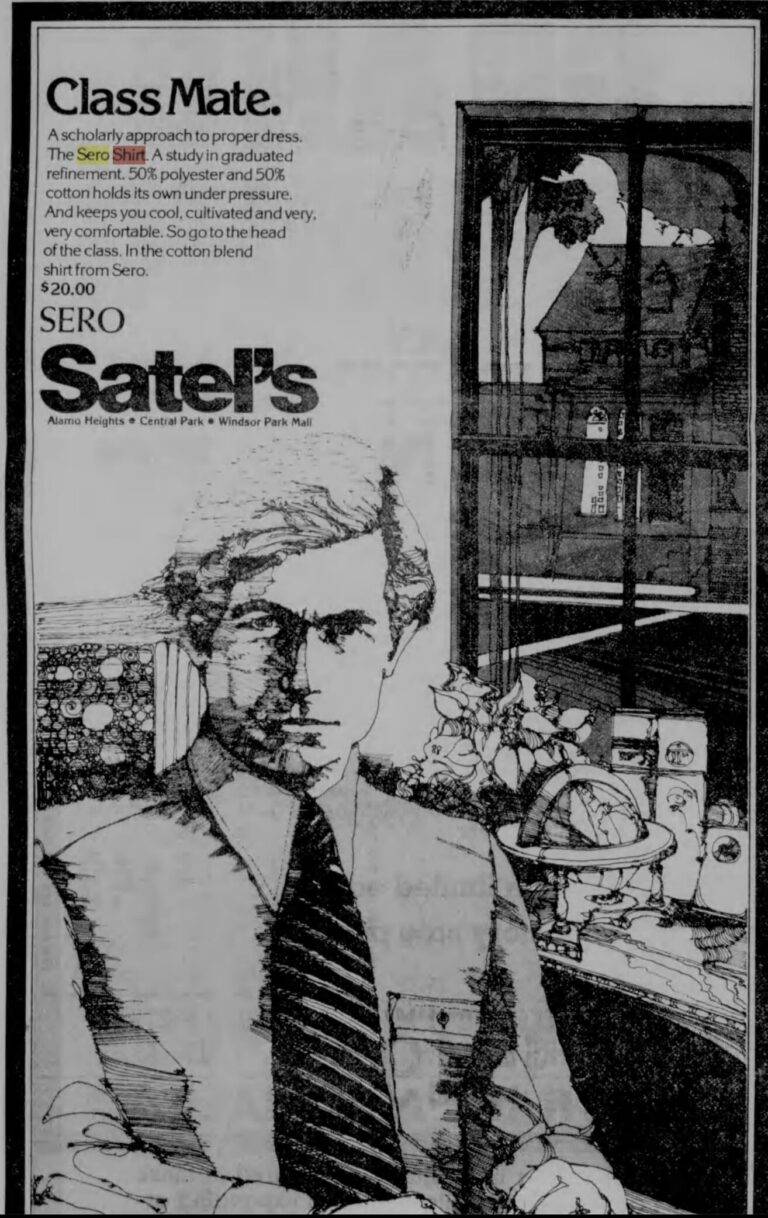
1972 San Antonio TX Express News 1977-08-14_6.pdf
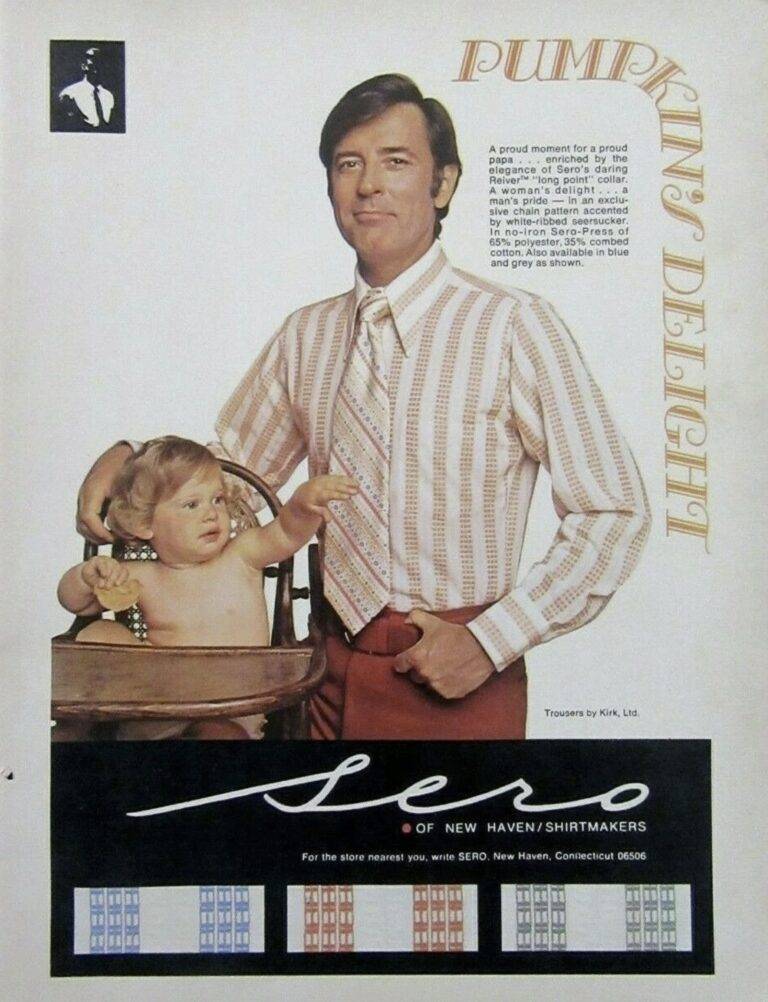
1972 Sero of New Haven/shirtmakers
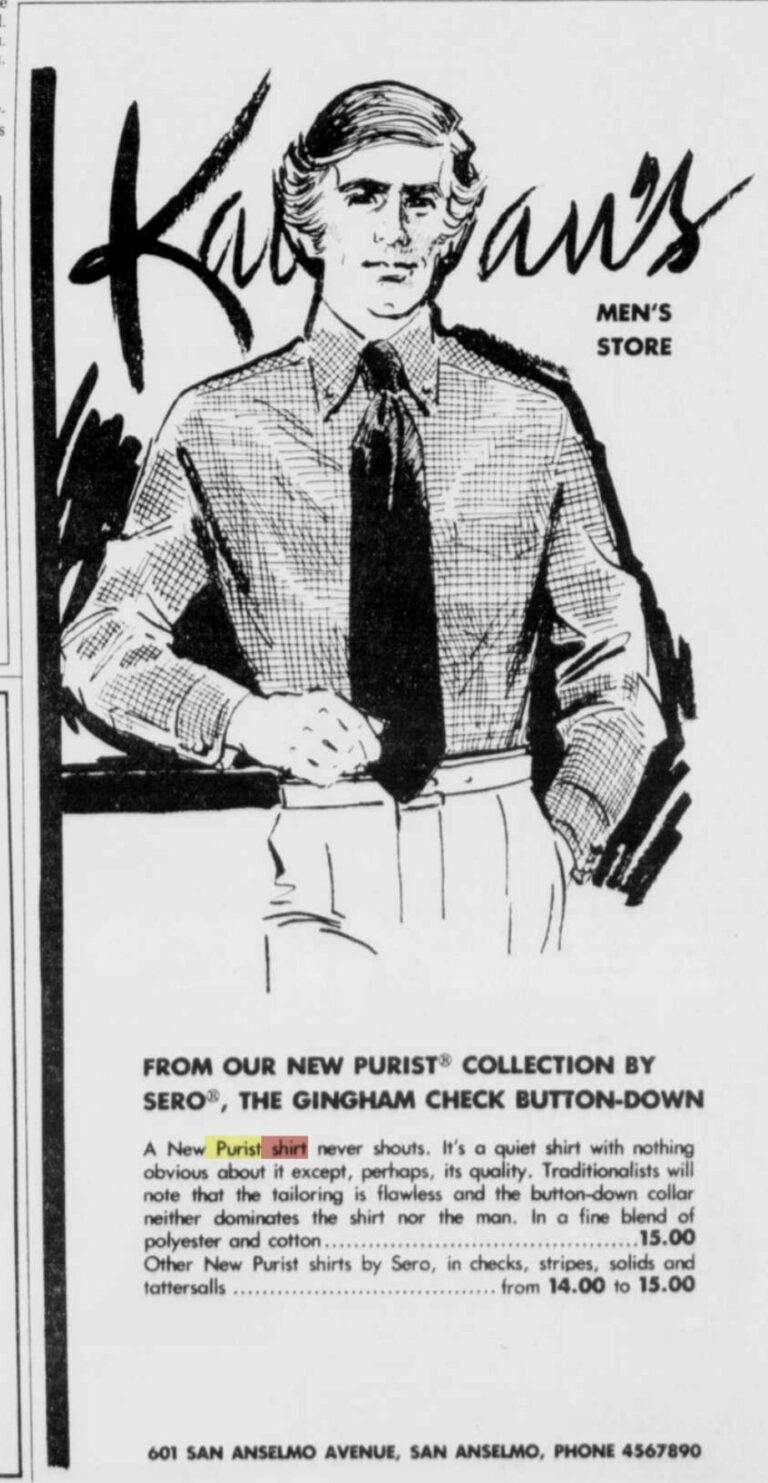
1974 San Raffael CA Daily Indenpendent Journal 1974-03-05_24.pdf
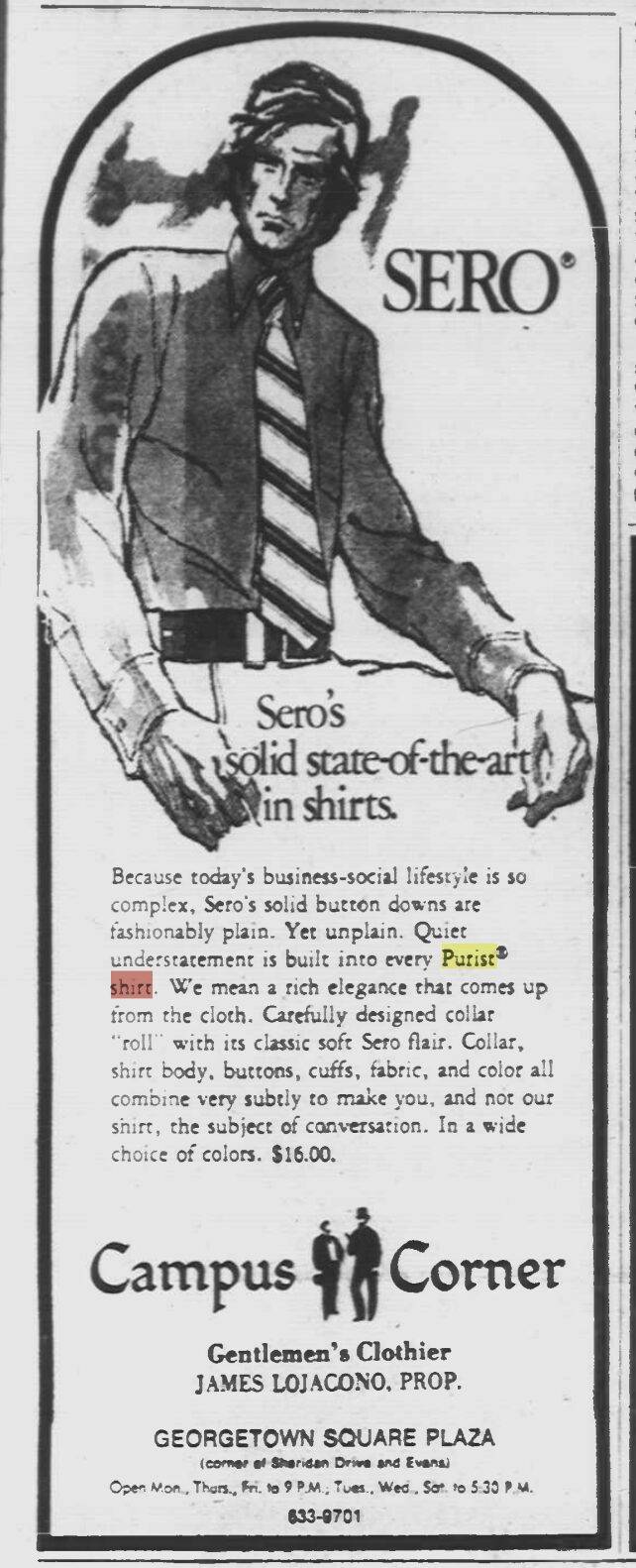
1974 Buffalo NY Courier Express 1976 a 02005_2
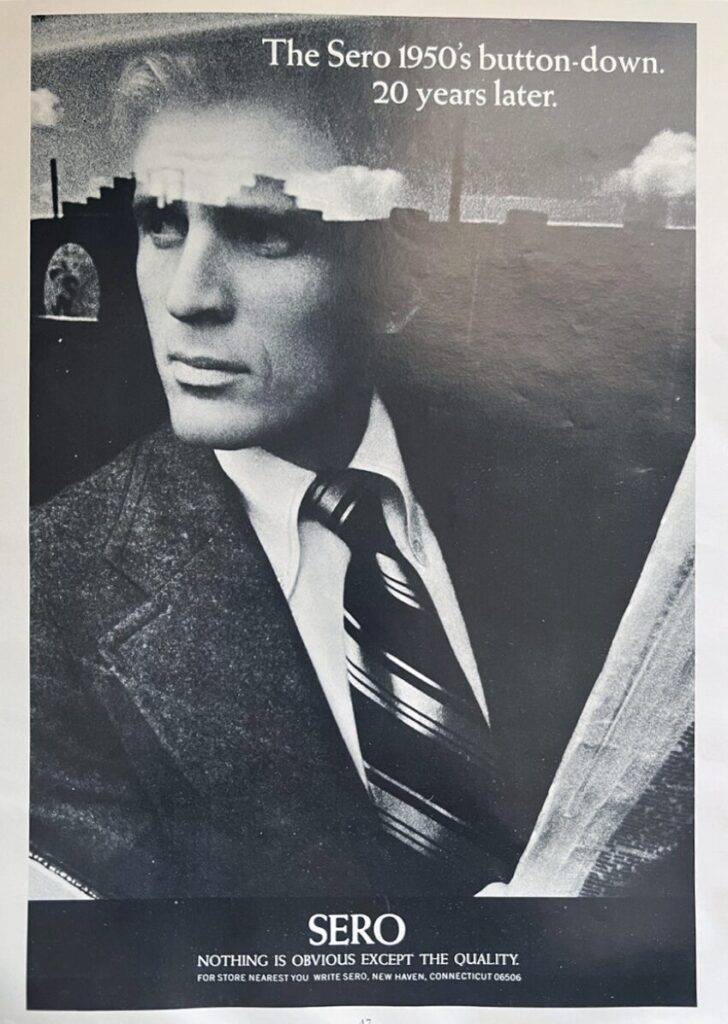
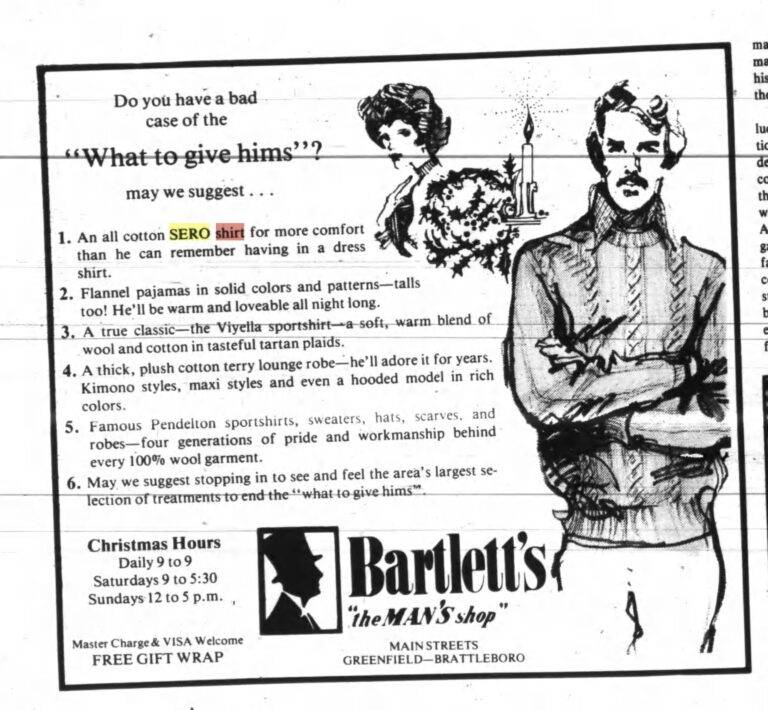
1979 Rockingham NC Richmond County Journal1972 – 4415.pdf
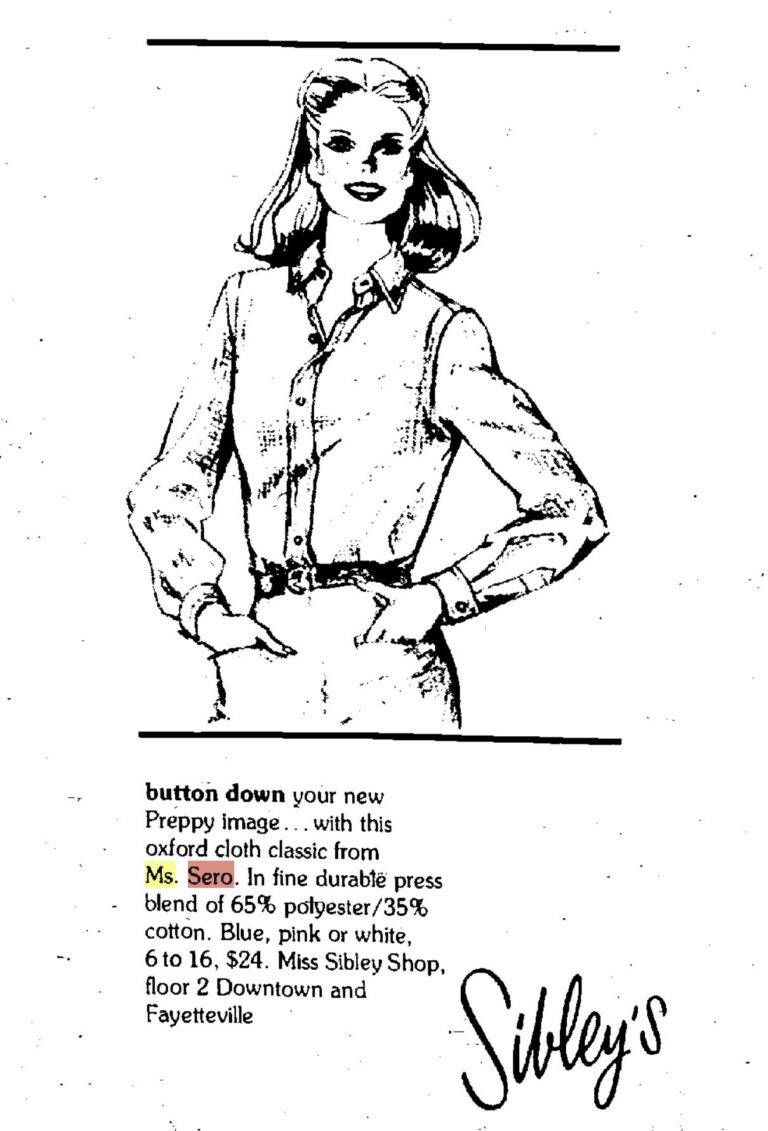
1979 Fayetteville NY Bulletin 1979 – 1980 a – 0804.pdf
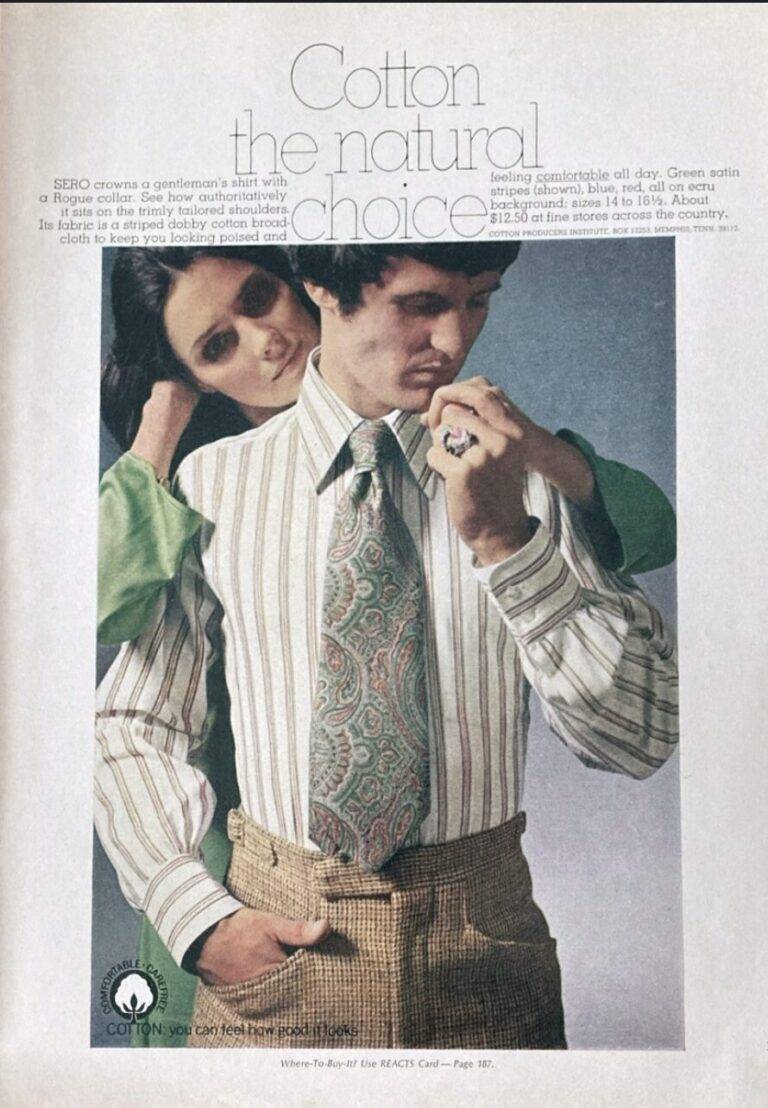
1970s AD
1980
The Last Radiance
In 1979, GANT’s New Haven factory was abruptly closed, and the lineage of shirtmaking that had long been rooted in the city reached a decisive break. In a place that had functioned for decades as a center of Ivy tradition, the industrial heart of manufacturing was rapidly slipping away.
Amid that growing void, it was SERO that continued to stand, keeping its lights on.
Entering the 1980s, SERO—operating within the corporate framework of NAC—came to embody a final commitment to traditional shirtmanship. As the market tilted toward globalization and relentless cost competition, and the foundations of domestic manufacturing were quietly eroded, SERO’s New Haven factory became one of the last places to give tangible form to what was often called “old-fashioned American craftsmanship.”
In this era, SERO was no longer a company striving for expansion or dominance.
Instead, it assumed the role of a “last guardian,” preserving standards that were steadily disappearing.
Even as the shadows of restructuring and collapse drew closer, it continued to stitch into every shirt the norms and pride that New Haven had once claimed as its own.
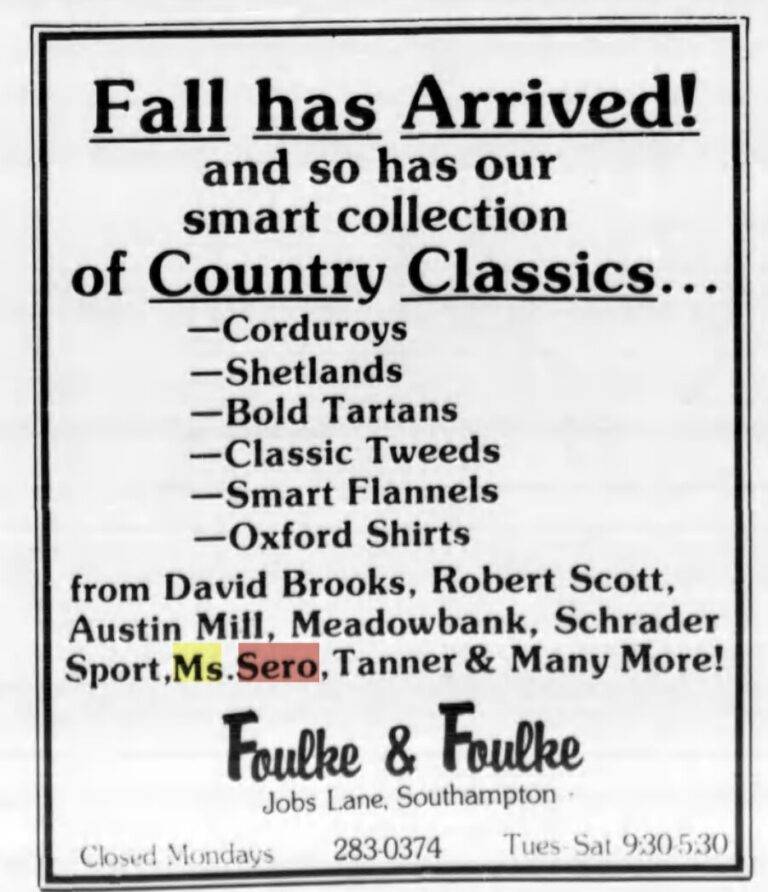
1980 East Hampton NY Star 1979 Sep-May 1980 – 0040.pdf
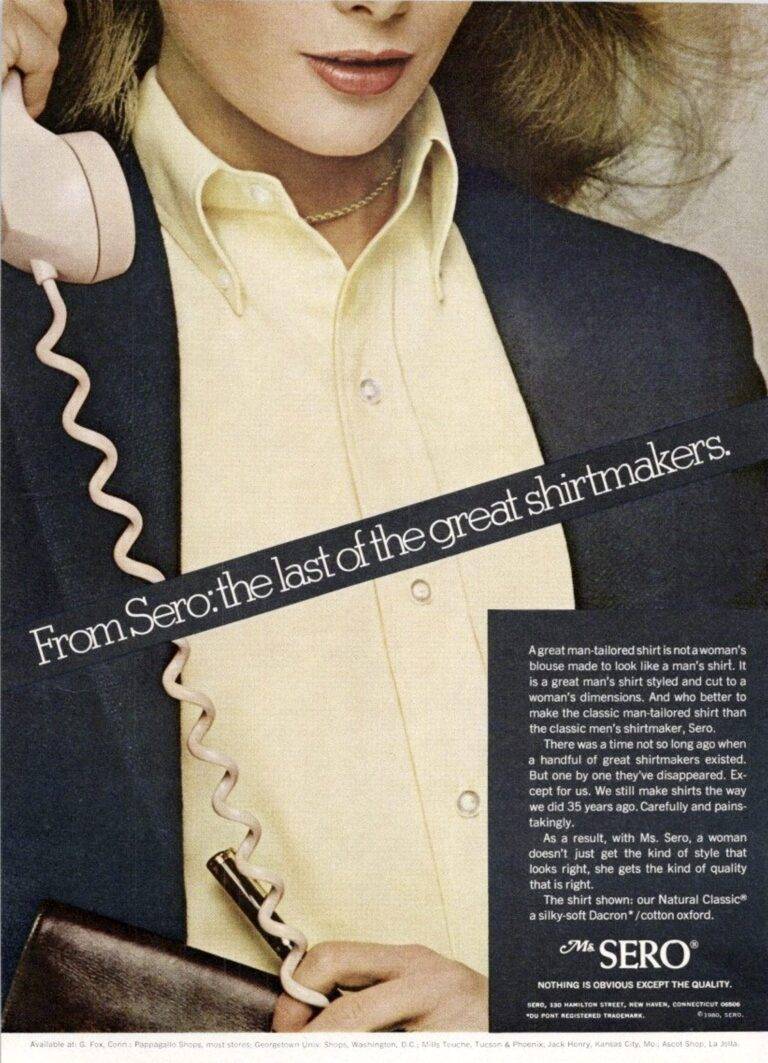
The last of the great shirtmakers.
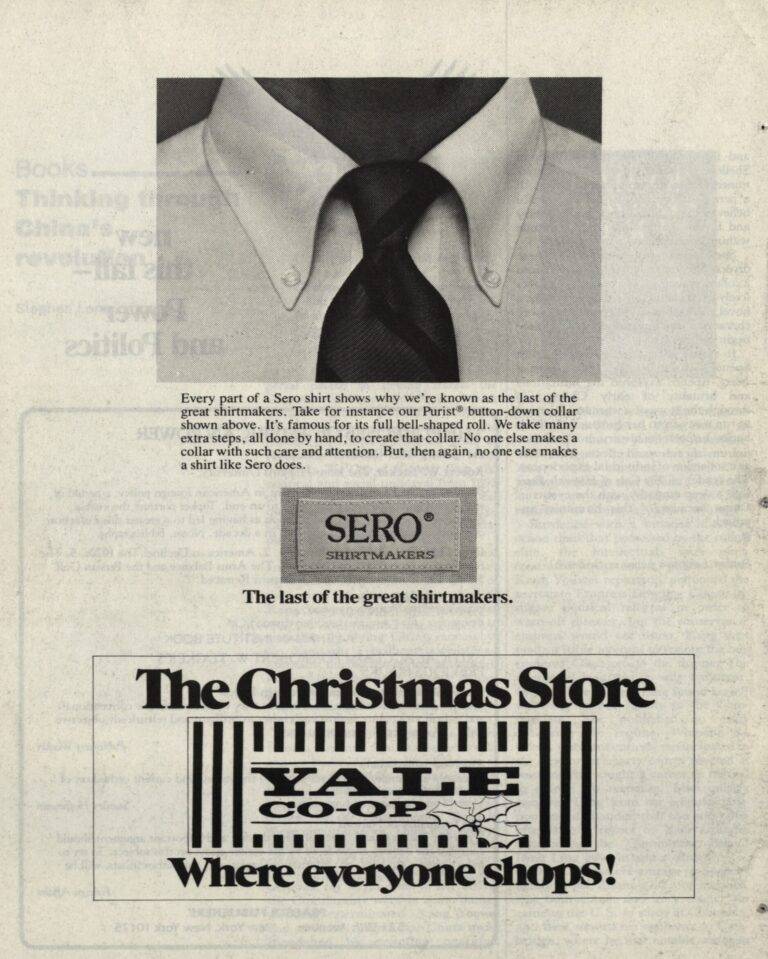
1981 The New journal, v. 14, no. 3, 12/5/1981
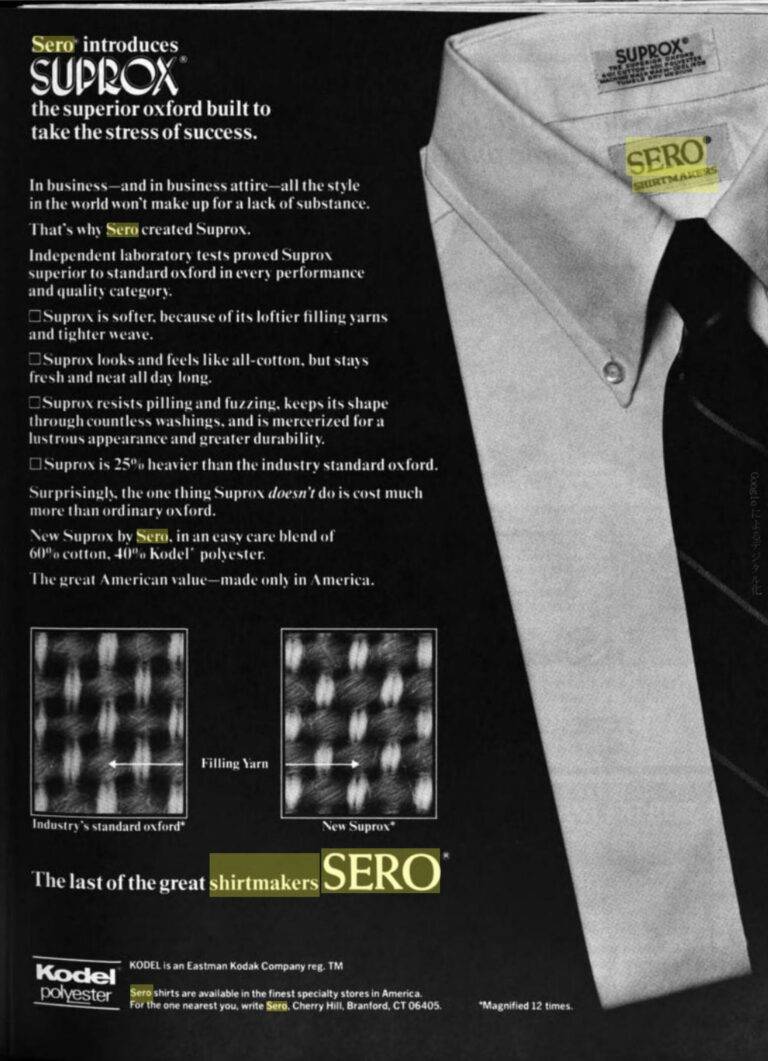
1981 PRINCETON ALUMNI WEEKLY September 12, 1984
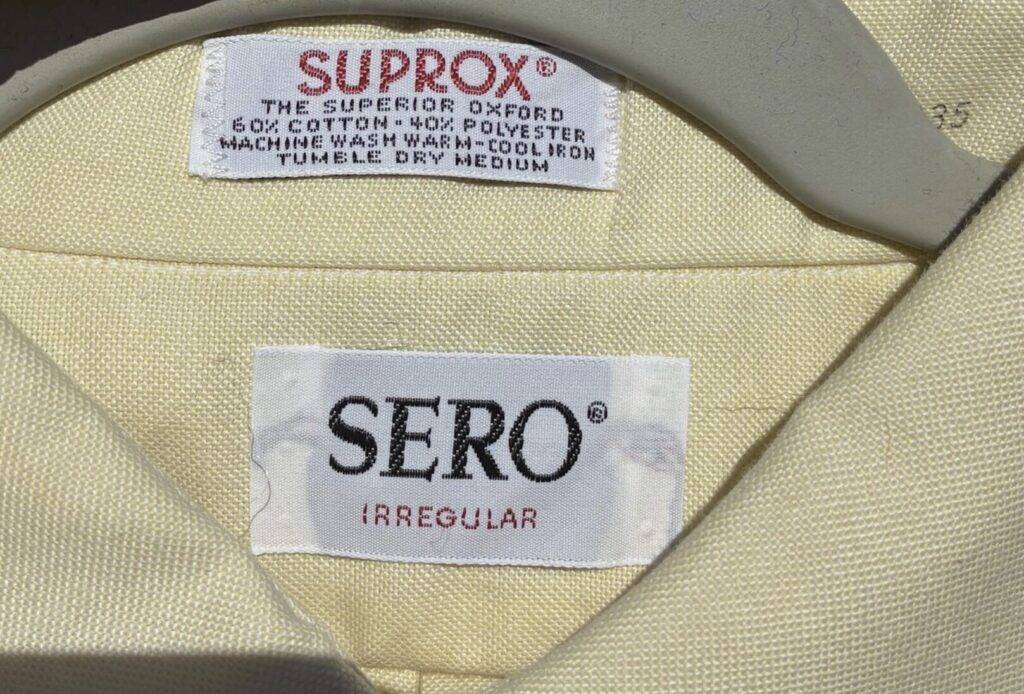
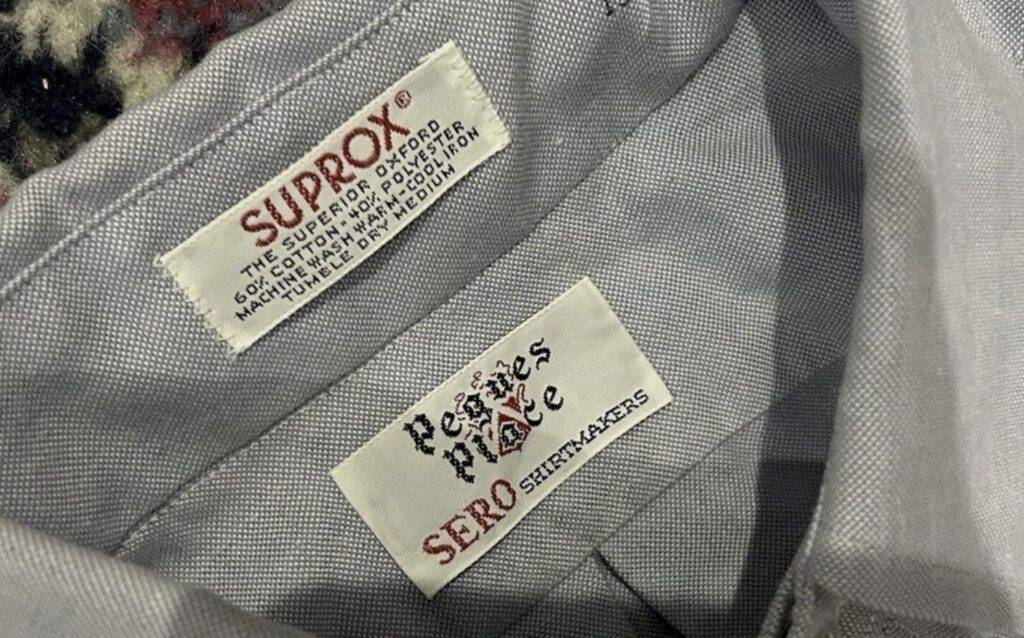
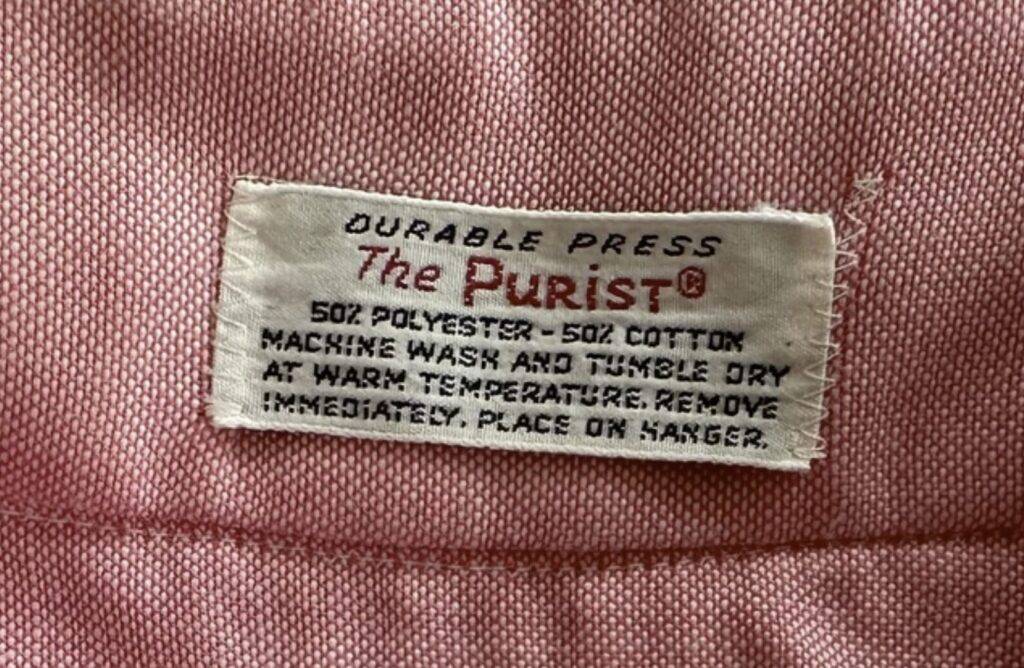
- Premium Blend Material: It features a specialized blend of 60% cotton and 40% Kodel® polyester. This composition was designed to “look and feel like all-cotton” while providing the enhanced performance and resilience of synthetic fibers.
- Superior Durability and Weight: SUPROX is notably more substantial than standard fabrics, being “25% heavier than the industry standard oxford.” With its “loftier filling yarn and tighter weave,” it remains extremely durable and retains its shape even after rugged, repeated laundering.
- Easy Care (Durable Press): Utilizing the “Durable Press” technology of the era, this shirt was famous for being iron-free. It was highly valued by busy students and professionals because it “stays fresh and neat all day long” without wrinkling.
- Refined Texture and Finish: The fabric is “mercerized for a lustrous appearance” and engineered to be “softer to the touch.” Additionally, it “resists pilling and fuzzing,” maintaining a high-quality, clean look throughout its lifespan.
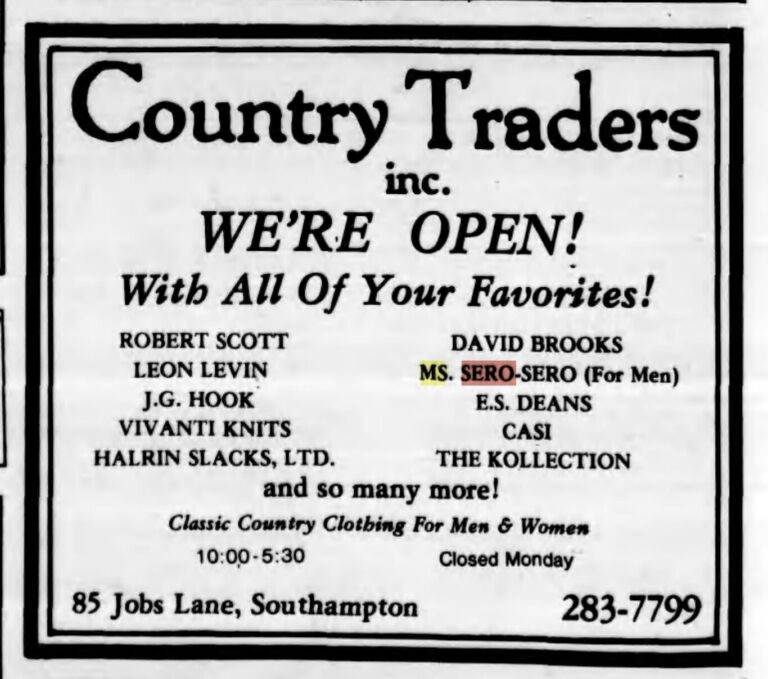
1981 East Hampton NY Star 1980 Sep-Jun 1981 – 0749.pdf
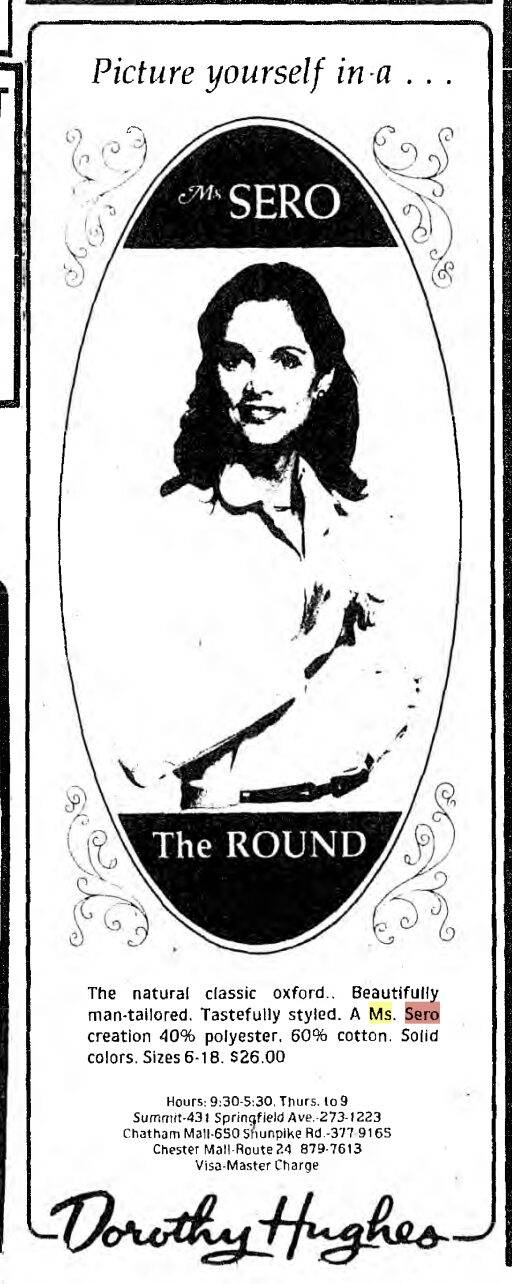
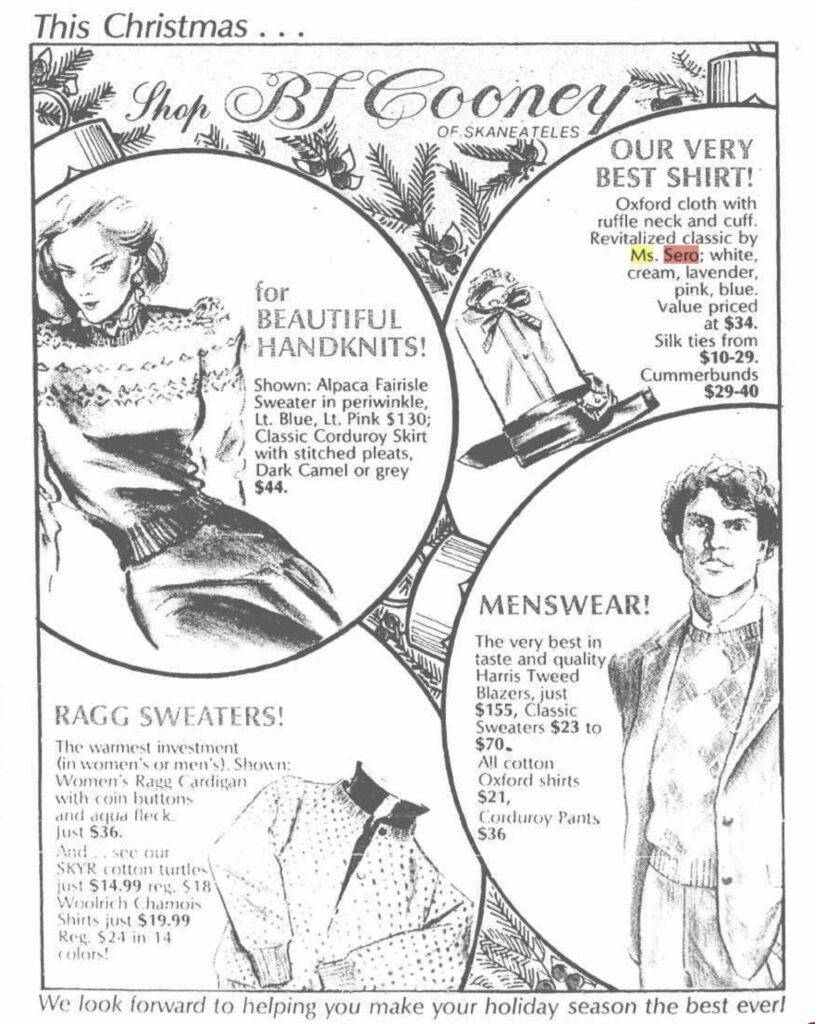
1982 Marcellus NY Weekly Observer 1982 – 1982 Grayscale – 1269.pdf
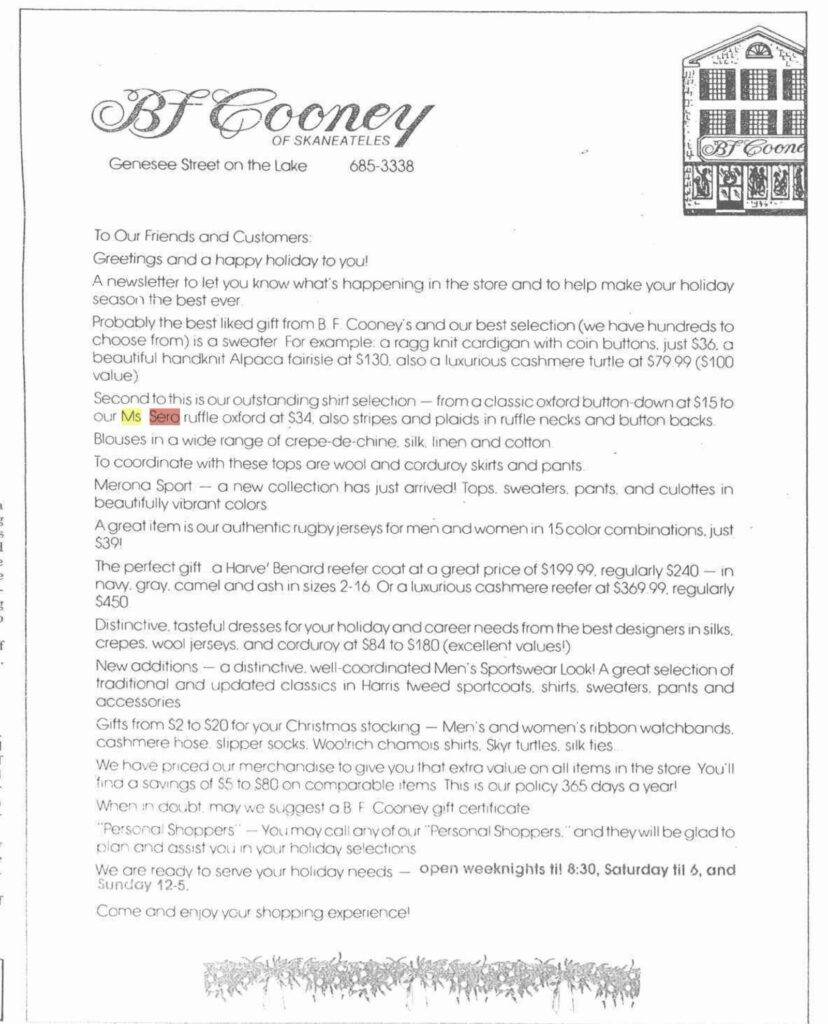
1982 Marcellus NY Weekly Observer 1982 – 1982 Grayscale – 1327.pdf
1982 Clinton NY Courier 1982 – 1982 Grayscale – 0635.pdf
The Westland Case: A Turning Point for Sero
On June 15, 1982, Sero of New Haven, Inc. terminated its sales agency agreement with William Westland, an independent sales representative responsible for the Midwest region. This decision was more than a routine personnel matter; it became a symbolic moment marking a turning point in the company’s management posture. Westland argued that, through years of business relations, there existed an understanding that his relationship with Sero would continue so long as he performed his duties in good faith. On that basis, he filed suit alleging breach of contract and promissory estoppel. His additional claim for unpaid sales commissions went beyond a narrow legal dispute and pointed instead to mounting financial strain within Sero at the operational level.
In January 1985, the United States District Court for the Northern District of Illinois partially denied Sero’s motion for summary judgment, holding that certain factual issues—particularly those concerning the payment of commissions—required resolution by a jury. What emerged through this process was a picture of a company shifting away from a long-standing, relationship-based sales network toward a more short-term, cost-driven and rationalized management approach. At the same time, the broader American apparel industry was being reshaped by rapid globalization, rising imports, high interest rates, and economic slowdown. The cost structure of domestic manufacturing itself was under pressure. The financial burden of maintaining production facilities grew heavier, making the reorganization of sales networks and the renegotiation of payment terms increasingly unavoidable.
The Westland case thus stands as a record of the internal fractures that surfaced within Sero at the intersection of external economic forces and internal financial constraints. The court record quietly captures a moment when the long-established human relationships and commercial practices of a traditional New Haven shirtmaker were forced to be redefined under the weight of economic rationalization and capital pressure.
1984 Hastings on the Hudson NY Enterprise 1984 0318_1.pdf
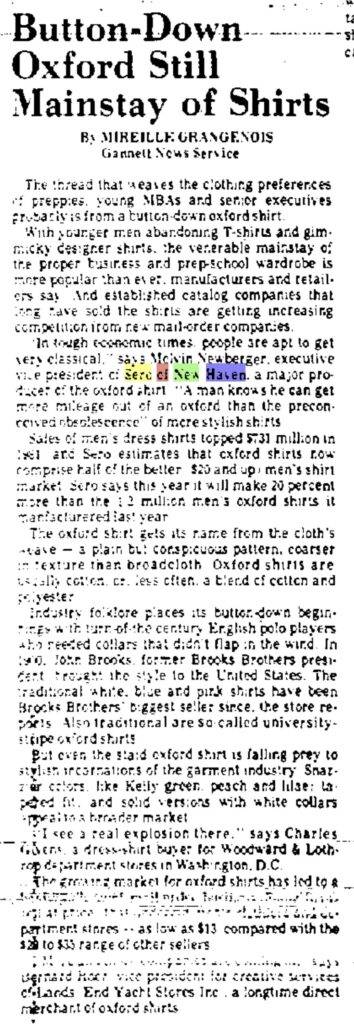
The breed that weaves the clothing preferences of preppies, young MBAs and senior executives probably is from a button-down oxford shirt. With younger men abandoning T-shirts and gimmicky designer shirts, the venerable mainstay of the proper business and prep-school wardrobe is more popular than ever, manufacturers and retailers say. And established catalog companies that once have sold the shirts are getting increasing competition from new mail-order companies.
“In tough economic times, people are apt to get very classical,” says Melvin Neuberger, executive vice president of Sero of New Haven, a major producer of the oxford shirt. “A man knows he can get more mileage out of an oxford than the perceived obsolescence of merely stylish shirts.”
Sales of men’s dress shirts topped $731 million in 1981 and Sero estimates that oxford shirts now comprise half of the better $3 billion men’s shirt market. Sero says this year it will make 20 percent more than the 12 million men’s oxford shirts it manufactured last year.
The oxford shirt gets its name from the cloth’s weave — a plain but conspicuous pattern, coarser in texture than broadcloth. Oxford shirts are usually cotton or, less often, a blend of cotton and polyester.
Industry folklore places its button-down beginnings at the turn of the century. English polo players who needed collars that didn’t flap in the wind. In 1900, John Brooks, former Brooks Brothers president, brought the style to the United States. The traditional white, blue and pink shirts have been Brooks Brothers’ biggest seller since, the store reports. Also traditional are so-called university stripe oxford shirts. But even the staid oxford shirt is falling prey to stylish interpretations of the garment industry. Shades of color, like Kelly green, peach and lilac, are being offered, and solid versions with white collars are appearing for a broader market.
“I see a real explosion there,” says Charles [判読不能], a dress-shirt buyer for Woodward & Lothrop department stores in Washington, D.C.
The growing market for oxford shirts has led to a [判読不能] … department stores … as low as $13 compared with the $25 to $30 range of other sellers.
1983 Geneva NY Finger Lake Times 1983 Nov 1983 – 0933.pdf
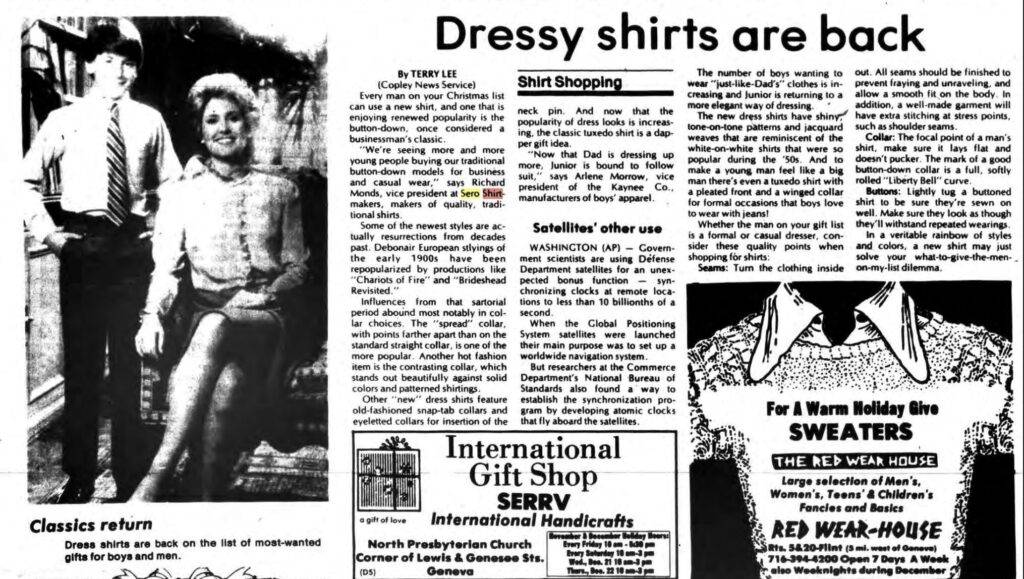
Every man on your Christmas list can use a new shirt, and one that is enjoying renewed popularity is the button-down, once considered a businessman’s classic. “We’re seeing more and more young people buying our traditional button-down models for business and casual wear,” says Richard Monds, vice president at Sero Shirtmakers, makers of quality, traditional shirts. Some of the newest styles are actually resurrections from decades past. Debonair European stylings of the early 1900s have been repopularized by productions like “Chariots of Fire” and “Brideshead Revisited.”
Influences from that sartorial period abound most notably in collar choices. The “spread” collar, with points farther apart than on the standard straight collar, is one of the more popular. Another hot fashion item is the contrasting collar, which stands out beautifully against solid colors and patterned shirtings. Other “new” dress shirts feature old-fashioned snap-tab collars and eyeletted collars for insertion of the neck pin.
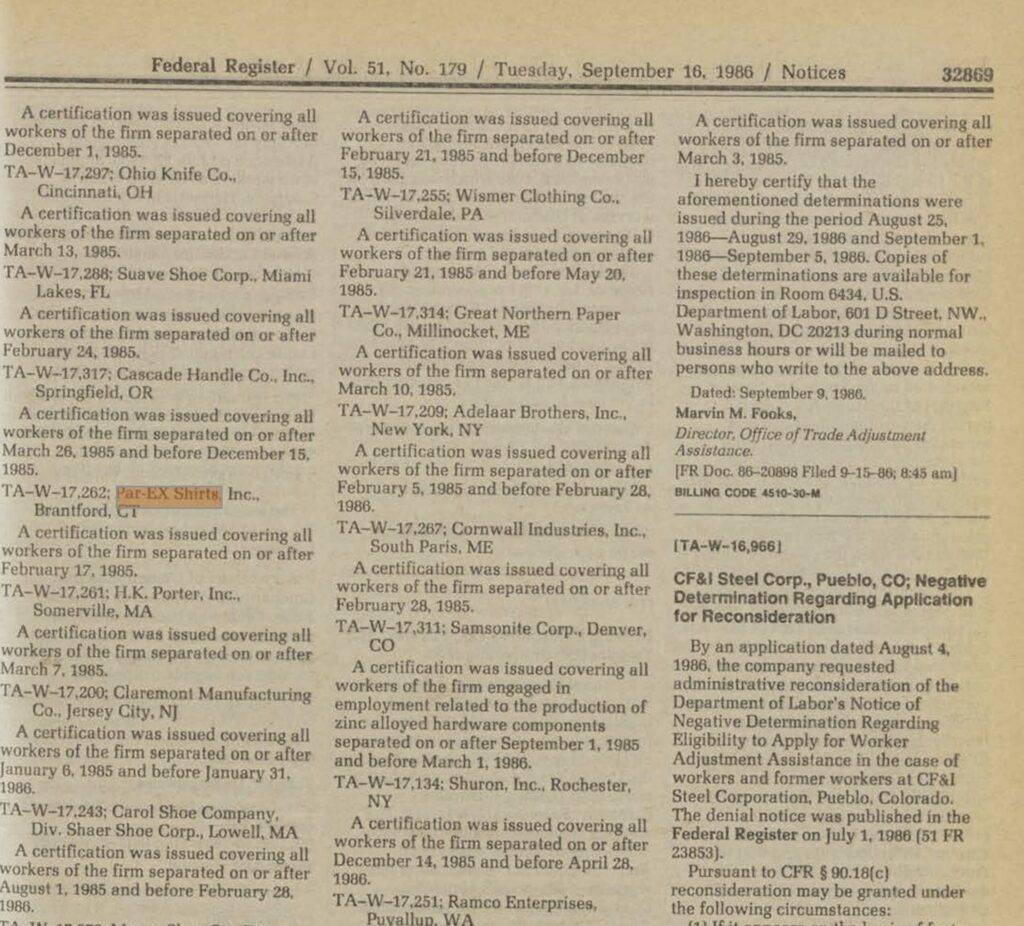
After parting ways with the Gantmacher family in 1949, the Shapiro family began its path as a “brand(after SERO),” and Par-Ex was long assumed to have faded from the historical stage. Yet the Federal Register in 1986 clearly records the name “Par-Ex Shirts, Inc., Branford, Connecticut” as an active employing entity. In other words, behind the “face” of SERO SHIRTMAKERS, the “manufacturing identity” of Par-Ex continued to live on. The separation in 1949 was not the disappearance of a company, but a separation of roles. On the surface stood SERO SHIRTMAKERS; behind it remained Par-Ex.
This dual structure—brand and factory, narrative and reality—endured at least until 1986, redefining SERO’s history not as a simple founding timeline, but as a continuous lineage of a living manufacturing entity. It had survived this far, only to be swept into the rough waters that would soon follow.
1988
Chapter 11 on December 22, 1988
Sero Company Files for Chapter 11
- Filing Date: Thursday, December 22, 1988.
- Location: U.S. Bankruptcy Court in Bridgeport, Connecticut.
- Assets and Liabilities: According to the filing, the company reported liabilities ranging from approximately $10 million to $12 million.
- Background: * The company was a prominent manufacturer of men’s and women’s shirts based in New Haven, Connecticut.
- Amidst reports of worsening cash flow, the newspaper stated that the company sought protection from creditors while attempting to reorganize its operations.
- Recent Developments: * The report mentions that operations had been suspended and employees had been laid off for several weeks leading up to the Chapter 11 filing.
・ On December 23, the day following the filing, the court granted emergency permission for the
company to use cash collateral and obtain new financing to maintain business operations.
(セロ・カンパニーが連邦破産法第11章を申請)
- 申請日: 1988年12月22日(木曜日)。
- 場所: コネチカット州ブリッジポートの連邦破産裁判所。
- 負債と資産: 申請書によると、負債額は約1,000万ドルから1,200万ドルに上ると報告されています。
- 背景: 同社はコネチカット州ニューヘイブンを拠点とする著名なメンズおよびウィメンズ用のシャツメーカーでした。
- 以前から資金繰りの悪化が指摘されており、同紙は「同社が経営再建を目指す間、債権者からの保護を求めた」と報じています。
直近の動き: - 破産法申請の直前、数週間にわたり操業停止や従業員のレイオフ(一時解雇)が発生していた事実に言及されています。
- 裁判所は申請翌日の23日、会社が事業を継続できるよう、担保となっている現金の確保(キャッシュ・コラテラル)と新たな融資の調達を緊急で認めました。
In December 1988, Sero of New Haven filed for protection under Chapter 11 of the U.S. Bankruptcy Code. As a result, the company’s operations were placed under the supervision of the federal bankruptcy court. Following the filing, Sero continued limited operations. However, major business decisions—including payroll, payments to vendors, continuation of production, and the disposition of assets—required approval from the court and the principal creditors. Both tangible assets (such as machinery, inventory, and facilities) and intangible assets (including trademarks, brand names, and contractual rights) were identified, evaluated, and organized as part of the creditor security and restructuring process.
During this period, financial institutions and restructuring advisors examined alternatives that included the continuation of operations, partial asset sales, and the potential transfer of the company’s trademarks and brand portfolio. The appearance of names such as Sero and Par-Ex within the same legal and financial framework in the court filings reflects the consolidation of multiple corporate identities into a single pool of assets for purposes of disposition. By the late 1980s, the broader U.S. apparel industry was undergoing structural change, driven by the expansion of offshore manufacturing, rising domestic labor costs, and intensified price competition. Within this context, the maintenance of a domestic manufacturing base became increasingly difficult.
As 1989 approached, Sero’s position had shifted from efforts at independent reorganization to preparations for the transfer or sale of its trademarks and related assets.
In 1988, SERO filed for Chapter 11, and with that filing, the era of the Shapiro family—stretching back to Morris Shapiro’s founding—came to a de facto close.
1989
NEW ORNER HAS COME
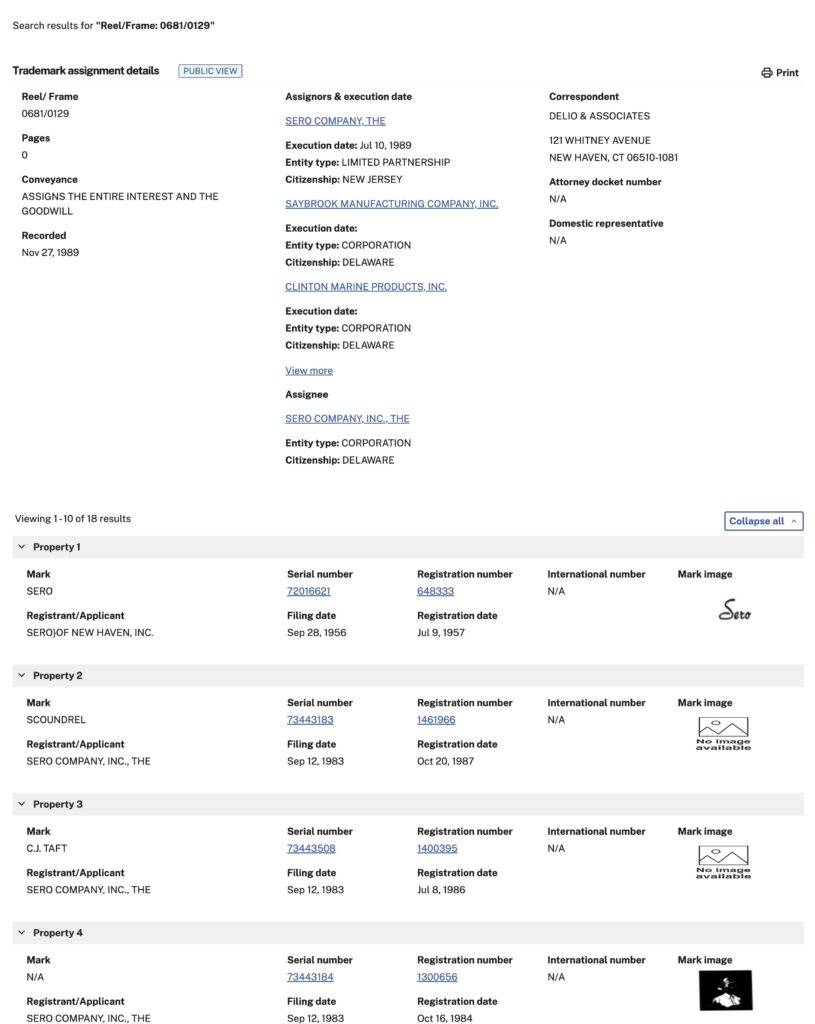
In 1989, following its Chapter 11 filing of December 22, 1988, SERO’s operations were conducted under the supervision of the bankruptcy court and its principal secured lenders, most notably Manufacturers Hanover Trust/Bank, which held a central position among the creditor banks involved in the proceedings. During the restructuring process, SERO, together with affiliated entities including Saybrook Manufacturing Company, Inc. and Clinton Marine Products, Inc., sought a buyer for its operating assets rather than a recapitalization of the existing corporate structure. On June 30, 1989, the United States Bankruptcy Court approved the sale of substantial assets, leases, and executory contracts to Brynwood Partners II L.P. for approximately $3.775 million, effectively transferring control of the business to a private investment partnership rather than preserving it as a family-run manufacturer. With this transaction, the historic New Haven, Connecticut manufacturing base was abandoned, marking the end of SERO’s identity as a locally rooted shirtmaker tied to the Shapiro family and the New England garment industry. Under the new ownership, operations were reorganized and shifted to Georgia, where a new production and distribution structure was established.
At the same time, manufacturing was increasingly externalized. Contemporary trade reporting and later industry accounts indicate that shirt production was moved to offshore facilities, particularly in the Dominican Republic, reflecting the broader late-1980s shift in the American apparel industry toward Caribbean and Central American manufacturing under cost and trade-preference pressures. While the court records document the asset sale and creditor structure in detail, the relocation of production offshore is primarily supported by secondary industry sources rather than explicit language in the bankruptcy rulings themselves.
By the end of 1989, SERO no longer existed as an independent New Haven manufacturer, but as a restructured brand and asset package under financial ownership, aligned with a production model centered on geographic relocation and offshore manufacturing rather than domestic factory continuity.
Trademark and Goodwill Assignment
On June 30, 1989, Sero of New Haven, Inc. formally assigned the SERO trademark and its associated goodwill to Kelso Company, Inc., as recorded in the USPTO Assignment Abstract of Title. Kelso Company, Inc. functioned as the acquisition vehicle affiliated with Brynwood Partners II L.P. The mark was subsequently transferred to the reorganized operating entity, The Sero Company, Inc., later in 1989.
Pension Plan Termination
On the same date, the SERO Company Defined Benefit Retirement Plan was formally terminated. This administrative action severed the company’s long-standing pension obligations tied to its New Haven workforce, marking the legal end of SERO’s status as a locally rooted, family-operated manufacturer.
Production Model — Evidence Boundary
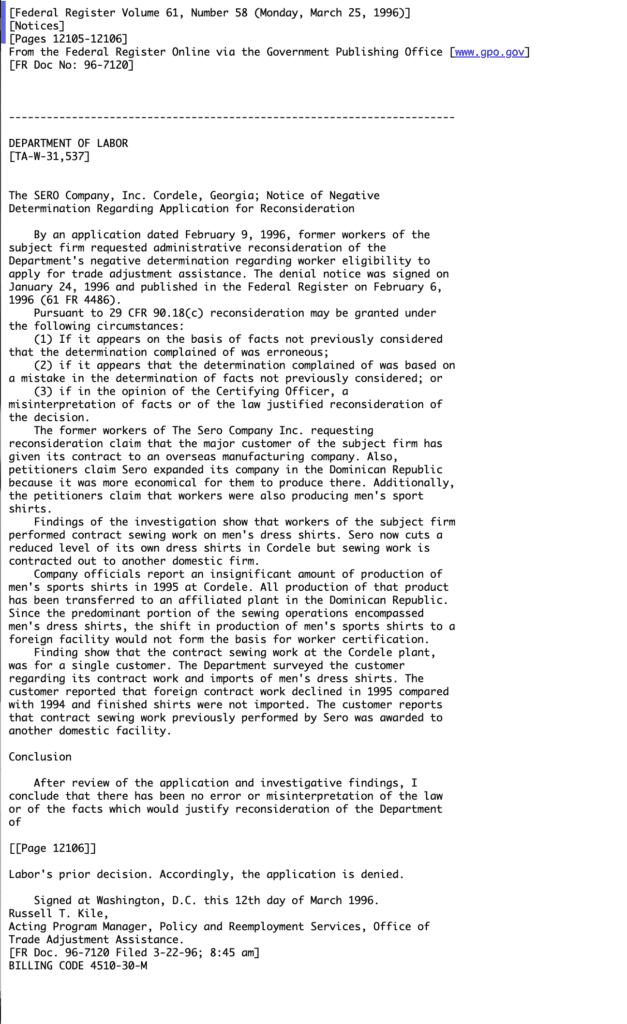
The bankruptcy court records document the asset sale and creditor structure in detail but do not explicitly mandate offshore manufacturing. Primary federal labor records issued in the mid-1990s, however, later establish that sewing operations had been externalized and that sports shirt production had been transferred to affiliated facilities in the Dominican Republic, providing the first formal governmental confirmation of the production model shift.
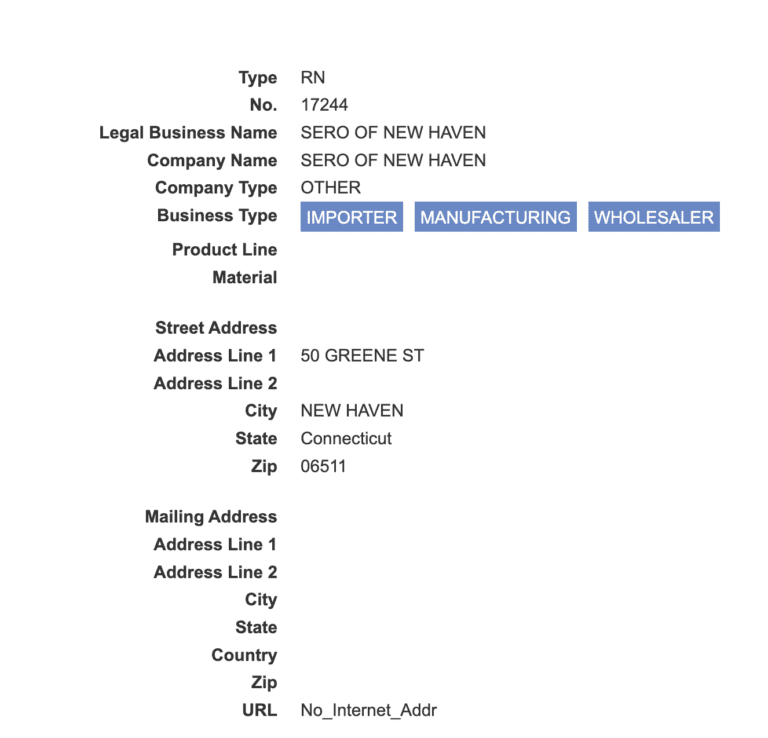
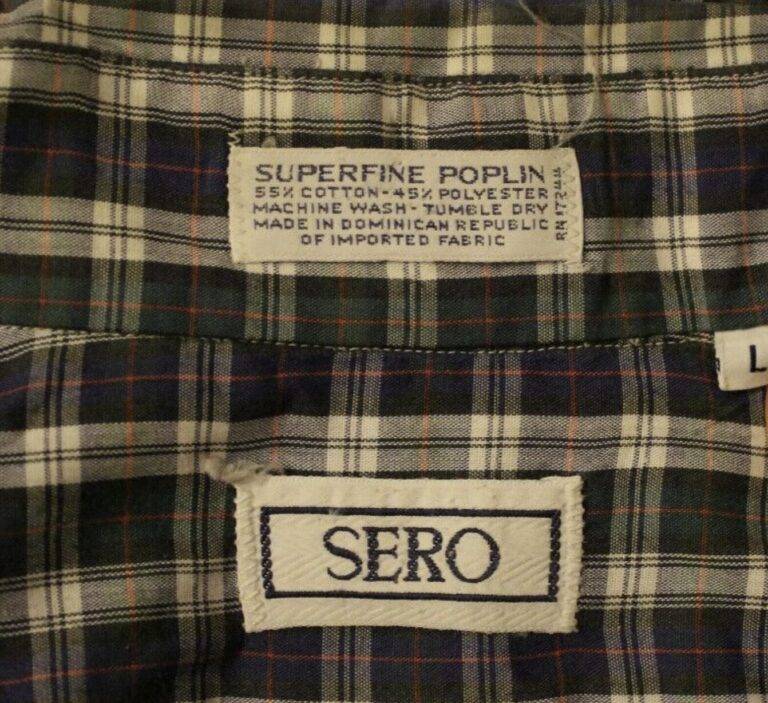
RN 17244 SERO OF NEW HAVEN NEWHAVEN
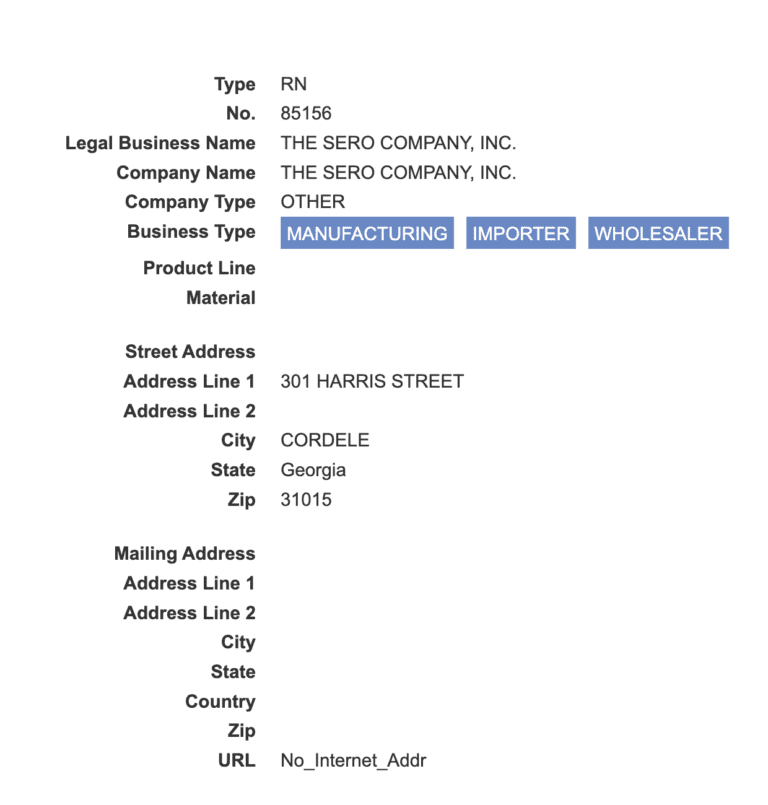
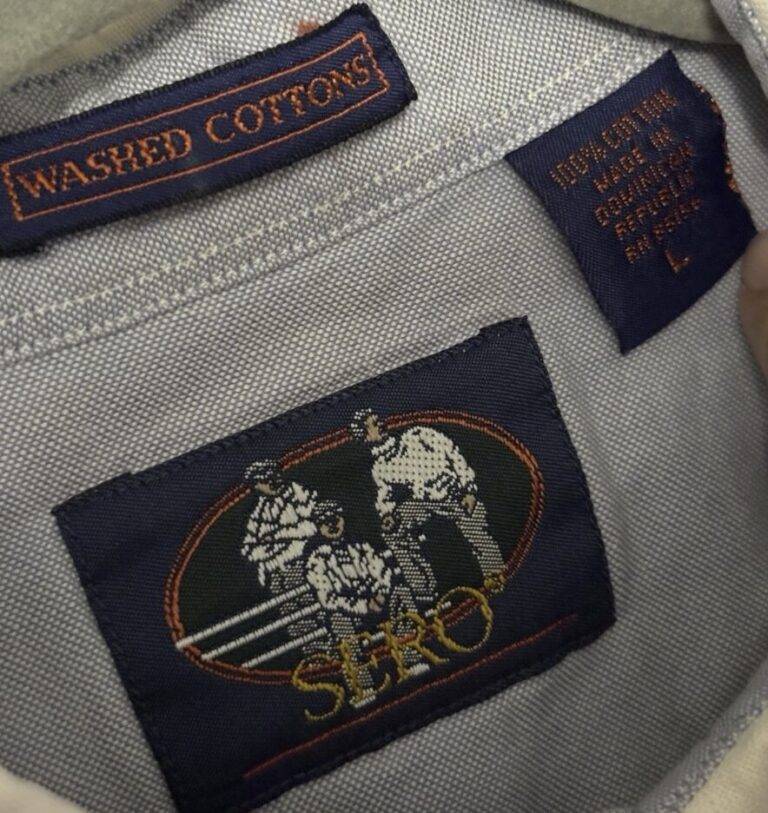
RN 85156 THE SERO COMPANY GEORGIA
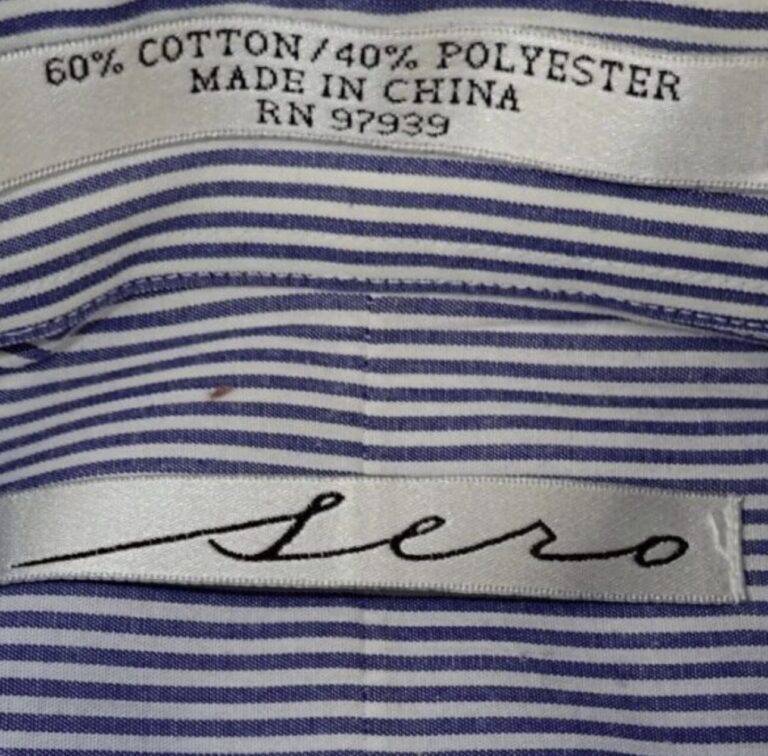
One bears RN 17244, registered to “Sero of New Haven,” 50 Greene Street, New Haven, Connecticut. This shows that, even after production moved offshore, SERO itself remained the legal importer and responsible party in the United States, and that this line was still controlled and distributed through the New Haven entity.
The other carries RN 85156, registered to “The Sero Company, Inc.,” 301 Harris Street, Cordele, Georgia. Here, the SERO name remains on the label, but the legal responsibility for import and U.S. distribution is tied to the Georgia operation that emerged after the 1989 reorganization and relocation.
Together, these two Dominican-made shirts demonstrate not merely a change in country of origin, but a restructuring of corporate responsibility, in which production and distribution coexisted under both the original New Haven registration and the post-1989 Georgia-based entity.
1996
1997
NEW ORNER HAS COME
In 1997, SERO’s operating structure—already weakened by the transfer of production to the Dominican Republic and the hollowing out of its domestic base—finally reached its breaking point. The investment-fund–led restructuring process that had begun with the 1989 change in ownership came to a close that year, as the shutdown of the Cordele, Georgia facility and the cessation of operations marked the practical end of the company’s activities as a functioning enterprise.
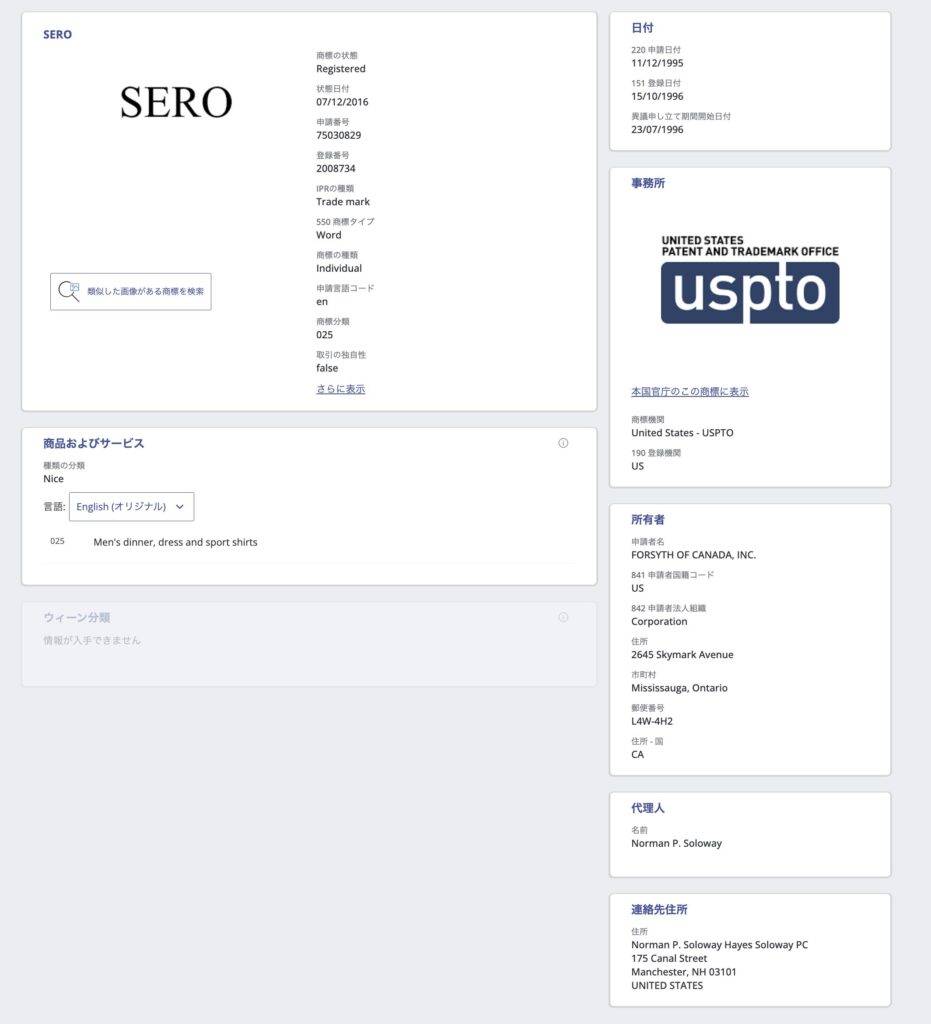
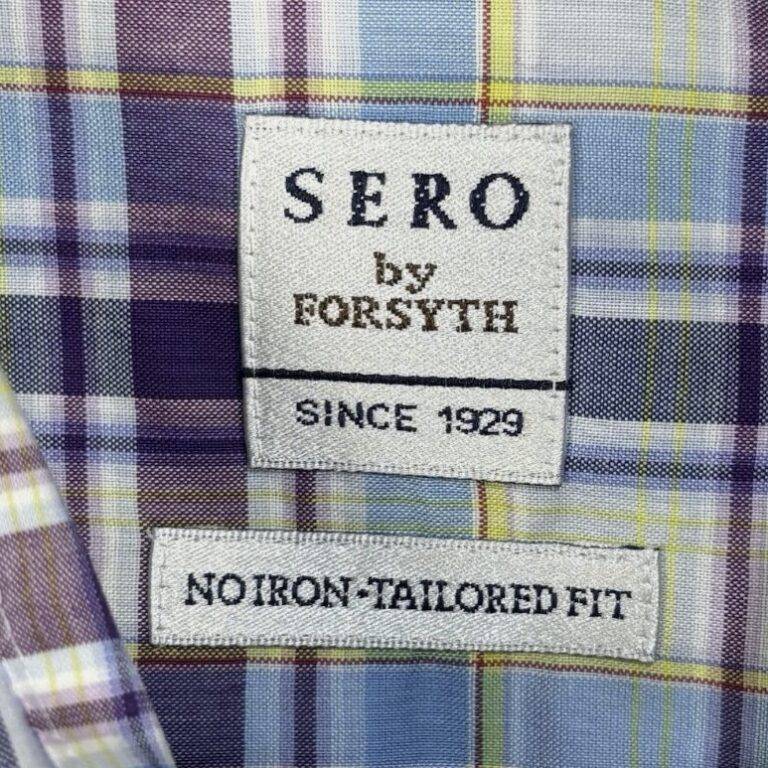
By this stage, legal control of the SERO mark had already shifted to Forsyth of Canada, Inc. According to the United States Patent and Trademark Office (USPTO) register, the SERO trademark filed in 1995 and registered in 1996 lists Forsyth as the owner, indicating that by the mid-1990s SERO was already being administered as part of the Forsyth Group’s brand portfolio rather than as an independent manufacturing concern.
This operational collapse was subsequently formalized as a legal and administrative “death” through two public records concentrated in 1998.
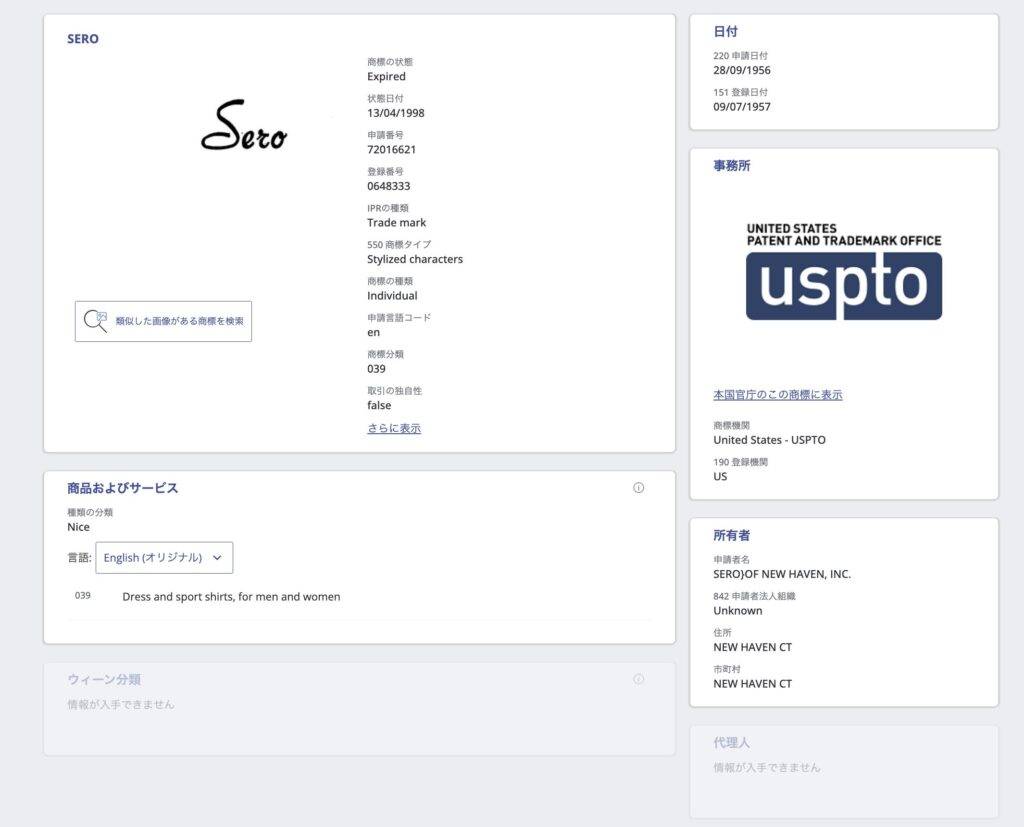
First, on April 13, 1998, the USPTO formally marked as “Expired” the long-standing SERO trademark originally registered in 1957 (Reg. No. 0648333). The lapse reflects the absence—by the 1997 maintenance window—of any entity capable of or willing to file the required Section 8/9 declarations to preserve the registration.
Second, on April 20, 1998, the Pension Benefit Guaranty Corporation (PBGC) assumed trusteeship of the SERO Company Defined Benefit Retirement Plan. This government intervention, triggered when an employer can no longer meet its pension obligations, constituted a formal federal acknowledgment that, by the end of 1997, SERO as an organization had lost all capacity to continue as a going concern.
A final movement occurred on December 22, 2001, when Sero Company of Delaware, Inc., the post-bankruptcy shell entity, formally consolidated the remaining trademark rights and associated goodwill into Forsyth Shirts, Inc., a Forsyth of Canada–affiliated company, as recorded in the USPTO Assignment Abstract of Title. This action did not revive SERO as a manufacturer; instead, it completed its transformation into a portfolio brand within a North American apparel network, managed as an intangible asset rather than a living industrial enterprise.
Thus, SERO’s historical arc closed not with a return to production, but with absorption into a corporate structure designed to preserve names rather than factories. Founded in New Haven in 1929 as a family-rooted shirtmaker, SERO passed through capital reorganization, offshore migration, and legal extinction before ultimately reemerging in 2001 as a trademarked legacy—alive in registries, but no longer in the workshops that once defined it.
Ivy Style: Its history and its resurgence today

Who invented the button-down ?